
Choosing among HDMI matrix switches for home theaters can be challenging because similar-looking models may differ significantly in resolution support, audio handling, control options, and compatibility.
This roundup compares 10 options for routing multiple sources to multiple displays, from compact 4K systems to higher-bandwidth HDMI 2.1 models with eARC, Dolby Atmos, and advanced EDID controls.
Best 10 Hdmi Matrix Switches for Home Theaters Picks for 2026
Flexible 4-Display Hub
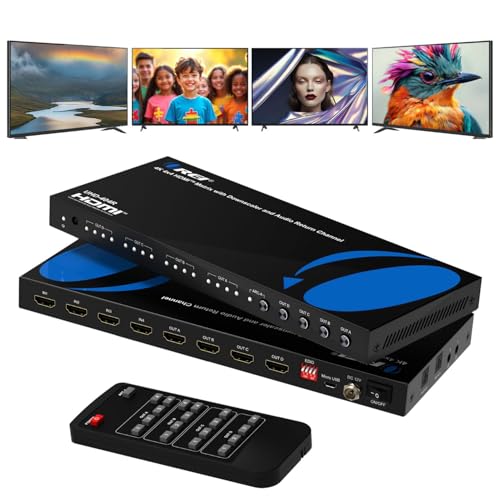
- 4K@60Hz with 18Gbps bandwidth
- Four inputs and four independent outputs
- Optical, 3.5mm, and ARC audio support
Best For: Multi-display home theaters with ARC audio needs
Source-Rich Switcher
6x2 HDMI Matrix with Downscaling

- Six HDMI inputs for numerous sources
- Two outputs with 4K/1080p flexibility
- Optical and 3.5mm audio extraction
Best For: Two-display theaters with many source devices
Mixed-Resolution Specialist
4x4 HDMI Matrix with Downscale

- 4K@60Hz, HDR, and 18Gbps support
- Downscales 4K for 1080p displays
- Four independent inputs and outputs
Best For: Multi-screen theaters mixing 4K and 1080p displays
Next-Gen Gaming Pick

- 8K@60Hz and 4K@120Hz support
- 40Gbps bandwidth with VRR and HDCP 2.3
- RCA, SPDIF, ARC, and EDID features
Best For: HDMI 2.1 gaming and high-refresh home theaters
Best for Large-Scale Routing
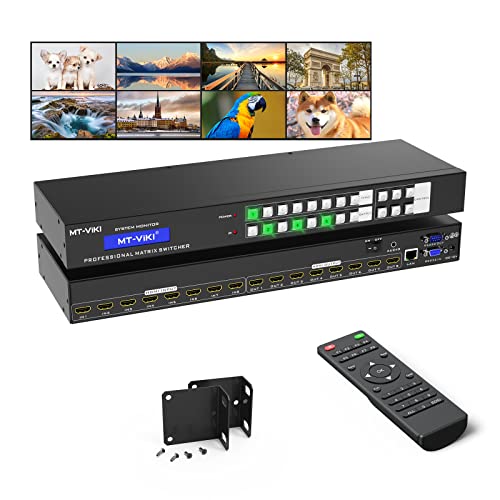
- Routes 8 sources to 8 displays
- Supports custom EDID and mixed 4K/1080p output
- Web, LAN, RS-232, app, API, and IR control
Best For: Large home theaters and multi-display AV systems
Best for 4K/60 Audio Extraction

- Supports 4K/60Hz, HDR, and HDCP 2.2
- Connects 4 sources to 2 displays
- Offers optical and 3.5mm audio extraction
Best For: Two-display theaters with separate audio equipment
Best for Mid-Size Installations

- Routes 4 sources to 4 displays
- Supports custom EDID and mixed resolutions
- Rack-mountable with broad control options
Best For: Mid-size theaters and four-display AV systems
Next-Generation Performance
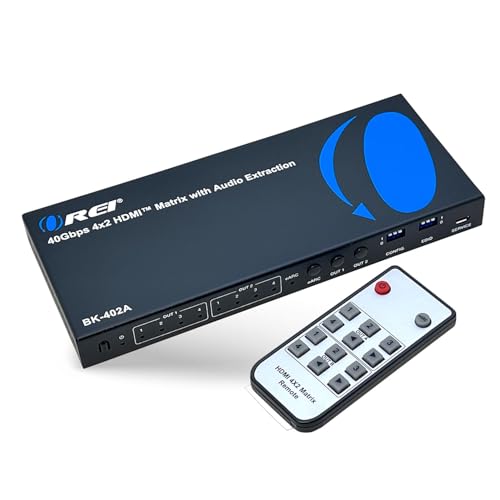
- HDMI 2.1 with 40Gbps bandwidth
- Supports 8K and 4K at 120Hz
- Adds VRR, ALLM, eARC, and audio extraction
Best For: 8K home theaters and high-refresh gaming systems
Flexible 4K Compatibility

- 4K at 60Hz with HDR and 18Gbps bandwidth
- Downscales 4K for 1080p displays
- Adds ARC and optical/3.5mm audio outputs
Best For: Mixed 4K and 1080p home theater displays
Flexible 4-Display Hub – 4×4 HDMI Matrix with ARC
For home theaters with several sources and displays, this 4×4 HDMI matrix switch routes up to four HDMI devices to four screens. It supports 4K at 60Hz, 18Gbps bandwidth, HDR, HDCP 2.2, and both optical and 3.5mm audio extraction.
Best For: Multi-display home theaters that need flexible routing and ARC-enabled audio extraction.
Pros:
- Four HDMI inputs and four independently routable HDMI outputs
- Supports 4K@60Hz, HDR, HDMI 2.0, and HDCP 2.2
- Provides optical and 3.5mm audio outputs, with ARC on Output A
- Metal enclosure and included remote control
Cons:
- Does not list HDMI 2.1 or 8K support
- Audio extraction and ARC features are tied to specified outputs
The OREI UHD-404R is a strong fit when your setup needs four sources and four displays, while its downscaling and audio features help accommodate mixed equipment.
Source-Rich Switcher – 6×2 HDMI Matrix with Downscaling
This 6×2 HDMI matrix switch is designed for home theaters with many source devices and two displays. It accepts six HDMI inputs, supports 4K at 60Hz and 18Gbps, and can automatically downscale 4K content to 1080p for compatible screens.
Best For: Setups with up to six sources feeding two displays, especially when independent audio output is useful.
Pros:
- Six HDMI inputs provide room for multiple players and consoles
- Routes signals to two displays and supports mixed 4K/1080p output
- Optical and 3.5mm audio extraction with EDID support
- Supports HDMI 2.0, HDCP 2.2, 3D, and a metal enclosure
Cons:
- Limited to two HDMI outputs
- Remote control batteries are not included
- Does not list HDMI 2.1 or 8K support
Choose this FERRISA model when input capacity matters more than the number of displays. Its automatic downscaling is useful for systems combining 4K and 1080p screens.
Mixed-Resolution Specialist – 4×4 HDMI Matrix with Downscale
Among HDMI matrix switches for home theaters, this OREI 4×4 model stands out for mixed-resolution systems. It connects four sources to four displays, supports 4K@60Hz and HDR, and can downscale 4K content to 1080p when screens have different capabilities.
Best For: Home theaters using a combination of 4K and 1080p televisions, monitors, or projectors.
Pros:
- Four inputs and four outputs support identical or independent content
- Downscales 4K to 1080p for mixed-display installations
- Supports HDR, HDMI 2.0a, HDCP 2.2, and 18Gbps bandwidth
- Handles up to 7.1-channel audio, including Dolby Digital and DTS-HD Master Audio
Cons:
- Uses HDMI 2.0 rather than HDMI 2.1
- International users may need the included adapter/converter arrangement
The UHD-404 is a practical choice for expanding a multi-screen theater without requiring every display to support 4K. Its 4×4 routing also leaves more flexibility than a basic HDMI switch.
Next-Gen Gaming Pick – 8K 4×2 HDMI 2.1 Matrix
This HDMI 2.1 matrix targets advanced home theaters and gaming systems, with support for 8K at 60Hz, 4K at 120Hz, up to 40Gbps, VRR, HDR10, Dolby Vision, and HDCP 2.3. Its four inputs can feed two displays while RCA and SPDIF outputs handle extracted audio.
Best For: PS5, Xbox, and high-refresh home theater setups that need HDMI 2.1 bandwidth and 8K support.
Pros:
- Supports 8K@60Hz, 4K@120Hz, and up to 40Gbps transmission
- Includes VRR, HDR10, Dolby Vision, HDCP 2.3, and CEC support
- Provides RCA and SPDIF audio extraction plus ARC and EDID management
- Four inputs and two independently switchable outputs
Cons:
- Provides two HDMI outputs rather than four
- Feature support may depend on connected devices and displays
- Uses a button-cell battery in the product, requiring child-safety precautions
For newer consoles and high-refresh displays, this FERRISA matrix offers substantially more bandwidth than HDMI 2.0 alternatives. It is best suited to buyers who specifically need 4K/120Hz or 8K capability.
Best for Large-Scale Routing – MT-VIKI 4K 8×8 HDMI Matrix
For larger home theaters and multi-room systems, the MT-VIKI 4K 8×8 is one of the more expansive HDMI matrix switches for home theaters. It can route any of eight sources to any of eight displays independently or simultaneously, with web, LAN, RS-232, IR, app, API, and front-panel control.
Best For: Large home theater systems, multi-display setups, and integrated AV installations.
Pros:
- Routes eight HDMI sources to eight displays independently or simultaneously.
- Supports 4K x 2K at 30Hz, 1080p, 3D, and deep color.
- Offers custom EDID writing and multiple control methods, including web GUI, LAN, RS-232, app, and API.
- Includes rack ears and supports simultaneous 4K and 1080p output.
Cons:
- 4K video is limited to 30Hz.
- 3.5mm audio extraction works only through OUT8 and requires routing the desired source there.
- Stable transmission is specified up to 30 feet on the input and output sides.
The MT-VIKI HD88L is best when flexibility and capacity matter more than 4K/60 performance. Its custom EDID and broad control options make it a strong fit for complex installations, while the OUT8 audio-extraction limitation should be planned around during setup.
Best for 4K/60 Audio Extraction – ENBUER 4×2 HDMI Matrix
The ENBUER 4×2 is a compact choice among HDMI matrix switches for home theaters when four source devices need to feed two displays. It combines 4K/60Hz and HDR support with optical and 3.5mm audio extraction, making it useful for systems that connect consoles, streaming players, and a separate audio setup.
Best For: Two-display home theaters that need 4K/60 video and flexible audio outputs.
Pros:
- Connects four HDMI sources to two displays.
- Supports 4K at 60Hz, 4K HDR, HDMI 2.0b, HDCP 2.2, and RGB 4:4:4.
- Provides optical Toslink and 3.5mm stereo audio extraction.
- Supports LPCM, Dolby, and DTS 5.1-channel audio.
Cons:
- EDID settings are configured for Output A and may require restarting the switch after adjustment.
- It provides only two HDMI outputs.
- The included details do not list web, app, or network control.
With 18.5Gbps bandwidth and 4K/60 HDR support, the ENBUER is the most suitable option here for a modern two-screen setup. Its optical and analog audio outputs add useful flexibility, but users should account for the Output A-centered EDID process.
Best for Mid-Size Installations – MT-VIKI 4K 4×4 HDMI Matrix
The MT-VIKI 4×4 provides a practical middle ground for HDMI matrix switches for home theaters. It routes four HDMI sources to four displays, supports simultaneous 4K and 1080p output, and includes web, LAN, RS-232, IR, app, API, and front-panel control for flexible system management.
Best For: Mid-size home theaters, conference rooms, and four-display AV systems.
Pros:
- Routes four sources to four displays independently or simultaneously.
- Supports 4K x 2K at 30Hz, 1080p, 3D video, and deep color.
- Includes custom EDID writing and extensive control options.
- Rack ears and a 1U rack-compatible design support permanent installations.
Cons:
- 4K output is limited to 30Hz.
- 3.5mm audio extraction is available only through OUT4.
- Audio extraction requires routing the desired source to OUT4.
The MT-VIKI 4×4 is a sensible fit for users who need more routing capacity than a basic switch but do not need an 8×8 chassis. Its installation-friendly design and control integration are useful strengths, while 4K/30 and the OUT4 audio restriction are important limitations.
Versatile 4K Routing – FERRISA 4×2 HDMI Matrix
For shoppers comparing hdmi matrix switches for home theaters, this FERRISA model offers four HDMI inputs, two outputs, and separate optical or stereo audio extraction. It supports 4K, 3D, and 1080p sources, though both displays must use the same resolution at the same time.
Best For: Home theater users who need basic 4K source switching with separate audio output.
Pros:
- Connects up to four HDMI sources to two displays.
- Provides optical and 3.5mm stereo audio outputs.
- Includes IR remote control and EDID management.
- Supports 4K, 3D, HD audio, and 8/10/12-bit deep color.
Cons:
- Cannot display different resolutions simultaneously.
- Supports HDMI 1.4b and HDCP 1.4 rather than newer standards.
- Does not support Dolby DD/DD+ or Dolby Vision according to the supplied notes.
This is a practical choice for a straightforward multi-source setup, especially when optical or analog audio extraction is useful. Verify your display resolution and audio-format requirements before buying.
Next-Generation Performance – OREI 8K 4×2 HDMI Matrix
Among hdmi matrix switches for home theaters, this OREI 4×2 model is designed for newer HDMI 2.1 systems. It routes four sources to two displays and supports up to 8K video, 4K at 120Hz, 40Gbps bandwidth, and advanced gaming features such as VRR and ALLM.
Best For: 8K home theaters, high-refresh gaming setups, and systems using eARC-capable equipment.
Pros:
- Supports HDMI 2.1, HDCP 2.3, and up to 40Gbps bandwidth.
- Handles 8K video and 4K at 120Hz.
- Includes VRR, ALLM, and FVA support for gaming.
- Offers eARC plus optical and 3.5mm audio extraction.
Cons:
- eARC requires both the TV and soundbar to support eARC.
- Its advanced features may be unnecessary for older HDMI systems.
This is the most future-oriented option in the group, with bandwidth and gaming support suited to demanding sources. Confirm that your displays, cables, and audio devices support the intended HDMI 2.1 and eARC features.
Flexible 4K Compatibility – OREI 4K 4×2 HDMI Matrix
This OREI model is a balanced option among hdmi matrix switches for home theaters, combining four inputs, two outputs, 4K at 60Hz, HDR, ARC, and an integrated downscaler. The downscaler allows a 4K source and a 1080p display to operate together without reducing the main 4K output.
Best For: Mixed 4K and 1080p display systems that need ARC and flexible source switching.
Pros:
- Supports 4K at 60Hz, HDR, HDMI 2.0, and HDCP 2.2.
- Downscales 4K to 1080p for compatibility with older displays.
- Includes ARC on HDMI Output A.
- Offers optical and 3.5mm audio outputs with front-button and IR control.
Cons:
- Does not provide the HDMI 2.1 features listed for the 8K OREI model.
- ARC is specified only for HDMI Output A.
Choose this matrix when compatibility between 4K and 1080p screens matters more than 8K or 4K/120Hz performance. Its downscaler and audio options make it particularly useful for upgrading a mixed-generation AV setup.
How We Picked the Best Hdmi Matrix Switches for Home Theaters
We focused on the features that affect real-world home theater performance: input and output count, supported resolution and refresh rate, HDR and HDCP compatibility, audio extraction, EDID management, downscaling, and control methods. We also considered whether each switch fits a simple living-room setup or a more complex system with several displays, receivers, soundbars, streaming devices, and game consoles.
Because product naming can be inconsistent, verify the manufacturer’s specifications for bandwidth, color formats, audio pass-through, and copy-protection support before buying. A switch that works well with 4K/60Hz sources may not support 8K, 4K/120Hz, or the latest gaming features.
Quick Comparison
| Best For | Typical Configuration | Important Features |
|---|---|---|
| Basic multi-display systems | 4 inputs, 2 outputs | 4K support, IR control, audio extraction |
| Balanced home theaters | 4 inputs, 4 outputs | Downscaling, HDR, EDID, ARC |
| Larger installations | 8 inputs, 8 outputs | Web control, custom EDID, centralized routing |
| Next-generation gaming and cinema | 4 inputs, 2 outputs | HDMI 2.1, 8K, eARC, Dolby Atmos |
Key Buying Factors for Hdmi Matrix Switches for Home Theaters
Inputs and Outputs
Count your sources and displays before choosing a model. Inputs are used for devices such as game consoles, Blu-ray players, cable boxes, and streaming players. Outputs connect to televisions, projectors, AV receivers, or other displays. Leave at least one spare input if you expect your system to grow.
Resolution, Refresh Rate, and HDR
For most home theater systems, 4K at 60Hz is sufficient. Gamers with newer consoles or high-refresh displays should look for HDMI 2.1 support and confirmation of 4K/120Hz or 8K operation. Check HDR compatibility as well, since HDR10, Dolby Vision, and other formats may not all be supported in every signal path.
Audio and EDID Support
Audio extraction can send sound to a soundbar, amplifier, or headphones while video goes to a display. ARC or eARC support is useful when the television or receiver is part of the audio chain. EDID controls help the switch negotiate compatible video and audio settings, which can prevent blank screens, dropouts, or unwanted resolution changes.
Downscaling and Control
Downscaling is valuable when a 4K source must feed both a 4K display and an older 1080p display. IR remotes are convenient for everyday switching, while web control and custom EDID options are better suited to rack-mounted or professionally managed installations.
Who Should Buy Which Hdmi Matrix Switches for Home Theaters?
Choose a 4×2 model if you have several sources but only two displays. It is usually the most practical choice for a television-and-projector setup. A 4×4 switch is better when multiple sources must be routed independently to several displays or an AV receiver. Large homes, media rooms, and commercial-style installations may benefit from an 8×8 model with web management and custom configuration.
For current 4K systems, prioritize reliable HDCP, HDR, audio extraction, and EDID controls. For new premium gaming or theater builds, choose an HDMI 2.1 model only after confirming its exact bandwidth and support for your desired refresh rate, HDR format, audio system, and cables.