
If you’re an aspiring filmmaker, you know that choosing the right lenses can make a significant difference in your projects. In 2026, budget options offer impressive quality without straining your finances. From versatile wide angles to cinematic primes, these lenses cater to various styles and needs. But how do you decide which ones are truly worth your investment? Let’s explore the top choices that can elevate your filmmaking game.
SIRUI 50mm F1.8 Anamorphic Lens for Micro Four Thirds Mount APS-C
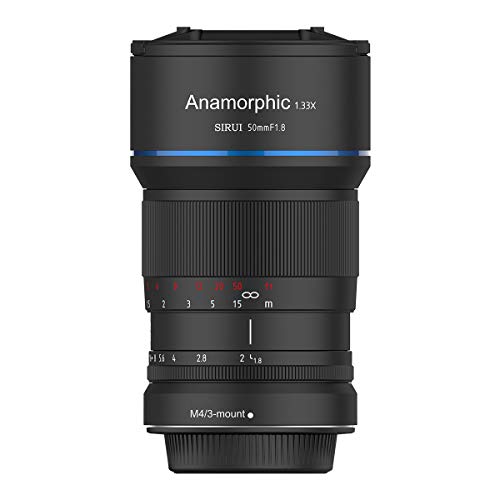
The SIRUI 50mm F1.8 Anamorphic Lens is a game-changer for aspiring filmmakers seeking a professional touch without breaking the bank. Designed for Micro Four Thirds and APS-C mounts, this lens offers a stunning 2.4:1 widescreen format, perfect for cinematic storytelling. Its 11 glass elements provide impressive optical clarity while producing unique effects like oval bokeh and sci-fi reflections. Weighing just 560 grams, it’s both robust and lightweight, making it easy to handle. With a closest focusing distance of 0.85 meters and a wide field of view, you’ll capture breathtaking scenes that elevate your filmmaking to the next level.
Best For: Aspiring filmmakers and content creators looking for an affordable professional anamorphic lens to enhance their cinematic storytelling.
Pros:
- High-quality optics: 11 glass elements deliver impressive clarity and unique visual effects.
- Lightweight design: Weighs only 560 grams, making it easy to handle during shoots.
- Cinematic format: Produces a stunning 2.4:1 widescreen aspect ratio for an immersive viewing experience.
Cons:
- Limited to Micro Four Thirds and APS-C mounts: Compatibility may restrict use with other camera systems.
- Manual focus only: Requires more skill and practice for precise focusing, which may not suit all users.
- Closest focusing distance of 0.85 meters: May limit close-up shot capabilities compared to other lenses with shorter minimum focus distances.
Rokinon Cine DS 85mm T1.5 AS IF UMC Full Frame Cine Lens for Micro Four Thirds

For filmmakers looking to achieve professional-quality results on a budget, the Rokinon Cine DS 85mm T1.5 AS IF UMC Full Frame Cine Lens is a standout choice designed specifically for Micro Four Thirds cameras. This lens features an impressive T1.5 aperture, allowing for beautiful low-light performance and shallow depth of field. With a minimum focusing distance of 3.6 feet and a 14.4-degree angle of view, it’s perfect for capturing stunning portraits and cinematic shots. Plus, its unified gear positions and dual focusing scales make it user-friendly. Weighing just 1.3 pounds, it’s a versatile addition to any filmmaker’s kit.
Best For: Filmmakers and videographers seeking a high-quality, budget-friendly lens for Micro Four Thirds cameras to achieve professional-looking results.
Pros:
- Exceptional low-light performance with a wide T1.5 aperture.
- User-friendly design with unified gear positions and dual focusing scales.
- Lightweight and compact, making it easy to carry for on-the-go filming.
Cons:
- Manual focus may not be ideal for all users, especially beginners.
- Limited to Micro Four Thirds compatibility, which may not suit all camera systems.
- Slightly heavy compared to other prime lenses in its class, weighing 1.3 pounds.
Meike 25mm T2.2 Mini Cine Lens for Micro Four Thirds

Designed for filmmakers on a budget, the Meike 25mm T2.2 Mini Cine Lens offers an impressive large aperture and low distortion, making it a standout choice for anyone working with Micro Four Thirds cameras. With its T2.2 aperture, you’ll achieve sharp, clear video even in low-light conditions. The lens features a construction of 10 elements in 8 groups, delivering smooth, circular bokeh and minimal focus breathing. It has an equivalent focal length of 50mm, perfect for various shooting environments. Whether you’re using an Olympus or Panasonic Lumix camera, this lens guarantees peak performance for your cinematic projects.
Best For: Filmmakers and content creators using Micro Four Thirds cameras who are looking for a budget-friendly lens that delivers high-quality video in various lighting conditions.
Pros:
- Large aperture of T2.2 allows for excellent performance in low-light environments.
- Low distortion characteristics provide sharp and clear video, enhancing the overall image quality.
- Compatible with a range of MFT cameras, including popular models from Olympus and Panasonic, ensuring versatility for different setups.
Cons:
- Manual focus only, which may not be ideal for users who prefer autofocus capabilities.
- Limited minimum focusing distance of 25mm may restrict close-up shots and detailed macro work.
- Not as widely known compared to more established lens brands, potentially leading to uncertainty about long-term reliability.
SIRUI VP-1 Vision Prime 50mm Full Frame Cine Lens

Offering a fast T1.4 aperture, the SIRUI VP-1 Vision Prime 50mm Full Frame Cine Lens is perfect for filmmakers looking to capture stunning low-light shots without sacrificing image quality. Its interchangeable mount system allows you to easily switch between E, RF, Z, and L mounts, enhancing compatibility with various cameras. Designed for 8K storytelling, this lens features aspherical elements and advanced glass, ensuring edge-to-edge sharpness and minimal distortion. The beautiful bokeh creates soft background separation, making your subjects pop. Constructed from durable aluminum, it’s lightweight and compact—ideal for travel and handheld filmmaking. This lens truly elevates your cinematic vision.
Best For: Filmmakers and content creators seeking a versatile, high-quality lens for low-light shooting and 8K storytelling.
Pros:
- Fast T1.4 aperture allows for excellent low-light performance and nuanced image details.
- Interchangeable mount system enhances compatibility with various camera types.
- Durable aluminum construction ensures longevity while remaining lightweight and portable.
Cons:
- Manual focus may not be ideal for all users, especially those accustomed to autofocus.
- Limited focal length (50mm) may not suit all shooting scenarios or styles.
- Higher price point compared to standard lenses might be a barrier for some filmmakers.
Rokinon Cine DS 35mm T1.5 Wide Angle Lens for Canon EF

The Rokinon Cine DS 35mm T1.5 Wide Angle Lens is a perfect choice for filmmakers seeking high-quality visuals without breaking the bank. With a full-frame coverage and an impressive T1.5 aperture, you’ll capture stunning imagery even in low light. Its 63.1-degree angle of view offers versatility for various shooting scenarios. The dual focusing scales make adjustments easy, and the unified gear positions enhance workflow. Weighing just 1.6 pounds, it’s lightweight yet sturdy. Rokinon’s commitment to reducing chromatic aberrations guarantees clarity and sharpness. With a solid customer rating of 4.5 stars, it’s a reliable option for any aspiring filmmaker.
Best For: Filmmakers and content creators looking for a high-quality, budget-friendly lens that excels in low-light conditions.
Pros:
- High T1.5 aperture allows for exceptional low-light performance and beautiful bokeh.
- Dual focusing scales and unified gear positions enhance usability and workflow efficiency.
- Constructed with high refractive index and aspherical elements to minimize chromatic aberrations, ensuring sharp and clear images.
Cons:
- Limited zoom capability as it is a fixed 35mm lens.
- Slightly heavier compared to some other lenses in its class, at 1.6 pounds.
- Manual focus only, which may not be ideal for all users or fast-paced shooting environments.
Meike 16mm T2.2 Mini Cine Lens for Micro Four Thirds

For filmmakers using Micro Four Thirds cameras, the Meike 16mm T2.2 Mini Cine Lens stands out as an exceptional choice thanks to its large aperture and manual focus capabilities. With a focal length equivalent to 32mm, this lens delivers sharp, high-quality video, enhancing your cinematic projects. Its construction features 13 elements in 10 groups, ensuring minimal distortion and smooth circular bokeh. Designed for models like the Olympus and Panasonic Lumix, it requires manual mode for peak performance. If you’re looking to elevate your filmmaking with a reliable, budget-friendly option, the Meike 16mm T2.2 is an excellent investment.
Best For: Filmmakers and photographers using Micro Four Thirds cameras who seek a high-quality manual focus lens for creative projects.
Pros:
- High-quality image output with sharpness and minimal distortion.
- Large aperture (T2.2) for excellent low-light performance and smooth bokeh.
- Compatible with various MFT models, making it versatile for different setups.
Cons:
- Manual focus may not be suitable for all users, especially those preferring autofocus.
- Requires camera to be set to Manual mode or “Release without lens” to operate.
- Limited focal length may not fit all shooting scenarios.
SIRUI 35mm T2.9 1.6X Full-Frame Anamorphic Lens Cinema Lens (RF Mount)

Filmmakers seeking a versatile and affordable option will appreciate the SIRUI 35mm T2.9 1.6X Full-Frame Anamorphic Lens. Weighing just 948g, it’s lightweight and perfect for run-and-gun setups. With a T2.9 maximum aperture, you’ll capture stunning images in various lighting conditions. The lens features a 1.6x squeeze factor, providing a wide cinematic field of view. Plus, you’ll enjoy unique effects like sci-fi lens flares and creamy oval bokeh. Its robust aluminum alloy construction guarantees durability, while the geared rings allow for precise manual focus and aperture control, making this lens an excellent choice for aspiring filmmakers.
Best For: Filmmakers looking for a lightweight, affordable anamorphic lens that delivers cinematic aesthetics and versatility for various shooting conditions.
Pros:
- Excellent for capturing stunning images in low-light environments due to its T2.9 maximum aperture.
- The 1.6x squeeze factor provides a wider cinematic field of view, enhancing visual storytelling.
- Robust aluminum alloy construction ensures durability while maintaining a lightweight design for easy mobility.
Cons:
- Manual focus may not be suitable for all filmmakers, especially those who prefer autofocus systems.
- Limited to a specific RF mount, which may restrict compatibility with other camera systems.
- The 35mm focal length may not be ideal for all shooting scenarios, depending on the desired composition.
ROKINON CINE DS T1.5 Cinema Lens Kit for Canon EF
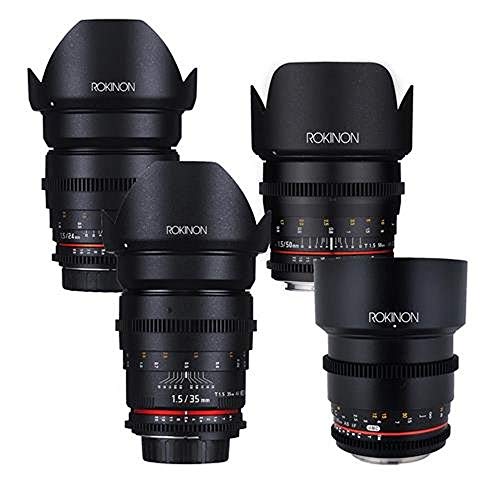
Looking to elevate your filmmaking without breaking the bank? The Rokinon Cine DS T1.5 Cinema Lens Kit for Canon EF is your perfect ally. This kit includes 24mm, 35mm, 50mm, and 85mm lenses, all designed for full-frame sensors. With an impressive T1.5 to T22 exposure range and a multi-layer coating to minimize flare, you’ll capture stunning visuals. The dual side focus and de-clicked aperture ring allow for smooth adjustments, giving you manual control over your shots. Built for robust professional use, these cine-style lenses offer the high-quality optics you need for serious cinema and video production.
Best For: Filmmakers and videographers seeking high-quality cinema lenses that enhance creative control without exceeding their budget.
Pros:
- High-quality optics with a wide T1.5 to T22 exposure range for stunning visuals.
- Dual side focus and de-clicked aperture ring for smooth and precise adjustments.
- Robust construction designed for professional cinema and video production use.
Cons:
- Manual focus and aperture control may not suit all users, especially beginners.
- The kit does not include autofocus capabilities, requiring more skill and practice.
- Lenses may be heavier compared to standard photography lenses, which could affect portability.
Meike 12mm T2.2 Manual Focus Wide Angle Cinema Lens for M43 Cameras

The Meike 12mm T2.2 Manual Focus Wide Angle Cinema Lens is an excellent choice for those using M43 cameras who seek high-quality optics without breaking the bank. With a 92-degree view angle and a fast T2.2 aperture, it captures sharp images and videos, making it ideal for cinematic storytelling. Its low distortion guarantees clarity, while the ability to create a shallow depth of field adds a professional touch. Built with a durable all-metal structure, this lens is compatible with popular models like the Panasonic Lumix GH5 and BMPCC 4K, making it a versatile addition to your filmmaking toolkit.
Best For: Those using M43 cameras who want a high-quality, affordable wide-angle lens for cinematic video and photography.
Pros:
- Produces sharp images and videos with low distortion.
- Capable of creating a shallow depth of field for a professional look.
- Durable all-metal construction ensures longevity and reliability.
Cons:
- Manual focus may not be suitable for all users, particularly those who prefer autofocus.
- Limited to M43 camera compatibility, which may restrict use with other systems.
- The fixed focal length may not provide versatility for all shooting scenarios.
SIRUI 40mm T1.8 Anamorphic Lens for Z Mount Cameras

For those seeking an affordable yet high-quality lens, the SIRUI 40mm T1.8 Anamorphic Lens stands out as an exceptional choice for Z Mount camera users. Weighing just 614g, it’s compact and perfect for portability. Its 1.33x anamorphic squeeze creates a stunning 2.35:1 aspect ratio, enhancing your cinematic storytelling. The advanced autofocus system guarantees quick, precise focusing, while the T1.8 aperture excels in low light, providing rich depth of field. With unique bokeh options and artistic flare effects, this lens inspires creative expression, making it ideal for run-and-gun shooting or mobile filmmaking setups. Get ready to elevate your visuals!
Best For: Filmmakers and content creators using Z Mount cameras who want a lightweight, high-quality anamorphic lens for cinematic storytelling.
Pros:
- Compact and lightweight design (614g) for easy portability.
- Advanced autofocus system for quick and accurate focusing, even in dynamic shooting conditions.
- Unique bokeh and flare options that enhance creative expression and cinematic quality.
Cons:
- Limited to Z Mount cameras, restricting compatibility with other camera systems.
- The 1.33x anamorphic squeeze may not suit all types of projects or preferences.
- Some users may find the price point higher compared to standard lenses without anamorphic features.
Factors to Consider When Choosing a Budget Cinema Lens
When you’re choosing a budget cinema lens, there are several key factors you should keep in mind. Lens compatibility with your camera, the importance of aperture range, and focal length can all impact your shooting experience. Additionally, consider the build quality and optical performance to guarantee you get the best value for your investment.
Lens Compatibility Options
Choosing a budget cinema lens requires careful evaluation of compatibility with your camera system, as this directly impacts your filming experience. First, verify the lens fits your camera’s mount—be it Micro Four Thirds (MFT), Canon EF, or Z Mount systems. Next, confirm that the lens covers your sensor size, whether full-frame, APS-C, or MFT, to prevent vignetting. It’s also essential to take into account if the lens supports manual focus and aperture control, which enhances your cinematic effects. If you plan to use multiple lenses, check for unified gear positions to maintain consistency in focus and aperture adjustments. Finally, look for lenses designed for video production, featuring low distortion and smooth bokeh to elevate your overall image quality.
Aperture Range Importance
After ensuring compatibility with your camera system, the next key factor to evaluate is the aperture range of your cinema lens. A wider maximum aperture (like T1.5 or T2.2) lets in more light, essential for low-light situations and achieving high-quality images. It also gives you better control over depth of field, allowing for beautiful bokeh and subject isolation. Consider the minimum aperture too; lenses that open to T22 or higher enhance versatility, providing sharper images in bright conditions. Additionally, a de-clicked aperture ring allows smooth adjustments during filming, vital for capturing audio. Ultimately, your choice of aperture range influences the overall aesthetic of your film, shaping sharpness and softness in your visuals.
Focal Length Selection
Understanding focal length is essential for achieving the desired visual storytelling in your films. The focal length directly impacts your field of view; shorter lengths offer wider angles, while longer ones zoom in on subjects. For Micro Four Thirds cameras, a 25mm lens acts like a 50mm, perfect for standard shots and portraits. If you want a cinematic flair, consider anamorphic lenses, like those with a 1.33x squeeze, which enhance the aspect ratio. Longer focal lengths, such as 85mm, help isolate subjects and create stunning bokeh. Think about your shooting environment too; wide-angle lenses (e.g., 16mm) excel in cramped spaces, while longer lenses shine in outdoor scenes or when capturing distant subjects. Choose wisely for your storytelling needs!
Build Quality Considerations
When selecting a budget cinema lens, it’s crucial to pay attention to build quality, as a well-constructed lens can greatly affect your filming experience. Look for lenses with solid, all-metal construction to guarantee durability in rigorous conditions. A smooth focus and aperture ring with precise control will make filming easier and more efficient. Don’t overlook the weight of the lens; a lightweight design is beneficial for handheld shooting and portability, especially in dynamic environments. Additionally, check for weather sealing or resistance features to protect your lens from moisture and dust. Finally, evaluate the filter thread size; a larger diameter allows for high-quality filters, enhancing versatility and preventing vignetting in various shooting scenarios.
Optical Performance Metrics
Selecting the right budget cinema lens involves more than just build quality; optical performance metrics play a significant role in achieving your desired results. First, consider the focal length, as it shapes your perspective and field of view, impacting how you frame subjects and manage depth of field. Next, check the maximum aperture values—wider apertures like T1.4 enhance low-light performance and create a shallower depth of field. Look at the lens construction: more elements and groups typically reduce optical aberrations, improving sharpness. The minimum focusing distance is essential for shooting versatility and creative framing. Finally, features like dual focusing scales and smooth aperture adjustments can elevate your production’s usability and precision, making your filming experience more enjoyable and efficient.
Weight and Size Factors
Weight and size are essential factors in choosing a budget cinema lens, especially for filmmakers on the go. Lighter lenses, around 560g, make handling easier and reduce fatigue during long shoots. A compact lens, approximately 106.6 mm in length, fits snugly in your camera bag and offers versatile shooting options. Opting for a lens with a smaller maximum diameter, like 68.2 mm, streamlines attachment of filters and accessories while keeping your gear lightweight. Portability is key; lenses built for easy travel often combine robustness with a lightweight design, perfect for run-and-gun filmmaking. However, it’s vital to find a balance between weight and performance, as heavier lenses can enhance stability and image quality, albeit at the cost of convenience.
Focus Mechanism Type
Choosing the right focus mechanism type can greatly affect your filmmaking experience, especially when you’re balancing portability with performance. Manual focus gives you more control for creative shots, while autofocus is perfect for fast-paced environments. If you’re looking for accessibility, consider lenses with dual focusing scales; they allow adjustments from either side, making it easier during shoots. A longer rotation angle on the focus ring provides finer control, vital for sharp focus in cinematic work. For smooth focus pulls, opt for lenses with a geared focus ring, which works well with follow-focus systems. Finally, de-clicked focus rings enable silent adjustments, important for maintaining audio quality while filming.
Price vs. Features Balance
While you might be tempted to focus solely on price when shopping for budget cinema lenses, it’s essential to balance affordability with important features that impact your filmmaking quality. Lenses generally range from $200 to $1,000, and this price affects optical performance, build quality, and functionalities. Higher-priced lenses provide superior glass elements, which enhance image sharpness and color accuracy. Features like dual side focus scales and de-clicked aperture rings, often found in mid to high-end lenses, improve usability for video projects. Additionally, advanced coatings in pricier options minimize flare and ghosting, significant for tricky lighting. When exploring budget choices, prioritize features such as aperture range and minimum focusing distance to suit your specific shooting needs effectively.