
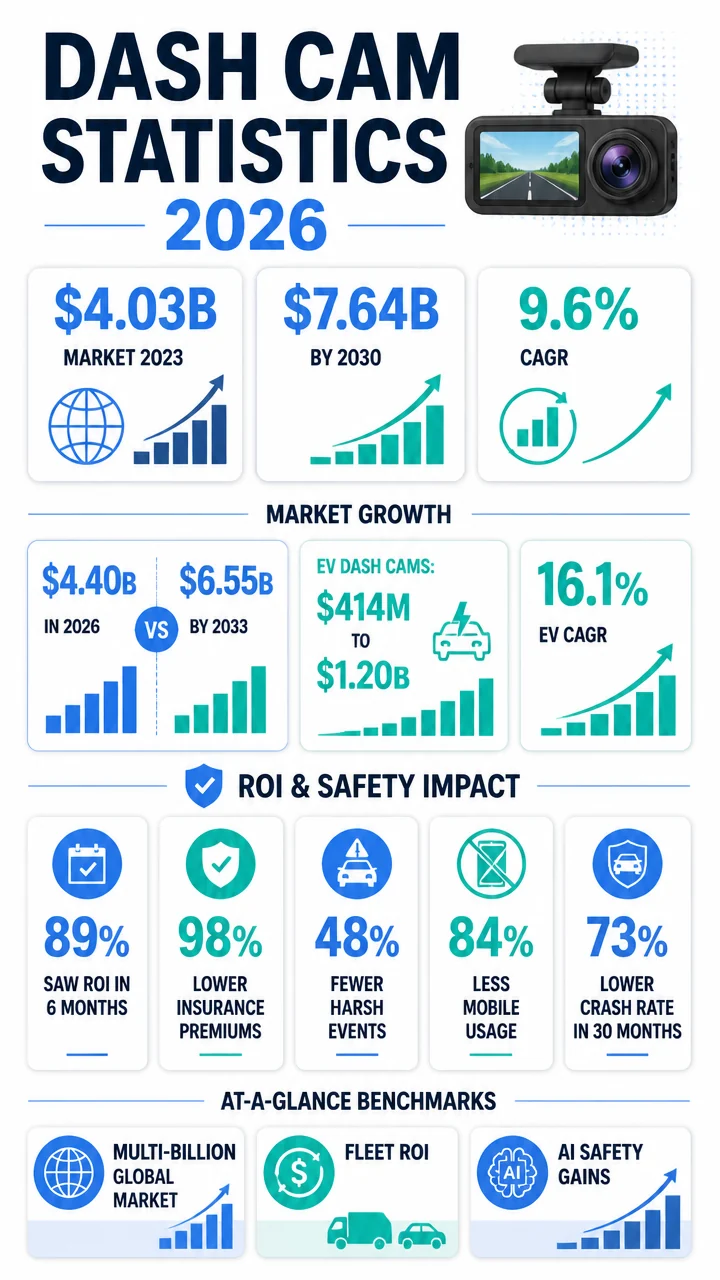
Dash cams are no longer a niche car accessory: the numbers show a fast-growing global market, measurable safety gains, and unusually strong ROI in fleet deployments.
From billion-dollar market forecasts to double-digit crash reductions, these dash cam statistics show why adoption keeps accelerating.
Big number: Multiple market trackers now place the dash cam category in the multi-billion-dollar range, with forecasts stretching from USD 6.55 billion by 2033 to USD 20.87 billion by 2033, depending on market scope and methodology.
Table of Contents
- Dash cam statistics at a glance
- Dash cam market growth statistics
- Dash cam ROI statistics for fleets and public sector agencies
- Dash cam safety and driver behavior statistics
- Dash cam regional and benchmarking statistics
- Dash cam product and technology statistics
- Dash cam resolution, field of view, and feature benchmarks
Dash Cam Statistics at a Glance
Fast facts:
- USD 4.03 billion: estimated global dashboard camera market size in 2023.
- USD 7.64 billion: projected global dashboard camera market size by 2030.
- 9.6% CAGR: expected growth rate from 2024 to 2030 in one major forecast.
- 89%: of public sector agencies reported ROI within the first six months of deployment.
- 98%: of agencies with dash cams saw annual insurance premiums decrease.
- 48%: decrease in harsh events within the first six months across more than 2,600 fleets.
- 84%: decrease in mobile usage within the first six months.
- 73%: decrease in crash rate over 30 months for fleets implementing the full AI safety solution.
- 16.1% CAGR: projected growth rate for the EV automotive dashcam market from 2026 to 2033.
Dash Cam Market Growth Statistics
The dash cam market is clearly expanding, but the exact size depends on how each firm defines the category. Across dashboard camera, car DVR, automotive dashcam, and related segments, every forecast in the dataset points upward.
Grand View Research estimated the global dashboard camera market at USD 4.03 billion in 2023 and projects it will reach USD 7.64 billion by 2030.
That implies a 9.6% CAGR from 2024 to 2030, a pace that suggests dash cams are moving from optional gadget to mainstream automotive tech.
In a related segment, Grand View Research estimated the global car DVR market at USD 3.15 billion in 2024 and expects it to grow to USD 4.20 billion by 2030, representing a more moderate 5.0% CAGR from 2025 to 2030.
MarketsandMarkets projects the automotive dashcam market at USD 4.40 billion in 2026 and USD 6.55 billion by 2033, with a 5.8% CAGR from 2026 to 2033.
That forecast is less aggressive than some others, but still points to sustained growth.
ResearchAndMarkets reported the global dash cam market at USD 5.491 billion in 2025 and expects it to hit USD 8.337 billion by 2030, supported by an 8.71% CAGR.
Emergen Research estimated the dash cams market at USD 4.5 billion in 2024 and projects USD 10.2 billion by 2034, reflecting an 8.5% CAGR from 2024 to 2034.
MarketDataForecast offers the most bullish numbers in this dataset, valuing the automotive dash cam market at USD 8.54 billion in 2024, USD 9.43 billion in 2025, and USD 20.87 billion by 2033, with a 10.44% CAGR from 2025 to 2033.
At the other end of the range, QYResearch estimated the global market for dash cams at USD 19.86 billion in 2023 and USD 24.51 billion by 2030, implying a much slower 2.6% CAGR from 2024 to 2030.
Even that lower growth rate still indicates market expansion rather than stagnation.
| Source | Segment | Base Value | Forecast Value | Growth Rate |
|---|---|---|---|---|
| Grand View Research | Dashboard camera market | USD 4.03B (2023) | USD 7.64B (2030) | 9.6% CAGR |
| Grand View Research | Car DVR market | USD 3.15B (2024) | USD 4.20B (2030) | 5.0% CAGR |
| MarketsandMarkets | Automotive dashcam market | USD 4.40B (2026) | USD 6.55B (2033) | 5.8% CAGR |
| ResearchAndMarkets | Global dash cam market | USD 5.491B (2025) | USD 8.337B (2030) | 8.71% CAGR |
| Emergen Research | Dash cams market | USD 4.5B (2024) | USD 10.2B (2034) | 8.5% CAGR |
| MarketDataForecast | Automotive dash cam market | USD 8.54B (2024) | USD 20.87B (2033) | 10.44% CAGR |
| QYResearch | Global dash cam market | USD 19.86B (2023) | USD 24.51B (2030) | 2.6% CAGR |
Why it matters: The forecasts vary widely, but they all point in the same direction: dash cam demand is rising across consumer, fleet, and commercial vehicle use cases.
The EV segment stands out as the fastest-growing niche in the dataset. MarketsandMarkets projects the EV automotive dashcam market at USD 414.1 million in 2026 and USD 1,202.3 million by 2033, with a striking 16.1% CAGR.
Among all supplied growth rates, this is the most aggressive, suggesting that electrified vehicle platforms may become a major adoption driver.
Dash Cam ROI Statistics for Fleets and Public Sector Agencies
If the market data explains why vendors are investing, the ROI data explains why buyers are adopting. Samsara’s Public Sector Dash Cam ROI Report surveyed 400 U.S. public sector leaders managing more than 85,000 vehicles and serving over 100 million citizens.
Key takeaway: 89% of agencies reported ROI within the first six months of dash cam deployment, and 61% started seeing returns within just three months.
The speed of payback is one of the most compelling figures in the dataset.
Samsara found that 68% of agencies fully recovered their initial investment within 12 months.
That is a short payback window for safety technology in public fleets.
The savings figures are just as notable.
Among agencies that achieved ROI within six months, 93% saved more than USD 100,000.
That moves dash cams from “nice-to-have” surveillance hardware into the category of budget-impacting operational tools.
- 95% agreed dash cam footage is a game changer for challenging false claims.
- 91% used dash cam footage to exonerate a driver in the past year.
- 98% saw annual insurance premiums decrease.
- 96% said dash cams reduced costs and freed up budget.
- 98% reported that dash cams make employees safer.
- 99% use footage for incident investigation.
Some of the strongest savings signals come from segment-level and high-deployment data.
63% of education agencies reported saving USD 10,000 or more annually, while 64% of state government agencies reported the same level of savings.
High-deployment agencies appear to capture the biggest upside.
In that group, 68% saved USD 100,000 or more from exonerations alone, 65% saved up to a week or more resolving incidents, 56% used footage for exoneration multiple times in the past 12 months, and 50% reported reduced vehicle theft and vandalism.
| ROI Metric | Statistic |
|---|---|
| ROI within 6 months | 89% |
| Returns seen within 3 months | 61% |
| Initial investment recovered within 12 months | 68% |
| Saved over USD 100,000 among those reaching ROI in 6 months | 93% |
| Insurance premiums decreased | 98% |
| Dash cams reduced costs and freed budget | 96% |
| Footage used for incident investigation | 99% |
| Footage used to exonerate a driver in past year | 91% |
Dash Cam Safety and Driver Behavior Statistics
The safety case for dash cams gets even stronger when paired with behavior tracking and AI-powered coaching. Samsara’s fleet safety analysis covered more than 2,600 fleets and tracked performance over 30 months.
Within the first six months, fleets saw a 48% decrease in harsh events and an 84% decrease in mobile usage.
Those are dramatic early gains, especially because distracted driving and risky maneuvers are among the behaviors fleet operators try hardest to reduce.
By month 30, the improvements deepened: harsh events were down 69% and mobile usage was down 96%.
That suggests the impact is not just an initial correction after monitoring begins, but a longer-term shift in driver behavior.
Pull quote: Mobile usage fell 96% by month 30 in Samsara’s fleet analysis, one of the biggest behavior-change figures anywhere in this dataset.
Larger fleets showed even stronger results.
Fleets with 500+ vehicles saw an 84% decrease in harsh events by 30 months and a 98% decrease in mobile usage.
Scale did not dilute performance; if anything, larger operations appeared to gain more.
Crash reduction figures are also substantial.
Fleets implementing the full AI safety solution saw a 73% decrease in crash rate over 30 months, while typical Samsara customers saw a 35% to 40% aggregate reduction in crashes over time.
Camera configuration matters too.
Dual-facing dash cams delivered a crash-rate reduction two times greater than front-facing dash cams alone. That is one of the most actionable deployment insights in the dataset because it ties setup choice directly to outcomes.
- 43% improvement in Unsafe Driving scores for fleets with 175+ vehicles.
- 57% improvement in HOS Compliance scores for fleets with 175+ vehicles.
- 83% improvement in Controlled Substances/Alcohol scores for fleets with 175+ vehicles.
Why it matters: The data suggests dash cams do more than record incidents after the fact.
When integrated into fleet safety programs, they appear to change driver behavior, reduce crashes, and improve compliance benchmarks.
Dash Cam Regional and Benchmarking Statistics
Regional data in the dataset reveals that risk patterns are not evenly distributed. Samsara’s benchmarks show different geographies stand out for very different reasons.
Canada recorded the lowest crash rates globally at -9% above or below baseline, making it the best performer on this metric in the dataset.
But Canada also posted a speeding rate of +38% above baseline, a reminder that low crash rates do not necessarily mean low-risk driving behavior across all categories.
Western Europe recorded the lowest speeding at -61% relative to baseline, which is a standout figure for speed management.
At the same time, Western Europe’s harsh events rate was +65% above baseline, suggesting a different type of driving risk exposure.
Mexico showed some of the highest risk indicators in the supplied numbers.
Mobile phone usage was +238% above baseline, while crash rate was +60% above baseline.
Those are among the most extreme regional deviations in the dataset.
| Region | Metric | Benchmark |
|---|---|---|
| Canada | Crash rate | -9% vs baseline |
| Canada | Speeding rate | +38% vs baseline |
| Western Europe | Speeding | -61% vs baseline |
| Western Europe | Harsh events | +65% vs baseline |
| Mexico | Mobile phone usage | +238% vs baseline |
| Mexico | Crash rate | +60% vs baseline |
The operational scale behind these insights is also significant.
Samsara says its Connected Operations Platform processes more than 20 trillion data points annually, which helps explain how these benchmarks can be built across broad fleet populations.
Dash Cam Product and Technology Statistics
Beyond market size and ROI, dash cam statistics also show how product expectations have shifted upward. Across Garmin, Nextbase, BlackVue, and Thinkware, 4K recording, wide viewing angles, parking features, wireless connectivity, and temperature tolerance all show up as recurring benchmarks.
Garmin’s current lineup illustrates tiered resolution positioning.
The Garmin Dash Cam X110 records in 1080p with a 140-degree field of view.
The X210 moves to 1440p with the same 140-degree field of view.
The X310 records in 4K Ultra HD, again with a 140-degree field of view.
The Garmin Dash Cam Live records in 1440p at 140 degrees.
Garmin also shows how connected features are becoming part of the category.
LTE connectivity requires a subscription for live view, location tracking, theft alerts, and parking guard notifications, while constant power support uses an OBD-II port connection.
The X310’s environmental stats reinforce how dash cams are designed for vehicle conditions.
It operates from -20 C to 60 C, charges from 0 C to 60 C, and supports Wi-Fi on 2.4 GHz, 5.1 GHz, and 5.7 GHz.
It also uses HEVC H.265 video encoding.
Garmin’s miniaturization is notable too.
The Garmin Dash Cam Mini measures just 5.0 x 3.0 x 3.2 cm excluding protrusions.
Dash Cam Resolution, Field of View, and Feature Benchmarks
Premium product specifications in the dataset make one trend obvious: higher resolution and wider coverage are becoming table stakes.
The Nextbase 622GW records in 4K at 30 fps, 1440p at 60 fps, and 1080p at 120 fps.
It includes a 3-inch HD IPS touch screen, Bluetooth 5.0, 10Hz GPS, Intelligent Parking Mode, a 140-degree viewing angle, and a 6-layer f1.3 lens.
When paired with a rear module, it continues recording in 4K while the rear camera captures 1080p at 30 fps.
The BlackVue DR970X adds another layer of premium detail.
It uses an 8-megapixel front CMOS sensor and an approximately 2.1-megapixel rear STARVIS CMOS sensor.
Front viewing angle is 155 degrees diagonal, 130 degrees horizontal, and 70 degrees vertical.
Rear viewing angle is 139 degrees diagonal, 116 degrees horizontal, and 61 degrees vertical.
Recording is 4K at 30 fps on the front and Full HD at 30 fps on the rear.
BlackVue’s installation and endurance numbers are also useful benchmarks:
- 32 GB to 256 GB microSD support.
- DC 12V to 24V input power.
- -20 C to 70 C operating temperature.
- -20 C to 80 C storage temperature.
- 75 C high-temperature cut-off.
- About 300 mA in normal 1-channel mode and 230 mA in parking mode.
- About 450 mA in normal 2-channel mode and 350 mA in parking mode.
The Thinkware U3000 records 4K UHD at 30 fps or 2K QHD at 60 fps, while rear recording is 2K QHD at 30 fps.
In parking mode timelapse, it records at 2 fps.
| Model | Front Resolution | Rear Resolution | Viewing Angle | Notable Features |
|---|---|---|---|---|
| Garmin Dash Cam X110 | 1080p | Not specified | 140° | Compact entry-tier model |
| Garmin Dash Cam X210 | 1440p | Not specified | 140° | Higher resolution than X110 |
| Garmin Dash Cam X310 | 4K Ultra HD | Not specified | 140° | 2.4-inch LCD, H.265, wide temp range |
| Nextbase 622GW | 4K at 30 fps | 1080p at 30 fps with rear module | 140° | 3-inch screen, Bluetooth 5.0, 10Hz GPS |
| BlackVue DR970X | 4K at 30 fps | Full HD at 30 fps | 155° front diagonal | 8MP sensor, Wi-Fi, GPS, Bluetooth |
| Thinkware U3000 | 4K at 30 fps or 2K at 60 fps | 2K at 30 fps | Not specified | Parking timelapse, radar parking features |
Thinkware’s own resolution guide helps frame what these product stats mean in practical terms.
According to the company, 1080p equals 1920 x 1080 pixels, 2K equals 2560 x 1440 pixels, and 4K equals 3840 x 2160 or 4096 x 2160 pixels.
Thinkware says professional dash cams start at 1920 x 1080 and go up to 4K.
At a glance: The dataset shows a clear premium-spec pattern: 4K front recording, 140°+ viewing angles, rear camera support, GPS, parking mode, and wireless connectivity are recurring features in higher-end dash cams.
One especially telling comparison comes from Thinkware’s note on Tesla’s built-in dash cam, which it describes as 1280 x 960 with a 60-degree viewing angle.
Based on the supplied specs alone, that is meaningfully narrower and lower-resolution than the dedicated aftermarket models listed here.
Parking and detection features are also becoming more sophisticated.
Thinkware’s RADAR Parking Mode example uses a 3-meter recognition distance for an elongated rear vehicle, and the brand suggests radar sensitivity at High for 4 meters or Highest for 5 meters in that scenario.
These numbers show how modern dash cam systems increasingly blur the line between passive recording and active vehicle monitoring.