
Choosing the right lens can make a bigger difference in astrophotography than almost any other camera upgrade. A bright, wide Sony E mount lens for astrophotography helps you capture more sky, keep shutter speeds usable, and preserve star detail.
Below, we focus on lenses that balance field of view, aperture speed, sharpness, and value so you can match the right option to your camera and shooting style.
Best 10 Sony E Mount Lens for Astrophotography Picks for 2026
Ultra-Wide APS-C Pick

- F2.8 aperture for low-light scenes
- 113.8° ultra-wide field of view
- Compact 175g APS-C prime
Best For: APS-C Sony shooters wanting a compact ultra-wide for night skies and landscapes
Fast Low-Light Prime

- Bright f/1.4 aperture for low light
- 16mm wide-angle prime design
- Compact and portable for field use
Best For: Sony E users who want a bright wide prime for low-light scenes and travel
Manual Fisheye Creative Pick

- 180° fisheye perspective for drama
- F2.0 aperture for low light
- Manual-focus creative specialty lens
Best For: Shooters who want a manual fisheye for stylized night and landscape images
Ultra-Wide Fisheye Pick

- 180° fisheye view for dramatic sky coverage
- Fast f/2 aperture supports low-light shooting
- Manual-focus APS-C lens with close 0.125m focus
Best For: creative APS-C astrophotography with a bold fisheye look
Bright Everyday Prime

- Fast f/1.7 aperture for better low-light shooting
- 38mm equivalent view feels natural and flexible
- STM autofocus with low focus breathing for video
Best For: APS-C users who want a fast all-around prime for night scenes and daily use
Compact Low-Light Prime
TTArtisan 25mm F2 Sony E APS-C

- F2 aperture helps in low light
- 25mm wide-angle prime on APS-C
- Manual focus, compact design
Best For: Sony APS-C users wanting a simple bright prime for night shooting
Fast Portrait Autofocus
VILTROX 56mm F1.7 Sony E APS-C

- Bright F1.7 aperture for low light
- STM autofocus with Eye/Face AF
- Lightweight 170 g build
Best For: Sony APS-C shooters wanting a fast autofocus prime for low-light portraits and everyday use
Ultra-Wide Night Prime
VILTROX 15mm F1.7 Sony E APS-C
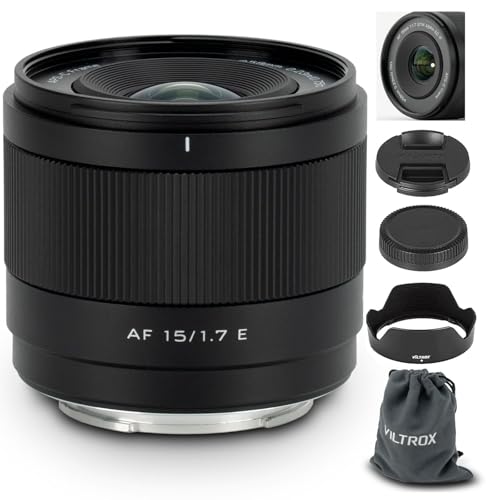
- 15mm ultra-wide 84.9° view
- F1.7 aperture for low light
- STM autofocus with manual focus support
Best For: Sony APS-C users needing a wide, bright lens for night landscapes and video
Ultra-Wide APS-C Pick – VILTROX 9mm F2.8 Sony E
If you want a Sony E mount lens for astrophotography that also handles landscapes and tight spaces, the VILTROX 9mm F2.8 is a practical ultra-wide APS-C option. Its F2.8 aperture helps gather more light in dim scenes, while the 113.8° field of view makes it easy to frame expansive night skies and foreground elements.
Best For: APS-C Sony shooters who want an affordable, compact ultra-wide lens for night skies, landscapes, and travel.
Pros:
- F2.8 aperture improves low-light shooting and helps reduce noise in night images.
- 113.8° ultra-wide view is useful for sweeping sky compositions and broad scenes.
- 0.13m minimum focus distance adds flexibility for close foreground detail.
- Eye/Face autofocus and compact 175g build make it easy to carry and use.
Cons:
- APS-C only, so it is not a full-frame astrophotography lens.
- Less fast than f/1.8 or f/1.4 alternatives for very dark skies.
- Ultra-wide framing may not suit shooters who want tighter celestial compositions.
This is a strong choice if you want a lightweight, wide-angle lens that can cover both night-sky scenes and everyday wide shots. It is more of a versatile low-light tool than a specialty astro lens, but the wide field and F2.8 aperture make it very usable for the price and size.
Fast Low-Light Prime – Sigma 16mm f/1.4 Sony E
The Sigma 16mm f/1.4 is a strong Sony E mount lens for astrophotography if you want a brighter wide-angle prime for dim conditions. Its f/1.4 aperture is the key feature here, giving you more light capture than slower wide lenses while still keeping the setup compact and easy to carry.
Best For: Sony E shooters who want a bright, portable wide prime for low-light work, nature, and event photography.
Pros:
- Very bright f/1.4 aperture supports superb low-light performance.
- 16mm wide-angle focal length works well for expansive scenes.
- Compact size makes it portable for travel and field use.
- Fast Hybrid AF adds flexibility for stills and general shooting.
Cons:
- Prime-only design offers no zoom versatility.
- Heavier than some ultra-compact APS-C options at 14.3 oz.
- Not specifically designed only for astrophotography, so it is a general-purpose wide prime.
For shooters who prioritize light-gathering over ultra-wide framing, this lens is one of the most compelling options in the group. The f/1.4 aperture makes it especially attractive for night work where every stop counts.
Premium Wide APS-C Choice – Sony 11mm F1.8 E
If you are choosing a Sony E mount lens for astrophotography and want a native Sony APS-C option, the 11mm F1.8 stands out for its combination of a very wide view and a bright aperture. The 104° angle of view helps capture broad night skies, and the f/1.8 design is well suited to low-light shooting.
Best For: APS-C Sony creators who want a lightweight native lens for wide night scenes, vlogging, and general low-light work.
Pros:
- 11mm focal length and 104° angle of view suit wide astrophotography compositions.
- F1.8 aperture helps in dim conditions and supports shallow depth of field.
- Compact, lightweight design is easy to balance on APS-C and Super35 bodies.
- Fast, precise, quiet AF with two linear motors benefits stills and video.
Cons:
- APS-C only, so it is not for full-frame Sony E cameras.
- Premium native option may cost more than third-party alternatives.
- Not the fastest aperture in this lineup compared with f/1.4 lenses.
This is the most balanced native Sony option for wide low-light shooting. It combines strong optical handling, compact size, and a bright aperture in a package that should appeal to creators who want reliability and portability.
Manual Fisheye Creative Pick – TTArtisan 7.5mm F2.0 Sony E
The TTArtisan 7.5mm F2.0 is a specialty Sony E mount lens for astrophotography if you want an extreme 180° perspective and are comfortable working manually. Its fisheye look is not for everyone, but it can create dramatic night-sky and landscape images when you want a highly stylized frame.
Best For: Photographers who want a manual fisheye lens for creative wide-angle shots and experimental night scenes.
Pros:
- 7.5mm fisheye design delivers a dramatic 180° angle of view.
- F2.0 aperture is usable in low-light conditions.
- Manual focus can be ideal for deliberate creative shooting.
- Works with a wide range of Sony E APS-C bodies.
Cons:
- Manual focus only, so it is less convenient for fast shooting.
- Fisheye distortion is extreme and not suited to natural-looking astro images.
- Less versatile than rectilinear wide primes for general astrophotography use.
This lens is best treated as a creative specialty tool rather than a standard astrophotography choice. If you want straight lines and conventional night-sky framing, the other lenses here are easier to use, but this one excels when you want a distinctive effect.
Milky Way-Friendly Ultra-Wide – VILTROX 14mm f/4 FE
If you want a Sony E mount lens for astrophotography that gives you a huge field of view without a lot of bulk, the VILTROX 14mm f/4 FE is an easy lens to consider. Its 112° angle of view makes it useful for capturing expansive night skies, and the optical design is built to reduce chromatic aberration, distortion, and flare.
Best For: Wide night-sky scenes, travel-friendly astro kits, and photographers who want a lightweight full-frame ultra-wide prime.
Pros:
- 14mm full-frame design with a 112° field of view for expansive compositions.
- 12-element optical design includes HR, ED, and aspherical elements to help control aberrations and flare.
- Lightweight 170g build makes it easy to carry for landscape or night-sky trips.
- Includes autofocus with STM motor plus manual focus support.
Cons:
- Maximum aperture is f/4, so it is not as bright as faster astro-focused primes.
- No image stabilization is listed.
- Designed for full-frame E-mount use, which may be more lens than some APS-C users need.
Overall, this is a practical option if you value portability and an ultra-wide view more than maximum brightness. It is better suited to wide, dramatic night scenes than to low-light work where every stop of light matters.
Ultra-Wide Fisheye Pick – TTARTISAN 7.5mm F2.0
The TTARTISAN 7.5mm F2.0 is a distinctive Sony E mount lens for astrophotography if you want a dramatic ultra-wide look on an APS-C body. Its 180° diagonal angle of view and bright f/2 aperture make it well suited to low-light scenes, while the manual-focus design keeps the build straightforward.
Best For: APS-C shooters who want an ultra-wide fisheye perspective for creative astrophotography and night landscapes.
Pros:
- 180° diagonal angle of view creates a dramatic fisheye perspective.
- Bright f/2 aperture is a strong match for low-light and night-sky shooting.
- 8-group, 11-element optical design includes 2 ED elements to help reduce purple fringing.
- Very close 0.125m minimum focus distance adds creative flexibility.
Cons:
- Manual focus only, so there is no autofocus assistance.
- Fisheye distortion is intentional, which is not ideal for every astrophotography style.
- It is an APS-C lens, so full-frame compatibility is limited to a special circular fisheye effect noted in the product details.
This lens stands out when you want sky coverage and visual drama rather than a corrected, natural-looking frame. If you are comfortable with fisheye rendering, it can deliver a very unique astrophotography look.
Bright Everyday Prime – VILTROX 25mm F1.7 E
If you are looking for a Sony E mount lens for astrophotography that can also handle everyday shooting, the VILTROX 25mm f/1.7 is a versatile APS-C prime to look at. Its bright aperture helps in low light, and the 38mm equivalent field of view offers a natural perspective that is easier to use for mixed photo and video work.
Best For: APS-C shooters who want one compact fast prime for night scenes, portraits, and general-purpose shooting.
Pros:
- Fast f/1.7 aperture improves low-light performance and background blur.
- 12-element optical design includes HR, ED, and aspherical elements to help control image defects.
- 38mm equivalent view gives a natural, flexible framing option.
- STM autofocus is fast, precise, and near-silent, with low focus breathing for video.
Cons:
- It is an APS-C lens, so it is not the widest option for night-sky landscapes.
- Close focus is listed around 0.3m to 0.33m, which is useful but not macro-level.
- No image stabilization is listed.
For photographers who want one fast lens that can cover low-light scenes without feeling too specialized, this is an appealing middle ground. It is less about extreme astro perspective and more about practical brightness with everyday usability.
Compact Low-Light Prime – TTArtisan 25mm F2 Sony E APS-C
If you want a Sony E mount lens for astrophotography that also works as a compact everyday prime, the TTArtisan 25mm F2 is a practical budget-friendly option. Its F2 aperture helps gather more light in dim conditions, and the manual-focus design gives you direct control when dialing in stars, night scenes, or other low-light subjects.
Best For: APS-C Sony shooters who want a simple manual wide-angle prime for low-light stills and general use.
Pros:
- Bright F2 aperture helps reduce noise in low-light shooting.
- 25mm focal length offers a natural wide view on APS-C cameras.
- Compact build makes it easy to carry for travel or night sessions.
- 0.25m minimum focus distance adds close-up flexibility.
Cons:
- Manual focus only, so it is less convenient for fast-moving subjects.
- APS-C lens, so full-frame bodies use it in APS-C mode.
- Not water resistant.
Overall, this lens makes sense if you value a bright, straightforward prime and do not mind focusing manually. For astrophotography and other low-light work on Sony E APS-C bodies, it is an affordable way to get a fast aperture in a portable package.
Fast Portrait Autofocus – VILTROX 56mm F1.7 Sony E APS-C
The VILTROX 56mm F1.7 is not a classic astrophotography lens, but it can still be useful as a Sony E mount lens for astrophotography when you want a fast, light prime for low-light work or detailed night-side subjects. Its bright F1.7 aperture, STM autofocus, and Eye/Face AF support make it a strong pick for handheld shooting when you also want quick, confident focus.
Best For: APS-C Sony shooters who want a lightweight autofocus prime for portraits, events, and general low-light use.
Pros:
- Bright F1.7 aperture suits low-light conditions.
- STM motor provides fast and quiet autofocus.
- Supports Eye AF and Face AF for easier subject tracking.
- Lightweight 170 g design is easy to carry.
Cons:
- 56mm focal length is more standard than wide, so it is less versatile for sweeping sky scenes.
- APS-C coverage means full-frame use is limited to APS-C mode.
- Minimum focus distance is about 0.55 m.
If you want autofocus convenience and a very bright aperture in a compact package, this lens is easy to recommend. It is better suited to low-light general photography than dedicated wide-field astro work, but it still earns a place for Sony E users who want a fast prime.
Ultra-Wide Night Prime – VILTROX 15mm F1.7 Sony E APS-C
If you are shopping for a Sony E mount lens for astrophotography, the VILTROX 15mm F1.7 stands out because it combines an ultra-wide 84.9° angle of view with a bright aperture and autofocus. That makes it a strong choice for night landscapes, architecture, indoor scenes, and video, especially when you want a wider perspective and reliable focus behavior.
Best For: Sony APS-C shooters who want a wide, fast autofocus lens for landscapes, vlogs, and low-light scenes.
Pros:
- 15mm focal length and 84.9° view suit wide scenes and expansive compositions.
- F1.7 aperture helps in low light and supports pleasing background blur.
- STM autofocus and manual focus support add flexibility.
- 0.23m minimum focus distance enables creative close-up wide-angle shots.
Cons:
- APS-C lens, so it is not a full-frame wide-angle option.
- Not water resistant.
- Wide-angle perspective may not be ideal for tighter subject framing.
For Sony APS-C owners who want a fast ultra-wide lens, this is the most astro-friendly option in the group. The wide field of view and bright F1.7 aperture make it especially appealing for night skies, travel scenes, and video work where you want more of the frame.
How We Picked the Best Sony E Mount Lens for Astrophotography
For this roundup, we prioritized lenses that are practical for night sky work: wide angles for Milky Way compositions, fast apertures for better light gathering, and optical designs that aim to keep stars crisp toward the edges. We also considered autofocus or manual focus usability, APS-C versus full-frame compatibility, and overall value for photographers building a Sony E Mount Lens for Astrophotography kit.
Quick Comparison
The fastest lenses in the group are generally the easiest to use under dark skies, while the widest lenses help you frame more foreground and sky in a single shot. APS-C shooters will usually want the 7.5mm to 16mm range for expansive scenes, while full-frame users should look closely at lenses that cover the larger sensor without vignetting. If you want a more versatile walkaround lens that can still work for stars, a normal or short telephoto option may be better than an ultra-wide.
Key Buying Factors for Sony E Mount Lens for Astrophotography
Aperture
Look for a lens with a wide maximum aperture, ideally f/1.4 to f/2.0 if your budget allows. A faster lens lets more light reach the sensor, which can reduce ISO pressure and improve star detail.
Focal Length
Ultra-wide lenses are often the best starting point because they capture large portions of the sky and are more forgiving with exposure times before star trailing becomes visible. Wider also means easier Milky Way compositions.
Sharpness and Coma Control
Astrophotography exposes optical flaws quickly. Edge sharpness and low coma matter because stretched or smeared stars can appear near the frame edges, especially on wide shots.
Focus Handling
Manual focus can be perfectly fine for night work if the lens has a smooth, precise focus ring and hard stop behavior. Autofocus is useful for daytime shooting and general versatility, but many photographers still switch to manual focus for stars.
Sensor Coverage
Make sure the lens matches your camera format. APS-C lenses are ideal for crop-sensor bodies, while full-frame lenses are the safer pick if you may upgrade later.
Who Should Buy Which Sony E Mount Lens for Astrophotography?
If you want the easiest entry into night-sky shooting, choose a fast ultra-wide APS-C lens. If you prefer a versatile lens that can handle landscapes, travel, and occasional star shots, a 15mm to 25mm option is a strong middle ground. Full-frame Sony shooters should lean toward lenses that cover the larger sensor cleanly, while budget-focused buyers may find manual lenses offer the best value. The best Sony E Mount Lens for Astrophotography is the one that fits your sensor, gives you enough light, and matches how often you shoot the night sky.