
If you have boxes of old negatives waiting to be digitized, the right scanner can make the process fast, simple, and far more satisfying than relying on a photo lab.
This roundup of the best film scanner for 35mm negatives options in 2026 focuses on image quality, convenience, and the features that matter most for home archiving.
Best 10 Film Scanner for 35mm Negatives Picks for 2026
Easy Home Digitizing
KODAK Slide N Scan Film & Slide Scanner
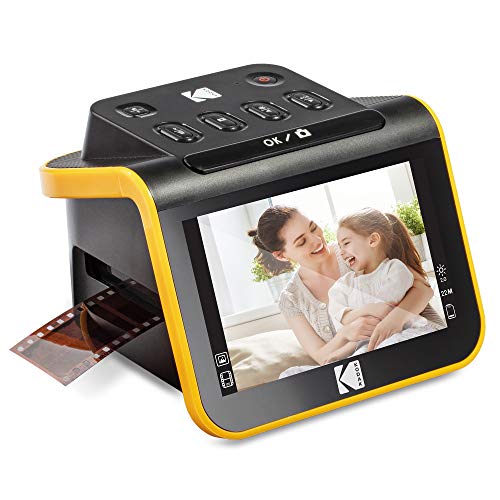
- 22MP scans with a 5" LCD for on-device viewing
- Supports 35mm, 110, and 126 negatives plus slides
- Saves to SD/SDHC and connects via USB or HDMI
Best For: Casual home users digitizing mixed film formats
High-Detail 35mm Scanning

- 7200 DPI and 48-bit output for detailed 35mm scans
- Includes QuickScan and SilverFast SE Plus software
- Supports Windows and Mac with a portable carry bag
Best For: Users who want maximum detail from 35mm negatives
Simple Standalone Archiving

- 24MP scans with a 5" display and HDMI support
- No computer or driver installation required
- Handles 35mm, 110, 126, and Super 8 formats
Best For: People who want quick standalone scanning at home
Flexible Mixed-Format Scanning

- Quick-feeding tray supports continuous scanning
- Direct saves to SD/SDHC cards without a computer
- Handles 135, 110, and 126 negatives and slides
Best For: Households digitizing mixed film collections quickly
Novelty Pick
KODAK Mobile Film Scanner for 35mm Negatives

- Uses your smartphone camera to scan 35mm film and slides
- Folds into a compact, travel-friendly cardboard design
- Includes LED backlight, tray, and free Android app support
Best For: Casual scanning and playful experimentation with old film
Editor-Friendly Pick
HP Film & Slide Scanner with 7" Touch LCD

- 7-inch touch screen lets you preview and edit on the device
- 13MP sensor handles color and black-and-white film
- Quick-feed loading supports 135, 126, and 110 formats
Best For: Standalone scanning with built-in editing and larger-screen viewing
Standalone Budget Pick
35mm Film and Slide Scanner with 2.4" Screen

- No-PC scanner saves JPEGs directly to an SD card
- Built-in 2.4-inch screen previews and edits images on-device
- Handles 35mm negatives and slides with easy-load adapters
Best For: Simple home archiving and computer-free film conversion
Classic High-Resolution Film Digitizer
KODAK SCANZA 35mm Film Scanner
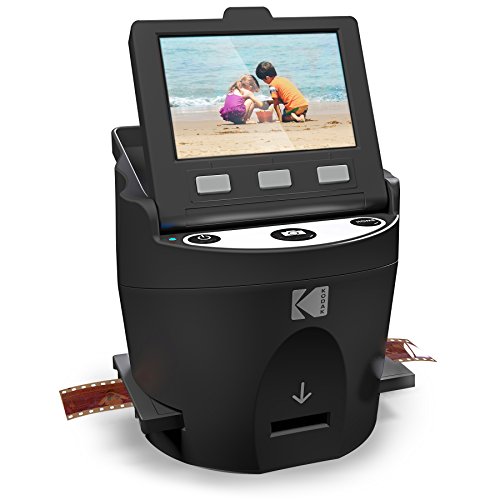
- Scans 35mm, 126, 110, Super 8, and 8mm film
- 3.5-inch LCD with adjustable brightness and tilt
- Includes adapters, cleaning brush, and cables
Best For: People digitizing 35mm negatives alongside other legacy film formats
Compact Portable Pick

- Up to 16MP scans with a CMOS sensor
- Supports 35mm/135 and 126 film plus slides
- Compact body with built-in editing controls
Best For: Travel-friendly scanning of 35mm negatives and slides
Big-Screen Standalone Choice

- 5-inch LCD for preview and playback
- Scans 35mm/135, 110, 126, slides, and Super 8
- One-touch scanning with HDMI and USB output
Best For: Users who want a larger screen for 35mm negatives and easy sharing
Easy Home Digitizing – KODAK Slide N Scan Film & Slide Scanner
If you want a film scanner for 35mm negatives that’s simple to use at home, this KODAK model focuses on quick loading, on-device viewing, and direct saving to SD. It supports 135, 110, and 126 negatives plus slides, so it works well if your archive includes more than just 35mm rolls.
Best For: Casual users who want an easy all-in-one scanner for mixed family film and slides.
Pros:
- 22MP output with a 5" LCD for previewing and editing without a computer
- Supports color and black-and-white negatives in 135, 110, and 126 formats
- Quick-feeding tray and included film holders make loading straightforward
- Can save directly to SD or SDHC cards and connect by USB or HDMI
Cons:
- SD or SDHC card is not included
- Designed more for convenience than professional scanning workflows
This is a practical pick if you want fast family-photo conversion with minimal setup and no complex software.
High-Detail 35mm Scanning – Plustek OpticFilm 8100
For buyers searching for a film scanner for 35mm negatives with a stronger focus on image quality, the Plustek OpticFilm 8100 is built around 7200 DPI resolution and 48-bit output. It is aimed at 35mm negatives and slides, making it a better fit for users who care more about fine detail than fast batch convenience.
Best For: Film owners who want high-resolution 35mm scans for large prints and careful archiving.
Pros:
- 7200 DPI and 48-bit output for high-detail 35mm digitizing
- Captures shadow and highlight detail with CCD-based scanning
- Includes Plustek QuickScan and SilverFast SE Plus software bundle
- Supports Windows and Mac, plus includes a carry bag for storage and travel
Cons:
- Focused on 35mm film, so it is less versatile than multi-format scanners
- USB workflow and software setup are more involved than standalone scanners
If your priority is quality-first 35mm scanning rather than quick family conversion, this model stands out as the most specialized option here.
Simple Standalone Archiving – Magnasonic FS71 Film Scanner
The Magnasonic FS71 is a straightforward film scanner for 35mm negatives if you want a standalone device that works without a computer. It converts 35mm, 110, 126, and Super 8 film, and it also handles 135, 126, and 110 slides, so it’s useful for mixed household collections.
Best For: Users who want a no-computer scanner for fast home digitizing.
Pros:
- 24MP JPEG output with a large 5" display for direct previewing
- No computer or driver installation required
- Supports 35mm negatives plus several other film and slide formats
- Brightness, RGB color correction, flip, and mirror controls are available on the scanner
Cons:
- SD card is not included
- Built-in memory is limited, so storage planning matters
This is a solid practical choice if you want fast, easy scanning and prefer to do everything right on the device.
Flexible Mixed-Format Scanning – KODAK Slide N Scan Max
If you need a film scanner for 35mm negatives that also handles a broader household archive, this KODAK Slide N Scan Max is built for speed and flexibility. It supports 135, 110, and 126 negatives and slides, saves directly to SD or SDHC, and tilts for easier viewing when used as a photo frame.
Best For: Families and hobbyists digitizing mixed film collections with minimal setup.
Pros:
- Quick-feeding tray supports continuous scanning
- Direct SD/SDHC saving keeps the workflow computer-free
- Supports color and black-and-white negatives in multiple formats
- One-touch editing and tilting design add convenience for home use
Cons:
- 13MP sensor with 22MP interpolation is less detailed than a dedicated high-resolution film scanner
- SD/SDHC card is not included
Choose this if convenience and mixed-format support matter more than maximum scan resolution.
Novelty Pick – KODAK Mobile Film Scanner for 35mm Negatives
If you want a film scanner for 35mm negatives that keeps things simple and fun, the KODAK Mobile Film Scanner is a lightweight way to view old negatives and slides using your smartphone camera. It is built for casual digitizing and experimentation rather than technical perfection, but it does make it easy to capture and share old memories.
Best For: Casual users who want an affordable, portable way to experiment with scanning 35mm negatives and slides on a smartphone.
Pros:
- Works with 35mm color negatives, black-and-white negatives, and 35mm slides
- Includes a collapsible cardboard platform, film tray, and LED backlight
- Portable, lightweight design folds down for storage and travel
- Simple scan-and-capture workflow with a free Android app
Cons:
- It is described as more of a toy than a professional conversion tool
- Resolution depends on the smartphone camera and image capture quality
- May require repeated tapping and autofocus attempts to get a sharp shot
This is a smart pick if you mainly want an inexpensive, nostalgic way to play with old film at home. It is not the most advanced digitizer, but for casual scanning and sharing, it keeps the process approachable.
Editor-Friendly Pick – HP Film & Slide Scanner with 7" Touch LCD
This film scanner for 35mm negatives is built for people who want preview, editing, and digitizing in one device. The HP Film & Slide Scanner uses a 7-inch touch LCD and a 13MP sensor, so you can review images directly on the unit and move through batches without needing a computer-first workflow.
Best For: Users who want a standalone scanner with a larger screen, built-in editing, and quick batch handling.
Pros:
- 7-inch color touch display makes previewing and editing straightforward
- 13MP sensor captures color and black-and-white images
- Quick-feed tray with 50mm adapter supports multiple film formats, including 135, 126, and 110
- USB and HDMI outputs add easy transfer and slideshow options
Cons:
- Uses a 1200 dpi specification rather than higher-end archival scanning claims
- May be more scanner than some casual users need for occasional use
If you want a more polished standalone experience, this model stands out for its touch interface and on-device editing tools. It is a practical choice for home users who want to convert film with less fuss and more control.
Standalone Budget Pick – 35mm Film and Slide Scanner with 2.4" Screen
For a film scanner for 35mm negatives that works without a PC, this standalone mini scanner focuses on simple home archiving. It converts 135 negatives and slides into JPEG files, lets you preview them on its built-in screen, and saves directly to an SD card for an easy all-in-one workflow.
Best For: Home archiving and easy family photo conversion without needing a computer.
Pros:
- Converts 35mm negatives and slides into 5MP or 10MP JPEGs
- Stand-alone design requires no complex software or driver installation
- 2.4-inch screen supports instant preview and on-device adjustments
- Includes easy-load adapters and supports TV out for bigger-screen viewing
Cons:
- Requires a separate SD card, which is not included
- Built-in screen is small compared with larger-touchscreen scanners
This is a straightforward pick if you want to digitize old film with minimal setup. Its strength is convenience: load, preview, save, and transfer without making the process complicated.
Classic High-Resolution Film Digitizer – KODAK SCANZA 35mm Film Scanner
If you want a film scanner for 35mm negatives that also handles several older formats, the KODAK SCANZA is built for fast standalone conversion to JPEG. It scans 35mm, 126, 110, Super 8, and 8mm film, and the built-in 3.5-inch LCD plus one-touch controls make it easy to move through batches without a computer.
Best For: Users who want an all-in-one scanner for 35mm negatives and multiple legacy film formats with simple on-device operation.
Pros:
- Converts 35mm, 126, 110, Super 8, and 8mm negatives and slides
- Built-in 3.5-inch LCD with adjustable brightness and tilt
- Includes multiple film inserts, adapters, cleaning brush, and cables
- Saves JPEG files directly to SD card, with support up to 128GB
Cons:
- SD card is not included
- Film support is limited to the listed formats
The SCANZA is a practical choice if you want a dedicated machine for digitizing negatives without relying on a PC workflow. Its included accessories and easy one-step scanning make it especially convenient for home archiving jobs.
Compact Portable Pick – BEONEGLOBAL ClearScan MINI
The BEONEGLOBAL ClearScan MINI is a compact film scanner for 35mm negatives if you want a lightweight, easy-to-use digitizer with built-in editing. It converts 35mm/135 and 126 film and slides to up to 16MP files, with a front-facing control layout and a 2.31-inch LCD for straightforward operation.
Best For: Travelers or casual users who want a small, portable scanner for 35mm negatives and quick SD-card saving.
Pros:
- Up to 16MP scans with a CMOS sensor
- Supports 35mm/135 and 126 film plus slides
- Compact, lightweight design for easy portability
- Built-in brightness, color, flip, and rotate adjustments
Cons:
- 2.31-inch screen is smaller than larger tabletop scanners
- SD card is not included and max capacity is 32GB
This model makes sense when portability and simplicity matter more than a large display. It is a good fit for quick home scanning sessions where you want direct saving and minor edits on the device itself.
Big-Screen Standalone Choice – DigitPro C190 5-inch Scanner
If you prefer a film scanner for 35mm negatives with a larger viewing screen, the DigitPro C190 puts a 5-inch LCD front and center. It supports 35mm/135, 110, 126, 50mm slides, and Super 8 film, and it saves directly to internal memory or an external SD card for quick, standalone digitizing.
Best For: Buyers who want a larger screen for previewing 35mm negatives and sharing scans without a computer.
Pros:
- Bright 5-inch LCD for previewing and playback
- Supports 35mm/135, 110, 126, slides, and Super 8 film
- One-touch scanning with built-in color, brightness, and date/time adjustments
- Includes HDMI, USB, power adapter, film holders, and cleaning brush
Cons:
- Built-in memory is only 128MB
- SD card and external storage are not included
The C190 is a strong pick if you want an easy standalone scanner with a bigger screen for checking results as you go. It also works well for family viewing, thanks to HDMI output and the picture-frame style display.
How We Picked the Best Film Scanner for 35mm Negatives
For a Film Scanner for 35mm Negatives, the most important factors are scan quality, usability, file handling, and whether the scanner fits your workflow. We prioritized models that make it easy to convert negatives to digital files without requiring a steep learning curve, while also considering resolution, display quality, and support for common film formats.
We also looked at real-world convenience: standalone operation versus computer-based scanning, speed, included software, and how well each scanner handles color and black-and-white negatives.
Quick Comparison
If you want the simplest setup, standalone scanners with built-in screens are usually the easiest choice. If your priority is maximum detail and finer control, dedicated desktop scanners tend to deliver stronger results, especially for serious archiving.
Portable or smartphone-based options can be useful for casual scans or occasional use, but they are generally better for convenience than for top-end image quality.
Key Buying Factors for a Film Scanner for 35mm Negatives
Resolution and Output Quality
Higher resolution helps preserve detail in old negatives, especially if you plan to crop, enlarge, or archive images long term. Look for clear native resolution claims and practical output quality rather than marketing numbers alone.
Ease of Use
Some scanners work fully standalone with an LCD and memory card, while others depend on a computer and software. Standalone models are often better for beginners; software-based models may suit users who want more control over color correction and editing.
Film Support
Not every scanner handles the same formats. If your collection includes only 35mm, a narrower-format unit may be enough. If you have mixed archives, a model that supports 126, 110, or slide film may offer better value.
Workflow Speed
Batch loading, quick-feed trays, and simple export options can save a lot of time if you have hundreds of negatives. For small personal projects, speed matters less than consistency and ease.
Display and Controls
A larger, sharper screen makes framing and previewing easier. Touch controls can be especially helpful if you want a more intuitive experience without frequent menu diving.
Who Should Buy Which Film Scanner for 35mm Negatives?
Choose a standalone Film Scanner for 35mm Negatives if you want the easiest path to digitizing family archives at home. Pick a higher-end desktop scanner if detail, flexibility, and scan quality matter most. If you only need occasional novelty scans or quick sharing, a simpler portable option may be enough.
For most buyers, the best choice is the model that balances image quality with a workflow you will actually use. The right scanner is the one that makes it realistic to finish the whole stack of negatives, not just scan a few test frames.