
Choosing a cooled astronomy camera for astrophotography can make a major difference in image quality, especially when you want cleaner detail, lower noise, and more consistent results on long exposures.
This roundup highlights ten options across color, monochrome, and planetary-focused designs, so you can match the camera to your telescope, target type, and budget.
Best 10 Cooled Astronomy Camera for Astrophotography Picks for 2026
High-Dynamic-Range APS-C Pick
ZWO ASI2600MC-Pro Cooled Color Camera

- 26MP back-illuminated APS-C sensor
- 16-bit ADC with up to 14 stops dynamic range
- Ultra-low readout noise and high peak QE
Best For: Deep-sky imagers who want a cooled color camera with APS-C framing
Budget Planetary Workhorse
SVBONY SV705C IMX585 Telescope Camera

- IMX585 back-illuminated sensor with 3856×2180 resolution
- About 90% peak QE and strong signal-to-noise ratio
- Useful for planetary, EAA, and entry-level deep-sky
Best For: Planetary imagers and EAA users who want a capable, value-oriented telescope camera
All-in-One Smart Rig
ZWO ASI585MM AIR Monochrome Camera

- 3-in-1 design for imaging, guiding, and control
- STARVIS 2 sensor with zero amp glow
- Built-in storage and wireless connectivity
Best For: Astrophotographers who want an integrated monochrome imaging system with guiding and control built in
Solar System Detail Specialist

- 20MP back-illuminated AR2020 BSI sensor
- ROI mode improves frame rate for planets
- USB-C and iCap software simplify capture
Best For: Moon, planet, and solar imagers who want a simple high-resolution plug-and-play camera
Entry-Level Planetary Pick

- IMX662 color sensor with low read noise
- 128MB buffer plus ROI and BIN support
- Made for planetary, lunar, and EAA use
Best For: Beginner planetary and lunar imaging
Deep-Sky Bundle

- Cooled IMX533 camera with 80% QE
- Includes SV555 Petzval APO refractor
- USB 3.0 and 512MB buffer for stability
Best For: Deep-sky imaging with a matched telescope kit
High-Resolution Cooled Choice

- APS-C IMX571 sensor with 26MP resolution
- Dual-stage TEC cooling with front-window heater
- 16-bit output plus zero amp-glow design
Best For: Advanced deep-sky imaging with APS-C coverage
Deep Sky Color Pick
SVBONY SV605CC Cooled Color Astronomy Camera
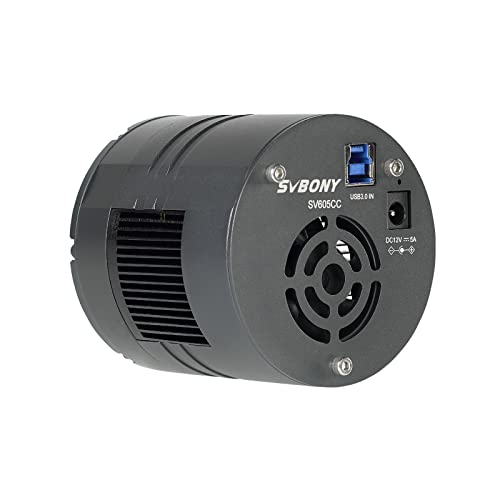
- IMX533 color sensor with 9MP square framing
- Cooling drops sensor temp by up to 30°C
- Glow suppression supports cleaner deep-sky data
Best For: Deep-sky beginners and color shooters
Mono Detail Performer
SVBONY SV605MC Cooled Monochrome Camera

- Monochrome IMX533 sensor suits filter-based imaging
- Two-stage TEC cooling drops temp up to 30°C
- Low read noise and 14-bit output support fine detail
Best For: Astrophotographers focused on narrow-band deep-sky work
Wide Field Color Choice
SVBONY SV405CC Cooled Color Telescope Camera

- IMX294 4/3-inch color sensor with 11.7MP output
- Two-stage TEC cooling reduces sensor temperature
- USB 3.0 and DDRIII buffer support stable capture
Best For: Deep-sky imagers wanting a larger color sensor
High-Dynamic-Range APS-C Pick – ZWO ASI2600MC-Pro Cooled Color Camera
ZWO ASI2600MC-Pro 26 Megapixel USB3.0 Cooled Color Astronomy Camera for Astrophotography
Check Price On AmazonIf you want a cooled astronomy camera for astrophotography that emphasizes clean data and wide dynamic range, the ZWO ASI2600MC-Pro is built around a back-illuminated IMX571 APS-C sensor. Its 16-bit ADC, low readout noise, and 80% peak QE make it a strong fit for deep-sky work where preserving star color and faint detail matters.
Best For: Deep-sky imagers who want a cooled color camera with APS-C framing and high dynamic range.
Pros:
- 26MP back-illuminated IMX571 APS-C sensor
- 16-bit ADC and up to 14 stops of dynamic range
- Ultra-low 0e- readout noise helps keep images clean
- High peak QE and USB connectivity for telescope/computer use
Cons:
- Color-only design may not suit monochrome workflows
- Requires external 12V power supply
- Not water resistant
This is a polished choice for serious astrophotography users who value sensor performance over simplicity. If your priority is a cooled color camera with strong deep-sky credentials, the ASI2600MC-Pro is one of the most capable options in this group.
Budget Planetary Workhorse – SVBONY SV705C IMX585 Telescope Camera
The SVBONY SV705C is a practical cooled astronomy camera for astrophotography if your focus is the Moon, planets, or entry-level deep-sky and EAA work. Its IMX585 sensor, back-illuminated design, and high signal-to-noise ratio are aimed at capturing detailed images efficiently, while the compact 1/1.2-inch frame gives you a strong balance of resolution and target coverage.
Best For: Planetary imagers and EAA users who want a capable, value-oriented telescope camera.
Pros:
- IMX585 sensor with up to 3856×2180 resolution
- Back-illuminated design with about 90% peak QE
- High full well capacity and strong signal-to-noise ratio
- Includes C-CS adapter ring for flexible lens use
Cons:
- Smaller sensor is less suited to wide deep-sky framing
- Best fit is solar system, EAA, and lucky imaging
- Uses a CS port front end, so accessories matter
For buyers who want a straightforward camera that performs well on bright targets, the SV705C hits a useful middle ground. It is especially appealing if you want good planetary detail and some flexibility for casual deep-sky experimentation.
All-in-One Smart Rig – ZWO ASI585MM AIR Monochrome Camera
The ZWO ASI585MM AIR is a different kind of cooled astronomy camera for astrophotography because it combines imaging, guiding, and control in one unit. With a STARVIS 2 sensor, built-in guide camera, 256GB eMMC storage, and integrated wireless control, it is designed to simplify a full imaging setup without giving up serious sensor performance.
Best For: Astrophotographers who want an integrated monochrome imaging system with guiding and control built in.
Pros:
- 3-in-1 design: imaging, guiding, and control system
- Built-in STARVIS 2 sensor with high sensitivity
- Low readout noise and zero amp glow
- 256GB eMMC storage plus Wi-Fi and Bluetooth connectivity
Cons:
- More specialized and expensive than a basic standalone camera
- Monochrome workflow requires a filter-based imaging approach
- Integrated system may be more than casual users need
This camera is best viewed as a compact imaging platform rather than just a sensor on a cable. If you want fewer external boxes and a more self-contained setup, the ASI585MM AIR is one of the most convenient advanced options here.
Solar System Detail Specialist – Celestron NexImage 20 Camera
If you are shopping for a cooled astronomy camera for astrophotography focused on the Moon, planets, or solar imaging, the Celestron NexImage 20 is built for speed and detail. Its 20MP back-illuminated AR2020 sensor, ROI cropping, and USB-C connection make it easy to capture and stack high-resolution solar system footage with minimal setup.
Best For: Moon, planet, and solar imagers who want a simple high-resolution plug-and-play camera.
Pros:
- 20MP back-illuminated AR2020 BSI CMOS sensor
- Region of Interest mode boosts frame rate for planets
- Built-in autoguiding support adds extra versatility
- USB-C connection and iCap capture software included
Cons:
- Purpose-built mainly for solar system targets
- Not intended as a general-purpose deep-sky camera
- Requires a telescope with a 1.25-inch eyepiece holder or adapter
The NexImage 20 is a focused tool rather than an all-rounder, which is exactly what some buyers want. If your priority is crisp lunar, planetary, and solar detail with easy setup, it is a strong, practical option.
Entry-Level Planetary Pick – SV305C IMX662 Color Camera
If you want a cooled astronomy camera for astrophotography? this SV305C is really aimed at beginner-friendly planetary, lunar, and EAA use rather than deep-sky cooling. Its IMX662 color sensor, low read noise, and built-in buffer make it a practical choice for fast capture work with a telescope.
Best For: Planetary and lunar imaging, plus EAA users who want an easy entry-level telescope camera.
Pros:
- IMX662 back-illuminated sensor with low readout noise and improved red sensitivity
- High-speed planetary mode and long-exposure mode can be set quickly in SharpCap
- 128MB DDRIII buffer helps prevent frame loss if USB transfers are interrupted
- ROI and BIN functions can improve capture rate and sensitivity
Cons:
- Not a cooled camera, so it is less suited to long deep-sky exposure work
- Entry-level design is focused on planets, the Moon, and EAA rather than advanced imaging
Overall, the SV305C makes sense if your priority is a simple color camera for bright targets and quick capture sessions. It gives you useful imaging features without pushing into the higher-cost cooled deep-sky category.
Deep-Sky Bundle – SV605CC Cooled IMX533 Kit
For buyers comparing a cooled astronomy camera for astrophotography, this SV605CC bundle is built around deep-sky work rather than planetary use. The cooled IMX533 camera brings high QE, a 9MP square sensor, and USB 3.0 support, while the included SV555 APO refractor is designed for flat-field, wide-field imaging.
Best For: Deep-sky photographers who want a cooled camera and telescope bundle for wide-field imaging.
Pros:
- Cooled IMX533 color sensor with 3008×3008 resolution and 80% QE
- USB 3.0 camera with a 512MB DDR3 buffer for stable transfer
- Bundle includes a Petzval APO refractor for flatter wide-field imaging
- Compatible with DSLR, mirrorless, and astronomy camera workflows
Cons:
- Bundle format may be more than some shoppers need if they already own a scope
- Square sensor and wide-field design are less tailored to planetary imaging
This is the strongest all-in-one option here for deep-sky users who want a cooled setup with a telescope matched to the camera. If you want a practical path into wide-field astrophotography, the kit format is a major advantage.
High-Resolution Cooled Choice – SC571CC APS-C Camera
If you are shopping for a cooled astronomy camera for astrophotography, the SC571CC is the most serious deep-sky option in this group. Its APS-C IMX571 sensor, dual-stage TEC cooling, front-window heater, and 16-bit output are all aimed at clean, detailed long-exposure imaging.
Best For: Advanced deep-sky imagers who want APS-C resolution, cooling, and dew protection.
Pros:
- APS-C IMX571 sensor with 26MP resolution and 3.76 µm pixels
- Dual-stage TEC cooling lowers sensor temperature by 35°C below ambient
- Front-window heater helps prevent dew and condensation during imaging
- 16-bit ADC, zero amp-glow, and 512MB DDR3 buffer support clean long exposures
Cons:
- More advanced than an entry-level camera, so it may be overkill for casual users
- Designed for deep-sky targets rather than planetary or quick EAA sessions
For users focused on faint nebulae and long nights at the telescope, this camera offers the most complete imaging feature set of the three. It is the best fit when image quality, cooling, and sensor size matter most.
Deep Sky Color Pick – SVBONY SV605CC Cooled Color Astronomy Camera
If you want a cooled astronomy camera for astrophotography that leans toward easy color capture, the SV605CC is built around the IMX533 one-inch square sensor and double-layer TEC cooling. It is aimed at deep sky work, panoramic astronomy, meteor monitoring, and lucky imaging, with a 9MP 3008×3008 output that keeps framing simple on short-focus or fast optical systems.
Best For: Deep-sky beginners and color shooters who want a square-sensor cooled camera with strong cooling and low-glow performance.
Pros:
- IMX533 color sensor with 9MP 3008×3008 square framing
- Double-layer semiconductor cooling can reach 30°C below ambient
- Glow suppression helps improve signal-to-noise performance
- 3.76µm pixels are suited to easier image sampling
Cons:
- Color sensor is less specialized than a monochrome setup for narrowband workflows
- Best results still depend on a capable telescope system
Overall, the SV605CC is a practical cooled astronomy camera for astrophotography if you want a color-first deep-sky option with strong thermal control and a sensor design that emphasizes clean, manageable framing.
Mono Detail Performer – SVBONY SV605MC Cooled Monochrome Camera
The SV605MC is a cooled astronomy camera for astrophotography built for users who want monochrome capture, especially with narrow-band filters and long-exposure deep sky imaging. Its IMX533 mono sensor, 14-bit output, and two-stage TEC cooling make it a focused option for reducing noise and preserving faint detail.
Best For: Astrophotographers who want a cooled monochrome camera for deep-sky targets and narrow-band filter work.
Pros:
- Monochrome IMX533 sensor is well suited to filter-based imaging
- Two-stage TEC cooling lowers temperature by up to 30°C below ambient
- Low read noise supports cleaner high-definition deep-sky captures
- 14-bit output and 20 FPS readout help with efficient data capture
Cons:
- Monochrome imaging usually requires filters and more processing steps
- Less convenient than color cameras for quick one-shot results
In practice, this model makes sense if your priority is image quality over simplicity. It gives you the cooling and low-noise foundation that matters for serious deep-sky work.
Wide Field Color Choice – SVBONY SV405CC Cooled Color Telescope Camera
If you need a cooled astronomy camera for astrophotography with a larger sensor and a proven color workflow, the SV405CC is designed around the back-illuminated IMX294 4/3-inch color sensor. It combines two-stage TEC cooling, HCG mode, and USB 3.0 performance, making it a strong fit for deep-sky imaging and fast live-view style use.
Best For: Deep-sky imagers who want a larger color sensor, good dynamic range, and broad software compatibility.
Pros:
- Back-illuminated IMX294 4/3-inch color sensor with 11.7MP resolution
- Two-stage TEC cooling lowers sensor temperature by up to 30°C
- HCG mode helps reduce read noise at higher gain settings
- USB 3.0 plus 256MB DDRIII buffer supports stable high-speed capture
Cons:
- Larger sensor and higher resolution may increase storage and processing demands
- Best value depends on using software and a rig that can take advantage of its features
For buyers comparing cooled color cameras, the SV405CC stands out for its balance of sensor size, cooling, and workflow flexibility. It is a sensible option when you want a versatile imaging camera rather than a minimal setup.
How We Picked the Best Cooled Astronomy Camera for Astrophotography
We focused on sensor size, cooling performance, USB connectivity, sensor type, and overall versatility. For a Cooled Astronomy Camera for Astrophotography, those factors matter more than headline megapixels alone. We also favored models that suit common use cases like deep-sky imaging, lunar and planetary work, and all-in-one beginner setups.
Quick Comparison
Use camera type to narrow the field fast. Cooled color cameras are usually the easiest starting point for deep-sky imaging. Cooled monochrome cameras can deliver more detail and flexibility, but they require filters and more processing. Smaller-sensor models are often better for planets and the Moon, while APS-C-class sensors are better when you want a wider field of view for nebulae and galaxies.
Key Buying Factors for a Cooled Astronomy Camera for Astrophotography
Sensor Size and Pixel Match
Match the sensor to your telescope’s focal length and your preferred targets. Larger sensors capture more sky and simplify framing. Smaller pixels can help with high-resolution imaging, but only if your optics and seeing conditions support it.
Cooling Depth and Stability
Effective cooling reduces thermal noise during long exposures and helps keep dark frames more consistent. Look for stable, well-controlled cooling rather than just a large advertised temperature drop.
Color Vs. Monochrome
Color cameras are simpler and more convenient for most beginners. Monochrome models offer greater sensitivity and finer control through filters, which makes them attractive to more advanced astrophotographers.
Planetary, Lunar, or Deep-Sky Use
Some cameras are tuned for fast capture and small targets like Saturn or the Moon, while others are built for longer exposures and larger deep-sky objects. A Cooled Astronomy Camera for Astrophotography can do both in some cases, but it usually excels most in one area.
Software, Power, and Workflow
Check driver support, capture software compatibility, and power requirements before you buy. Integrated systems can simplify setup, while standard USB cameras often offer more flexibility with different rigs and operating systems.
Who Should Buy Which Cooled Astronomy Camera for Astrophotography?
Beginners who want the easiest path should look at cooled color cameras with strong all-around performance. Imaging enthusiasts who want more control over narrowband or fine-detail work should consider cooled monochrome options. If your focus is mostly the Moon and planets, a high-frame-rate planetary camera may be the better fit than a larger deep-sky model. If you want one camera for multiple targets, choose a balanced sensor size with proven cooling and broad software support.