
The right tripod makes product photography more repeatable: it keeps framing steady, supports longer exposures, and lets you refine lighting and composition without constantly repositioning the camera.
This roundup covers 10 options ranging from overhead-capable designs and fluid-head video tripods to compact travel models and simple phone-friendly stands. The best choice depends on your camera weight, shooting angle, workspace, and need for portability.
Best 10 Camera Tripods for Product Photography Picks for 2026
Best Overhead Pick
K&F Concept 76 in Overhead Camera Tripod

- Removable 180-degree boom arm for overhead framing
- 76.7-inch maximum height with compact 15.3-inch fold
- 360-degree ball head and 17.6-pound stated capacity
Best For: Overhead product photography and flat lays
Best Fluid-Head Option
SMALLRIG 73 in Heavy Duty Video Tripod

- Adjustable fluid drag for smooth pans and tilts
- 8 kg capacity with 65 mm leveling bowl
- Includes phone holder, case, and accessory mounts
Best For: Product photography combined with video production
Best Budget-Friendly All-Rounder
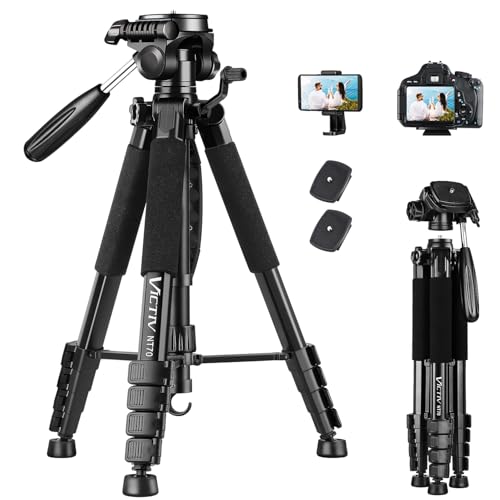
- 74-inch height with a compact folded design
- 3-way pan head supports portrait and panoramic shots
- Includes phone holder and extra quick-release plate
Best For: Beginners and camera-and-phone content creators
Best Convertible Design
SmallRig CT-10 Ball Head Tripod

- Converts from tripod to monopod
- Inverted center column supports macro and low-angle shots
- 360-degree ball head with accessory mounting threads
Best For: Travel, macro, and adaptable product photography
Best Budget Starter
NEEWER TP53 Entry-Level Tripod

- Lightweight 568g aluminum design
- Supports phones and cameras up to 3.3lb
- 360° pan and horizontal-to-vertical shooting
Best For: Beginners shooting lightweight products, phones, or compact cameras
Best Load Capacity
K&F Concept 64-Inch Travel Tripod

- 8kg/17.6lb stated load capacity
- Folds to 15.5 inches for travel
- Supports low-angle shooting with column options
Best For: Travel photographers using heavier camera setups or varied angles
Best Multifunctional Design

- Extends to 75 inches and folds to 14.17 inches
- Converts to a monopod or selfie stick
- Supports low-angle and uneven-terrain positioning
Best For: Creators needing one flexible tripod for products, phones, and outdoor content
Best Travel-Ready Pick
K&F CONCEPT 75-Inch Aluminum Tripod

- 75-inch maximum height with compact 20-inch fold
- 8.8-pound capacity and 2.6-pound weight
- Includes phone/tablet holder, remote, bag, and quick-release plates
Best For: Travel photographers and multi-device creators
Best All-Purpose Option
CAMBOFOTO 74-Inch Camera Tripod

- 74-inch height range with 8.8-pound capacity
- Works with cameras, phones, and GoPros
- Includes pan head, phone mount, quick-release plate, and bag
Best For: Multi-device product and content shoots
Best Lightweight Budget Pick

- Weighs 1.23 pounds and folds to about 16.9 inches
- Adjusts from 16.1 to 50 inches
- 4.4-pound limit with 3-way head and quick-release plate
Best For: Lightweight tabletop and travel photography
Best Overhead Pick – K&F Concept 76 in Overhead Camera Tripod
For product photography, the K&F Concept stands out when you need flexible overhead positioning. Its removable boom arm, tall working height, and multi-angle ball head make it easier to frame flat lays, tabletop scenes, and panorama shots.
Best For: Overhead product photography, flat lays, and creators who need a tall, portable setup.
Pros:
- Extension boom arm moves from 0 to 180 degrees and rotates horizontally 360 degrees.
- Height adjusts from 17.3 to 76.7 inches and folds to 15.3 inches.
- 360-degree metal ball head and 17.6-pound stated load capacity provide flexible camera positioning.
- Includes a carrying bag and supports cameras, smartphones, projectors, and telescopes.
Cons:
- The aluminum tripod is not water resistant.
- The boom-arm setup may be more involved than a conventional tripod.
This is a versatile choice for photographers who want one tripod to handle standard and overhead compositions. Its relatively low 3.63-pound weight and compact folded size also make it practical for transporting between shoots.
Best Fluid-Head Option – SMALLRIG 73 in Heavy Duty Video Tripod
For product photography that also includes video, this SMALLRIG tripod combines a heavy-duty aluminum platform with an adjustable fluid head. The drag control and broad tilt range are useful for smooth camera movements, while the bowl mount helps with leveling.
Best For: Product photographers who also shoot video, livestreams, or location-based content.
Pros:
- Supports up to 8 kg (18 pounds) and reaches 73 inches.
- Fluid head provides adjustable tilt drag with a +85 to -78 degree tilt range.
- 65 mm bowl mount assists with leveling on different surfaces.
- Includes a phone holder, carrying case, and two 1/4-inch accessory mounts.
Cons:
- At 6.8 pounds, it is heavier than the other listed options.
- Its minimum height is 33 inches, limiting very low-angle setups.
- The tripod is not water resistant.
The AD14 is a strong fit when smooth panning matters as much as still-camera stability. It is less convenient for ultra-light travel, but its fluid head, accessory mounts, and 8 kg capacity suit more involved studio or location productions.
Best Budget-Friendly All-Rounder – VICTIV 74 in Camera Tripod
The VICTIV is a practical all-purpose option for camera tripods for product photography, especially if you also use a phone. Its 3-way pan head supports horizontal, vertical, and portrait positioning, while the included phone holder and quick-release plate simplify switching devices.
Best For: Beginners, food photographers, content creators, and mixed camera-and-phone shooting.
Pros:
- Adjusts from 19.5 to 74 inches and folds to about 20 inches.
- Includes a 360-degree phone holder and an extra quick-release plate.
- 3-way pan head supports horizontal panoramas, vertical movement, and portrait orientation.
- Weight hook and non-slip pads can add stability during indoor or outdoor shoots.
Cons:
- The supplied notes do not specify the tripod’s material load capacity beyond a 9.5-pound weight limit.
- It is not water resistant.
- A 3-way head may be slower to adjust than a ball head for rapidly changing angles.
This VICTIV offers a useful combination of reach, portability, and included accessories. It makes the most sense for everyday tabletop, food, portrait, and content-creation work rather than specialized overhead photography.
Best Convertible Design – SmallRig CT-10 Ball Head Tripod
The SmallRig CT-10 is a flexible choice for product photography when you want both tripod and monopod modes. Its 360-degree ball head, inverted center column, and low minimum height support macro and unusual camera angles, while threaded mounting points accommodate accessories.
Best For: Travel photographers, macro shooters, and creators who need tripod-to-monopod flexibility.
Pros:
- Converts from a tripod to a monopod for travel and hiking.
- 36 mm ball head rotates 360 degrees for horizontal and vertical compositions.
- Inverted center column supports low-angle and macro photography.
- Offers three 1/4-inch accessory threads and a stated vertical capacity of 33 pounds.
Cons:
- The stated 33-pound capacity applies vertically; the tilt capacity is listed as 11 pounds.
- Telephoto lenses may require an additional tripod mount ring or lens mount for balance.
- The tripod is not water resistant.
With a 16-inch minimum height and a monopod conversion, the CT-10 is particularly adaptable for changing product-photo setups. It is a compelling option for creators who value portability and angle flexibility over a dedicated overhead arm.
Best Budget Starter – NEEWER TP53 Entry-Level Tripod
For shoppers comparing camera tripods for product photography, the NEEWER TP53 is a straightforward, lightweight option for beginners. Its aluminum construction, adjustable height, and phone-friendly design cover basic tabletop-to-standing shooting and content creation needs.
Best For: Beginners who need an affordable tripod for lightweight cameras, smartphones, vlogging, or simple product shots.
Pros:
- Lightweight 568g design folds to 16.9 inches and includes a carrying bag.
- Supports cameras, mirrorless cameras, action cameras, and smartphones up to 3.3 pounds.
- Offers horizontal-to-vertical shooting, 360-degree panning, and adjustable tilt.
- Phone holder includes a cold shoe for lights or microphones.
Cons:
- Its 3.3-pound weight limit may not suit heavier camera and lens combinations.
- The action-camera adapter is not included.
- Designed as an entry-level model, so it focuses on essential features rather than advanced controls.
The TP53 makes sense when portability, simplicity, and low cost matter more than heavy-duty support. For lightweight product photography setups and phone-based content, it provides useful positioning flexibility without much bulk.
Best Load Capacity – K&F Concept 64-Inch Travel Tripod
The K&F Concept 64-inch model is a versatile choice among camera tripods for product photography, especially when you want a portable setup with more equipment headroom. Its 36mm ball head, 8kg capacity, and low-angle configuration support varied camera positions.
Best For: Photographers who want a travel-friendly tripod with a higher stated load capacity and flexible shooting angles.
Pros:
- Supports up to 17.6 pounds with its 36mm ball head.
- Extends from 20.4 to 64.1 inches and folds to 15.5 inches.
- Inverted center-column installation and included short column enable low-angle shooting.
- Quick flip locks and a 360-degree ball head help speed setup and positioning.
Cons:
- At 2.53 pounds, it is heavier than the most minimalist travel tripods.
- The supplied notes do not identify dedicated product-photography features such as a geared center column.
- It is not water resistant.
This model is a strong middle ground for photographers who need portability without giving up substantial load capacity. The low-angle options are particularly useful for creative product perspectives and detail-oriented compositions.
Best Multifunctional Design – XXZU 75-Inch Camera Tripod
The XXZU 75-inch tripod stands out among camera tripods for product photography when height range and shooting flexibility are priorities. It combines a tall maximum height with low-angle leg positions, a detachable center column, leveling features, and phone-friendly remote operation.
Best For: Content creators and photographers who want one portable system for tall, low-angle, phone, and camera shooting.
Pros:
- Reaches 75 inches while folding to 14.17 inches and weighing 2.18 pounds.
- Detachable center column converts the system to a monopod or selfie stick.
- Legs adjust independently for uneven terrain and low-angle shooting down to 15.35 inches.
- Includes a remote, phone holder, leveling features, accessory mounting, and a bottom hook.
Cons:
- The maximum stated load varies by position: 17.64 pounds vertically or 6.61 pounds at a 45-degree tilt.
- Its many convertible functions may be more than needed for a simple fixed product setup.
- The remote is most directly useful for compatible phone-based shooting workflows.
Choose the XXZU if you value versatility more than a dedicated studio-only design. Its broad height range and conversion options make it adaptable for product photos, overhead-style positioning, vlogs, and outdoor content.
Best Travel-Ready Pick – K&F CONCEPT 75-Inch Aluminum Tripod
For photographers who need camera tripods for product photography as well as travel and content creation, the K&F CONCEPT offers a useful combination of reach, portability, and device flexibility. It extends to 75 inches, folds to about 20 inches, and weighs 2.6 pounds.
Best For: Travel photographers and creators switching between cameras, phones, and tablets.
Pros:
- Adjusts from 19 inches to 75 inches for tabletop and standing compositions.
- Supports up to 8.8 pounds and includes two quick-release plates.
- Includes a 360-degree 3-way pan head, bubble level, phone/tablet holder, remote, and carrying bag.
- Folds compactly and uses a lightweight aluminum, five-section design.
Cons:
- Five leg sections may require more setup adjustments than a simpler three-section tripod.
- It is not water resistant.
The broad height range makes this a versatile option for product setups, overhead-style framing, and general video work. Its included accessories add convenience, though the feature set is more extensive than necessary for a basic camera-only setup.
Best All-Purpose Option – CAMBOFOTO 74-Inch Camera Tripod
The CAMBOFOTO is a practical choice for camera tripods for product photography when you want one stand for cameras, phones, and occasional video accessories. Its aluminum construction supports up to 8.8 pounds while remaining relatively portable at 2.8 pounds.
Best For: Product photographers and content creators who alternate between DSLR, mirrorless, smartphone, and GoPro setups.
Pros:
- Adjusts from 19 inches to 74 inches for tabletop, portrait, and standing shots.
- Supports up to 8.8 pounds and includes a quick-release plate and phone mount.
- 360-degree pan head supports smooth panning, tilting, and wide compositions.
- Includes a carry bag and folds to approximately 20.5 inches.
Cons:
- At 2.8 pounds, it is slightly heavier than the K&F CONCEPT model in this roundup.
- It is not water resistant.
With a strong stated capacity and broad compatibility, this tripod suits creators building a flexible product-shooting kit. The three-section legs should also make height changes straightforward for everyday use.
Best Lightweight Budget Pick – Amazon Basics 50-Inch Tripod
For smaller cameras and simple setups, the Amazon Basics model is a compact option among camera tripods for product photography. It weighs just 1.23 pounds, folds to about 16.9 inches, and offers adjustable height up to 50 inches.
Best For: Lightweight travel kits, tabletop product photos, and cameras with modest equipment loads.
Pros:
- Very light at 1.23 pounds and easy to carry for travel, hiking, or camping.
- Adjusts from approximately 16.1 inches to 50 inches with three-section lever-lock legs.
- Three-way head supports tilt, swivel, portrait, and landscape positioning.
- Includes a bubble level, quick-release plate, and zippered storage bag.
Cons:
- Its 4.4-pound weight limit is lower than the other tripods in this roundup.
- It is not recommended for heavy high-end DSLRs, long lenses, or large telescopes.
- Its 50-inch maximum height is shorter than the other options here.
This tripod makes the most sense when portability matters more than maximum load capacity or height. For lightweight product cameras and controlled indoor setups, its quick-release plate and adjustable 3-way head provide useful basic control.
How We Picked These Camera Tripods for Product Photography
We focused on the features that matter most in a controlled product-shooting setup: stability, height range, head adjustment, load support, portability, and compatibility with cameras and phones. The selection includes overhead-oriented models, video tripods with fluid heads, ball-head tripods, monopod-capable designs, and compact entry-level stands.
For product images, specifications are only part of the decision. A tripod should remain steady when you adjust a focus ring, trigger a remote shutter, or use a longer exposure. We also considered how easily each design can fit on a tabletop, in a small studio, or in a travel bag.
Quick Comparison
| Best For | Look For | Trade-Off |
|---|---|---|
| Overhead product shots | Reversible or overhead center column | May be larger and less portable |
| Video and moving products | Fluid head with smooth pan and tilt | Can be heavier than a photo tripod |
| General camera use | Stable aluminum legs and adjustable head | Setup may take longer |
| Phone photography | Included phone holder and remote | Lower load capacity and less precision |
| Travel and small spaces | Compact folded length and low weight | Less rigid at maximum height |
Key Buying Factors for Camera Tripods for Product Photography
Stability and Load Capacity
Choose a tripod rated comfortably above the combined weight of your camera, lens, and accessories. Wider leg sections, firm locks, and a solid center column help reduce vibration. If you use a macro lens or heavy zoom, prioritize rigidity over the lightest possible design.
Head Type and Framing Control
A ball head allows fast angle changes and is useful for varied still-life compositions. A fluid head is better for smooth video movements. For repeatable overhead or straight-down images, confirm that the center column and head can position the camera securely without excessive flex.
Height, Footprint, and Working Space
Maximum height is useful, but the minimum height and leg spread may matter more on a tabletop. Check the folded length and footprint before buying if your studio is small. Tall tripods can also be more vulnerable to vibration when fully extended.
Camera, Phone, and Accessory Compatibility
Verify the mounting thread, quick-release plate style, and whether a phone holder is included. A remote shutter or wireless camera control can prevent shake. For overhead work, make sure cables, battery grips, and larger lenses will not collide with the center column or legs.
Who Should Buy Which Camera Tripods for Product Photography?
Choose the K&F Concept overhead model if straight-down compositions are central to your workflow. Choose the SmallRig fluid-head tripod if you also shoot video and want smoother pans and tilts. Choose a ball-head model such as the SmallRig CT-10 for flexible camera positioning and a useful balance of portability and control.
Choose the VICTIV, NEEWER, XXZU, or CAMBOFOTO options if you need a versatile camera-and-phone setup with accessible features. Choose a lightweight K&F Concept travel tripod when portability matters more than maximum rigidity. Choose the Amazon Basics 50-inch stand for simple, occasional shooting where a compact, budget-friendly support is enough.