
A body camera for cyclists can help document a commute, capture a scenic ride, or preserve footage of a close pass. The right choice depends on more than resolution: mounting security, stabilization, battery life, and easy file access all matter on the road.
These 10 compact cameras include simple clip-on models and feature-rich 4K options. Use the buying guide below to narrow down which setup fits the way you ride.
Best 10 Body Camera for Cyclists Picks for 2026
Lightest Clip-On Pick

- 26g with rotatable clip
- 120° lens and small screen
- 120-minute runtime; microSD extra
Best For: Low-weight, uncomplicated ride recording
Stabilized 4K Pick

- Advertised 4K/30fps with six-axis EIS
- Wi-Fi/Bluetooth and preview screen
- Cycling mount and waterproof case included
Best For: Stabilized footage with flexible mounting
Included-Storage Pick
Mini POV Camera with 128GB Card

- Listed with built-in 128GB card
- Screen, six-axis EIS and cycling mount
- Resolution and runtime listings conflict
Best For: Riders who prefer included storage
Front-Screen Pick

- 1.5-inch front-facing screen
- 32g with cycling and helmet mounts
- Waterproof case blocks audio; card extra
Best For: On-camera framing and phone sharing
Best for Social Clips
4K Mini Body Camera with Wi-Fi

- 4K/30fps, 150° POV video
- Landscape and vertical modes
- No stabilization or water resistance
Best For: Cyclists sharing short POV ride videos
Best for Wet-Weather Flexibility

- 35.7g with versatile mounts
- Waterproof case included
- Up to 90 minutes at 4K
Best For: Riders wanting light weight and a waterproof housing
Lightweight POV Pick
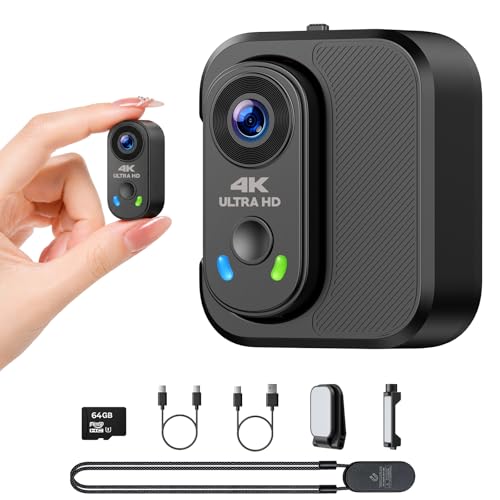
- 28 g with clip and magnetic lanyard
- 4K, 150° lens, and electronic stabilization
- 64GB card and charging case included
Best For: Dry-weather riders seeking lightweight POV footage
Long-Recording Pick
kaysunlink A18 Mini Body Camera

- 1080p video with audio
- Rated for 4–6 hours of recording
- 64GB card; loop and motion modes
Best For: Dry-weather riders prioritizing recording time
Versatile Mounting Pick

- 4K video with a 120° view
- 36 g body; magnetic mounts and back clip
- 64GB card and waterproof case included
Best For: Riders wanting flexible mounts and a wet-weather case
Lightest Clip-On Pick – 26g 1080p Mini Body Camera
If you want a body camera for cyclists that feels unobtrusive on your clothing, this 26g model offers 1080p recording, a 120° lens and a rotatable clip. Its small screen lets you check recording status and preview your framing.
Best For: Riders who prioritize low weight and simple, cable-based file transfers.
Pros:
- 26g thumb-sized body with a 360° swivel clip and magnetic lanyard.
- Up to 120 minutes of recording; supports recording while charging.
- 120° lens and built-in screen help with framing.
Cons:
- Requires a separately purchased microSD card.
- No Wi-Fi, Bluetooth or app connectivity; listed water-resistance details conflict, so do not assume it is rainproof.
This is the straightforward lightweight option, especially if you can charge during longer rides. Plan on USB-C file transfers and protect it from wet weather.
Stabilized 4K Pick – 35g POV Camera with Mount Kit
For a body camera for cyclists who also want smoother action footage, this 35g model pairs advertised 4K/30fps recording with six-axis electronic stabilization. The 1.5-inch screen helps you frame shots before setting off.
Best For: Riders who want stabilized POV video, phone transfers and multiple mounting options.
Pros:
- Advertised 4K/30fps capture and switchable six-axis stabilization.
- Wi-Fi and Bluetooth support app preview, remote control and file transfer.
- Includes cycling and helmet mounts, a rotating clip and a waterproof case; rated for up to 150 minutes per charge.
Cons:
- Waterproofing depends on using the included case.
- Phone-sharing features require pairing with an app.
The supplied mounts make this a more ride-ready package than a clip-only camera. Check that your preferred mounting position gives you a clear view before relying on it for a full ride.
Included-Storage Pick – Mini POV Camera with 128GB Card
This body camera for cyclists stands out for its listed built-in 128GB memory card, alongside a 1.5-inch preview screen and six-axis electronic stabilization. Its supplied feature bullets advertise 4K/30fps recording, although the separate details list 1080p video resolution.
Best For: Riders who want included storage and several recording modes without sourcing a card separately.
Pros:
- Listed with a built-in 128GB memory card.
- Screen supports preview and playback; six-axis EIS is intended to reduce movement shake.
- Includes cycling and helmet mounts, a rotating clip and a waterproof case.
Cons:
- Supplied specifications disagree on video resolution: the bullets say 4K/30fps, while the details say 1080p.
- The 150-minute battery claim in the bullets conflicts with a five-hour figure in the details.
Included storage is convenient, but confirm the actual resolution and runtime before buying if either is essential to your rides.
Front-Screen Pick – 32g 4K Magnetic POV Camera
If framing matters when choosing a body camera for cyclists, this 32g model puts a 1.5-inch screen on the same side as its lens. It also lists 4K recording, six-axis electronic stabilization and wireless phone connectivity.
Best For: Riders who want to check their framing on-camera and transfer clips to a phone.
Pros:
- Front-facing screen helps you see the shot while positioning the camera.
- 32g magnetic design; kit includes cycling and helmet mounts plus a rotating clip.
- Up to 150 minutes per charge, with Wi-Fi/Bluetooth pairing and a waterproof case.
Cons:
- MicroSD card is not included; supports cards up to 256GB.
- Sound is not captured when the camera is sealed in its waterproof case.
This is a practical choice for riders who regularly change camera positions and want immediate framing feedback. For rainy rides, use the housing but expect silent footage while it is sealed.
Best for Framing – CAMWORLD 4K Mini Body Camera
If you want a body camera for cyclists that makes it easy to check your shot before riding, this CAMWORLD model pairs a 1.47-inch preview screen with a 150° wide-angle lens. Its 44g body and magnetic mount support hands-free POV recording.
Best For: Riders who want on-camera framing and flexible video formats.
Pros:
- Records 4K video and includes a 64GB memory card.
- Screen supports live framing and video playback.
- Offers Wi-Fi app control and 16:9 or 9:16 recording.
Cons:
- Supplied notes do not specify battery runtime or water resistance.
The screen is the practical draw if you frequently adjust camera placement. Check the mounting setup and weather protection you need before relying on it for every ride.
Best for Social Clips – 4K Mini Body Camera with Wi-Fi
For cyclists who share ride clips, this body camera for cyclists records 4K/30fps footage with a 150° field of view and switches between landscape and vertical video. A 1.47-inch screen lets you review footage without opening the phone app.
Best For: Riders making short POV videos in both landscape and vertical formats.
Pros:
- Includes a 64GB card and supports Wi-Fi app preview and downloads.
- Weighs 44g and includes magnetic and clip-style mounting accessories.
- Supports loop recording and recording while charging.
Cons:
- Does not have electronic or mechanical image stabilization.
- Listed as not water-resistant.
The format options and phone transfers suit quick content creation, but bumpy roads may show in the footage. Plan for separate rain protection when cycling in wet weather.
Best for Wet-Weather Flexibility – Sixmou i3 Thumb Action Camera
The Sixmou i3 is a compact body camera for cyclists who want multiple mounting options and a supplied waterproof case. At 35.7g, it can attach with a magnetic lanyard or rotating clip, while other included accessories allow mounting on cycling gear.
Best For: Riders who prioritize light weight, mounting flexibility, and an included waterproof housing.
Pros:
- Records 4K POV video and includes a 64GB card.
- Offers magnetic, clip, bike, and helmet mounting options.
- Supplied case is rated waterproof to 131 feet; recording while charging is supported.
Cons:
- The camera itself is not waterproof without its housing.
- Quoted battery life falls from 150 minutes at 1080p to 90 minutes at 4K.
This is the more adaptable pick for changing mounts or riding in wet conditions with the housing fitted. Choose your recording resolution with the stated battery limits in mind.
Lightweight POV Pick – CAMWORLD 4K Mini Body Camera
If you want a body camera for cyclists that feels unobtrusive on a ride, this 28 g CAMWORLD model combines a 150° lens, 4K recording, and electronic image stabilization. Its clip and magnetic lanyard give you wearable mounting options without a separate mount purchase.
Best For: Dry-weather riders who want lightweight, wide-angle POV footage and quick phone transfers.
Pros:
- 150° field of view and electronic image stabilization.
- Wi-Fi app preview and transfer, plus USB-C OTG transfer to iPhone 15 or later.
- Pre-installed 64GB card; charging case supports up to three hours of continuous 4K recording.
Cons:
- Not waterproof, limiting its usefulness in rain.
- Additional mounts are not included.
The low weight and included wearable attachments make it appealing for everyday cycling footage. If wet-weather recording matters, its lack of water resistance is the deciding limitation.
Long-Recording Pick – kaysunlink A18 Mini Body Camera
For cyclists prioritizing recording time over 4K resolution, the kaysunlink A18 is a compact body camera for cyclists with 1080p video and audio recording. Its included 64GB card is described as holding approximately 10 hours of video, while the 1000 mAh battery is rated for 4–6 hours of recording.
Best For: Riders who want extended 1080p recording and straightforward USB or card-based playback.
Pros:
- Rated for 4–6 hours of recording and can record while charging.
- Included 64GB card offers approximately 10 hours of video storage.
- Loop and motion-detection recording modes.
Cons:
- 1080p resolution and 90° viewing angle offer less coverage than the wider-angle 4K options here.
- Not water resistant.
The A18 makes sense when longer recording sessions matter most. Plan for dry rides, and check that its narrower field of view suits where you intend to wear it.
Versatile Mounting Pick – 4K Mini WiFi Body Camera
This 36 g body camera for cyclists pairs 4K recording with a 120° field of view and a kit that includes magnetic mounts, a back clip, and a waterproof case. Wi-Fi connectivity and record-while-charging support add flexibility for riders who also use their camera off the bike.
Best For: Cyclists who want several mounting options and an included case for wet conditions.
Pros:
- 4K recording with a 120° wide-angle view.
- Includes a 64GB card and supports external memory up to 256GB.
- Accessory kit includes magnetic mounts, a back clip, and a waterproof case rated to 30 m.
Cons:
- Waterproof protection depends on using the included case.
- No specific recording-runtime figure is provided despite the listed 800 mAh battery.
The accessory bundle is the main reason to choose this model: it offers ways to set up wearable footage without piecing together a kit. For rainy rides, use the case rather than assuming the camera itself is waterproof.
How We Picked the Best Body Camera for Cyclists
We focused on compact, wearable cameras that could plausibly record from a cyclist’s clothing, bag strap, or other suitable mount. The selection spans basic 1080p models and 4K cameras with features such as electronic image stabilization (EIS), screens, Wi-Fi, and included memory cards. Listed specifications are a starting point, not proof of real-world performance: battery endurance, image quality, and mounting stability are worth checking against current product details and owner feedback.
Quick Comparison: Which Type Fits Your Ride?
For routine commuting, prioritize a camera that starts recording quickly, stays attached, and offers enough storage for your trip. For rough pavement or recreational footage, consider one of the listed 4K models with EIS. A screen can make framing and setting checks easier, while Wi-Fi may simplify transferring clips to a phone. If you want the smallest setup, a thumb-size camera may be appealing, but check its controls and runtime before choosing it over a larger model.
Key Buying Factors for a Body Camera for Cyclists
Mounting and Field of View
A clip or magnetic mount is convenient only if it remains secure over bumps. Check where the camera can attach and whether clothing movement could tilt the lens or block the road ahead. Use any magnetic mount only as directed by its manufacturer, and test your view before traffic-heavy rides.
Footage Quality and Stabilization
Resolution alone does not guarantee readable details. Motion blur, glare, low light, and vibration can all affect footage. EIS can smooth movement, but it may crop the image. If incident documentation is your priority, aim for a wide, unobstructed view and review a test recording in your usual riding conditions.
Battery, Storage, and Weather
Compare stated recording time with the length of your rides, especially if you plan to use 4K recording or Wi-Fi. A bundled 64GB card is convenient, but confirm supported card capacity and whether older files can be overwritten. Also check the camera’s stated water resistance; do not assume a wearable camera is rainproof.
Audio, Controls, and File Access
Simple, glove-friendly recording controls can matter more than extra modes on a commute. Audio may add context, subject to local recording laws. Screens and wireless transfer are useful for checking settings and saving clips, but confirm how easily you can protect an important recording from accidental deletion.
Who Should Buy Which Body Camera for Cyclists?
Daily commuters should start with secure mounting, dependable controls, and sufficient battery life rather than chasing the highest resolution. Riders who want smoother clips should look at the EIS-equipped 4K options; casual vloggers may value a screen and Wi-Fi. If size is the deciding factor, compare the thumb-style models, including the i3, against your preferred mounting location. Before buying any Body Camera for Cyclists, verify the latest specifications and test the setup on a low-stakes ride.