
A camera slider can add smooth, repeatable motion to interviews, product videos, time-lapses, and cinematic B-roll. Models with vertical movement go further by supporting angled or upright camera moves when paired with a stable support setup.
This roundup compares 10 options ranging from compact phone and macro sliders to longer motorized rails designed for heavier cameras, gimbals, and automated shots.
Best 10 Camera Sliders with Vertical Movement Picks for 2026
Best Long-Track App-Controlled Slider
NEEWER ER1 47.2" Motorized Slider

- 47.2-inch carbon-fiber rail
- App and time-lapse control
- Supports up to 45° tilt movement
Best For: Long-track video, time-lapse, and angled camera moves
Best Pro Gimbal Integration
IFOOTAGE Shark Slider Nano II-860

- 5-axis DJI gimbal integration
- 5.5-pound vertical load rating
- Near-silent AI-powered motor
Best For: Professional gimbal-based filmmaking and complex camera moves
Best Versatile 48-Inch Slider
GVM Motorized Camera Slider 120

- 48-inch carbon-fiber rail
- Supports vertical and 45° shooting
- Includes cables and carrying bag
Best For: Versatile automated shooting across studio and outdoor setups
Best Compact Phone and Pocket Camera Slider

- Compact 15.8-inch motorized design
- Works with phones and DJI Pocket cameras
- Seven-hour battery and 4-axis control
Best For: Portable smartphone, pocket-camera, and action-camera filmmaking
Best Adjustable Manual Slider
Zecti 24-Inch Carbon Fiber Camera Slider

- Supports vertical, diagonal, and horizontal use
- Lightweight 654g travel-friendly design
- Multiple mounting threads and adjustable legs
Best For: Portable manual camera movement with small cameras and phones
Best Motorized Long-Track Slider
GVM 48-Inch Automatic Camera Slider
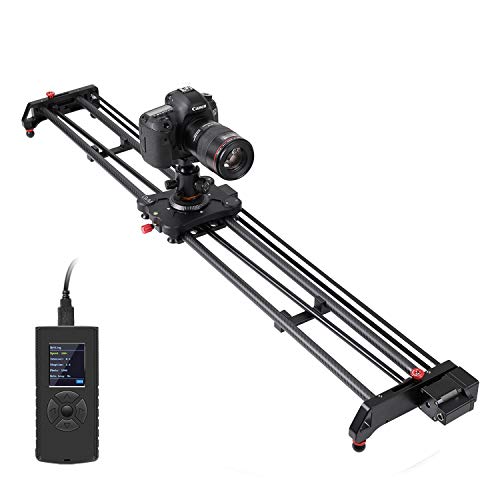
- Programmable motorized travel and auto loop
- 48-inch rail for extended camera moves
- Supports tracking, time-lapse, and panoramic shooting
Best For: Automated long-distance moves and repeatable time-lapse shots
Best Compact Vertical Slider
NEEWER CS1M 16-Inch Camera Slider

- Supports vertical, horizontal, and 45-degree shooting
- Includes ball head, phone clamp, and action mount
- Lightweight 615g design with adjustable legs
Best For: Compact cameras, smartphones, and action cameras on the move
Flexible Motorized Pick

- Automated video, time-lapse, and round-trip modes
- Supports vertical, horizontal, and 45-degree shooting
- 2.5 kg capacity with tripod and cellphone compatibility
Best For: Multi-angle automated camera movement
Macro Precision Pick

- Four-way manual movement with numeric scales
- Quick-release mounting for many DSLR and mirrorless cameras
- Lightweight 1.3-pound aluminum design supports 2.5 kg
Best For: Macro and close-up camera positioning
Heavy-Duty Motorized Pick
NEEWER ER1-80 Carbon Fiber Slider

- 80 cm motorized rail with app and optional remote control
- Supports 11 pounds horizontally and 5.5 pounds at 45 degrees
- Quiet motor with video and time-lapse modes
Best For: Larger-camera automated video moves
Best Long-Track App-Controlled Slider – NEEWER ER1 47.2" Motorized Slider
If you need camera sliders with vertical movement, the NEEWER ER1 offers a long 47.2-inch rail, app control, and support for horizontal, tilted, and panoramic shots. Its carbon-fiber construction and included NP-F750 battery make it practical for mobile video and time-lapse work.
Best For: Creators who want a long motorized slider with app-controlled video and time-lapse modes.
Pros:
- Supports horizontal loads up to 11 pounds and tilt shooting up to 45 degrees with a 5.5-pound load.
- Offers app control, manual control, video, and time-lapse modes.
- Includes a 4400mAh NP-F750 battery and uses a quiet stepper motor.
- Carbon-fiber rail has 1/4-inch and 3/8-inch mounting threads.
Cons:
- The 2.4G remote and charger are not included.
- Minor shake may occur during macro photography.
- It is not water resistant.
The ER1 is a versatile choice when long travel and multiple mounting angles matter. Its vertical and 45-degree capabilities are useful, though heavier tilted setups require staying within the lower load limit.
Best Pro Gimbal Integration – IFOOTAGE Shark Slider Nano II-860
For filmmakers seeking camera sliders with vertical movement and coordinated camera motion, the IFOOTAGE Shark Slider Nano II-860 combines a 24.9-inch travel distance with 5-axis gimbal integration. It is built for heavier mirrorless and DSLR setups while remaining suited to on-location production.
Best For: Filmmakers using compatible DJI gimbals who need synchronized, professional camera movement.
Pros:
- Supports up to 11 pounds horizontally and 5.5 pounds vertically.
- Works with DJI RS2, RS2 Pro, RS3 Pro, RS4, and RS4 Pro gimbals.
- Provides app-based keyframes, customizable motion paths, and AI-powered tracking.
- Uses a near-silent brushless motor and supports PD60W or NPF Battery 60W+ power.
Cons:
- Its 7.65-pound weight is substantial for a portable slider.
- The 24.9-inch travel distance is shorter than the longer 47-inch-class models here.
- Full 5-axis functionality depends on compatible DJI gimbal equipment.
The Nano II-860 is the strongest fit for advanced motion-control setups. Its vertical load rating and gimbal compatibility make it suitable for complex moves, but the system is best justified by filmmakers already using compatible gear.
Best Versatile 48-Inch Slider – GVM Motorized Camera Slider 120
The GVM-Slider-120 is a flexible option for camera sliders with vertical movement, offering a 48-inch carbon-fiber rail, app control, and mounting positions for horizontal, vertical, and 45-degree shooting. Its broad mode selection also covers tracking, panoramas, time-lapse, and video capture.
Best For: Shooters who want a long rail with adjustable legs, multiple mounting points, and many automated shooting modes.
Pros:
- Supports vertical, horizontal, and 45-degree shooting through multiple 1/4-inch and 3/8-inch ports.
- Provides tracking, panoramic, time-lapse, video, and programmable start-and-end-point modes.
- App control works through iOS and Android devices.
- Includes six shutter-release cables, an extension cable, and a carrying bag.
Cons:
- Battery life is listed at approximately two hours.
- The slider weighs about 4 kilograms.
- It is not water resistant.
The GVM stands out for flexible setup options and included accessories. It is a practical pick when you want vertical capability without giving up a long travel range, particularly for controlled studio or outdoor shoots.
Best Compact Phone and Pocket Camera Slider – iFootage Shark Slider PICO
The iFootage Shark Slider PICO is a compact choice for camera sliders with vertical movement when portability matters more than long travel. It supports DJI Pocket cameras, action cameras, and smartphones, while its app and 4-axis integration enable tracking, panorama, and repeatable time-lapse moves.
Best For: Mobile creators using phones, DJI Pocket cameras, or action cameras in lightweight setups.
Pros:
- Supports DJI Pocket 3/4, Action 5/6, and smartphones.
- Offers 4-axis motion control with compatible DJI Pocket cameras.
- Provides five shooting modes and up to eight programmable app points.
- Weighs 1.9 pounds and offers up to seven hours of battery operation.
Cons:
- Its 15.8-inch size provides less travel than the full-length sliders.
- The listed payload is 2.4 pounds, limiting heavier camera setups.
- Advanced integration depends on compatible USB-C, Bluetooth, or NFC devices.
The PICO is the most travel-friendly option in this group. It is well suited to phones and small cameras, but larger DSLR or mirrorless rigs should be paired with a higher-capacity slider.
Best Adjustable Manual Slider – Zecti 24-Inch Carbon Fiber Camera Slider
If you want camera sliders with vertical movement without adding a motor or battery, the Zecti 24-inch slider is a practical manual option. Its adjustable legs, rubber feet, bubble level, and multiple mounting threads support horizontal, diagonal, sideways, and vertical setups.
Best For: Travelers and creators seeking a lightweight manual slider for cameras, phones, and action cameras.
Pros:
- Supports vertical, horizontal, diagonal, and sideways operation.
- Lightweight 654g design includes a scratch-resistant carrying bag.
- Four precision bearings and dual carbon fiber rails are designed for quiet, stable movement.
- Multiple 1/4-inch and 3/8-inch screw holes support flexible mounting.
Cons:
- Manual operation requires the user to control the slide speed.
- Overtightened screws may cause noise or rough movement; slight adjustment may be needed.
- Maximum recommended load is 4.4 pounds.
The Zecti is a versatile entry-level choice for vertical camera slider movements, especially when portability matters. Check the fasteners and adjust tension before shooting for smoother results.
Best Motorized Long-Track Slider – GVM 48-Inch Automatic Camera Slider
For automated camera sliders with vertical movement and repeatable motion, the GVM 48-inch motorized slider offers programmable travel and a long carbon fiber rail. It supports manual or electric operation, time-lapse, tracking, and panoramic shooting.
Best For: Filmmakers and time-lapse creators who need long, programmable camera moves and automatic round trips.
Pros:
- Programmable start and end points, speed, intervals, stop time, photo count, and auto loop.
- 48-inch/120cm rail provides a longer travel range than compact sliders.
- Supports manual and motorized modes, tracking, time-lapse, and panoramic shooting.
- Includes a battery, charger, controller, shutter cables, extension cable, and carrying bag.
Cons:
- At 11.8 pounds, it is substantially less portable than compact manual sliders.
- The motorized system requires battery and controller setup.
- Maximum recommended load is listed as 5kg, so camera and accessory weight should be checked.
The GVM is the strongest fit here for automated, repeatable movement over a long distance. Its larger size makes it better suited to planned shoots than lightweight travel setups.
Best Compact Vertical Slider – NEEWER CS1M 16-Inch Camera Slider
The NEEWER CS1M is a compact option among camera sliders with vertical movement, combining adjustable legs, a bubble level, and a 360-degree ball head. Its 16-inch carbon fiber rail is designed for smooth, quiet movement with cameras, phones, and action cameras.
Best For: Mobile creators who need a lightweight slider for vertical, horizontal, or 45-degree shooting with compact equipment.
Pros:
- Supports horizontal loads up to 4.4 pounds and vertical loads up to 2.2 pounds.
- Adjustable legs elevate from 2 to 5cm and help balance the slider on uneven ground.
- Four precision bearings provide smooth, noiseless sliding.
- Includes a 360-degree ball head, phone clamp, and action camera mount.
Cons:
- Vertical and 45-degree load capacity is limited to 2.2 pounds.
- The 16-inch rail offers less travel than a 24- or 48-inch slider.
- It is not water resistant.
Choose the NEEWER when portability and accessory compatibility matter more than maximum travel length. Its lower vertical load rating makes it best for phones, action cameras, and lightweight camera bodies.
Flexible Motorized Pick – GVM 27-Inch Motorized Slider
The GVM 27-inch motorized slider is a practical choice for camera sliders with vertical movement, especially when you want automated motion for video, time-lapse, or repeatable round-trip shots. Its adjustable feet, tripod mounting points, and support for horizontal, vertical, and 45-degree shooting make it adaptable to different setups.
Best For: DSLR, video, or cellphone users who need automated slider movement and flexible mounting options.
Pros:
- Supports video, time-lapse, and automatic round-trip shooting.
- Allows horizontal, vertical, and 45-degree shooting, with DSLR support on slopes up to 70 degrees when mounted on a tripod.
- Includes adjustable non-slip feet, multiple 1/4- and 3/8-inch mounting holes, and a carrying bag.
- Supports cameras and cellphones up to 2.5 kg.
Cons:
- At 26.8 inches long and 2.36 kg, it is less compact than a short manual rail.
- It is not water resistant.
The GVM stands out when automated, multi-angle movement matters more than minimal weight. Its 27-inch travel and broad mounting flexibility suit controlled interview, photography, and time-lapse setups.
Macro Precision Pick – NEEWER 4-Way Focusing Rail
The NEEWER 4-Way Macro Focusing Rail is a compact option among camera sliders with vertical movement, designed for precise close-up positioning rather than long tracking shots. Its four-way adjustment and numeric scales help refine camera placement for macro photography, close-ups, and time-lapse work.
Best For: Macro photographers and close-up shooters who need controlled forward, backward, left, and right adjustments.
Pros:
- Provides four-way movement for precise camera positioning.
- Large adjustment knobs and numeric scales support repeatable setup changes.
- Quick-release plate and 1/4-inch screw fit most Canon, Nikon, Sony, and Fujifilm DSLR or mirrorless cameras.
- Lightweight aluminum construction weighs 1.3 pounds and supports up to 2.5 kg.
Cons:
- Designed for macro and close-up positioning rather than motorized video travel.
- Adjustment knobs must be managed carefully: the horizontal knob should be fastened when adjusting vertically, and vice versa.
- It does not include motorized movement.
This rail is best viewed as a precision focusing accessory. It offers useful vertical-axis adjustment and tripod compatibility, but it is not the right choice for long, automated camera moves.
Heavy-Duty Motorized Pick – NEEWER ER1-80 Carbon Fiber Slider
The NEEWER ER1-80 is a strong option for camera sliders with vertical movement when you need longer travel, quiet automation, and a higher horizontal load capacity. Its app control, optional remote compatibility, time-lapse features, and support for horizontal or 45-degree tilted shooting suit repeatable video production.
Best For: Videographers who want quiet, app-controlled motion with support for larger camera setups.
Pros:
- Offers manual, constant-speed video, slow-start/stop, and time-lapse modes.
- Supports up to 11 pounds horizontally and 5.5 pounds at a 45-degree tilt.
- Provides app control and optional 2.4G RT-08 remote control, with a quiet stepper motor.
- Carbon fiber construction, four roller bearings, and 1/4- and 3/8-inch mounting holes support stable tripod setups.
Cons:
- The included battery charger is not included, and a portable charger is also not included.
- The slider weighs 8.7 pounds, making it less convenient for lightweight travel.
- It is not water resistant.
The ER1-80 is the most capable choice here for larger cameras and repeatable automated moves. Its 80 cm length and high horizontal capacity are useful for production work, while the 45-degree limit and accessory requirements should be considered before buying.
How We Picked These Camera Sliders with Vertical Movement
We focused on rail length, drive systems, payload claims, control options, portability, and the accessories included with each slider. The selection covers motorized and manual designs, compact macro rails, phone-friendly models, and longer carbon-fiber or aluminum systems for DSLR and mirrorless cameras.
Because “vertical movement” depends on both the slider mechanism and the support beneath it, we also considered mounting flexibility. A slider should use secure threaded points, stay stable when angled, and provide enough traction or motor power for the intended camera and lens combination.
Quick Comparison
| Best For | Recommended Type | What to Prioritize |
|---|---|---|
| Phone and compact cameras | Short motorized slider | Low weight, simple controls, included clamp |
| Macro photography | Four-way focusing rail | Fine manual adjustment and rigid locking |
| Travel and tabletop filming | 16- to 24-inch manual slider | Portability, smooth bearings, tripod threads |
| Time-lapse and repeatable shots | Motorized slider with app control | Interval settings, battery life, programmable movement |
| Large cameras or gimbals | Long, high-capacity motion slider | Payload rating, rigidity, motor torque, support points |
Key Buying Factors for Camera Sliders with Vertical Movement
Payload and Balance
Check the combined weight of the camera, lens, cage, monitor, gimbal, and any accessories. Vertical or steeply angled movement places more demand on the motor and support system than a level slide. Keep the setup centered and stay comfortably below the stated maximum load.
Rail Length and Portability
Longer rails create wider moves but are harder to pack and support. A 16- or 24-inch slider suits tabletop work and travel, while 31.5- to 48-inch models are better for establishing moves, interviews, and product footage with greater visual separation.
Motor, Controls, and Power
For automated shots, look for app control, adjustable speed, time-lapse intervals, repeatable endpoints, and useful battery capacity. Confirm whether the battery is removable, how it charges, and whether the slider can operate while powered externally.
Mounting and Stability
Vertical operation usually requires a sturdy tripod, multiple support points, or a dedicated rig. Inspect the threaded mounting options and use safety lines or secondary support for elevated equipment. A smooth rail cannot compensate for a flexing or poorly secured base.
Movement Quality
Bearings, belt or lead-screw design, rail rigidity, and carriage play all affect the final shot. For macro work, prioritize precision and backlash control; for cinematic moves, prioritize quiet operation and consistent speed.
Who Should Buy Which Camera Sliders with Vertical Movement?
Choose a compact motorized slider if you film phones, action cameras, tabletop products, or short social clips. Choose a manual carbon-fiber slider if you want a lighter, simpler setup and can control movement by hand. Choose a longer motorized model for automated time-lapse, repeatable product shots, and wider cinematic moves.
Choose a high-capacity motion-control slider when using a heavier mirrorless or cinema camera, gimbal, or multi-axis setup. For close-up and macro photography, a dedicated four-way focusing rail is usually more practical than a long camera slider. Before buying, match the slider’s load rating and mounting design to the exact camera package and the angle at which you plan to operate it.