
Choosing the right action camera for drag racing comes down to speed, vibration control, and clarity at the strip. A good camera should keep the pass smooth, readable, and easy to review later.
Below, we focus on the features that matter most for fast launches, in-car footage, and trackside coverage so you can pick a camera that fits how you race.
Best 10 Action Camera for Drag Racing Picks for 2026
Pro-Grade Low-Light Pick
DJI Osmo Action 5 Pro Essential Combo

- 1/1.3" sensor with 4K/120fps video
- 360° HorizonSteady stabilization
- Dual OLED touchscreens and 4-hour battery
Best For: Track-day racers and videographers who want premium stabilization and low-light performance.
Budget Action Cam Value

- 4K30fps video with 20MP photos
- Built-in EIS for smoother footage
- Includes wrist remote and waterproof case
Best For: Affordable racers who want a basic, easy-to-use action camera.
Ultra-Compact Wearable Option

- 44g wearable body with magnetic mount
- 4K video plus 150° wide-angle lens
- 1.47-inch screen and 64GB included
Best For: Hands-free POV racing footage in a tiny, easy-to-mount package.
Premium Stabilized Flagship
Insta360 Ace Pro 2 Dual Battery Bundle
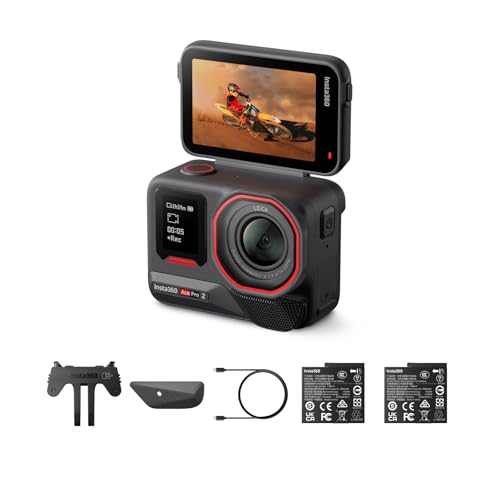
- 8K sensor with Leica Summarit lens
- Dual AI Chips and FlowState stabilization
- Wind Guard and flip touchscreen
Best For: Creators who want premium race footage with strong stabilization and better audio.
Thumb-Sized POV Cam

- Thumb-size body weighs just 1.25 oz
- Magnetic mount, clip, and accessories included
- Records 4K and comes with 64GB card
Best For: Compact hands-free drag racing POV mounting
360 Story Cam
GoPro MAX 5.6K Waterproof Action Camera

- 5.6K30 360 video with reframing support
- Object tracking and stealth mounting options
- Also works in standard single-lens modes
Best For: Creators who want flexible 360 drag racing coverage
Low-Light Race Cam
DJI Osmo Action 4 Standard Combo

- 1/1.3-inch sensor for better low-light capture
- 4K/120fps with 155° ultra-wide view
- Three stabilization modes keep footage smooth
Best For: Smooth drag racing footage in mixed lighting
Editor’s Pick

- 4K50FPS video with 360° horizon lock
- Super 5.0 stabilization for fast motion
- Magnetic quick release for quick mounting
Best For: Drag racers who want stabilized 4K track footage
Compact POV Pick
4K Mini Body Camera with Audio

- 35 g ultra-compact wearable design
- 6-axis EIS 3.0 for smoother motion
- WiFi + Bluetooth with 1.5" preview screen
Best For: Racers who want a tiny wearable POV camera
Pro-Grade Low-Light Pick – DJI Osmo Action 5 Pro Essential Combo
If you want an action camera for drag racing that can handle fast motion and changing track lighting, the DJI Osmo Action 5 Pro is built around speed-friendly imaging. Its 1/1.3″ sensor, 4K/120fps capture, and strong stabilization help keep footage sharp and steady while the dual OLED screens make framing easy from either side of the camera.
Best For: Drivers and crews who need stabilized, low-light-ready footage with easy touchscreen control.
Pros:
- 1/1.3″ sensor with 13.5-stop dynamic range for better low-light clarity
- 4K/120fps recording and advanced subject tracking for fast action
- 360° HorizonSteady helps keep the horizon level during rough movement
- Dual OLED touchscreens make setup and review simple on the fly
Cons:
- Essential Combo is the stripped-down kit, without the curved adhesive base
- Best results depend on careful mounting for high-speed runs
Overall, this is the most capable all-around pick here if your priority is clean, stabilized race footage with strong performance when the light drops.
Budget Action Cam Value – AKASO EK7000 4K30FPS
For a budget action camera for drag racing, the AKASO EK7000 gives you 4K30fps recording, EIS stabilization, and a simple remote-control setup. It is not the most advanced option in the group, but it covers the basics well if you want an affordable way to capture runs and quick pit-side clips.
Best For: Budget-minded buyers who need a simple 4K action camera for occasional racing footage.
Pros:
- Records 4K30fps video and 20MP stills
- Built-in EIS helps smooth out fast-moving footage
- Includes a wrist remote for easier operation
- Waterproof case and accessories expand placement options
Cons:
- 4K tops out at 30fps, so motion capture is less fluid than higher-end models
- Remote is not waterproof
- Battery life is listed at about 90 minutes
This is the practical entry-level choice if price matters most, but serious drag racing footage will benefit from the more advanced stabilization and frame rates of higher-tier cameras.
Ultra-Compact Wearable Option – 4K Mini Body Camera with 64GB
If you need a compact action camera for drag racing that can mount almost anywhere, this mini body camera focuses on portability and flexible placement. Its 4K recording, 150° wide-angle lens, real-time 1.47-inch screen, and magnetic mount make it useful when you want a lightweight POV angle from the car, bike, or pit area.
Best For: Buyers who want a tiny, wearable camera for hands-free POV racing shots.
Pros:
- Ultra-compact 44g body is easy to wear or hide
- Includes a 64GB card for out-of-box recording
- 1.47-inch screen helps with framing and playback
- 150° wide-angle lens and magnetic mount support flexible POV angles
Cons:
- Smaller form factor is better for convenience than pro-level imaging
- Built for compact use, not the most feature-rich option here
Choose this if your priority is simple, lightweight mounting and easy on-camera operation rather than maximum image quality or stabilization.
Premium Stabilized Flagship – Insta360 Ace Pro 2 Dual Battery Bundle
For a premium action camera for drag racing, the Insta360 Ace Pro 2 is built to deliver sharp detail, strong stabilization, and useful audio features. Its 8K sensor, Leica lens, Dual AI Chip setup, and FlowState stabilization are designed for high-motion shooting, while the flip touchscreen and magnetic mounting make it easier to work around a track.
Best For: Enthusiasts and creators who want top-tier image quality, stabilization, and audio.
Pros:
- 8K sensor with Leica Summarit lens for high-end image quality
- Dual AI Chip system adds processing power and noise reduction
- FlowState stabilization helps keep fast runs steady
- Wind Guard and improved audio algorithms support cleaner sound
Cons:
- Premium feature set will cost more than basic action cams
- Flip touchscreen and accessory setup add a bit more complexity
If you want the most advanced option in this roundup, this is the camera that best blends image quality, stabilization, and creator-friendly tools for race-day footage.
Thumb-Sized POV Cam – i3 4K Thumb Action Camera
If you want an action camera for drag racing that disappears on the car or your gear, the i3 4K Thumb Action Camera is built for ultra-compact POV recording. Its thumb-size body, magnetic mounting options, and spring clip make it easy to position in tight spots where a larger camera would be harder to fit.
Best For: Hands-free drag racing POV shots where tiny size and flexible mounting matter most.
Pros:
- Very small and lightweight at 1.25 oz, so it is easy to mount almost anywhere.
- Magnetic design, lanyard pad, spring clip, and included accessories expand mounting options.
- Records up to 4K video and includes a 64GB card in the bundle.
- Supports recording while charging for longer sessions.
Cons:
- The camera itself is not waterproof without the included housing.
- Battery life drops to about 90 minutes in 4K mode.
- Digital stabilization is listed, but it is not a dedicated high-end stabilization system.
For drag racing builds where size and mounting flexibility are the priority, this model offers an easy way to capture cockpit- or body-mounted footage without adding much bulk. It is less about premium creator features and more about getting a tiny camera into places larger action cams cannot go.
360 Story Cam – GoPro MAX 5.6K Waterproof Action Camera
The GoPro MAX is a strong action camera for drag racing if you want to capture the run and the surroundings in one shot. Its 360 capture, plus easy reframing in the Quik app, makes it useful when you want flexible footage from a fixed mount or a pole-style setup.
Best For: 360-degree drag racing footage with flexible editing and re-framing later.
Pros:
- Captures 5.6K30 spherical video for full-scene coverage.
- GoPro Quik app lets you reframe clips and use object tracking.
- Stealth mounting can hide the pole for cleaner-looking shots.
- Waterproof design and traditional single-lens modes add versatility.
Cons:
- It is relatively heavy at 13.12 ounces compared with smaller action cams.
- 360 footage usually requires more editing after recording.
- Best results depend on using the app workflow and mounting setup.
If your drag racing content benefits from both immersive footage and the ability to choose the angle later, MAX stands out for flexibility. It is a better fit for creators who value coverage and post-production control over simple point-and-shoot use.
Low-Light Race Cam – DJI Osmo Action 4 Standard Combo
The DJI Osmo Action 4 is a practical action camera for drag racing when you need clean footage, strong stabilization, and reliable performance in changing light. Its 1/1.3-inch sensor, 4K/120fps capture, and wide 155° field of view make it a strong choice for fast passes and in-car viewpoints.
Best For: Smooth, high-quality drag racing footage in daylight or low-light conditions.
Pros:
- 1/1.3-inch sensor is designed for better low-light image quality.
- 4K/120fps and 155° FOV help capture fast action with an immersive look.
- Three stabilization modes help keep footage smooth and level.
- Magnetic quick-release system makes angle changes fast and simple.
Cons:
- Heavier than ultra-compact thumb cameras at 145 g.
- Standard Combo does not include the extra accessories of the Adventure Combo.
- Waterproofing is listed to 18m, but it is still a conventional action-cam setup.
For drag racing, this model is the most balanced pick here if you care about image quality and stabilization as much as mounting. It gives you a more polished result than a tiny clip-on camera while staying straightforward to use trackside or in the cockpit.
Editor’s Pick – XTU S7 PRO 4K Action Camera
If you want an action camera for drag racing that focuses on smooth, level footage, the XTU S7 PRO is built around stabilization, fast frame rates, and a detailed sensor. Its 4K50FPS recording and 360° horizon lock can help keep hard-launch runs and trackside POV clips looking more polished, while the magnetic quick release makes it easier to swap mounts quickly.
Best For: Drag racers and track-day shooters who want stabilized 4K footage with fast mounting changes.
Pros:
- Super 5.0 stabilization is designed to reduce shake during fast-paced action.
- 4K50FPS recording with 360° horizon lock helps keep footage level and smooth.
- 1/2″ 48MP sensor with AI ISP is aimed at clearer detail and richer color.
- Magnetic quick release is useful when you need to change camera positions fast.
Cons:
- Not water resistant, so it is less suited to wet track conditions.
- Battery and runtime specifics are not emphasized in the supplied notes.
For drag racing, this model stands out most for stability and speed-oriented capture rather than rugged weatherproofing. If your priority is clean cockpit or exterior footage with minimal hassle between runs, it is a strong fit.
Premium Sensor Choice – Xtra Edge 4K Cinematic Action Camera
For an action camera for drag racing, the Xtra Edge leans into image quality and steady footage rather than ultra-compact size. Its big 1/1.3″ sensor and 4K cinematic video are a strong match for recording straight-line runs, pit moments, and event coverage where detail matters. Hyper Stabilization also helps reduce shake when the camera is mounted on a vehicle or carried around the track.
Best For: Racers and event shooters who want a larger sensor and steady 4K footage.
Pros:
- Big 1/1.3″ sensor is designed for richer detail and color.
- Hyper Stabilization helps smooth out rough, high-motion footage.
- 4K cinematic video gives a clean look for track highlights and recaps.
- Waterproof to 52 ft adds flexibility for wet or outdoor conditions.
Cons:
- Heavier than the other options listed here at 222 g.
- Battery average life is stated as 160 minutes, which may be limiting for long event days.
If you care most about sensor size and polished video quality, this is the most image-focused choice in the group. It is especially appealing for users who want a versatile camera that can handle racing footage and general adventure shooting.
Compact POV Pick – 4K Mini Body Camera with Audio
If you need an action camera for drag racing in the smallest possible form, this mini body camera is built for lightweight POV use. It records 4K/30FPS video with audio, and the 6-axis EIS 3.0 stabilization is meant to cut down shake during fast movement. The tiny body and included mounts also make it easy to place on a helmet, chest rig, bike frame, or other gear.
Best For: Minimalist racers who want a tiny wearable POV camera with built-in screen and wireless sharing.
Pros:
- Ultra-compact 35 g design is easy to wear or mount.
- 6-axis EIS 3.0 helps smooth out motion during high-speed footage.
- 1.5″ screen allows real-time preview and playback.
- WiFi + Bluetooth support faster pairing, preview, and transfers.
Cons:
- Records at 4K/30FPS rather than a higher frame rate.
- Battery life is listed at 150 minutes, so long sessions may need planning.
- Less suited to users who want a larger camera body or bigger display.
This is the most portable option in the roundup and makes sense when size and flexibility matter most. For quick POV setup and easy sharing after a run, it brings a lot of convenience in a very small package.
How We Picked the Best Action Camera for Drag Racing
For an Action Camera for Drag Racing, we prioritized image stabilization, high frame rates, reliable mounting options, strong low-light performance, and battery life. We also considered how easy each camera is to set up on a roll cage, windshield, helmet, or exterior mount without adding unnecessary complexity.
Quick Comparison
In general, the best choices for drag racing fall into three groups: premium cameras with the strongest video quality and stabilization, budget models that cover the basics, and compact body-style cameras that are easy to mount in tight spaces. If you want the cleanest footage of launches and shifts, look for 4K recording at 60fps or higher and stabilization that stays effective under hard acceleration.
Key Buying Factors for an Action Camera for Drag Racing
Stabilization and Vibration Handling
Drag racing produces sharp vibration and sudden movement, so electronic stabilization or advanced horizon correction can make a major difference. A camera that softens shake will make gauges, shifts, and track details much easier to see.
Frame Rate and Resolution
4K is the sweet spot for most buyers, but frame rate matters just as much. Faster recording helps capture launch reaction, wheelspin, and shift points more clearly. If you plan to analyze runs, higher frame rates are especially useful.
Low-Light Performance
Many drag events happen at dusk or under mixed lighting. A larger sensor and good processing help preserve detail in darker staging lanes, especially if you also film night passes or indoor events.
Mounting and Form Factor
Choose a camera that matches your setup. Compact body cams and thumb-style models work well in cramped cockpits, while larger action cameras usually offer better controls, battery life, and overall video quality.
Durability and Storage
Look for rugged construction, secure mounting hardware, and enough storage for repeated runs. For track use, a camera that is easy to start, stop, and reposition between passes saves time and reduces hassle.
Who Should Buy Which Action Camera for Drag Racing?
If you want the best all-around option, choose a premium model with strong stabilization and a fast sensor. If you are on a tighter budget, a simpler 4K camera can still deliver usable footage for casual track days. If you need discreet mounting inside a cabin or on a helmet, a thumb or body-style camera is often the most practical choice.
For most buyers, the right pick is the one that balances clean video, dependable mounting, and simple operation at the strip. That combination matters more than chasing the highest resolution on the box.