
SmallRig VT-20 Mini Tripod review searches usually come from people who want a compact support that does more than just sit on a desk.
This one stands out for its small folded size, adjustable working height, and a ball head that is built for flexible framing.
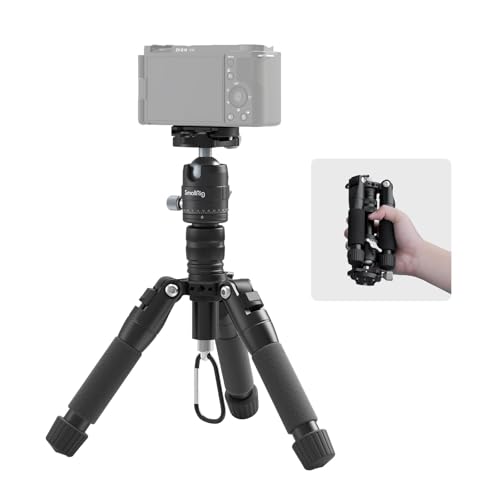
SmallRig VT-20 Review Summary
The SmallRig VT-20 Mini Tripod makes sense for creators who need a tabletop tripod that can travel easily, set up fast, and still handle real camera accessories.
Based on the listing, it is a strong fit for compact DSLRs, mirrorless cameras, smartphones, and action cameras, with enough load capacity and mounting flexibility to serve as a practical everyday support rather than a toy accessory.
Best for buyers who want a compact, adjustable tripod with accessory-friendly expandability. It is especially appealing if you shoot product clips, desk content, talking-head video, or lightweight photo work and want something that can move between a table, countertop, or portable kit without taking much room.
Review Scorecard
| Category | Score | Editorial assessment |
|---|---|---|
| Portability | 9/10 | Folds to about 7 inches and weighs under 1.5 lbs, so it is easy to keep in a bag. |
| Build practicality | 8/10 | Aluminum alloy construction and a center-column design suggest a sturdy, compact layout. |
| Height flexibility | 8/10 | The 5-section legs and 6.7 to 20 inch working range cover most tabletop angles. |
| Framing control | 9/10 | The 360-degree ball head and 90-degree notch are well suited to flexible shooting positions. |
| Accessory support | 8/10 | The 1/4-inch threaded hole and included phone holder widen its use case. |
| Load confidence | 8/10 | The listed 13.2 lb capacity is reassuring for light-to-medium camera setups. |
| Value for niche use | 8/10 | It is clearly designed for creators who care more about versatility than bulk. |
Key Features and Specifications of SmallRig VT-20
The core appeal of the SmallRig VT-20 is that it compresses into a very small package without giving up the features creators actually use.
The listing describes it as a mini tripod for compact DSLRs, mirrorless cameras, smartphones, action cameras, and other devices, which makes it broad enough for hybrid creators rather than a single-device niche.
The most useful measurement is its size profile: it folds down to about 18 cm, or 7 inches, and weighs under 700 g, or about 1.5 lbs.
That matters because this is the kind of tripod you are more likely to carry in a camera bag, drawer, or desk kit if it does not dominate the space.
The working height range runs from about 17 cm to 52 cm, or roughly 6.7 to 20 inches.
That is not full-size tripod territory, and it is not meant to be.
It is built for close-up shooting positions, low-angle framing, and desktop use where compactness matters more than tall extension.
Feature-wise, the legs use a 5-section design with a quick tightening mechanism, and the angle adjustment lever offers three positions: 23 degrees, 50 degrees, and 80 degrees.
That is a meaningful detail because it gives you more control over stance and stability than a fixed desktop stand.
The center column can be removed and installed in reverse, which opens up additional shooting perspectives.
For product shots, overhead setups, or low-angle creative framing, that is more useful than a simple height boost.
The head is a 360-degree ball head with an Arca-Swiss style interface and a 90-degree notch for vertical shooting.
In practice, that combination points to easier composition changes and quicker transitions between horizontal and vertical content.
The package also includes a smartphone holder, hook, allen wrench, and user manual.
The accessory hole is a 1/4-inch-20 threaded mount, so the tripod can accept add-ons such as magic arms, microphones, and monitors.
That makes the VT-20 more adaptable than a basic phone stand.
Pros and Cons of SmallRig VT-20
Pros
- Very compact when folded, which makes it easier to store and travel with.
- Broad device compatibility for cameras, phones, and action cameras.
- 360-degree ball head and vertical notch give it strong framing flexibility.
- Three leg-angle options help with stability and creative shooting positions.
- Reverse center-column use expands angle options for tabletop content.
- Accessory mounting support makes it useful in more than one setup.
Cons
- It is still a mini tripod, so buyers needing taller standing-height support should skip it.
- The best use case is clearly close-range shooting, not general-purpose full-size tripod work.
- Creators who only need a simple phone stand may find the feature set more than they need.
- Its compact design favors portability over the feel of a heavier studio tripod.
Who Should Buy SmallRig VT-20?
Buy the SmallRig VT-20 if your work happens around a desk, table, counter, or small studio area and you want one compact support that can handle different devices.
It is a good match for content creators, product reviewers, livestreamers, vloggers, and photographers who want a portable tripod with enough real articulation to adapt to different shots.
It also makes sense for people building a lightweight camera kit.
The combination of a 13.2 lb listed load capacity, an Arca-style ball head, and accessory mounting makes it more credible than the cheapest mini tripods that only work well with phones.
You should probably skip it if you want a tripod for landscape work, outdoor standing-height filming, or long telephoto setups.
The compact dimensions are the point, and that means this model is optimized for close-in shooting instead of maximum reach.
If you already own a full-size tripod, the VT-20 is better viewed as a secondary support.
It is the kind of tool that stays in your desk bag or camera cube for situations where a larger tripod would be inconvenient.
How the SmallRig VT-20 Handles Real Shooting Scenarios
Desktop Video and Product Shots
For tabletop video, the SmallRig VT-20 looks especially sensible because the height range and reverse center-column option support low, controlled framing.
That is useful when you are filming hands, gear, packages, or small objects and need the camera to sit close to the action.
Angle Changes and Vertical Content
The ball head is one of the most important parts of the design.
A 360-degree head with a vertical notch makes it easier to move between standard landscape framing and portrait-oriented shooting without fighting the mount.
For social video and product clips, that kind of fluidity matters more than a generic static base.
Stability and Positioning
The three leg-angle options and 5-section construction give the tripod more positioning control than many basic mini stands.
That does not make it a heavy studio system, but it does suggest a more thoughtful layout for balancing portability and usable stability.
Accessory-Heavy Setups
The 1/4-inch threaded hole is a practical detail for people who want to mount extra gear.
If your workflow includes a microphone, monitor, or magic arm, the VT-20 is closer to a small rigging platform than a simple camera perch.
Alternatives to SmallRig VT-20
If you want similar options, the best comparisons are other compact tripods and travel-friendly supports that show up often on Amazon.
- JOBY GorillaPod tripod for flexible legs and unusual mounting positions.
- Manfrotto compact tripod if you want a more traditional small tripod from a premium brand.
- Ulanzi mini tripod if you want a creator-focused compact support at a similar scale.
- SmallRig tabletop tripod if you want to stay within the same brand family but compare different layouts.
The main reason to compare these is not brand prestige alone.
It is about whether you want the VT-20’s combination of compact folding size, adjustable leg angles, reverse column use, and accessory-ready design, or whether your workflow would be better served by more flexibility, a different head design, or a simpler stand.
Is SmallRig VT-20 Worth It?
Yes, if you want a compact tripod that behaves like a real creator tool. The SmallRig VT-20 is worth considering for buyers who need a portable tabletop tripod with meaningful angle control, a useful ball head, and accessory support for a small camera or phone rig.
It is not the right choice if you need height, outdoor versatility, or a general-purpose tripod for all-day use away from a table.
But for desktop content, close-range shooting, and lightweight camera kits, the SmallRig VT-20 looks like a well-judged compromise between size and capability.
If that matches your workflow, it is an easy model to put on the shortlist.