
The best landscape lens for your camera depends on more than how wide it goes. Sensor size, mount compatibility, portability, and the light you shoot in all matter when choosing a Sigma lens.
These 10 options span ultrawide zooms, bright primes, and versatile travel lenses. Start with your camera mount, then match the focal length and aperture to the scenes you photograph most.
Best 10 Sigma Lens for Landscape Photography Picks for 2026
Nikon DSLR Wide-Angle

- 10-20mm ultra-wide range
- Constant f/3.5 aperture
- Quiet HSM autofocus
Best For: Wide landscapes on Nikon DSLRs
Fast Fuji X Prime
Sigma 12mm F1.4 DC Contemporary
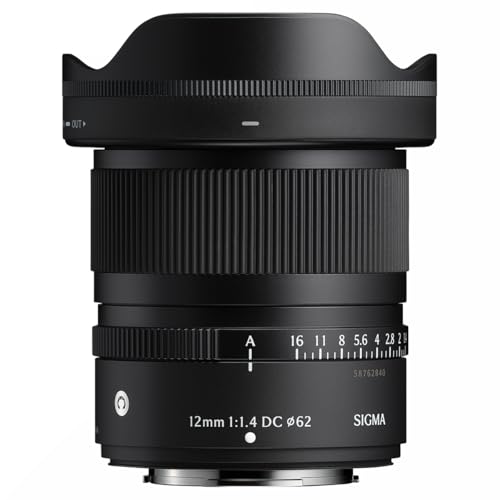
- Fixed 12mm ultra-wide view
- Bright f/1.4 aperture
- No image stabilization
Best For: Fuji X wide-angle and low-light scenes
Full-Frame Sony Zoom

- Full-frame Sony E fit
- 16-28mm wide zoom
- Constant f/2.8 aperture
Best For: Flexible full-frame Sony landscapes
Wide-Angle Zoom Pick
Sigma 10-20mm f/4-5.6 EX DC HSM for Canon

- 10-20mm wide-angle zoom
- Ring-type ultrasonic AF
- Designed for APS-C sensors
Best For: Canon APS-C DSLR landscape photographers seeking flexible framing
Low-Light Prime Pick
Sigma 16mm f/1.4 DC DN Contemporary for Sony E

- Wide 16mm prime
- Large f/1.4 aperture
- Compact Sony E-mount design
Best For: Sony E-mount shooters wanting a wide, low-light-capable prime
Full-Frame Wide Prime Pick
Sigma 20mm f/2 DG DN Contemporary for Sony E

- Ultra-wide 20mm prime
- f/2 maximum aperture
- All-metal, splash-resistant build
Best For: Sony E-mount landscape shooters prioritizing a wide, sturdy prime
Filter-Ready Travel Kit
Sigma 18-50mm f/2.8 Sony E Bundle

- Sony E-mount APS-C zoom
- Constant f/2.8 aperture
- UV, CPL, and FLD filters included
Best For: Sony APS-C landscape outings with bundled filters and accessories
All-in-One Range

- 16-300mm all-in-one zoom
- Optical image stabilization
- Dust- and splash-resistant structure
Best For: Canon RF travel photographers covering wide scenes and distant subjects
Backpack and UV Kit

- Sony E-mount APS-C zoom
- Constant f/2.8 aperture
- Backpack, UV filter, and 128GB card included
Best For: Sony APS-C shooters needing a lens plus carry and storage essentials
Lightweight APS-C Zoom – Sigma 10-18mm F2.8 DC DN for Sony E
If you want a compact sigma lens for landscape photography on a Sony APS-C camera, the 10-18mm F2.8 DC DN gives you an ultra-wide zoom range and a constant f/2.8 maximum aperture.
Best For: Sony APS-C shooters who want a lightweight lens for landscapes, travel, and video.
Pros:
- 10-18mm range makes it easy to adjust wide compositions.
- Constant f/2.8 maximum aperture offers flexibility in changing light.
- 260 g weight makes it convenient to carry.
Cons:
- Designed for Sony APS-C E-mount cameras, not full-frame coverage.
- 18mm long end offers limited reach beyond wide-angle scenes.
This is the portable choice when fitting more of a landscape into the frame matters more than telephoto reach.
Nikon DSLR Wide-Angle – Sigma 10-20mm f/3.5 EX DC HSM
Sigma 10-20mm f/3.5 EX DC HSM ELD SLD Aspherical Super Wide Angle Lens for Nikon Digital SLR Cameras
Check Price On AmazonFor Nikon DSLR owners seeking a sigma lens for landscape photography, this 10-20mm zoom combines an ultra-wide field of view with a constant f/3.5 maximum aperture.
Best For: Nikon DSLR photographers who want flexible wide framing without switching lenses.
Pros:
- 10-20mm zoom covers a useful range of wide compositions.
- Constant f/3.5 maximum aperture stays the same across the zoom range.
- Super multi-layer coating is designed to reduce flare and ghosting.
- HSM provides quiet, fast autofocus.
Cons:
- Nikon F-mount DSLR lens, so it is not a direct fit for other mounts.
- At 1.1 pounds, it is heavier than the 260 g Sony APS-C zoom in this roundup.
Choose it if you shoot a compatible Nikon DSLR and value a wider framing range over the portability of a smaller mirrorless lens.
Fast Fuji X Prime – Sigma 12mm F1.4 DC Contemporary
If you use a Fujifilm X camera and want a sigma lens for landscape photography with a wide fixed view, the 12mm F1.4 DC Contemporary pairs an ultra-wide focal length with a bright f/1.4 maximum aperture.
Best For: Fujifilm X shooters who prefer a wide prime for landscapes and low-light scenes.
Pros:
- 12mm focal length offers an ultra-wide perspective.
- f/1.4 maximum aperture gives you room to work in dimmer conditions.
- Designed for comfortable stills and video shooting.
Cons:
- Fixed 12mm focal length cannot reframe by zooming.
- No image stabilization is specified.
Pick this prime when a wide perspective and fast aperture matter more than the framing flexibility of a zoom. Check the Fujifilm X fit carefully, as the supplied specifications also contain a conflicting Canon RF mount entry.
Full-Frame Sony Zoom – Sigma 16-28mm F2.8 DG DN
For full-frame Sony E-mount users comparing a sigma lens for landscape photography, the 16-28mm F2.8 DG DN offers a wide zoom range and a constant f/2.8 maximum aperture.
Best For: Sony E-mount full-frame photographers who want adjustable wide framing for landscapes.
Pros:
- 16-28mm zoom lets you refine compositions without changing lenses.
- Constant f/2.8 maximum aperture offers flexibility across the range.
- Five FLD and four aspherical elements are included in the optical design.
- Weighs 450 g.
Cons:
- 16mm wide end is less expansive than the 10mm and 12mm APS-C options listed here.
- Listed as not water resistant.
This is the full-frame option for buyers who want a practical balance of wide coverage, f/2.8 aperture, and zoom flexibility on Sony E mount.
Wide-Angle Zoom Pick – Sigma 10-20mm f/4-5.6 EX DC HSM for Canon
If you want a sigma lens for landscape photography on a compatible Canon APS-C DSLR, this 10-20mm zoom lets you adjust your framing without changing lenses. Its listed Canon APS-C equivalent range is 16-32mm.
Best For: Canon APS-C DSLR owners who want flexible ultra-wide landscape framing.
Pros:
- 10-20mm zoom covers multiple wide-angle compositions.
- Ring-type ultrasonic autofocus supports full-time manual focusing.
- Accepts 77mm filters and focuses as close as 0.24m.
Cons:
- Variable f/4-5.6 maximum aperture is less suited to low-light shooting than a faster lens.
- Using it on sensors larger than APS-C causes vignetting.
Choose this lens when framing flexibility matters most; check camera compatibility and sensor size before buying.
Low-Light Prime Pick – Sigma 16mm f/1.4 DC DN Contemporary for Sony E
For Sony E-mount mirrorless shooters comparing a sigma lens for landscape photography, this fixed 16mm prime offers a wide view and a large f/1.4 maximum aperture. Its compact design also makes it practical to carry on outings.
Best For: Sony E-mount users who prioritize a wide prime for landscapes and low-light photography.
Pros:
- f/1.4 maximum aperture provides flexibility in low light.
- 16mm focal length offers a wide-angle perspective.
- Compact design and support for Fast Hybrid AF.
Cons:
- Fixed focal length cannot reframe by zooming.
- Sony E-mount compatibility limits which cameras can use it.
This is the aperture-focused option of the three, provided a fixed 16mm view suits the landscapes you photograph.
Full-Frame Wide Prime Pick – Sigma 20mm f/2 DG DN Contemporary for Sony E
If you need a sigma lens for landscape photography on a compatible Sony E-mount camera, this 20mm prime pairs a listed 94.5-degree angle of view with an f/2 maximum aperture. Its all-metal body and dust- and splash-resistant design are useful considerations for outdoor shooting.
Best For: Sony E-mount landscape photographers who want a wide prime with an all-metal build.
Pros:
- 20mm focal length provides an ultra-wide perspective.
- f/2 maximum aperture offers low-light flexibility.
- All-metal body with dust- and splash-resistant construction.
Cons:
- No zoom for adjusting focal length.
- No built-in image stabilization.
Pick this lens if its 20mm view and build appeal to you; plan around the fixed framing and lack of lens stabilization.
Filter-Ready Travel Kit – Sigma 18-50mm f/2.8 Sony E Bundle
If you want a compact sigma lens for landscape photography on a Sony E-mount APS-C camera, this 18-50mm f/2.8 bundle covers everyday wide-to-standard views and includes filters and a padded pouch for outings.
Best For: Sony APS-C photographers who want a versatile zoom with a CPL filter and basic field accessories in one purchase.
Pros:
- Constant f/2.8 maximum aperture across the 18-50mm range.
- Included filter kit has UV, CPL, and FLD filters.
- Bundle includes a water-resistant padded pouch and cleaning tools.
Cons:
- No optical image stabilization.
- Its 18mm wide end may not suit photographers seeking a more expansive view.
This is a practical kit for varied landscapes and travel scenes, particularly if you want a CPL included; check that the Sony E-mount APS-C format fits your camera.
All-in-One Range – Sigma 16-300mm DC OS Canon RF
For Canon RF-mount photographers seeking one sigma lens for landscape photography and distant details, this 16-300mm zoom spans wide-angle to super-telephoto views without a lens change.
Best For: Canon RF-mount shooters who value a broad focal range for travel landscapes, close-ups, and faraway subjects.
Pros:
- 16-300mm range covers wide scenes and distant details.
- Optical stabilization is rated at 6 stops at the wide end and 4.5 stops at the telephoto end.
- Dust- and splash-resistant structure and a water- and oil-repellent front coating.
Cons:
- Variable f/3.5-6.7 maximum aperture narrows as you zoom in.
- Its all-in-one range may be unnecessary if you only shoot wide landscapes.
Its strongest case is convenience: carry one stabilized lens when the scene might call for a broad vista, a distant feature, or a close-up.
Backpack and UV Kit – Sigma 18-50mm f/2.8 Sony E
This sigma lens for landscape photography pairs an 18-50mm f/2.8 Sony E-mount APS-C zoom with a Tiffen UV protector, a 128GB memory card, and a camera backpack for a more complete travel setup.
Best For: Sony E-mount APS-C photographers who also need a backpack, memory card, and basic front-element protection.
Pros:
- Constant f/2.8 maximum aperture throughout the zoom range.
- Compact, lightweight lens with fast, silent autofocus.
- Includes a Tiffen 55mm UV protector, 128GB SD card, and backpack.
Cons:
- No optical image stabilization.
- No CPL filter is listed in this kit.
Choose this package for the carry and storage accessories rather than a specialized landscape filter set; the lens itself provides a useful everyday range.
How We Picked the Best Sigma Lens for Landscape Photography
We compared the 10 selected lenses by camera-mount compatibility, intended sensor format, angle-of-view versatility, maximum aperture, and usefulness for common landscape situations. An ultrawide lens can fit more foreground and sky into a frame; a standard zoom is often easier to use for varied compositions. Neither is automatically the better choice.
This is a buying comparison, not a claim that every lens was tested side by side. Confirm the exact mount and camera compatibility before ordering, particularly for older DSLR lenses and newer mirrorless bodies.
Quick Comparison: Which Type Fits Your Photography?
- Ultrawide zooms: The 10–18mm, 10–20mm, and 16–28mm options suit expansive scenes, dramatic foregrounds, and tight viewpoints. Check sensor format: the 16–28mm DG DN is a full-frame mirrorless lens, while DC designs target APS-C.
- Wide primes: The 12mm f/1.4, 16mm f/1.4, and 20mm f/2 appeal to photographers who want a wide view and a brighter aperture for low-light work. Their fixed focal lengths demand more deliberate framing.
- Everyday and travel zooms: The 18–50mm f/2.8 balances landscape and general photography. The 16–300mm prioritizes a much longer reach in one lens, with a variable maximum aperture.
Key Buying Factors for a Sigma Lens for Landscape Photography
Mount and Sensor Size Come First
Sony E, Fujifilm X, Canon RF, and Canon or Nikon DSLR mounts are not interchangeable. Sigma’s DC designation generally indicates an APS-C design; DG denotes full-frame coverage. A lens that mounts through an adapter may still have autofocus or handling limitations, so verify the exact camera-and-lens combination.
Choose the Focal Length for Your Subjects
Ultrawide focal lengths help in confined spaces and with close foregrounds, but can make distant mountains look small. A standard zoom lets you tighten a composition without changing lenses. On APS-C cameras, account for crop factor when comparing a lens’s field of view with full-frame examples.
Balance Aperture, Portability, and Extras
Bright f/1.4 or f/2 primes offer flexibility at dusk or for night scenes; for daylight landscapes, the focal length and composition may matter more. Compare carrying weight and filter compatibility if you hike or use polarizers and neutral-density filters. Two listed 18–50mm options are accessory bundles of the same lens, so judge their extras separately rather than treating them as different optical choices.
Who Should Buy Which Sigma Lens for Landscape Photography?
Choose an ultrawide zoom if you regularly photograph sweeping vistas, architecture, or prominent foregrounds. Pick a bright prime if low-light landscapes matter and you are comfortable working with one focal length. Start with an 18–50mm if you want a compact, flexible APS-C option; consider the 16–300mm if minimizing lens swaps and adding telephoto reach matter more. Full-frame Sony E users should look first at the DG DN options and check coverage before considering a DC lens. For any Sigma Lens for Landscape Photography, the best purchase is the one that fits your camera and the way you frame scenes.