
Running local large language models demands more than a compact chassis and a fast processor. Memory capacity, integrated graphics performance, storage, cooling, and upgrade flexibility all influence how smoothly a mini PC handles model loading, inference, development tools, and everyday work.
We’ve compared 10 powerful systems with 96GB or more of RAM, including Ryzen AI Max+, Ryzen AI 9, Ryzen 9, and Intel Core Ultra platforms, to help you choose the right balance of performance, connectivity, and value for local AI workloads.
Best 10 Mini PCs with 96gb RAM for Local LLMs Picks for 2026
Best Balanced AMD Pick

- Ryzen AI 9 HX 370 with up to 80 TOPS
- 96GB removable DDR5, expandable to 128GB
- OCuLink, dual USB4, and quad-display support
Best For: Local AI experimentation and versatile desktop use
Best High-Memory Workstation

- 128GB LPDDR5X-8000 unified memory
- 16-core Ryzen AI Max+ 395 with up to 126 TOPS
- Dual M.2 slots and four-display output
Best For: Large local AI models and memory-intensive creation
Best Intel Connectivity

- 96GB DDR5 with support for up to 128GB
- Up to 99 TOPS from the Core Ultra platform
- Dual 10GbE and PCIe 5.0 x8 external-GPU support
Best For: AI developers needing fast networking and expansion
Best for Large Local Models

- 128GB LPDDR5X-8000 unified memory
- 16-core processor with up to 126 TOPS
- 2TB SSD, second M.2 slot, and dual USB4
Best For: Large local LLMs and private AI workloads
Best Expansion-Ready Powerhouse

- 16-core/32-thread Ryzen 9 processor
- 96GB DDR5 and three M.2 slots
- PCIe x16 for added hardware
Best For: Custom local AI builds needing expansion flexibility
Best Integrated AI Workstation

- 128GB RAM with up to 96GB allocatable VRAM
- Ryzen AI Max+ 395 and Radeon 8060S
- 2TB SSD with upgrade path to 8TB
Best For: Compact offline AI and private-data workloads
Best Balanced AI Mini PC

- 96GB DDR5 and 2TB PCIe 4.0 SSD
- Ryzen AI 9 HX 370 with 50 TOPS NPU
- OCuLink support for an external GPU
Best For: 96GB buyers wanting an upgrade path for graphics
Linux Local AI Powerhouse
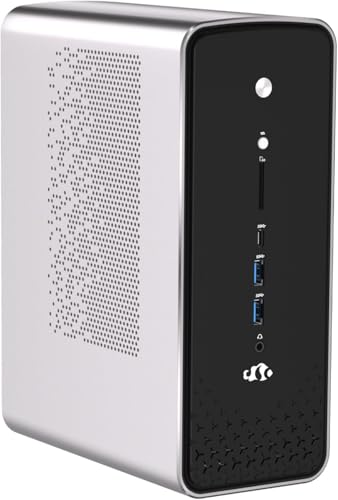
- 128GB LPDDR5X unified memory
- 50 TOPS NPU and Radeon 8060S graphics
- Linux, dual 2.5GbE, and dual USB4
Best For: Linux developers running local AI and demanding parallel workloads
Balanced Creator Workstation
- 128GB memory and included 2TB NVMe SSD
- Windows 11 Pro with up to 126 TOPS AI performance
- Four-display output and Wi-Fi 7 connectivity
Best For: Windows users combining local AI with creative and business work
Expandable AI Workstation

- 128GB unified memory and 2TB SSD
- Dual 10GbE, PCIe x16, and USB4 V2
- Supports multi-unit local AI clusters
Best For: Power users building expandable local AI labs or clusters
Best Balanced AMD Pick – MINISFORUM AI X1 Pro
The MINISFORUM AI X1 Pro is a well-rounded choice among mini pcs with 96gb ram for local llms, pairing a Ryzen AI 9 HX 370 processor with 96GB of removable DDR5 memory and a 2TB SSD. It is suited to buyers who want local AI capability alongside gaming, multitasking, and strong display connectivity.
Best For: Local AI experimentation, demanding multitasking, gaming, and multi-monitor workspaces.
Pros:
- Ryzen AI 9 HX 370 offers 12 cores, 24 threads, and up to 80 TOPS.
- 96GB DDR5 memory is removable and expandable up to 128GB.
- OCuLink, dual USB4, dual 2.5GbE, and support for up to four 4K displays.
- Includes a 2TB SSD and supports up to three PCIe 4.0 SSDs.
Cons:
- Its local-LLM suitability depends on model size and software configuration.
- Higher-end expansion features such as OCuLink may require additional hardware.
This is a strong general-purpose option if you specifically want 96GB of upgradeable memory rather than onboard RAM. Its combination of fast connectivity, expandable storage, and Radeon 890M graphics makes it flexible beyond local AI workloads.
Best High-Memory Workstation – GMKtec EVO-X2 AI Mini PC
The GMKtec EVO-X2 goes beyond the 96GB target with 128GB of unified LPDDR5X-8000 memory. For shoppers comparing mini pcs with 96gb ram for local llms, its large shared memory pool is especially relevant for AI inference, graphics workloads, and projects that benefit from substantial memory capacity.
Best For: Large local AI workloads, software development, rendering, video editing, and high-memory multitasking.
Pros:
- Ryzen AI Max+ 395 provides 16 cores, 32 threads, and up to 126 TOPS across CPU, GPU, and NPU.
- 128GB unified LPDDR5X-8000 memory gives the integrated graphics access to a large shared pool.
- Dual PCIe 4.0 M.2 slots support additional storage, with up to 8TB per drive listed.
- Performance modes range from 54W Silent to 120W Performance, with extensive cooling.
Cons:
- The memory is onboard rather than user-removable.
- The included SSD capacity is 1TB, so larger AI datasets may require expansion.
- Its 120W performance mode may prioritize speed over low power consumption.
The EVO-X2 is a compelling choice when memory capacity matters more than upgradeability. Its 128GB unified design and Radeon 8060S graphics are well aligned with demanding local AI and creation workloads in a compact system.
Best Intel Connectivity – Beelink GTi15 Core Ultra 9
The Beelink GTi15 combines 96GB of DDR5 memory with an Intel Core Ultra 9 285H and unusually fast networking. It stands out among mini pcs with 96gb ram for local llms for buyers who need substantial memory, high-speed NAS or cluster access, and a compact system for AI, business, or development work.
Best For: Developers, AI enthusiasts, NAS users, and power users who need dual 10GbE connectivity.
Pros:
- Core Ultra 9 285H includes 16 cores, 16 threads, and up to 99 TOPS of total AI performance.
- 96GB DDR5 is installed, with two SO-DIMM slots supporting up to 128GB.
- Dual 10GbE ports are useful for AI server clustering and high-speed storage access.
- Supports an external graphics upgrade through a PCIe 5.0 x8 connection and EX Pro Dock.
Cons:
- The external graphics dock is sold separately.
- It has a smaller thread count than the AMD 16-core/32-thread alternatives listed here.
- Local model performance will vary with the integrated Intel Arc graphics and software support.
This is the most network-focused option in the group. Choose it when dual 10GbE, upgradeable RAM, and potential external-GPU expansion are more important than the larger unified-memory pools offered by the AMD systems.
Best for Large Local Models – BOSGAME M5 Ryzen AI Max+ 395
The BOSGAME M5 is aimed at buyers who want more than the minimum memory capacity for local AI. Its Ryzen AI Max+ 395, 128GB of unified LPDDR5X-8000 memory, and Radeon 8060S graphics make it one of the most ambitious choices for local LLM experimentation, 8K content work, and demanding multitasking.
Best For: Large local LLMs, private AI workflows, creators, researchers, and power users.
Pros:
- 16 Zen 5 cores, 32 threads, and up to 126 TOPS of total AI compute.
- 128GB unified memory is designed for memory-intensive AI and graphics workloads.
- Includes a 2TB PCIe 4.0 SSD and a second M.2 slot for expansion or RAID.
- Dual USB4, 2.5GbE, and quad-display output provide flexible connectivity.
Cons:
- The 128GB memory is onboard and not presented as user-upgradable.
- Claims about supported model sizes should be treated as workload- and software-dependent.
- The integrated graphics shares the system memory pool with the CPU and AI workloads.
The M5 is a strong fit when your priority is running larger local models on a compact x86 desktop. Its unified memory and high-end integrated graphics are impressive, though buyers should plan around the fixed memory configuration.
Best Expansion-Ready Powerhouse – Ryzen 9 9955HX MS-A2
For shoppers comparing mini pcs with 96gb ram for local llms, the MINISFORUM MS-A2 stands out for its 16-core Ryzen 9 9955HX processor, 96GB of DDR5 memory, and unusually flexible expansion options. Its integrated Radeon 610M graphics make it more dependent on added hardware for demanding GPU workloads, but the PCIe x16 slot and multiple storage interfaces provide a strong foundation for a customized local AI system.
Best For: Power users who want 96GB of RAM, substantial storage expansion, and the option to add a professional graphics card or high-speed networking.
Pros:
- 16 cores and 32 threads with boost speeds up to 5.4GHz for heavily multithreaded work.
- Three M.2 storage slots, RAID 0/1 support, and support for large-capacity NVMe configurations.
- PCIe x16 expansion can accommodate selected graphics or networking hardware.
- Two 10G SFP+ ports, two 2.5G LAN ports, and 8K display support offer strong connectivity.
Cons:
- Its integrated Radeon 610M graphics may not suit GPU-intensive local LLM workloads without expansion.
- The maximum listed memory is 96GB, leaving no headroom beyond the included capacity.
The MS-A2 is a particularly practical choice if you view 96GB as a starting point rather than the entire solution. Its CPU, PCIe expansion, networking, and storage flexibility make it well suited to a build that may grow into a more capable local inference workstation.
Best Integrated AI Workstation – GEEKOM A9 Mega
The GEEKOM A9 Mega is the most ambitious option here for buyers seeking mini pcs with 96gb ram for local llms, although it includes 128GB of system memory rather than exactly 96GB. Its Ryzen AI Max+ 395 platform combines a 50 TOPS NPU with Radeon 8060S graphics and claims up to 96GB of allocatable VRAM, making it the most directly AI-focused configuration in this selection.
Best For: Developers and professionals who want a compact, high-memory workstation for offline model deployment, private data processing, and GPU-accelerated creative work.
Pros:
- 128GB of LPDDR5X memory with up to 96GB allocatable as VRAM according to the supplied specifications.
- Ryzen AI Max+ 395 offers 16 Zen 5 cores, a 50 TOPS NPU, and 126 TOPS total compute claimed by the product listing.
- Radeon 8060S graphics, dual USB4, dual HDMI 2.1, and support for up to four displays.
- 2TB PCIe Gen4 NVMe storage is included and listed as upgradeable to 8TB.
Cons:
- It exceeds the requested 96GB system-memory target, which may mean a higher purchase cost than lower-memory alternatives.
- Its integrated memory and compact design provide less user-upgrade flexibility than a socketed desktop platform.
With its large shared-memory design and powerful integrated graphics, the A9 Mega is the strongest match for users prioritizing local AI capability in a compact enclosure. Confirm software compatibility and actual model-size performance before relying on the listing’s 128B deployment claim.
Best Balanced AI Mini PC – MINISFORUM AI X1 Pro-370
For users specifically shopping mini pcs with 96gb ram for local llms, the MINISFORUM AI X1 Pro-370 offers an attractive balance of memory, modern AI acceleration, and connectivity. It pairs 96GB of DDR5 RAM with the Ryzen AI 9 HX 370, Radeon 890M graphics, and an OCuLink port for a possible external GPU setup.
Best For: Enthusiasts who want a ready-to-use 96GB mini PC with integrated graphics today and a practical path to stronger GPU performance later.
Pros:
- Includes 96GB DDR5 RAM and a 2TB PCIe 4.0 SSD.
- Ryzen AI 9 HX 370 provides 12 cores, 24 threads, and up to 50 TOPS of NPU performance.
- Radeon 890M graphics and four video outputs support demanding display and productivity setups.
- OCuLink enables an external PCIe 4.0 x4 GPU connection, while Wi-Fi 7 and 2.5G LAN provide fast networking.
Cons:
- OCuLink is not hot-swappable and requires use of an M.2 PCIe 4.0 SSD slot.
- Integrated Radeon 890M graphics may still be limiting for the largest or most GPU-dependent local models.
- The product listing states storage can expand to 12TB, but additional drives are required.
The X1 Pro-370 is a well-rounded option when 96GB is the target and future expandability matters. Its NPU and integrated graphics handle everyday AI-enabled work, while OCuLink gives advanced users a route to add more GPU power when local inference needs grow.
Linux Local AI Powerhouse – NIMO Ryzen AI Max+ 395
The NIMO is an unusually capable choice among mini pcs with 96gb ram for local llms, offering 128GB of fast LPDDR5X memory, a Ryzen AI Max+ 395 processor, and a Linux installation ready for development work. Its unified memory and Radeon 8060S graphics are well suited to local inference, compiling, virtualization, and other demanding workloads.
Best For: Linux-first developers, local LLM experimentation, and sustained multitasking in a compact workstation.
Pros:
- 128GB LPDDR5X-8000 unified memory with a wide 256-bit memory bus
- Ryzen AI Max+ 395 provides 16 cores, 32 threads, and a 50 TOPS NPU
- Dual 2.5GbE, dual USB4, four-display support, and dual PCIe 4.0 M.2 slots
- Pre-installed Linux and a multi-heatpipe cooling system suit developer workflows
Cons:
- Linux may require more setup than a Windows-based alternative for some users
- The supplied notes do not specify included SSD capacity
Choose this model when a Linux-ready environment and broad connectivity matter as much as memory capacity. It is a strong fit for users who want a compact local AI workstation rather than a basic office mini PC.
Balanced Creator Workstation – BOSGAME M5 AI Mini PC
The BOSGAME M5 is a polished option for buyers comparing mini pcs with 96gb ram for local llms. It pairs 128GB of LPDDR5X-8000 unified memory with a 2TB PCIe 4.0 SSD, Windows 11 Pro, and Ryzen AI Max+ 395 processing, making it ready for local AI, creative applications, and large project files.
Best For: Users who want a ready-to-use Windows workstation for local inference, media creation, and virtualization.
Pros:
- 128GB unified memory supports large models, multiple virtual machines, and creative workloads
- Includes a 2TB PCIe 4.0 NVMe SSD and a second M.2 slot for expansion
- Radeon 8060S graphics, 50 TOPS NPU, and up to 126 TOPS total AI performance
- Wi-Fi 7, 2.5GbE, dual USB4, and support for up to four displays
Cons:
- Its 240-watt power consumption is higher than that of simpler mini PCs
- The 3.8 kg chassis is less travel-friendly than ultracompact models
The M5 stands out for its combination of generous memory, included storage, and Windows 11 Pro. It is a practical all-rounder when local AI is only one part of a broader creator or professional workflow.
Expandable AI Workstation – MINISFORUM MS-S1 MAX
The MINISFORUM MS-S1 MAX is a serious contender for mini pcs with 96gb ram for local llms, combining 128GB of LPDDR5X unified memory with a Ryzen AI Max+ 395 APU, 2TB SSD, and unusually extensive expansion options. Its PCIe x16 slot, dual 10GbE ports, and cluster support make it especially interesting for advanced home labs and professional deployments.
Best For: Advanced local AI users, homelabs, and teams planning high-speed networking or multi-unit clusters.
Pros:
- 128GB unified memory, 50 TOPS NPU, and up to 126 TOPS total system output
- Full-length PCIe x16 slot, dual M.2 PCIe 4.0 slots, and USB4 V2 up to 80Gbps
- Dual 10GbE networking and Wi-Fi 7 support demanding data movement
- Designed for clustering, including support for larger models across multiple units
Cons:
- Its advanced expansion and cluster features may be unnecessary for basic desktop use
- The supplied details list the operating system only as “OS,” so software setup should be verified
- High-performance cooling and the 320-watt power supply indicate a substantial workstation design
This is the most infrastructure-oriented option in the group. Consider it when expansion, 10GbE networking, and future multi-node scaling are more important than keeping the system as simple as possible.
How We Picked the Best Mini PCs with 96gb RAM for Local LLMs
We focused on compact computers with at least 96GB of memory, since larger language models can consume substantial RAM before accounting for the operating system, context windows, development tools, and background services. We also considered processor performance, integrated GPU capability, memory bandwidth, storage capacity, connectivity, cooling potential, and practical workstation features.
Because these systems use different memory designs, advertised capacity is not the only factor. Fast LPDDR5X can benefit integrated graphics and AI workloads, while user-upgradeable DDR5 may offer more flexibility later. We also treated ports, networking, display support, Linux compatibility, and expansion options as important differentiators.
Quick Comparison
| What to Compare | Why It Matters |
|---|---|
| Memory capacity | Determines how comfortably the system can load larger models and run other applications simultaneously. |
| Memory type and speed | Higher bandwidth can improve integrated-GPU performance and some AI workloads. |
| CPU and NPU | Influences prompt processing, multitasking, development, and supported AI acceleration. |
| Integrated graphics | Helps with GPU-accelerated inference, visualization, encoding, and creative workloads. |
| Storage and expansion | A 2TB SSD is useful for model files, containers, datasets, and applications. |
| Connectivity | 10GbE, USB4, multiple display outputs, and extra M.2 slots can improve a workstation setup. |
Key Buying Factors for Mini PCs with 96gb RAM for Local LLMs
Memory Capacity and Bandwidth
Choose 96GB when you want a capable local-model machine without immediately paying for 128GB. Systems with 128GB provide more room for larger models, longer context windows, multiple containers, and multitasking. Fast unified or soldered memory can be excellent for integrated graphics, but it generally cannot be upgraded.
Model Size and Inference Expectations
Check the memory requirements of the models you actually plan to run. Quantized models use less memory than full-precision versions, but operating-system overhead and runtime requirements still matter. More RAM does not automatically match the performance of a dedicated GPU with large VRAM.
Cooling and Sustained Performance
Local inference and model conversion can create prolonged loads. Favor designs with robust active cooling, adequate ventilation, and reputable power delivery. Compact systems may throttle under sustained workloads, so independent testing and return policies are valuable.
Ports, Networking, and Storage
USB4 is useful for fast external storage and docks, while 10GbE benefits networked datasets, NAS workflows, and remote access. Prefer at least 2TB of storage if you expect to keep multiple models locally, and look for expansion options when possible.
Who Should Buy Which Mini PCs with 96gb RAM for Local LLMs?
Choose a 96GB DDR5 model if you want a balance of capacity, upgradeability, and value. Choose a 128GB LPDDR5X system when maximum out-of-box memory and bandwidth matter more than future upgrades. Choose a Ryzen AI Max+ 395 workstation for demanding integrated-GPU workloads and larger local-model experiments. Choose a Ryzen AI 9 or Intel Core Ultra system for a more balanced mix of local AI, productivity, development, and everyday desktop use.
Before buying, confirm the operating-system support, memory configuration, storage layout, power adapter, and return terms. The best mini PC for local LLMs is the one that provides enough usable memory and sustained performance for your specific models—not simply the one with the highest headline specification.