
Choosing the right microscope camera for jewelry inspection can make tiny hallmarks, stone settings, prongs, and surface flaws much easier to see. The best options balance sharp imaging, stable focusing, and practical lighting.
In this roundup, we focus on models that are useful for close inspection work, whether you want a screen-based digital microscope or a camera-equipped setup for more traditional viewing.
Best 10 Microscope Camera for Jewelry Inspection Picks for 2026
Auto-Focus 4K View

- Autofocus with TOF sensing
- 4K video and 52MP imaging
- 8-inch IPS screen with HDMI/USB
Best For: Jewelers and collectors who want fast autofocus with a built-in display
Jeweler’s Zoom Bundle
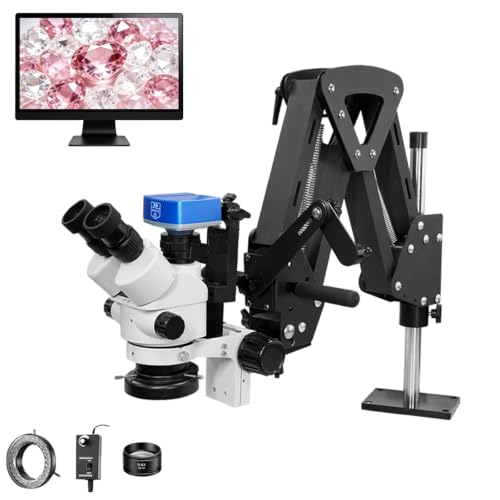
- Complete bundle with camera and light
- 7X-45X zoom with long working distance
- HDMI/USB camera with mouse control
Best For: Jewelers and engravers who want an all-in-one trinocular setup
Screened Detail Viewer

- 7-inch rotatable display
- 12MP camera with 1080P output
- PC view plus 16GB card included
Best For: Beginners and hobbyists who want an easy screened microscope
High-Detail Inspection Rig

- 60MP photos and 4K video
- 1X-150X zoom with long working distance
- Adjustable 56-LED ring light
Best For: Users needing high-resolution inspection with glare control and workspace
Coin Detail Viewer
Elikliv 4.3" LCD Digital Microscope

- Black base reduces reflections on shiny surfaces
- 4.3-inch 720P screen with 8 adjustable LEDs
- PC compatible for larger Windows/Mac viewing
Best For: Inspecting coins, jewelry, and other reflective small items
Hands-Free Repair Scope
Aikokkl 5" LCD Soldering Microscope

- C-clamp stand keeps both hands free
- 5-inch IPS display with flexible arm mount
- Simple PC viewing with no extra software
Best For: Hands-free close inspection at a repair bench or desk
Large-Screen Inspection Microscope
TOMLOV DM10 10.1" Digital Coin Microscope

- 10.1-inch IPS screen with 178° viewing angle
- 5x-1200x magnification for fine-detail work
- 10 LEDs plus USB PC output and capture features
Best For: Detailed jewelry and coin inspection on a bigger screen
Versatile Multi-Lens Pick
LM266S 5 Lens 7" HDMI Digital Microscope

- Five lenses support coins, slides, and precision work.
- 7-inch IPS screen with HDMI/USB output.
- 24MP photos, 2160P video, and 32GB storage.
Best For: Shoppers who want one setup for jewelry, coins, and bench inspection
Glare-Reducing Value Pick
TOMLOV DM9B 7" Digital Microscope

- Black base helps cut glare and reflections.
- 7-inch rotatable FHD screen with 12MP camera.
- 8 LEDs, 2 gooseneck lights, and 16GB card included.
Best For: Collectors and hobbyists who want an easy-to-use jewelry inspection microscope
Auto-Focus 4K View – Elikliv EM4K-AF
If you want a microscope camera for jewelry inspection that prioritizes speed and convenience, the Elikliv EM4K-AF stands out for its autofocus system and crisp 4K imaging. It is designed to make close-up viewing easier on coins and fine detail work, with a built-in screen, HDMI output, and a tall stand that gives you room to work.
Best For: Jewelers, coin collectors, and detail-focused users who want autofocus plus a built-in display.
Pros:
- Autofocus with TOF sensing helps it refocus quickly, even on moving objects.
- 4K UHD video and 52MP imaging provide very sharp detail for inspection.
- 8-inch IPS screen and HDMI/USB outputs make viewing flexible.
- 10-inch stand and broad base give extra working height and stability.
Cons:
- Its feature set is more advanced than a basic jewelry-only microscope.
- Maximum magnification is geared toward digital viewing rather than traditional optical zoom.
Overall, this is a strong pick if you value fast focusing, a built-in screen, and high-resolution imaging for close inspection work. The freeze and split-screen features also add practical value when comparing small details.
Jeweler’s Zoom Bundle – DZQ Trinocular Microscope
This microscope camera for jewelry inspection is built as a ready-to-use bundle, so you get the camera, stand, eyepieces, and lighting in one package. With 7X-45X zoom, a 95-300mm working distance, and a 4K HD camera, it is set up for detailed hands-on work where you still need space for tools.
Best For: Jewelers, engravers, and workshop users who want a complete trinocular setup out of the box.
Pros:
- Bundle includes a 4K HD camera, eyepieces, stand, mouse, and 60-LED ring light.
- HDMI and USB camera modes support standalone use and direct saving.
- 7X-45X zoom with 95-300mm working distance leaves room for tools and hands.
- Dimmer-controlled ring light helps provide shadow-free illumination.
Cons:
- Maximum optical magnification tops out at 45X.
- It is a more specialized workstation setup than a simple tabletop viewer.
For jewelry work that needs both inspection and workspace, this bundle is very practical. The included camera and lighting reduce the need for extra accessories and make it easier to start using immediately.
Screened Detail Viewer – TOMLOV DM9
If you need a microscope camera for jewelry inspection that is easy to view and simple to share, the TOMLOV DM9 offers a practical 7-inch screen plus PC compatibility. Its 12MP camera, 1080P output, and included lighting make it a solid choice for checking small details without a complicated setup.
Best For: Beginners, hobbyists, and collectors who want a straightforward screened microscope.
Pros:
- 7-inch rotatable screen improves viewing comfort and reduces neck strain.
- 12MP camera with 1080P imaging captures detailed photos and video.
- PC view works with Windows and macOS without extra software.
- Includes 16GB micro SD card and multiple LED lights for convenience.
Cons:
- Maximum magnification is lower than some digital models at 1200X.
- Best suited for viewing and documenting rather than advanced optical workstation use.
For everyday inspection tasks, this model keeps things simple while still offering useful image quality and storage. The rotatable screen and PC connectivity make it especially friendly for longer sessions and sharing observations.
High-Detail Inspection Rig – NICE-POWER 60MP Microscope
For a microscope camera for jewelry inspection that leans toward high-resolution inspection and hands-free work, this NICE-POWER model offers 60MP imaging, 4K output, and a long working distance. The adjustable ring light and flexible stand make it easier to examine reflective surfaces like coins and jewelry while keeping your tools in place.
Best For: Users who want a high-resolution inspection camera with long reach and adjustable lighting.
Pros:
- 60MP photos and 4K HDMI/USB video support detailed inspection.
- 1X-150X continuous zoom and up to 1000mm working distance provide flexibility.
- 56-LED ring light is adjustable to help reduce glare on shiny surfaces.
- 4-part adjustable stand improves positioning for hands-free work.
Cons:
- It is more of an industrial-style setup than a compact desktop viewer.
- Maximum magnification is 150X, so it is not focused on extreme zoom.
This is a strong option if you care most about resolution, lighting control, and space under the lens. It is especially useful when reflective jewelry surfaces need careful, glare-managed inspection.
Coin Detail Viewer – Elikliv 4.3" LCD Digital Microscope
If you want a microscope camera for jewelry inspection that keeps setup simple, this Elikliv coin microscope is built for close-up viewing with a 4.3-inch LCD, 8 adjustable LEDs, and up to 1000x magnification. The black base is designed to reduce reflections, which can help when checking shiny surfaces, small markings, and fine surface detail.
Best For: Inspecting coins, jewelry, stamps, and other small items where a compact LCD microscope with reduced glare is useful.
Pros:
- Black base helps minimize light reflection for clearer imaging on reflective items.
- 4.3-inch 720P display reduces eye and neck strain during longer sessions.
- 8 adjustable LED lights improve visibility in lower-light conditions.
- USB connection supports viewing on Windows or Mac for a larger shared screen.
Cons:
- Memory card is required if you want to save photos or videos.
- Small screen is less immersive than the larger models in this roundup.
Overall, this is a practical entry-level choice if you want a portable inspection tool with easy PC viewing and a glare-conscious base for examining fine detail on jewelry and other collectibles.
Hands-Free Repair Scope – Aikokkl 5" LCD Soldering Microscope
For buyers looking for a microscope camera for jewelry inspection that also works well at a bench, this 5-inch LCD digital microscope pairs a hands-free C-clamp stand with PC viewing and up to 1000x digital magnification. It is positioned as a tool for micro-detail inspection, with manual focus and distance adjustment to help sharpen the image.
Best For: Bench-style close inspection, soldering checks, and small-object viewing where hands-free operation matters.
Pros:
- C-clamp stand keeps both hands free during inspection.
- 5-inch IPS display helps reduce neck and eye strain.
- Plug-and-play PC viewing works through built-in Windows Camera or Mac Photo Booth.
- Flexible arm makes it easier to position over tight workspaces and irregular objects.
Cons:
- Not auto-focus, so you need to adjust distance and the focus wheel manually.
- Micro SD card is required to record videos and save photos.
This model makes sense if you want a stable inspection setup for detailed work and do not mind a manual focus workflow. Its hands-free design and simple computer connection are the main strengths.
Large-Screen Inspection Microscope – TOMLOV DM10 10.1" Digital Coin Microscope
If you want a microscope camera for jewelry inspection with a bigger viewing area, the TOMLOV DM10 centers on a 10.1-inch IPS screen and a wide 178° viewing angle. It also offers 5x to 1200x magnification, USB output for computer viewing, and a light system built around 10 LEDs for brighter close-up inspection.
Best For: Users who want a larger screen for detailed viewing, photo capture, and shared inspection sessions.
Pros:
- Large 10.1-inch IPS screen gives a more spacious viewing experience.
- 5x-1200x magnification covers a wide range of detailed inspections.
- USB output supports real-time viewing on a computer.
- 10 LED lights, including flexible side lights, help illuminate fine details.
Cons:
- Larger footprint may take up more bench space than smaller LCD scopes.
- Best results still depend on proper focus and distance adjustment.
As a roundup pick, this model stands out if screen size and viewing comfort are priorities. It is especially appealing for anyone who wants to examine small details, capture media, and share what they see more easily.
Versatile Multi-Lens Pick – LM266S 5 Lens 7" HDMI Digital Microscope
If you want a microscope camera for jewelry inspection that can also handle coins, slides, and repairs, the LM266S is built for versatility. Its five-lens setup, 7-inch IPS screen, and HDMI/USB output make it easy to inspect small details on a bench or larger display.
Best For: Users who want one microscope for jewelry, coins, biology, and precision repair work.
Pros:
- Five integrated lenses cover full-view work, higher-magnification slide viewing, and longer working distances.
- 7-inch IPS screen plus HDMI/USB output supports stand-alone use or big-screen viewing.
- Mechanical X-Y stage helps keep specimens steady during detailed inspection.
- Includes 24MP photos, 2160P video, 32GB storage, remote control, and adjustable lighting.
Cons:
- Broad feature set may be more than needed if you only want a simple jewelry microscope.
- Best suited to bench use rather than portable, handheld inspection.
Overall, the LM266S is a strong pick if you need a flexible inspection tool with serious imaging and display options. For jewelry work, the combination of screen viewing, lighting control, and multiple lenses makes it easy to study surface details without constantly repositioning the sample.
Glare-Reducing Value Pick – TOMLOV DM9B 7" Digital Microscope
The TOMLOV DM9B is a practical microscope camera for jewelry inspection if you want a simple screen-based setup with good lighting and easy PC viewing. The black base is designed to reduce glare and reflections, which can help make small metal details easier to study.
Best For: Jewelry, coins, and hobbyists who want a straightforward microscope with reduced glare and a large screen.
Pros:
- Black base helps reduce glare and reflections for clearer viewing.
- 7-inch rotatable FHD screen improves ergonomics and reduces neck strain.
- 12MP camera with 1080P imaging and 5X-1200X zoom range.
- Includes 8 LED fill lights, 2 gooseneck lights, and a 16GB SD card.
Cons:
- Magnification is listed as actual-use dependent on screen size and working distance.
- More basic than higher-end multi-lens microscopes for specialized tasks.
For jewelry inspection, the DM9B stands out for its glare-reducing base and straightforward screen workflow. It offers the essentials collectors and hobbyists need: bright lighting, a large display, and PC connectivity for sharing or closer analysis.
Angle-View Specialist – TOMLOV TM3K-3D 7" Digital Microscope
The TOMLOV TM3K-3D is aimed at users who need a microscope camera for jewelry inspection from multiple angles, not just straight down. Its 3D side-viewing design, rotating imaging, and adjustable spotlight make it easier to examine engravings, settings, and other fine details.
Best For: Jewelry appraisals, engraving checks, and detailed inspection that benefits from side viewing.
Pros:
- 3D side-viewing and 360° rotation help inspect details from multiple angles.
- W wide-angle lens supports full-frame viewing of coins, jewelry, and specimens.
- L long-distance lens provides extra workspace for soldering and repair.
- 7-inch IPS screen, 3K resolution, HDMI/USB output, and adjustable gooseneck spotlight.
Cons:
- More specialized than a standard top-down microscope for casual viewing.
- Flexible-arm setup may be better for bench use than quick, portable checks.
If your jewelry inspection work requires seeing edges, surfaces, and angles beyond a simple overhead view, this model is a strong fit. The TM3K-3D combines flexible viewing, strong display options, and focused lighting in a setup that suits careful detail work.
How We Picked the Best Microscope Camera for Jewelry Inspection
We looked for models that make fine detail easier to evaluate without adding unnecessary complexity. The most useful picks offer clear image output, dependable focus control, adjustable illumination, and a stable working distance for examining rings, chains, gemstones, and clasps.
We also prioritized setups that are practical for real bench use: decent screen size, PC or HDMI output where helpful, flexible stands, and enough working room to position jewelry without constantly readjusting the piece.
Quick Comparison
Digital LCD microscopes are usually the easiest choice for fast inspections and shared viewing. HDMI and USB models are better if you want a larger monitor or computer-based workflow. Trinocular and C-mount styles are more suited to users who want a more traditional microscope setup with a camera attached.
If your work is mostly quick authentication, surface checks, and general detail review, a compact digital microscope may be enough. If you need more precision and a steadier optical feel, a trinocular microscope with camera support is often the stronger route.
Key Buying Factors for a Microscope Camera for Jewelry Inspection
Magnification and Working Distance
Higher magnification is not always better. For jewelry, you need enough zoom to inspect prongs, settings, and engraving, but also enough space to move the piece comfortably. A usable working distance matters as much as raw power.
Image Quality and Focus
Look for sharp optics, good sensor resolution, and fine focus control. A Microscope Camera for Jewelry Inspection should reveal crisp edges and texture without excessive digital blur or lag.
Lighting
Adjustable LED lighting is important because reflective metals and gemstones can wash out detail. Even lighting with dimming control helps reduce glare and makes inspection more accurate.
Display and Connectivity
Built-in LCD screens are convenient for bench work, while HDMI and USB output are useful if you want a larger display or computer capture. Choose the format that fits your workspace and documentation needs.
Stand Stability
A stable stand or clamp reduces vibration and keeps the subject in view. This is especially useful when you are evaluating small hallmarks, tiny repairs, or uneven stone seats.
Who Should Buy Which Microscope Camera for Jewelry Inspection?
If you want a simple all-in-one setup, choose a digital microscope with an LCD screen. If you need better workflow integration or image capture, go with HDMI or USB output. If your priority is traditional inspection with camera attachment flexibility, a trinocular model is the better fit.
Casual buyers and hobbyists can usually start with a compact screen-based model, while jewelers, appraisers, and repair-focused users may prefer a more stable, higher-precision system with stronger lighting and better stand control.