
Choosing the right storage can make or break your editing workflow. A good hard drive enclosure for video editing helps you move large footage files faster, keep projects organized, and scale storage as your library grows.
Below, we’ve rounded up 10 strong options for editors who want a balance of speed, capacity, cooling, and value.
Best 10 Hard Drive Enclosure for Video Editing Picks for 2026
4-Bay Media Hub
WAVLINK 4-Bay 10Gbps with HDMI

- 4 SATA bays for 3.5-inch and 2.5-inch drives
- 10Gbps USB-C transfer speed
- Dual fans plus aluminum shell for cooling
Best For: Editors wanting a multi-use enclosure with HDMI and fast transfers
Thunderbolt RAID Tower

- Thunderbolt 3 with up to 1527MB/s sustained performance
- Supports 3.5-inch and 2.5-inch drives without adapters
- RAID 0/1/4/5/1+0 configuration options
Best For: Thunderbolt users who need fast, configurable RAID storage
Quiet USB DAS

- 10Gbps USB 3.2 Gen2 performance
- Tool-free trays with hot-swappable bays
- Quiet cooling with temperature-controlled fan
Best For: Editors who want simple, quiet, plug-and-play storage
High-Capacity RAID Pick
ORICO 4 Bay RAID 4-Bay 88TB Enclosure

- 8 RAID modes for flexible storage setups
- Up to 88TB total capacity with 22TB drive support
- Aluminum case with 80mm fan and 150W power
Best For: Editors needing RAID flexibility and high-capacity HDD storage
Quiet Budget DAS
CENMATE 4-Bay Tool-Free Aluminum Enclosure

- Supports 2.5-inch and 3.5-inch SATA HDDs/SSDs
- Up to 80TB total with hot-swappable, tool-free bays
- USB 3.0 with UASP and included USB A/C cables
Best For: Creators wanting simple plug-and-play multi-drive storage
Fastest Transfer Option
ORICO 4 Bay RAID 20Gbps Enclosure

- USB 3.2 Gen 2x2 with up to 20Gbps support
- 6 RAID modes for flexible storage setups
- Up to 104TB total capacity with 26TB drive support
Best For: Editors needing faster transfers and RAID-capable large storage
RAID Studio Archive
ORICO 5 Bay RAID External Hard Drive Enclosure

- 5-bay RAID enclosure with multiple modes
- Up to 110TB total capacity for media storage
- Built-in 150W PSU and active cooling
Best For: Large video libraries and RAID-based desktop editing
High-Speed RAID Expansion
ORICO 5 Bay RAID Hard Drive Enclosure
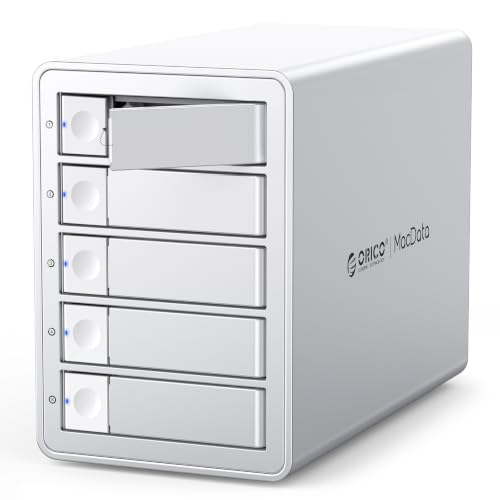
- USB 3.2 Gen 2x2 with JMS591 chip
- Supports RAID 0, 1, 5, 10, JBOD, and Normal
- Up to 130TB total storage capacity
Best For: Editors needing fast, high-capacity RAID storage
Simple Dual-Bay DAS
CENMATE Aluminum 2 Bay 10Gbps Hard Drive Enclosure

- 10Gbps USB 3.2 Gen 2 connectivity
- Supports 2.5-inch and 3.5-inch SATA drives
- Hot-swap plus daisy-chain expansion
Best For: Editors wanting simple, fast dual-drive storage
4-Bay Media Hub – WAVLINK 4-Bay 10Gbps with HDMI
If you need a hard drive enclosure for video editing that doubles as a workspace hub, this WAVLINK 4-bay model is built around speed, cooling, and display expansion. Its 10Gbps USB-C connection is suited to moving large project files, while the aluminum shell and dual fans help keep drives cooler during longer sessions.
Best For: Editors who want a four-bay enclosure with 10Gbps transfers, hot-swap flexibility, and HDMI output for a cleaner desk setup.
Pros:
- Four SATA bays support 3.5-inch and 2.5-inch HDDs/SSDs for large project libraries
- 10Gbps USB 3.2 Type-C helps handle big media transfers efficiently
- Built-in cooling fans and aluminum housing support heat dissipation during heavier workloads
- Independent bay power switches make drive swapping more convenient
Cons:
- 2.5-inch hard drives need extra mounting brackets, which are not included
- HDMI output requires a host USB-C port with video support and the USB-C to C cable
- Capacity depends on installed drives, despite the large maximum rating
This is a strong pick if you want a storage enclosure that does more than store drives. The extra HDMI and USB-C connectivity make it especially useful for editors building a compact, multi-purpose editing station.
Thunderbolt RAID Tower – OWC ThunderBay 4 40Gb/s
This hard drive enclosure for video editing is aimed at users who need high-throughput storage rather than a simple drive box. With Thunderbolt 3 connectivity and support for user-configurable RAID modes, the OWC ThunderBay 4 is designed for sustained performance in demanding media workflows.
Best For: Mac or PC editors who want a Thunderbolt RAID enclosure with high sustained speeds and flexible drive configuration.
Pros:
- Thunderbolt 3 interface supports up to 1527MB/s sustained performance
- Works with 3.5-inch or 2.5-inch drives with no adapter needed
- User-configurable RAID 0/1/4/5/1+0 adds workflow flexibility
- Aluminum chassis is built for quiet operation and heat dissipation
Cons:
- Requires Thunderbolt-capable Mac or PC for best use
- Drive configuration is more advanced than basic plug-and-play enclosures
- Ships diskless, so storage must be added separately
For editors who value throughput and RAID options, this is the most performance-focused enclosure in the group. It makes more sense as a serious production tool than as a casual external drive case.
Compact 4-Bay Dock – WAVLINK 4-Bay 88TB 10Gbps
If your editing workload needs a hard drive enclosure for video editing with room to grow, this WAVLINK four-bay design covers the essentials. It offers 10Gbps USB-C transfers, temperature-controlled cooling fans, and HDMI output, all in an aluminum shell built for regular drive use.
Best For: Editors who want a four-bay enclosure with fast USB-C transfer speed, cooling, and basic docking features.
Pros:
- Four SATA bays support both 3.5-inch and 2.5-inch HDDs/SSDs
- 10Gbps USB 3.2 Type-C is suitable for large media transfers
- Dual cooling fans activate automatically at 48°C to help manage heat
- Independent bay power switches add convenience for hot-swapping
Cons:
- 2.5-inch hard drives require separate mounting brackets
- HDMI only works when the host USB-C port supports video output
- Video output depends on using the USB-C to C cable
This enclosure is a practical middle ground for editors who need expansion without moving to a Thunderbolt RAID system. Its mix of storage, cooling, and docking features makes it a flexible desktop companion.
Quiet USB DAS – TerraMaster D4-320 4-Bay
The TerraMaster D4-320 is a hard drive enclosure for video editing that focuses on speed, simplicity, and low noise. It uses USB 3.2 Gen2 for 10Gbps transfers, supports multiple drive types, and adds tool-free trays plus hot swapping for easier day-to-day media management.
Best For: Editors who want a quiet, plug-and-play four-bay DAS with fast USB-C transfer and simple drive access.
Pros:
- USB 3.2 Gen2 delivers up to 10Gbps transfer speed
- Supports 3.5-inch SATA hard drives, 2.5-inch SATA hard drives, and 2.5-inch SATA SSDs
- Tool-free trays and push-lock design make drive swaps easy
- Temperature-controlled fan and damping features help reduce noise
Cons:
- No RAID function, so it is not built for RAID-based workflows
- Diskless design means drives must be purchased separately
- It is a DAS, not a NAS, so network sharing is not the goal
For editors who mainly want straightforward external storage, this is an efficient and well-rounded choice. The lack of RAID may limit advanced setups, but the quiet operation and easy tray access are real workflow benefits.
High-Capacity RAID Pick – ORICO 4 Bay RAID 4-Bay 88TB Enclosure
If you need a hard drive enclosure for video editing, this ORICO 4-bay model is built for large media libraries, backup workflows, and smoother project organization. It supports multiple RAID modes, up to 88TB total capacity, and a 5Gbps USB 3.0 connection for moving footage and other large files more efficiently.
Best For: Editors who want RAID flexibility, high capacity, and a built-in cooling setup for big SATA HDD storage.
Pros:
- Supports 8 RAID modes, including RAID 0, 1, 3, 5, 10, JBOD, CLONE, and CLEAR.
- Handles up to 88TB total capacity with support for 22TB single drives.
- Aluminum build with an 80mm silent fan and front/rear vents for heat management.
- Built-in 150W power supply and trayless, lockable design for convenience and safety.
Cons:
- Uses USB 3.0/5Gbps, so it is not the fastest option here for large transfers.
- Only supports 3.5-inch SATA HDDs, not 2.5-inch drives or SSDs.
- RAID setup changes can erase data, so planning and backups matter.
Overall, this is a practical choice if your editing workflow centers on capacity, redundancy, and dependable multi-drive storage rather than top-end transfer speed. It makes the most sense for users who want a desktop DAS-style enclosure with flexible RAID options.
Quiet Budget DAS – CENMATE 4-Bay Tool-Free Aluminum Enclosure
This hard drive enclosure for video editing is aimed at users who want straightforward external storage without RAID complexity. The CENMATE 4-bay DAS supports 2.5-inch and 3.5-inch SATA HDDs or SSDs, offers up to 80TB capacity, and uses USB 3.0 with UASP for practical day-to-day file transfers.
Best For: Creators who want simple plug-and-play multi-drive storage for editing, backups, and desktop organization.
Pros:
- Supports both 2.5-inch and 3.5-inch HDDs/SSDs.
- Up to 80TB total capacity, with 20TB per drive support.
- Tool-free, hot-swappable design makes drive changes easy.
- Aluminum body, 2-inch fan, USB A/C 3.0 cables, and DC 12V power supply.
Cons:
- No RAID or NAS functionality, so it is not built for array-based redundancy.
- Fan noise is listed around 40–50 dB, which may bother sensitive users.
- Transfers top out at 5Gbps, so it is not the fastest enclosure in this group.
If you want a simple multi-bay enclosure that stays focused on storage access and easy drive swapping, this one fits well. It is especially sensible for editors who prefer plug-and-play expansion over advanced RAID management.
Fastest Transfer Option – ORICO 4 Bay RAID 20Gbps Enclosure
For a hard drive enclosure for video editing where transfer speed matters, this ORICO 4-bay RAID model stands out with USB 3.2 Gen 2×2 20Gbps support and an upgraded JMS591 chip. It is designed for large-file workflows, supports up to 104TB total capacity, and includes RAID modes for users who want performance and data protection in one desktop enclosure.
Best For: Video editors and data-heavy users who want faster transfers and RAID support for large SATA drive arrays.
Pros:
- USB 3.2 Gen 2×2 connection supports up to 20Gbps on compatible USB4 ports.
- Supports 6 RAID modes, including RAID 0, RAID 1, RAID 5, RAID 10, JBOD, and Normal.
- Up to 104TB total capacity with support for 26TB drives.
- Built-in 150W power supply, aluminum body, and low-noise cooling fan.
Cons:
- Thunderbolt connections are limited to around 10Gbps, so you will not see full 20Gbps there.
- Changing RAID mode can erase data, so setup requires care and backups.
- Designed around SATA drives, so it is not a universal SSD-only speed enclosure.
This is the strongest fit when your editing workflow involves frequent large transfers and you want more headroom than standard USB 3.0 enclosures provide. It offers a good mix of speed, capacity, and RAID options for demanding storage setups.
RAID Studio Archive – ORICO 5 Bay RAID External Hard Drive Enclosure
If you want a hard drive enclosure for video editing that can also double as a serious backup hub, this ORICO 5-bay DAS is built for high-capacity desktop workflows. It supports multiple RAID modes, large-capacity SATA HDDs and SSDs, and a built-in power supply, so it suits editors handling big media libraries and long-term projects.
Best For: Editors who want configurable RAID storage, high capacity, and stable multi-drive operation for large video libraries.
Pros:
- Hardware RAID controller supports RAID 0, 1, 3, 5, 10, JBOD, Clone, and Clear modes.
- Supports both 2.5" and 3.5" SATA HDDs and SSDs, with up to 110TB total capacity.
- Built-in 150W power supply helps keep five drives running stably.
- Aluminum alloy shell, 80mm fan, and airflow vents are designed for long-term cooling.
Cons:
- Uses USB 3.0 Type-A, so transfer speeds are listed up to 230MB/s rather than higher-gen connectivity.
- Best suited to desktop setups rather than portable use.
This is a strong choice if your editing workflow prioritizes capacity, RAID flexibility, and sustained reliability over compact size. It is especially appealing for studios managing multiple drives and large media archives.
High-Speed RAID Expansion – ORICO 5 Bay RAID Hard Drive Enclosure
This hard drive enclosure for video editing is aimed at users who want faster transfers and RAID options in a five-bay desktop unit. With a JMS591 chip, USB 3.2 Gen 2×2 connectivity, and support for large 3.5-inch SATA drives, it fits workloads that move a lot of footage and need organized storage.
Best For: Video editors and data-heavy users who want 20Gbps-class connectivity, RAID support, and large-capacity expansion.
Pros:
- USB 3.2 Gen 2×2 and JMS591 chip are designed for faster large-file transfers.
- Supports RAID 0, 1, 5, 10, JBOD, and Normal modes.
- Up to 130TB capacity with 3.5-inch SATA drives rated to 26TB each.
- Built-in 150W power supply, aluminum construction, and low-noise cooling fan.
Cons:
- Thunderbolt connections are limited to about 10Gbps, so full 20Gbps needs USB4.
- Configuring or changing RAID modes erases drive contents, so setup requires care.
For editors moving large footage files, this model offers a strong blend of speed, capacity, and RAID flexibility. Its value is highest when paired with the right USB4 or Gen 2×2 host system.
Simple Dual-Bay DAS – CENMATE Aluminum 2 Bay 10Gbps Hard Drive Enclosure
If you need a practical hard drive enclosure for video editing without moving to a full multi-bay RAID box, this CENMATE dual-bay DAS keeps things straightforward. It supports 2.5-inch and 3.5-inch SATA HDDs and SSDs, offers 10Gbps connectivity, and includes hot-swapping plus daisy-chain expansion for flexible desktop storage.
Best For: Editors who want a simple dual-drive enclosure with fast USB 3.2 performance and expansion options.
Pros:
- USB 3.2 Gen 2 interface supports up to 10Gbps transfers.
- Works with both 2.5" and 3.5" HDDs and SSDs, up to 20TB per drive.
- Hot-swappable design makes drive replacement easier.
- USB HOST port allows daisy-chain expansion up to 120TB through 3 devices.
Cons:
- This is a DAS with no RAID or NAS functionality.
- Fan noise is listed around 40-50 decibels, which may bother noise-sensitive users.
This enclosure makes sense when you want fast external storage and simple workflow management rather than RAID complexity. It is a good fit for editors who value practical capacity expansion and easy drive access.
How We Picked the Best Hard Drive Enclosure for Video Editing
For a Hard Drive Enclosure for Video Editing, we focused on practical editing needs rather than just raw storage specs. That means looking at interface speed, bay count, drive support, cooling design, RAID capability, and maximum capacity. We also favored enclosures that suit common editing workflows, from single-editor desktop setups to larger project archives.
Quick Comparison
If you want the simplest setup, a 2-bay or 4-bay direct-attached enclosure is usually the easiest choice. If you work with multiple streams of high-bitrate footage, a faster USB 3.2 Gen 2×2 or Thunderbolt model can offer more headroom. For editors handling active projects plus backups, RAID-capable 4-bay and 5-bay options provide more flexibility for speed, redundancy, or a mix of both.
Key Buying Factors for a Hard Drive Enclosure for Video Editing
Speed and Connection Type
Connection speed matters because editing involves frequent reads and writes. USB 3.2 Gen 2, USB 3.2 Gen 2×2, and Thunderbolt enclosures are generally better choices for large 4K or 6K files than older USB standards. Match the enclosure to your computer’s fastest supported port.
Bay Count and Capacity
Two bays are good for compact setups and smaller project libraries. Four bays are the sweet spot for many editors because they balance capacity, performance, and desk space. Five-bay enclosures suit heavier workloads, larger media libraries, or users who want more room for RAID configurations and long-term storage.
RAID Support
RAID can improve performance or add redundancy, depending on how you configure it. If you need speed for active timelines, look for models with RAID modes that suit your workflow. If your priority is data protection, choose a setup that supports safer mirrored storage or reliable backup planning.
Cooling and Noise
Video editing sessions can be long, so thermal stability matters. Enclosures with active cooling or well-designed aluminum bodies help protect drive performance during sustained transfers. Quieter designs may be preferable in small studios or shared workspaces.
Who Should Buy Which Hard Drive Enclosure for Video Editing?
If you edit on a laptop and move between locations, a 2-bay USB-C model is often the most practical option. If you cut 4K projects regularly and want more scalable storage, a 4-bay enclosure is the best all-around choice. If you manage multiple active projects, need RAID flexibility, or want room for a growing archive, a 5-bay unit is worth the extra space.
For maximum performance, choose Thunderbolt or 20Gbps USB models when your computer supports them. For a more budget-conscious workflow, a solid 10Gbps enclosure can still deliver dependable results for many editors.