
If you regularly move huge media libraries, backups, or disk images, the right duplicator can save hours. The best models for large-file workflows focus on sustained speed, stable offline cloning, and support for the drive types you actually use.
Below, we break down 10 options for different needs, from simple dual-bay docks to higher-capacity multi-drive duplicators built for heavier copying jobs.
Best 10 Hard Drive Duplicators for Large Files Picks for 2026
Budget Dual-Bay Cloner
- Offline cloning up to 60Mbps
- USB 3.0 transfers up to 5Gbps
- Supports 2.5-inch and 3.5-inch SATA drives
Best For: Simple dual-bay cloning and large-file transfers
High-Speed 1-to-3 Duplicator
Systor SYS103HS-DP 1:3 Duplicator
- Standalone operation with no PC needed
- Copies multiple drives at up to 90MB/s
- Supports data copy and DoD 5220.22-M erase
Best For: Batch duplication and drive sanitization
USB-C Offline Cloner

- Offline cloning up to 60MBps
- Mounts two drives separately over USB
- Supports 2.5-inch and 3.5-inch SATA drives
Best For: USB-C users who need easy SATA cloning
Production 1-to-5 Duplicator
Systor SYS205HS-DP 1:5 Duplicator

- Standalone copying with no computer needed
- Copies multiple drives at up to 150MB/s
- Supports data copy and DoD 5220.22-M erase
Best For: Higher-volume multi-drive duplication
Offline Clone Dock for Everyday Backups

- Offline cloning works without a computer.
- Supports 2.5-inch and 3.5-inch SATA drives up to 44TB total.
- USB 3.0 with UASP and Trim supports faster transfers.
Best For: Users who want a compact dual-bay dock for drive-to-drive cloning and large-file backups.
Standalone Multi-Drive Duplicator
Systor SYS305DP 1:5 Duplicator
- Standalone operation requires no computer or software.
- Copies multiple drives simultaneously in a 1:5 format.
- Supports data duplication and DoD-style sanitization.
Best For: IT teams or shops that need multi-drive duplication and sanitization.
Dual-Bay Cloner with USB Hub

- Offline cloning supports backup without a computer.
- Handles 2.5-inch and 3.5-inch SATA drives up to 48TB total.
- Adds 3 USB 3.0 ports, including one charging port.
Best For: Users who want a dual-bay duplicator with extra USB port expansion.
Multi-Drive NVMe Flex
FIDECO 3-Bay NVMe/SATA Cloner Dock

- Supports 2 NVMe plus 1 SATA drive
- 10Gbps USB 3.2 Gen 2 for large files
- Offline clone with no software needed
Best For: mixed NVMe and SATA users who need fast cloning and file access
Five-Bay Clone Station

- Offline clone works without a computer
- Supports up to 110TB across 5 bays
- Digital cloning progress display
Best For: SATA-based backups and cloning across several drives
IT Pro Clone & Wipe
StarTech 4-Bay Duplicator/Eraser

- Standalone clone and secure erase modes
- Supports SATA and IDE drives with adapters
- Up to 4.2 GB/min duplication speed
Best For: IT teams that need cloning, wiping, and dock access
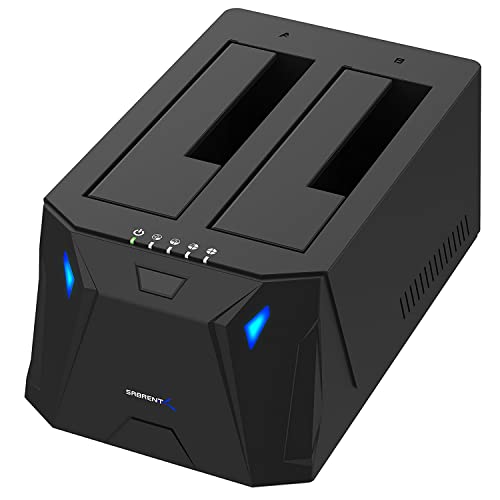
Budget Dual-Bay Cloner – SABRENT USB 3.0 Dual Bay Dock
If you need hard drive duplicators for large files without overcomplicating the workflow, this Sabrent dual-bay dock gives you a simple offline cloning option plus USB 3.0 connectivity for everyday transfers. It supports 2.5-inch and 3.5-inch SATA hard drives and SSDs, making it a practical pick for straightforward drive-to-drive copying and file access.
Best For: Users who want an easy dual-bay dock for offline cloning and normal large-file transfers.
Pros:
- Offline cloning up to 60Mbps with no drivers needed
- USB 3.0 transfer speeds up to 5Gbps for connected use
- Supports standard 2.5-inch and 3.5-inch SATA hard drives or SSDs
- Plug-and-play design keeps setup simple
Cons:
- Cloning speed is capped at 60Mbps
- Designed for SATA drives only
- Maximum drive support is listed at up to 10TB
This is a good fit if you want a compact docking station that can handle large files and basic offline cloning without a dedicated duplicator chassis. It is more of a versatile dock-cloner than a high-volume production unit.
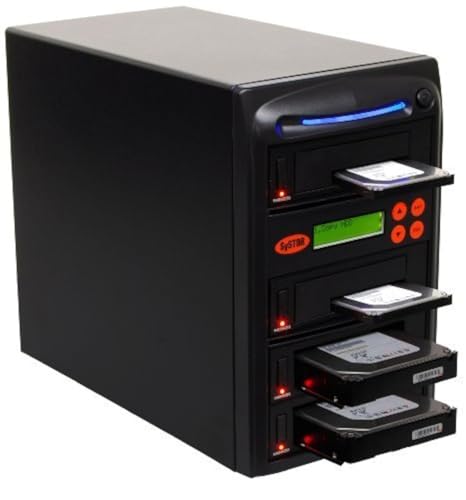
High-Speed 1-to-3 Duplicator – Systor SYS103HS-DP 1:3 Duplicator
For buyers comparing hard drive duplicators for large files, this Systor 1:3 model is built for standalone copying and sanitizing without a computer or software. It can duplicate multiple HDDs or SSDs at once, and the rated speed stays the same even as the load increases, which makes it useful for repeatable batch work.
Best For: Standalone multi-drive duplication and data erasure with consistent speed.
Pros:
- No computer or software required
- Copies multiple drives simultaneously at up to 90MB per second
- Supports both 3.5-inch and 2.5-inch hard drives without an adapter
- Can copy data only or whole drives, and erase drives to DoD 5220.22-M standards
Cons:
- Limited to 1:3 duplication
- Speed tops out at 5.4GB per minute
- Bulkier than a simple docking station
This model makes sense when you need a standalone duplicator that can handle large-file workflows and drive sanitization in one unit. Its biggest advantage is predictable multi-drive output without relying on a PC.
USB-C Offline Cloner – Sabrent Dual-Bay USB-C Dock
This Sabrent USB-C dock is a practical choice if you want hard drive duplicators for large files and also want a modern connection for computer-based work. It can clone one SATA drive to another offline at the press of a button, or mount both bays over USB so you can move files between drives from a Windows or Mac system.
Best For: Users who want USB-C convenience plus offline 1-to-1 SATA cloning.
Pros:
- Offline 1-to-1 cloning up to 60MBps
- Mounts both drives separately over USB for file transfers
- Supports 2.5-inch and 3.5-inch SATA HDDs and SATA SSDs
- Hot-swappable, tool-free design with an LED per bay
Cons:
- Target drive must be the same size as the source or larger for cloning
- Does not support IDE, PATA, Molex-powered, M.2, or NVMe drives
- USB-C cable is included, so the host computer needs USB-C or a separate adapter cable
It stands out as a flexible dock-cloner for people moving large files regularly and also needing simple offline duplication. If your drives are SATA-based, it offers a clean mix of cloning and everyday access.
Production 1-to-5 Duplicator – Systor SYS205HS-DP 1:5 Duplicator
If you need hard drive duplicators for large files in a more productive format, this Systor 1:5 unit is built to copy up to five HDDs or SSDs at once without using a computer. Its standalone design and higher throughput make it a strong fit for repeated cloning jobs where speed and volume matter.
Best For: Higher-volume standalone duplication and sanitization jobs.
Pros:
- No computer or software required
- Copies multiple drives simultaneously at up to 150MB per second
- Supports both 2.5-inch and 3.5-inch hard drives without an adapter
- Can copy data only or whole drives, and erase drives to DoD 5220.22-M standards
Cons:
- More specialized than a simple docking station
- Limited to a 1:5 duplication ratio
- Does not mention USB file-transfer use
For users who need repeatable multi-drive cloning, this unit is the most production-oriented option in the group. Its combination of standalone operation and faster rated throughput makes it well suited to large-file duplication workflows.
Offline Clone Dock for Everyday Backups – ORICO Dual Bay Cloning Dock
If you want hard drive duplicators for large files that are simple to use, this ORICO dual-bay dock is built around offline cloning and fast USB 3.0 access. It supports 2.5-inch and 3.5-inch SATA HDDs and SSDs, with up to 44TB total capacity, so it works well for moving big media libraries, backups, and disk images without a complicated setup.
Best For: Users who want a compact dual-bay dock for offline drive-to-drive cloning and large-capacity file transfers.
Pros:
- Offline clone function lets you duplicate a drive without connecting to a computer.
- Supports 2.5-inch and 3.5-inch SATA HDDs and SSDs up to 44TB total.
- USB 3.0 with UASP and Trim support helps speed up file backup and transfer work.
- Includes a 36W power supply and tool-free design for easier everyday use.
Cons:
- Target disk must be larger than the source disk for cloning.
- No-drive-inserted behavior means the unit will not power on without a drive present.
This is a practical choice if you need an approachable duplicator for large files and general SATA drive handling, especially when offline cloning matters more than advanced workstation features.
Standalone Multi-Drive Duplicator – Systor SYS305DP 1:5 Duplicator
For hard drive duplicators for large files in higher-volume workflows, the Systor SYS305DP stands out because it is fully standalone and can copy multiple drives at once. It supports both 3.5-inch and 2.5-inch drives, and its copy rate is listed at up to 300MB per second, making it a strong fit when you need to duplicate data or sanitize drives without using a computer.
Best For: IT teams or shops that need standalone multi-drive duplication and drive sanitization.
Pros:
- Copies multiple hard drives or SSDs simultaneously in a 1:5 layout.
- No computer or software required for operation.
- Supports both data-only copying and whole-drive duplication.
- Includes DoD 5220.22-M compliant data sanitization.
Cons:
- Designed more for duplication jobs than for everyday USB docking use.
- Bulkier workflow may be more than casual users need.
If your priority is fast, repeatable cloning of large files across several drives, this model is geared toward production-style use rather than simple home backup duties.
Dual-Bay Cloner with USB Hub – MAIWO SATA Docking Station
If you need hard drive duplicators for large files plus a little extra connectivity, this MAIWO dual-bay dock adds cloning and a 3-port USB 3.0 hub in one unit. It supports 2.5-inch and 3.5-inch SATA HDDs and SSDs up to 48TB total, and it can clone offline without a computer, which is useful for backups, file transfers, and recovery tasks.
Best For: Users who want a dual-bay duplicator with offline cloning and built-in USB hub expansion.
Pros:
- Offline cloning works without connecting to a computer.
- Supports both 2.5-inch and 3.5-inch SATA HDDs and SSDs up to 48TB total.
- USB 3.0 interface offers up to 5Gbps bandwidth for file transfers.
- Includes 3 USB 3.0 Type-A ports, including one 2.4A charging port.
Cons:
- Cloning progress is shown by LEDs rather than a detailed display.
- Like other dock-style cloners, it is limited to SATA drives.
This MAIWO model is a good fit if you want a cloning dock that doubles as a compact USB hub, especially when you are moving large data sets and need easy access to extra ports.
Multi-Drive NVMe Flex – FIDECO 3-Bay NVMe/SATA Cloner Dock
If you want hard drive duplicators for large files that can also handle mixed storage, this FIDECO dock is built for NVMe SSDs and 2.5/3.5-inch SATA drives in one tool. It supports offline cloning without software, and its 10Gbps USB 3.2 Gen 2 connection is aimed at moving large files quickly.
Best For: Users who need one dock for NVMe cloning, SATA access, and fast large-file transfers.
Pros:
- Supports 2 NVMe SSDs plus one 2.5/3.5-inch SATA HDD/SSD at the same time.
- Offline clone modes include NVMe to NVMe and 2.5/3.5-inch SATA to NVMe.
- USB 3.2 Gen 2 delivers up to 10Gbps transfer speed for large files.
- Foldable cooling fan helps reduce heat during heavier workloads.
Cons:
- Offline cloning requires the target drive to be equal to or larger than the source.
- Clone failures are indicated by flashing blue lights, so setup needs attention.
- Best suited to supported NVMe and SATA drive types rather than broader legacy formats.
This is a practical choice if your workflow mixes cloning and day-to-day file access across NVMe and SATA drives. The cooling fan and 10Gbps USB speed make it especially relevant for large file handling.
Five-Bay Clone Station – MAIWO 5-Bay SATA Dock
For buyers comparing hard drive duplicators for large files, this MAIWO 5-bay dock focuses on simple SATA cloning and multi-drive expansion. It supports offline cloning without a computer, and its USB 3.0 connection with UASP is designed for faster transfers when you are moving data or backing up files.
Best For: Users who want a 5-bay SATA dock for offline cloning and high-capacity storage expansion.
Pros:
- Offline clone function works without needing a computer.
- Supports up to 110TB total capacity across 5 bays.
- Compatible with 2.5-inch and 3.5-inch SATA HDDs and SSDs.
- Digital 0%-100% cloning display makes progress easy to monitor.
Cons:
- Supports SATA drives only, not NVMe.
- Maximum stated transfer speed is 5Gbps, not the faster 10Gbps class.
- The open design may not suit users looking for a fully enclosed dock.
This dock makes sense if you need multiple SATA drives in one place and value a straightforward offline clone workflow. The progress display and capacity support add convenience for backup-heavy setups.
IT Pro Clone & Wipe – StarTech 4-Bay Duplicator/Eraser
This StarTech unit is a more specialized option among hard drive duplicators for large files because it combines standalone cloning with drive erasing and docking. It works with 2.5/3.5-inch SATA drives, supports IDE via included adapters, and offers up to 4.2 GB/min sector-by-sector duplication.
Best For: IT professionals who need cloning, secure erasure, and dock access in one standalone tool.
Pros:
- Standalone cloning and erasing work without a host computer.
- Supports 2.5/3.5-inch SATA drives and IDE drives with included adapters.
- Quick Erase and Secure Erase options support sanitizing workflows.
- LCD menu and drive doors make operation more controlled and organized.
Cons:
- Cloning is limited to SATA and IDE drive families rather than NVMe.
- Target disk must be equal to or larger than the source disk.
- It is more tool-oriented than a simple plug-and-transfer dock.
This model stands out if you need one device for copying, wiping, and dock-style access. Its standalone operation and erase modes make it especially useful for professional maintenance and decommissioning tasks.
How We Picked Hard Drive Duplicators for Large Files
We focused on sustained clone performance, supported drive formats, bay count, and whether the unit can handle large transfers without relying on a computer. For Hard Drive Duplicators for Large Files, consistent throughput matters more than peak headline numbers, especially when copying multi-hundred-gigabyte or multi-terabyte drives.
We also favored models with clear standalone workflows, good thermal design, and broad compatibility with 2.5-inch and 3.5-inch SATA drives, plus NVMe where relevant.
Quick Comparison
Dual-bay docks are best for quick one-to-one duplication and occasional backups. 1:3 and 1:5 duplicators suit users who need to copy one source to multiple drives at once, which is useful for IT deployment, media distribution, and archive workflows. Multi-bay docks with cloning functions add flexibility when you need both everyday access and offline duplication.
Key Buying Factors for Hard Drive Duplicators for Large Files
Clone Speed and Sustained Performance
Don’t just look at the maximum advertised rate. Large file sets are better served by stable sustained copying, especially when drives are nearly full or contain many mixed-size files. Faster is helpful, but consistency is what keeps long jobs predictable.
Drive Support and Capacity
Check whether the unit supports SATA HDDs, SATA SSDs, M.2 NVMe drives, or a combination. If your workflow spans backup disks, video drives, and project archives, compatibility matters as much as speed. Also confirm the maximum supported capacity if you work with high-density drives.
Number of Targets
Choose the bay count based on your workflow. One-to-one duplication is enough for personal backups, while 1:3 or 1:5 systems are better for businesses, labs, and teams that need identical copies for multiple users or devices.
Offline Cloning and Ease of Use
Standalone cloning is valuable when you want a simple, reliable process without software setup. Clear status indicators, one-button copy functions, and safe eject behavior reduce mistakes during long transfers.
Who Should Buy Which Hard Drive Duplicators for Large Files?
If you want a simple desktop solution for occasional cloning and drive access, a dual-bay dock is usually the best fit. If your priority is duplicating large datasets to several drives at once, choose a higher-bay standalone duplicator. Users with mixed NVMe and SATA storage should look for hybrid models that can handle both in one workflow.
For IT teams, photographers, editors, and anyone managing large archives, the best choice is the one that balances speed, compatibility, and the number of copies you need to make regularly.