
Choosing among handheld 3D scanners can be tricky: some prioritize speed and portability, while others focus on precision, color capture, or easier tracking on larger objects.
This roundup narrows the field to 10 strong options for 3D printing, hobby scanning, and practical reverse-engineering work—so you can match the scanner to your budget and use case.
Best 10 Handheld 3d Scanners Picks for 2026
Outdoor Flexible Scanning

- Wi-Fi 6.0 wireless scanning and mobile streaming
- 0.05 mm accuracy with infrared and laser modes
- Scans outdoors up to 20,000 lux
Best For: Portable scanning for 3D printing, reverse engineering, and outdoor capture
Beginner-Friendly Detail

- 0.07 mm accuracy and 0.10 mm resolution
- Markerless AI helps relock during handheld scans
- JMStudio handles scanning, editing, and optimization
Best For: Beginners and hobbyists needing an easy medium-format scanner
Wireless Precision Pick
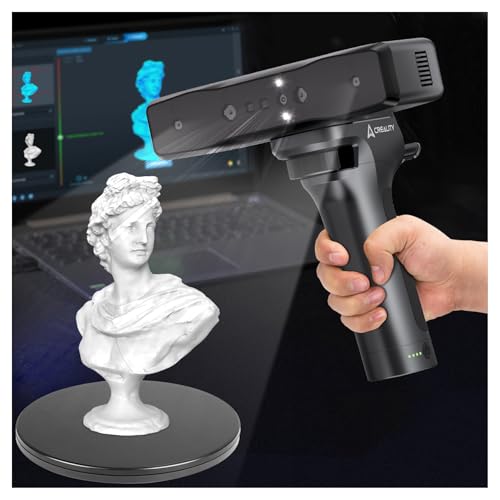
- 0.05 mm accuracy with infrared structured light
- Wi-Fi and smartphone-based mobile control
- Handles objects from 20 mm³ to 2000 mm³
Best For: Users who want a wireless handheld scanner for varied object sizes
High-End Multi-Mode Capture

- Up to 0.03 mm single-frame accuracy
- Five modes for indoor, outdoor, and specialty capture
- Wireless Wi-Fi 6.0 with mobile preview and control
Best For: Advanced scanning across precision parts, large objects, and difficult surfaces
Value Wireless Pick

- Dual-mode scanning for large and detailed objects
- Up to 0.1mm accuracy with full-color capture
- ASIC processing helps improve speed and tracking
Best For: Portable scanning with color texture capture and Android/PC use
Precision Quiet Pick
3DMakerpro Moose Lite Premium Kit

- 0.05mm accuracy with 0.1mm resolution
- AI tracking plus integrated scanning software
- Lightweight design with no fan noise
Best For: Detailed medium-object scanning with a quiet, portable build
Wireless Performance Pick

- WiFi 6 Bridge for faster wireless transfer
- 0.1mm accuracy with 30FPS scanning
- Anti-shake tracking and outdoor-capable design
Best For: Wireless scanning with stable tracking and broad device support
Editor’s Choice
Revopoint POP3 Plus 3D Scanner
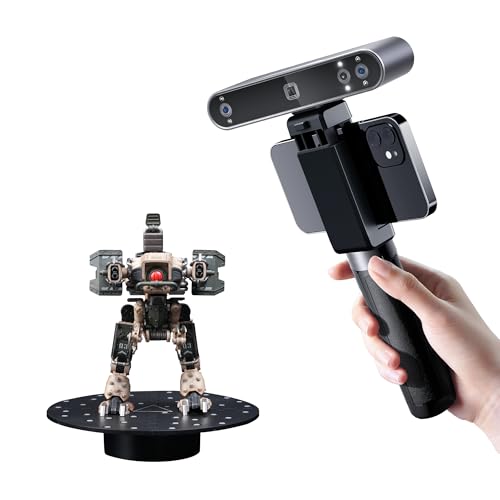
- 20-micron accuracy with improved calibration
- Full-color scanning with Wi-Fi 6 or USB-C
- Lightweight 190g design with broad file support
Best For: Portable scanning for medium-sized objects and scan-to-CAD workflows
Best for Precision

- Up to 0.02mm accuracy with blue laser scanning
- Fast capture up to 60fps with anti-shake tracking
- 24-bit full-color scans for small to large objects
Best For: Precision scanning for industrial parts, miniatures, and larger objects
Best for Beginners

- Easy-to-use wireless handheld scanner
- Lightweight 105g body with travel-friendly kit
- 24-bit full-color scanning with anti-shake tracking
Best For: Entry-level users who want simple wireless scanning for medium-sized objects
Outdoor Flexible Scanning – Revopoint INSPIRE 2
If you want handheld 3d scanners that can move between indoor work, outdoor capture, and mobile workflows, the Revopoint INSPIRE 2 is built for that kind of flexibility. It combines Wi-Fi 6.0 wireless scanning, infrared structured light, and multi-line laser modes so you can handle different surfaces and object sizes without switching tools.
Best For: Users who want a lightweight, wireless scanner for 3D printing, reverse engineering, and outdoor or on-the-go capture.
Pros:
- Wireless Wi-Fi 6.0 scanning with PC-to-mobile interactive streaming
- 11 infrared laser lines help scan dark or reflective surfaces without spray
- 0.05 mm accuracy, 0.03 mm precision, and support for outdoor scanning up to 20,000 lux
- Includes RGB texture capture and a full scan-to-CAD workflow option
Cons:
- Revo Design is sold separately and supports Windows only
- Requires fairly strong system specs for best performance
- Some advanced workflows depend on the companion software ecosystem
Overall, the INSPIRE 2 is a strong pick if portability and mixed-surface performance matter more than a basic plug-and-scan setup. It looks especially practical for creators who need one scanner for field use, textured models, and precise follow-up work.
Beginner-Friendly Detail – 3DMakerpro Fox
For shoppers comparing handheld 3d scanners at the entry level, the 3DMakerpro Fox aims to make medium-format scanning approachable without giving up useful detail. It pairs 0.07 mm accuracy with markerless AI visual tracking, so it is designed to help beginners recover quickly if a handheld pass gets shaky.
Best For: Beginners and hobbyists who want an accessible scanner for detailed prints, modeling, and quality checks.
Pros:
- Entry-level design with medium-format scanning support
- 0.07 mm accuracy and 0.10 mm resolution for detailed results
- Markerless AI visual tracking can relock after a missed pass
- JMStudio combines scanning, editing, and optimization in one workflow
Cons:
- Positioned more for beginners than advanced industrial users
- Focused on a single software ecosystem
- No extra outdoor or wireless feature set is highlighted in the supplied notes
The Fox makes the most sense if you want a straightforward way into handheld scanning and value software support that helps clean up the process. It is aimed at practical project work rather than maximum feature complexity.
Wireless Precision Pick – Creality Otter Lite
If you need handheld 3d scanners that balance precision with mobility, the Creality Otter Lite is built around wireless freedom and a wide object range. Its 0.05 mm accuracy, Wi-Fi support, and mobile control make it useful for users who want a portable scanner that still targets professional-grade results.
Best For: Engineers, designers, and hobbyists who want a wireless handheld scanner for small parts through larger objects.
Pros:
- 0.05 mm accuracy with infrared structured light
- Scans from tiny 20 mm³ objects up to 2000 mm³ parts
- Built-in Wi-Fi and smartphone display support for flexible scanning
- Works in low light or bright outdoor conditions up to 30,000 lux
Cons:
- Best performance depends on compatible Windows or macOS systems
- Wireless features may add workflow complexity for some users
- Not as heavily positioned around industrial-scale scanning as some higher-end models
In practice, the Otter Lite stands out as a versatile mobile scanner for mixed-size work and on-location use. It looks especially appealing if you want one handheld unit that can travel easily and still deliver sharp, detailed captures.
High-End Multi-Mode Capture – Revopoint POP 4
Among handheld 3d scanners, the Revopoint POP 4 is the most feature-heavy option here, with multiple scan modes, strong outdoor performance, and AI-assisted cleanup. It is built for users who want fine detail, fast capture, and flexible scanning across small parts, larger objects, and challenging surfaces.
Best For: Advanced users who need a multi-mode scanner for precision modeling, outdoor work, and complex surfaces.
Pros:
- Up to 0.03 mm single-frame accuracy and 0.03 mm + 0.05 mm x L(m) volumetric accuracy
- Five scanning modes, including laser, structured light, and VCSEL options
- Scans reflective metals and dark objects without scanning spray in blue light mode
- Wireless Wi-Fi 6.0 support with mobile cross-screen preview and control
Cons:
- Outdoor filter is sold separately
- Some AI features are Windows only
- Best results may depend on using the right scan mode for the object and lighting
The POP 4 is the most capable all-rounder in this group if you need more than simple handheld capture. Its strength is flexibility: it is designed to adapt to difficult surfaces, varied lighting, and both small and large scanning jobs.
Value Wireless Pick – Creality Ferret 3D Scanner
If you want handheld 3d scanners that balance portability, color capture, and broad device support, the Creality CR-Scan Ferret is a practical option. It combines dual-mode scanning with up to 0.1mm accuracy in fine-detail mode, plus a built-in RGB camera for full-color models. The latest firmware and ASIC processing are aimed at smoother tracking and faster output, which helps when scanning both larger objects and smaller parts.
Best For: Users who want a portable scanner for color models, mixed-size objects, and mobile-friendly scanning on supported devices.
Pros:
- Dual-mode scanning covers large objects and fine-detail work, with up to 560 × 820 mm range per scan.
- Up to 0.1mm accuracy and 0.16mm resolution in high-accuracy mode.
- ASIC chipset supports up to 60 FPS image processing and 30 FPS point cloud capture.
- Built-in RGB camera captures full-color textures for more realistic models.
Cons:
- Mobile scanning is limited to Android support on this model.
- Requires specific system specs, including newer CPUs and 8GB RAM on most platforms.
This is a strong pick if you want a flexible scanner that emphasizes speed, portability, and color output. It is especially appealing for buyers who plan to move between PC and supported mobile setups.
Precision Quiet Pick – 3DMakerpro Moose Lite Premium Kit
Among handheld 3d scanners, the 3DMakerpro Moose Lite Premium Kit stands out for buyers who care most about fine detail and low-noise operation. It uses blue light technology with AI visual tracking, delivering up to 0.05mm accuracy and 0.1mm resolution. The software also combines scanning, editing, and optimization, which makes it easier to move from raw capture to a printable model.
Best For: Makers who want a lightweight, high-precision scanner for medium objects and detailed print-ready models.
Pros:
- Up to 0.05mm accuracy and 0.1mm resolution for detailed captures.
- AI visual tracking and point cloud processing help preserve object detail.
- JMStudio combines scanning, editing, and optimization in one workflow.
- Lightweight design and no fan noise make it easy to use in quiet spaces.
Cons:
- Scanning speed is 10 FPS, which is slower than some faster handheld options.
- Best fit is medium objects, so it may not be the top choice for very large scans.
If you want precision first and convenience second, this scanner is easy to recommend. Its combination of accuracy, quiet operation, and all-in-one software makes it a solid tool for 3D printing projects.
Wireless Performance Pick – Creality Ferret Pro
If you want handheld 3d scanners with stronger mobility, the Creality CR-Scan Ferret Pro is built around wireless workflow and stable tracking. It delivers up to 0.1mm accuracy, 0.16mm resolution, and 30FPS scanning, while WiFi 6 Bridge support speeds up transfer for a smoother process. It also adds anti-shake tracking and one-shot 3D imaging, which can make scanning easier for beginners and more forgiving when your hands move.
Best For: Users who want wireless scanning, dependable tracking, and color 3D capture on supported iOS, Android, and PC setups.
Pros:
- Wireless WiFi 6 Bridge improves data transfer speed and workflow stability.
- Up to 0.1mm accuracy, 0.16mm resolution, and 30FPS scanning.
- Anti-shake tracking and one-shot 3D imaging help reduce scan errors.
- Supports outdoor scanning in ambient light up to 30,000 lux.
Cons:
- Not ideal for highly reflective, transparent, or extremely dark surfaces.
- Wireless phone scanning is limited by device compatibility requirements.
This is the most mobility-focused option in the group, especially if you want wireless scanning and broad workflow flexibility. It makes the most sense for users who value convenience without giving up detailed output.
Editor’s Choice – Revopoint POP3 Plus 3D Scanner
If you want a versatile handheld 3d scanner for everyday 3D printing and design work, the Revopoint POP3 Plus is built around accuracy, portability, and easy workflow integration. It combines refined precision, full-color capture, and broad file support in a lightweight body that suits both desktop and mobile scanning setups.
Best For: Users who want a portable, full-color scanner for medium-sized objects, scan-to-CAD work, and cross-device scanning.
Pros:
- Up to 20 microns of accuracy with a new calibration board and improved precision.
- Optical zoom and 18 fps scanning help capture more point cloud detail.
- Full-color scanning with HD RGB camera, pixel mapping, and Flash LED lighting.
- Works with iOS, Android, Windows, and macOS via Wi-Fi 6 or USB-C.
Cons:
- Revo Scan is only compatible with x86_64 architecture.
- Best suited to medium-sized objects rather than the tiniest parts.
Overall, the POP3 Plus is a strong all-rounder if you want a handheld scanner that balances precision, portability, and software support without getting overly specialized.
Best for Precision – Creality CR-Scan Raptor
The Creality CR-Scan Raptor is a handheld 3d scanner aimed at users who need high accuracy and fast capture across a wide range of object sizes. With blue laser and NIR scanning, it’s designed for detailed model work, reverse engineering, and full-color scans with less setup.
Best For: Users who want a precision-focused scanner for small-to-large objects, including industrial parts, figurines, and full-body scans.
Pros:
- Up to 0.02mm accuracy with 7 parallel blue laser lines.
- Fast scanning up to 60fps in blue laser mode.
- Supports very small to very large objects, from 5×5×5mm to 2000×2000×2000mm.
- 24-bit full-color scanning with dual lighting for richer textures.
Cons:
- Requires a fairly capable computer for best results.
- Wireless convenience is not the main focus compared with dedicated mobile-first models.
For buyers who care most about scan quality and speed, the Raptor stands out as the most technically ambitious option in this group.
Best for Beginners – Creality CR-Scan Ferret Pro
The Creality CR-Scan Ferret Pro is a handheld 3d scanner built for first-time users who want simple setup, wireless freedom, and easy color scanning. Its lightweight design and cross-platform support make it a practical pick for home projects, casual creators, and portable scanning sessions.
Best For: Beginners and DIY users who want a lightweight wireless scanner for medium-sized objects and mobile scanning.
Pros:
- WiFi 6 wireless scanning with Windows, macOS, Android, and iOS support.
- Lightweight 105g body is easy to carry and use anywhere.
- 24-bit full-color scanning with anti-shake tracking.
- Comes with a useful kit including WiFi box, tripod, power bank, phone holder, and carrying case.
Cons:
- Not suitable for very small or highly detailed items like jewelry or precision parts.
- Best results depend on avoiding reflective, transparent, or very dark surfaces.
If you want a low-fuss entry point into handheld scanning, the Ferret Pro is the most approachable option here, especially for everyday objects and travel-friendly use.
How We Picked These Handheld 3d Scanners
We focused on scanners that offer a useful mix of accuracy, tracking stability, scanning speed, object-size flexibility, and workflow convenience. For buyers comparing Handheld 3d Scanners, that usually matters more than a single headline spec.
We also favored models with broad device compatibility, clearer setup paths for beginners, and features that reduce rescans, such as anti-shake tracking, wireless operation, AI-assisted segmentation, or full-color capture.
Quick Comparison: What Matters Most
If you want the shortest path to a decision, start with your main priority. High-accuracy models are better for mechanical parts and fit-critical work. Wireless or anti-shake options are often easier for fast mobile scanning. Full-color scanners make more sense for visual assets, props, and display models.
Among Handheld 3d Scanners, the best choice is rarely the one with the biggest spec sheet—it is the one that matches your object size, intended output, and tolerance for post-processing.
Key Buying Factors for Handheld 3d Scanners
Accuracy and Resolution
Look for accuracy if you need parts to fit together, while resolution matters more for capturing fine surface detail. For cosplay, figurines, and general 3D printing, moderate accuracy can be enough. For engineering or replacement parts, prioritize tighter accuracy claims.
Tracking and Scan Stability
Good tracking helps the scanner stay locked onto the subject as you move around it. Anti-shake features, better surface tracking, and support for markers can make a big difference on reflective, dark, or feature-poor objects.
Scan Speed and Object Size
Fast scan rates help with larger objects and reduce fatigue, but speed alone does not guarantee better results. Make sure the scanner suits the size of the items you actually scan—small props, medium consumer goods, or larger body-sized objects all have different needs.
Connectivity and Workflow
Wireless models can be more convenient in the field, while USB-tethered setups may feel more stable on a desk. Also consider software quality, export formats, and whether the scanner works with your computer or Android workflow.
Who Should Buy Which Handheld 3d Scanners?
Beginners and casual makers should look for an easy-to-use handheld 3D scanner with solid tracking and forgiving software. If you scan small-to-medium objects for printing, a balanced all-around model is often the safest buy.
Creators and prosumers who want more detail should lean toward higher-precision or color-capable scanners. If your work involves parts, product mockups, or reverse engineering, choose the scanner that best balances accuracy, speed, and post-processing time rather than chasing one spec alone.