
A reliable field monitor for DSLR cameras can make focusing, framing, and exposure checks much easier than relying on a built-in display. The right model gives you a larger, brighter view while adding tools such as focus peaking, histograms, false color, and 3D LUT support.
This roundup covers 10 options ranging from compact 5.5-inch monitors to bright 7-inch displays. We compare screen brightness, resolution, HDMI support, touch controls, power considerations, and outdoor usability so you can choose a monitor that fits your camera and shooting style.
Best 10 Field Monitor for Dslr Picks for 2026
Best for Bright Outdoor Shoots
NEEWER F700 7-inch 2000nit Monitor

- 2000-nit touchscreen with auto backlight control
- 4K HDMI loop-through and headphone monitoring
- Advanced waveform, LUT, focus, and exposure tools
Best For: Bright outdoor DSLR and mirrorless filming
Best Complete Lightweight Bundle
FEELWORLD S55 V3 6-inch Monitor
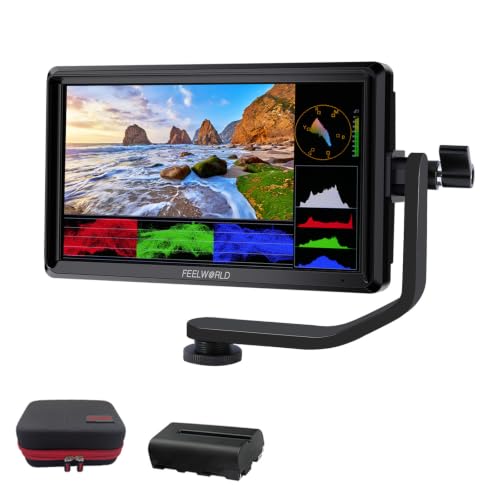
- Compact 6-inch Full HD display for portable rigs
- 4K HDMI input and loop-out with audio monitoring
- Includes battery, case, sunshade, tilt arm, and cables
Best For: Handheld, gimbal, and ready-to-shoot DSLR setups
Best for SDI Workflows
NEEWER F700U 7-inch OLED Monitor

- 1200-nit 7-inch OLED touchscreen
- Adds 3G-SDI input and output to 4K HDMI loop-out
- Includes two NP-F750 batteries and advanced monitoring tools
Best For: Advanced DSLR and video rigs requiring HDMI and SDI
Best Compact High-Brightness Pick
VILTROX DC-550 5.5-inch Monitor

- 1200-nit 1080p touchscreen with Rec.709 calibration
- 4K HDMI input and output with professional monitoring tools
- Includes battery, sunshade, case, adapters, and cables
Best For: Compact, bright DSLR and mirrorless camera rigs
Best Lightweight Touchscreen

- 7-inch 1280x800 touchscreen display
- Focus, histogram, zebra, and false color tools
- 300g body with batteries and cables included
Best For: Beginner creators and lightweight DSLR rigs
Best Feature-Rich 7-Inch Option
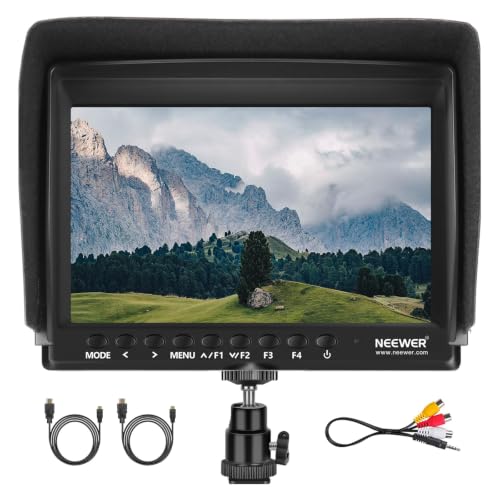
- 450-nit 7-inch 1280x800 IPS screen
- Extensive focus, exposure, and framing tools
- Ball head, sunshade, and HDMI cables included
Best For: Format-flexible DSLR filming and stabilizer setups
Best for Bright Outdoor Shooting

- 1600-nit 5.5-inch sunlight-visible display
- Waveform, histogram, false color, and LUT preview
- Mounts on cameras, cages, gimbals, and tripods
Best For: Outdoor filming and professional Log workflows
Best Sunlight-Ready Pick
Portkeys HD7H 7-Inch Field Monitor

- 1,000-nit display for daylight viewing
- 4K30p HDMI input with audio output
- Focus, exposure, and anamorphic tools
Best For: Outdoor DSLR filming and bright shooting locations
Best Full HD Upgrade
FEELWORLD FW568 PRO 6-Inch Monitor

- 1920×1080 IPS screen
- 1,200-nit outdoor visibility
- Waveform, vectorscope, histogram, and LUT preview
Best For: Creators seeking detailed monitoring and professional exposure tools
Best Beginner-Friendly Option
FEELWORLD S55 V3 6-Inch Monitor

- Full HD screen with 4K HDMI in/out
- Waveform, focus assist, false color, and 3D LUT
- Multiple power and mounting options
Best For: Indoor creators and beginners building a DSLR video setup
Best for Bright Outdoor Shoots – NEEWER F700 7-inch 2000nit Monitor
If you need a field monitor for DSLR filming in bright daylight, the NEEWER F700 stands out with its 2000-nit touchscreen and automatic backlight control. Its 7-inch 1080p display, 4K HDMI loop-through, and extensive exposure and focus tools make it useful for outdoor productions and more demanding camera setups.
Best For: DSLR and mirrorless shooters who need a highly visible monitor for bright outdoor work.
Pros:
- Very bright 2000-nit IPS touchscreen with automatic ambient-light adjustment.
- Supports 4K HDMI input and loop output, plus headphone audio monitoring.
- Includes waveform, vectorscope, false color, zebras, histogram, HDR, and focus tools.
- Accepts NP-F batteries, USB-C power, or DC input and can provide 8V camera power.
Cons:
- Battery and DC power cable are not included.
- At 1.6 pounds, it is less suitable for very lightweight rigs.
- Custom LUT loading requires an SD card, which is not included.
The F700 is a strong choice when screen visibility and monitoring depth matter more than minimizing rig weight. Its cooling controls and flexible mounting options also support longer outdoor sessions.
Best Complete Lightweight Bundle – FEELWORLD S55 V3 6-inch Monitor
The FEELWORLD S55 V3 is a practical field monitor for DSLR users who want a ready-to-shoot kit rather than a bare display. It combines a compact 6-inch 1080p screen with 4K HDMI loop-out, a battery, carry case, sunshade, tilt arm, and camera-power output.
Best For: Handheld rigs, gimbals, and shooters who want useful accessories included.
Pros:
- Compact 6-inch Full HD display with a wide 160-degree viewing angle.
- Supports 4K HDMI input and loop-out for sending the signal to another display.
- Includes a rechargeable battery, case, sunshade, tilt arm, and cables.
- Offers NP-F and LP-E6 battery compatibility and 8.4V output for powering a camera.
Cons:
- Its 500 cd/m² brightness is lower than the brighter monitors in this roundup.
- The included camera dummy battery or coupler is not included.
- The supplied specifications identify the model as S55V 2, which may cause naming confusion.
For buyers building a portable DSLR setup, the S55 V3’s bundled accessories add real convenience. It is especially appealing when a sunshade, battery, and protective case would otherwise need to be purchased separately.
Best for SDI Workflows – NEEWER F700U 7-inch OLED Monitor
For a field monitor for DSLR setups that may also need professional video connectivity, the NEEWER F700U adds 3G-SDI input and output to a 7-inch OLED touchscreen. Its 1200-nit brightness, very high stated contrast ratio, 4K HDMI loop-out, and included NP-F750 batteries make it well suited to more advanced production rigs.
Best For: Videographers who need both HDMI and SDI connectivity with an OLED display.
Pros:
- 7-inch 1080p OLED touchscreen with 1200-nit brightness and 100000:1 contrast.
- Provides 4K HDMI input and loop-out plus 3G-SDI input and output.
- Includes two 4400mAh NP-F750 batteries.
- Offers waveform, vectorscope, false color, zebras, histogram, HDR, and custom LUT support.
Cons:
- SDI cable and DC adapter are not included.
- Custom LUT loading and firmware updates require an SD card, which is not included.
- Its broader connectivity may be unnecessary for basic HDMI-only DSLR users.
The F700U is the most connectivity-focused option here. Choose it if SDI compatibility and OLED contrast are priorities; for a simple DSLR-only rig, its professional inputs may add more capability than you need.
Best Compact High-Brightness Pick – VILTROX DC-550 5.5-inch Monitor
The VILTROX DC-550 is a compact field monitor for DSLR cameras that balances a 1200-nit touchscreen with a supplied sunshade and battery. Its 5.5-inch 1080p IPS panel, 4K HDMI loop-through, professional exposure tools, and included cables make it a convenient option for smaller camera rigs.
Best For: DSLR and mirrorless users who want a bright, compact monitor with accessories included.
Pros:
- 1200-nit IPS touchscreen with 1080p resolution and Rec.709 color calibration.
- Supports 4K HDMI input and output with a headphone jack for audio monitoring.
- Includes an NP-F550 battery, sunshade, carry case, cold shoe adapter, and HDMI cables.
- Provides waveform, vectorscope, histogram, false color, focus assist, HDR, and 3D LUT support.
Cons:
- The 5.5-inch screen is smaller than the 6- and 7-inch alternatives.
- Only one NP-F550 battery is included.
- Its 4K support is paired with a native 1920×1080 display.
The DC-550 makes sense for shooters who value portability without giving up a bright screen or professional monitoring aids. Its complete accessory package also reduces the setup work for new DSLR video rigs.
Best Lightweight Touchscreen – FEELWORLD FW759 Pro
If you want a practical field monitor for DSLR setups, the FEELWORLD FW759 Pro provides a larger 7-inch 1280×800 IPS display for easier framing and focus checks. Its touchscreen controls, HDMI connectivity, multiple power options, and included accessories make it convenient for handheld rigs, gimbals, studio work, and location shooting.
Best For: Beginners, vloggers, interview creators, and anyone needing a lightweight monitor with touchscreen controls and a complete starter kit.
Pros:
- 7-inch 1280×800 IPS screen offers a clearer view than a camera’s built-in display.
- Includes histogram, zebra, focus assist, and false color tools for exposure and focus checks.
- Lightweight 300g design suits handheld and gimbal rigs.
- Includes two F550 batteries, sunshade, mounting hardware, and HDMI cables.
Cons:
- At 400 nits, the display is less bright than some monitors designed for direct sunlight.
- Uses a single HDMI port.
The FW759 Pro is a well-rounded choice when portability, touchscreen operation, and included power accessories matter more than maximum outdoor brightness.
Best Feature-Rich 7-Inch Option – NEEWER F100
The NEEWER F100 is a capable field monitor for DSLR users who want a large 7-inch viewing area and extensive monitoring controls. Its 450-nit 1280×800 IPS panel supports common HD video formats, while the included ball head and sunshade help with mounting and outdoor viewing.
Best For: Filmmakers and DSLR operators who need broad format support, detailed framing aids, and flexible positioning on a camera or stabilizer.
Pros:
- 7-inch IPS display provides 1280×800 resolution, 450-nit brightness, and a 1200:1 contrast ratio.
- Offers peaking, histogram, pixel-to-pixel, safe frames, image flip, freeze, and grid tools.
- Supports a wide range of 480p through 1080p video formats.
- Includes a 360-degree ball head, sunshade, and HDMI-to-mini/micro HDMI cables.
Cons:
- Battery is not included.
- Weighs 733g, making it less suitable for very lightweight gimbal setups.
- Uses HDMI connectivity with one HDMI port.
The F100 stands out for its comprehensive monitoring tools and mounting flexibility, but plan for a separate battery and account for its heavier build.
Best for Bright Outdoor Shooting – FEELWORLD F5 Prox
For outdoor work, the FEELWORLD F5 Prox is a field monitor for DSLR cameras with a highly bright 5.5-inch display rated at 1600 nits. It combines touchscreen-style field monitoring with focus and exposure tools, including waveform, histogram, false color, and LUT preview for Log workflows.
Best For: Outdoor filmmakers, wedding and commercial shooters, travel vloggers, and creators who prioritize sunlight visibility in a compact monitor.
Pros:
- 1600-nit display is designed to remain visible in direct sunlight.
- Includes focus peaking, waveform, histogram, false color, and LUT preview tools.
- Works with DSLR, mirrorless, and cinema cameras.
- Mounts on rigs, cages, gimbals, tripods, and handheld setups.
Cons:
- 5.5-inch screen is smaller than the 7-inch alternatives in this roundup.
- Listed weight is 2.82 pounds, which may be substantial for some lightweight rigs.
- Fewer included accessories are specified in the supplied details.
The F5 Prox is the strongest fit when direct-sun visibility and advanced exposure assistance are top priorities, though its smaller screen and listed weight may influence rig balance.
Best Sunlight-Ready Pick – Portkeys HD7H 7-Inch Field Monitor
If you need a field monitor for DSLR work outdoors, the Portkeys HD7H emphasizes visibility with a 1,000-nit display and included sunshade. Its 7-inch screen, HDMI support, and practical focus and exposure tools make it a useful upgrade for DSLR and mirrorless camera rigs.
Best For: DSLR shooters who prioritize bright, outdoor-viewable monitoring and a larger screen.
Pros:
- 1,000-nit 7-inch IPS display is designed for daylight viewing.
- Supports HDMI video up to 4K30p and includes headphone audio monitoring.
- Includes luma histogram, false color, focus peaking, zoom, and anamorphic de-squeeze tools.
- Lightweight 278g body with three 1/4-inch mounting threads.
Cons:
- Native resolution is 1280×720 rather than Full HD.
- NP-F battery is not included.
The HD7H is a strong choice when sunlight readability and flexible mounting matter most. Its lower native resolution may be less appealing if you want the sharpest possible on-camera preview, but the high brightness and monitoring tools are well suited to field production.
Best Full HD Upgrade – FEELWORLD FW568 PRO 6-Inch Monitor
The FEELWORLD FW568 PRO is a practical field monitor for DSLR users who want a sharper Full HD preview without adding much weight to a camera rig. Its 1,200-nit screen, 4K HDMI input/output, and advanced scopes support more confident exposure and focus decisions.
Best For: Filmmakers, vloggers, and event shooters who want Full HD monitoring with strong daylight visibility.
Pros:
- 1920×1080 IPS display provides a detailed preview.
- 1,200-nit brightness is suitable for outdoor filming.
- Includes waveform, vectorscope, RGB histogram, focus assist, and LUT preview tools.
- Supports NP-F or USB-C power and can provide DC 8.4V output to a camera.
Cons:
- The supplied details list the item weight as 1.76 pounds, so verify the actual kit weight if using a gimbal.
- Its advanced controls may be more than beginners need for simple monitoring.
With its combination of high brightness, Full HD resolution, and professional scopes, the FW568 PRO is the most feature-focused option in this group. It is especially compelling when accurate exposure checks and LUT preview are more important than keeping a rig minimal.
Best Beginner-Friendly Option – FEELWORLD S55 V3 6-Inch Monitor
For beginners looking for a field monitor for DSLR or mirrorless cameras, the FEELWORLD S55 V3 combines a Full HD screen with straightforward mounting and multiple power options. It also includes waveform, focus assist, false color, and 3D LUT support for creators who are ready to improve their monitoring workflow.
Best For: Beginner videographers, vloggers, and indoor creators who want a capable external camera screen.
Pros:
- 1920×1080 IPS display with 4K HDMI input/output up to 4K30Hz.
- Offers waveform, vectorscope, RGB histogram, false color, focus assist, and 3D LUT support.
- Supports Type-C, DC, NP-F, and LP-E6 power options.
- Can mount through a 1/4-inch thread or hot-shoe tilt arm and includes a sunshade.
Cons:
- At roughly 450–500 nits according to the supplied notes, it is less bright than the other two monitors.
- The product details identify the model series as S55 V2 in places, so confirm the exact package version before buying.
The S55 V3 offers a useful balance of resolution, monitoring tools, and setup flexibility. It is best suited to indoor work and moderate lighting; outdoor users who frequently shoot in direct sun may prefer a brighter monitor such as the FW568 PRO or HD7H.
How We Picked the Best Field Monitor for Dslr
We focused on features that affect real-world monitoring rather than headline specifications alone. The selected models were compared for screen size, resolution, brightness, viewing usability, HDMI compatibility, focus and exposure tools, touch or shortcut controls, and included accessories such as sun hoods or battery solutions. We also considered how easily each monitor could fit into a compact DSLR rig.
Brightness received particular attention because a monitor used outdoors needs to remain readable in changing light. However, a brighter panel may consume more power, so battery compatibility and practical portability remain important trade-offs.
Quick Comparison
| What to compare | Why it matters |
|---|---|
| Screen size | 5.5- to 6-inch models save space; 7-inch displays are easier to inspect. |
| Brightness | Higher nit ratings generally improve outdoor visibility, especially without a hood. |
| Resolution | 1920×1080 provides a sharper monitoring image than lower-resolution panels. |
| Input support | Check HDMI resolution and frame-rate compatibility with your DSLR or recorder. |
| Monitoring tools | Peaking, histograms, false color, zebras, and LUT support help with focus and exposure. |
Key Buying Factors for a Field Monitor for Dslr
Brightness and Outdoor Readability
For daylight shooting, look for a high-brightness display and consider a sun hood. Models rated around 1,000 nits or more are typically better suited to bright locations, while lower-brightness monitors can work well indoors, in shade, or when budget and battery life are priorities.
Resolution, Size, and Rig Balance
A 7-inch monitor offers a more comfortable view for critical focus, but it adds weight and takes up more space on a cage or articulating arm. A 5.5- or 6-inch model is easier to travel with. Full HD is preferable when you need to judge fine focus or texture accurately.
Camera Compatibility and Power
Confirm that your DSLR outputs a supported HDMI signal and that the monitor uses a battery type you already own or can easily source. Also check whether the package includes a cable, battery, charger, or carry case. HDMI monitoring may affect camera settings and battery life, so test the complete setup before an important shoot.
Useful Monitoring Tools
Focus peaking helps identify sharp edges, while histograms, zebras, and false color make exposure decisions more consistent. 3D LUT support is especially useful for previewing a graded look, but it should complement—not replace—a properly exposed recording.
Who Should Buy Which Field Monitor for Dslr?
Choose a bright 7-inch monitor if you frequently shoot outdoors, work from a tripod, or need the clearest possible view for manual focus. Pick a smaller 5.5- or 6-inch model for handheld rigs, travel, gimbals, and lightweight DSLR setups. A full-HD screen is a strong general-purpose choice, while a lower-resolution monitor may be sufficient for basic framing and playback.
For filmmakers who rely on exposure and focus aids, prioritize waveform-style tools, histograms, peaking, zebras, false color, and LUT functions over touch controls alone. If you mostly shoot in controlled indoor environments, a 400- to 500-nit display can offer good value. Outdoor creators should favor the brightest practical panel, a supplied hood, and a dependable battery system.