
Moving to a Canon EOS R camera doesn’t mean retiring your EF and EF-S lenses. An EF-to-RF adapter lets you mount them on an RF camera while retaining electronic lens functions when the adapter, lens, and camera support them.
These 10 options span Canon’s standard adapter, third-party alternatives, a control-ring model, and a drop-in filter kit. The best choice depends on which lenses you own and whether you value straightforward compatibility, extra controls, or filter convenience.
Best 10 Ef to Rf Lens Adapter Picks for 2026
OEM Standard Pick

- Canon standard adapter for EF/EF-S lenses
- Dust- and water-resistant construction
- Metal mounts on both sides
Best For: A straightforward Canon adapter without a control ring
Third-Party Control Ring

- Assignable control ring
- Autofocus, stabilization, and EXIF support
- Metal mounts with rear rubber ring
Best For: Adding a control ring to a third-party EF/EF-S adapter
Canon Control Ring Pick
Canon Control Ring Mount Adapter EF-EOS R

- Built-in control ring
- EF/EF-S compatibility
- Dust- and water-resistant design
Best For: Canon users who want quick-access controls on the adapter
Lightweight Tripod Option
K&F Concept EF to EOS R Adapter

- Listed weight of 40 g
- Autofocus and EXIF support
- Bottom 1/4-inch screw hole
Best For: Lightweight setups needing an adapter mounting point
Everyday EF Carryover

- AF and camera-side aperture control
- Metal mounts on both sides
- Listed dust- and water-resistant
Best For: Adapting EF/EF-S lenses to listed EOS R-series bodies
Tripod-Ready Pick

- Removable 1/4"-20 tripod foot
- Retains AF and lens stabilization
- Excludes Sigma EF/EF-S lenses
Best For: Compatible EF/EF-S setups needing a tripod foot
Video-Body Option

- Lists C70 and RED Komodo support
- AF and automatic aperture contacts
- Conflicting water-resistance claims
Best For: EF/EF-S users considering listed cinema or EOS R bodies
Best with Extra Features

- EF/EF-S to EOS R compatibility
- Autofocus, aperture control, and EXIF
- Bottom 1/4-inch mounting point
Best For: Photographers wanting an electronic adapter with a tripod mounting option
Weather-Resistant Pick
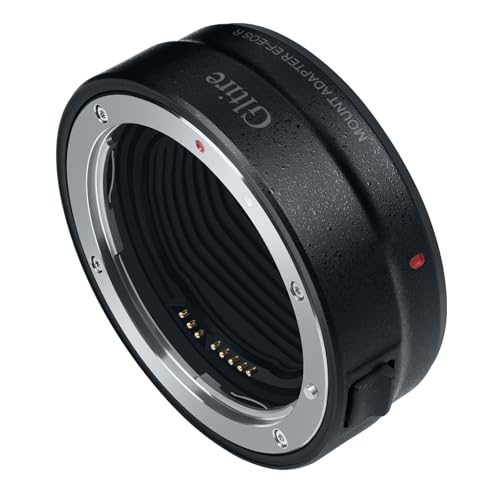
- Broad listed EOS R compatibility
- Autofocus, aperture, and EXIF support
- Stated dust and water resistance
Best For: Photographers seeking basic electronic adaptation with weather resistance
Drop-In Filter Pick

- ND3–ND500, CPL, and clear filters
- Retains autofocus and stabilization
- Removable tripod mount
Best For: Photographers wanting drop-in filters with adapted EF or EF-S lenses
OEM Standard Pick – Canon Mount Adapter EF-EOS R
Canon Mount Adapter EF-EOS R, Black | Allows -S Lens Compatibility with the R CameraExterior
Check Price On AmazonThis Canon ef to rf lens adapter lets you use EF and EF-S lenses on compatible EOS R cameras, including the EOS R, RP, R5, and R6. It is the straightforward choice when you want Canon’s standard adapter without an added control ring.
Best For: Canon shooters who want a standard EF/EF-S adapter for a compatible EOS R camera.
Pros:
- Supports both EF and EF-S lenses.
- Dust- and water-resistant construction.
- Metal mounts on the lens and camera sides.
Cons:
- No built-in control ring is listed.
Choose this model for the basic Canon-made connection; consider a control-ring adapter if you want an extra camera control at the mount.
The Meike MK-EFTR-B ef to rf lens adapter adds an assignable control ring while adapting EF and EF-S lenses to compatible EOS R cameras. Its listed functions include autofocus, lens image stabilization, and EXIF transmission.
Best For: Shooters who want an assignable control ring on a third-party EF/EF-S adapter.
Pros:
- Control ring can be assigned settings such as aperture, ISO, shutter speed, or exposure compensation.
- Supports autofocus, lens stabilization, and EXIF transmission.
- Metal front and rear mounts; a rear rubber ring helps with dust and water protection.
Cons:
- The rear rubber ring is described as improving protection, not guaranteeing a waterproof seal.
This is a useful alternative if the extra control matters to you; check your particular camera and lens combination against the stated compatibility before buying.
This Canon ef to rf lens adapter brings EF and EF-S lenses to the EOS R system and adds a built-in control ring for quick access to camera functions. The supplied compatibility list includes the EOS R, RP, R5, and R6.
Best For: Canon shooters who want a built-in control ring when adapting EF or EF-S lenses.
Pros:
- Built-in control ring provides quick access to camera functions.
- Compatible with EF and EF-S lenses on the listed EOS R cameras.
- Dust- and water-resistant design with metal mounts on both sides.
Cons:
- Weighs 4.64 ounces, more than the listed 3.84-ounce Canon standard adapter.
If you will use the ring regularly, this Canon model offers that control without giving up the stated dust- and water-resistant design.
The K&F Concept ef to rf lens adapter connects EF and EF-S lenses to compatible EOS R cameras while supporting autofocus, aperture control, lens stabilization, and EXIF transmission. At a listed 40 g, it also includes a bottom 1/4-inch screw hole for mounting accessories.
Best For: Shooters who want a lightweight adapter with a 1/4-inch mounting point.
Pros:
- Supports autofocus, aperture control, lens stabilization, and EXIF data.
- Listed weight is 40 g.
- Bottom 1/4-inch screw hole accommodates compatible mounting hardware.
Cons:
- Listed as not water-resistant.
- No control ring is listed.
This model is worth considering when low weight and the mounting point matter more than weather resistance or a control ring.
Everyday EF Carryover – YELLBIN EF-EOS R Adapter
Lens Mount Adapter EF-EOS R for Canon EF/EF-S Lens to Canon EOS R RP R5 R6 R7 R10 Cameras
Check Price On AmazonThis ef to rf lens adapter lets you use Canon EF and EF-S lenses on the listed EOS R-series bodies, including the R, RP, R5, R6, R7, and R10. It is a practical choice if you want to keep autofocus and camera-side aperture control while moving to a mirrorless body.
Best For: EOS R-series owners adapting existing Canon EF or EF-S lenses for everyday shooting.
Pros:
- Supports autofocus, aperture control, and transmission of shooting information.
- Metal mounts on both sides provide a sturdy lens-to-camera connection.
- Listed as dust- and water-resistant.
Cons:
- The supplied compatibility list does not include every EOS R-series body.
- No tripod foot is listed.
Choose this one for its straightforward feature set and stated sealing; check your specific camera model against the listed compatibility before buying.
This ef to rf lens adapter stands out for its removable tripod foot, which has a 1/4″-20 socket. JJC says it retains autofocus and image stabilization when adapting compatible EF or EF-S lenses to an RF-mount camera, but explicitly excludes Sigma EF/EF-S lenses.
Best For: RF-camera owners who want a tripod mounting option for a compatible EF or EF-S lens.
Pros:
- Removable tripod foot adds a 1/4″-20 mounting point.
- Aluminium-alloy and brass construction.
- Includes front and rear caps plus a storage pouch.
- Matte interior is designed to reduce reflections.
Cons:
- Not compatible with Sigma EF/EF-S lenses, according to the listing.
The tripod foot and included accessories make this the most purpose-built option here for supported tripod setups; the Sigma exclusion is the key compatibility check.
This ef to rf lens adapter is listed for Canon EOS R-series bodies as well as the C70 and RED Komodo. Its electrical contacts support autofocus, auto-exposure, and automatic aperture functions with compatible EF or EF-S lenses.
Best For: Shooters seeking a listed EF/EF-S adapter option for an EOS R camera, C70, or RED Komodo.
Pros:
- Listed compatibility includes the C70 and RED Komodo alongside several EOS R bodies.
- Electrical contacts support autofocus and automatic exposure and aperture functions.
- Metal construction and gold-plated contacts.
Cons:
- Water-resistance information conflicts: the bullets describe a waterproof structure, while the specifications say it is not water-resistant.
The broader stated camera compatibility is its main draw. Given the conflicting water-resistance information, do not rely on this adapter for weather protection without confirming that detail first.
Best with Extra Features – Commlite CM-EF-EOS R Adapter
The Commlite CM-EF-EOS R is an ef to rf lens adapter for using compatible Canon EF and EF-S lenses on EOS R-series cameras. Electronic contacts support autofocus, camera-side aperture adjustment, and EXIF transmission, while a bottom 1/4-inch screw mount provides a mounting option for a tripod or support frame.
Best For: EOS R photographers who want an electronic adapter with a mounting point for supported EF or EF-S lenses.
Pros:
- Supports autofocus and camera-side aperture control.
- Transmits EXIF data through gold-plated contacts.
- Includes a bottom 1/4-inch mounting point.
Cons:
- Does not support continuous autofocus (AF-C) in video mode.
- The seller advises checking its compatibility table before purchase.
This is a practical choice if the mounting point matters to you. Check your specific lens and camera against Commlite’s compatibility table, especially if you plan to shoot video.
Weather-Resistant Pick – Gltire EF-EOS R Adapter
The Gltire EF-EOS R is an ef to rf lens adapter listed for Canon EF and EF-S lenses and a range of EOS R bodies, including the R5, R6 Mark II, R7, R8, R10, and R50. Its electronic connection is described as retaining autofocus, camera-side aperture control, image stabilization, and EXIF transmission with compatible lenses.
Best For: Photographers looking for a straightforward electronic adapter with stated dust and water resistance.
Pros:
- Lists compatibility with a broad selection of EOS R cameras.
- Supports autofocus, aperture control, and EXIF data transfer.
- Described as dust- and water-resistant.
Cons:
- No drop-in filters or tripod mount are listed in the supplied specifications.
- The stated weather resistance does not establish waterproof performance.
Choose this one for its advertised electronic functions and weather-resistant design, rather than filter or mounting extras. Check your particular lens and camera combination before buying.
Drop-In Filter Pick – JJC EF-EOS R Filter Adapter
The JJC EF-EOS R is an ef to rf lens adapter for photographers who also want filters that sit behind the lens. It includes drop-in variable ND (ND3–ND500), circular polarizing, and clear filters, so the filter slot can stay filled when neither the ND nor polarizer is needed.
Best For: EOS R photographers who want drop-in ND and polarizing options when adapting EF or EF-S lenses.
Pros:
- Includes variable ND, circular polarizing, and clear drop-in filters.
- Retains autofocus and image stabilization capabilities.
- Includes a removable tripod mount with a 1/4-inch-20 screw for heavier lenses.
- Has no optical components in the adapter.
Cons:
- Listed as not water-resistant.
- Requires managing the included drop-in filters and accessories.
The included filter set is the reason to choose this model over a basic mount adapter. Its clear insert provides an option for keeping the slot filled when you are not using ND or polarization.
How We Picked the Best Ef to Rf Lens Adapter
We focused on adapters intended to mount Canon EF or EF-S lenses on EOS R-series cameras, then compared the differences that matter in use: electronic contacts, control options, filter features, construction, and stated camera compatibility. The list includes Canon’s standard adapter alongside third-party alternatives. Listings can vary by seller, so confirm the exact model and included accessories before ordering.
Quick Comparison: Which Type Fits Your Needs?
Standard electronic adapter: The simplest choice if you want to keep using EF lenses without adding new controls. Canon’s Mount Adapter EF-EOS R is the straightforward first option; the K&F Concept, Commlite, Meike, and other listed models offer alternatives.
Control-ring adapter: The Meike MK-EFTR-B adds a ring intended for camera-setting adjustments. Check how its ring functions with your camera before choosing it over a basic adapter.
Drop-in filter adapter: The JJC kit includes VND, CPL, and UV filter options. It may be useful if you switch among EF lenses with different front-filter sizes, but check precisely what is included and whether the adapter requires a filter or clear insert during use.
Key Buying Factors for an Ef to Rf Lens Adapter
Lens and Camera Compatibility
Check that the adapter explicitly supports your EF or EF-S lens and your EOS R camera model. An EF-S lens can be mounted on a compatible RF camera through an adapter, but the camera generally uses a cropped image area; it will not gain full-frame coverage. If you use specialized lenses or a cinema camera, confirm compatibility rather than relying on a broad product title.
Electronics and Handling
An electronic Ef to Rf Lens Adapter is the appropriate type if you need lens-to-camera communication for functions such as autofocus and aperture control. That does not guarantee identical behavior with every lens: performance can depend on the lens, camera, firmware, and adapter. Also consider a secure fit, comfortable release button, and adequate support for heavy lenses. For large telephotos, support the lens itself rather than letting its weight hang from the mount.
Controls, Filters, and Value
A control ring or drop-in filter system is worth paying for only if it simplifies how you shoot. With a variable ND filter, check the stated strength range and watch for color shifts or uneven darkening at stronger settings. With any third-party adapter, weigh the price against return terms and the specific compatibility information available for your gear.
Who Should Buy Which Ef to Rf Lens Adapter?
Choose Canon’s standard adapter if you want a simple, brand-matched path for an existing EF lens collection. Consider a basic third-party electronic adapter if price is your priority and your particular camera-and-lens combination is supported. Pick the Meike control-ring model if quick access to an assignable control matters to you. Choose the JJC drop-in filter kit if you regularly use filters across multiple EF lenses and have checked its included inserts. If you mainly own RF lenses, you do not need an adapter for those lenses.