
The best DMX controller for a live performance depends on your fixtures, venue, programming style, and how quickly you need to make changes during a show. This roundup covers compact software interfaces, wireless DMX kits, traditional consoles, dimmer packs, and app-based systems.
Use the comparison and buying advice below to narrow the field by channel capacity, fixture support, control method, portability, and budget before choosing a setup for your stage, club, event, or mobile rig.
Best 10 Dmx Controllers for Live Performances Picks for 2026
Performance Command Center

- Two DMX universes with Thru option
- Tactile controls and RGB performance pads
- Engine DJ and live audio BPM support
Best For: DJs and performers needing hands-on, software-connected lighting control
Wireless Stage Link

- One transmitter and seven receivers
- Standard DMX512 wireless transmission
- Automatic frequency hopping and seven ID groups
Best For: Multi-fixture stages needing a wireless DMX distribution layer
Compact Software Interface

- USB-to-DMX interface for one universe
- Ultra-compact design with connection LED
- Three-month SoundSwitch subscription included
Best For: Mobile computer-based lighting rigs and streamlined DJ setups
Traditional Console Control

- Controls up to 12 fixtures
- Stores up to 240 scenes
- Dedicated physical controls and voice scene switching
Best For: Event and stage users who prefer a standalone hardware console
Flexible Dimmer Control

- Four-channel DMX-512 dimmer/relay pack
- Assignable DMX addresses and 0–100% dimming
- Works with or without DMX
Best For: Small live rigs needing focused dimmer or relay control
App-Based Wireless Control

- 256-channel tablet-based DMX control
- 15,000-plus fixture library
- Presets and automatic effects without programming
Best For: Tablet-driven lighting control for DJs and small live teams
Hands-On Scene Programming

- 384 DMX channels for stage lighting
- 30 banks of eight programmable scenes
- Supports 24 fixtures with LED gooseneck light
Best For: Operators who prefer physical controls and programmed scenes
Best Compact Dimmer
MAD OWL 12-Channel DMX Controller

- Controls up to 12 DMX512 channels
- Compact aluminum design for travel
- Simple fader-based operation
Best For: Small stages and portable dimming setups
Best Beginner Programmer
192-Channel DMX Stage Controller
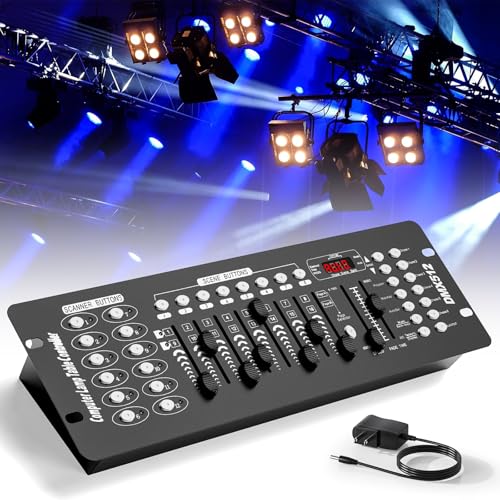
- Controls 12 devices with 16 channels each
- Stores scenes and programmable chases
- Includes a 3-pin cable and LED display
Best For: Small live shows and beginner-friendly programming
Best Full-Size Console
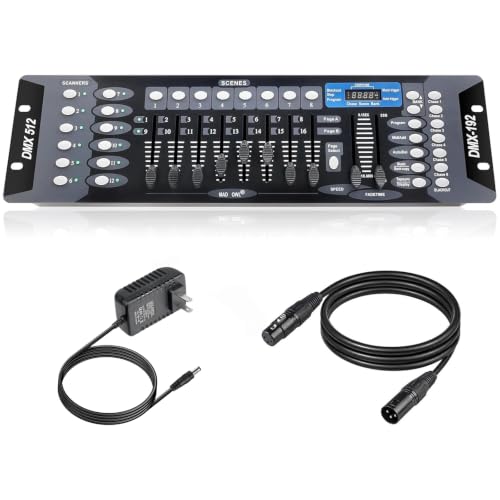
- Controls 12 fixtures with 192 total channels
- Programs scenes and six multi-step chases
- Includes a 6.6-foot DMX cable
Best For: Clubs, stages, and multi-fixture performance venues
Performance Command Center – SoundSwitch Control One
For DJs and performers seeking dmx controllers for live performances, the SoundSwitch Control One combines tactile hardware control with SoundSwitch software. It offers two DMX universes, dual USB connections, and compatibility with select Engine DJ and AlphaTheta setups.
Best For: DJs and live performers who want hands-on control over synchronized lighting effects.
Pros:
- Provides two DMX universe inputs and outputs, including a Thru option for installations.
- Works directly with compatible Engine DJ devices without a computer.
- Offers touch-strip, encoder, and RGB pad control for lighting intensity and effects.
- Supports live audio BPM detection from bands, DAWs, and DJ software.
Cons:
- Some AlphaTheta PRO DJ LINK Bridge configurations require a laptop running SoundSwitch.
- Its broad feature set may be more than casual users need.
The Control One is a strong choice when responsive physical controls and multi-universe connectivity matter. Its software-focused workflow makes it especially suitable for programmed and improvised DJ lighting shows.
Wireless Stage Link – CHINLY 2.4G DMX Wireless Kit
The CHINLY wireless kit is a practical add-on for dmx controllers for live performances when running cables across a stage is inconvenient. One transmitter and seven receivers carry standard DMX512 data over 2.4 GHz, with automatic frequency hopping for more reliable operation.
Best For: Stage and event setups that need wireless DMX distribution to multiple compatible fixtures.
Pros:
- Includes one transmitter and seven receivers for multi-fixture coverage.
- Transmits standard DMX512 data in real time without stated signal delay.
- Offers a claimed 400-meter visible-distance communication range.
- Seven selectable ID groups support separate wireless networks in the same location.
Cons:
- This is a wireless transmission system rather than a standalone lighting console.
- Performance depends on line of sight and the surrounding wireless environment.
Choose this kit when your existing DMX controller already does the programming and you need to distribute its signal wirelessly. The seven receivers make it more suitable for larger fixture layouts than basic point-to-point wireless systems.
Compact Software Interface – SoundSwitch Micro DMX
The SoundSwitch Micro DMX Interface is a compact option for dmx controllers for live performances built around a computer and SoundSwitch software. Its USB-to-DMX design supports one DMX universe and includes live audio BPM detection for syncing lights to varied music sources.
Best For: Mobile DJs and compact rigs that need a simple computer-based DMX interface.
Pros:
- Provides a dedicated USB-to-DMX XLR interface for one DMX universe.
- Its ultra-compact design is convenient for mobile setups.
- Supports live audio BPM detection from bands, DAWs, USB, and internal-mic sources.
- Includes a three-month SoundSwitch subscription with preset and custom show options.
Cons:
- It requires a computer and SoundSwitch software for operation.
- Only one DMX universe is supported.
- Subscription fees apply after the included trial period.
This interface keeps the hardware footprint small while retaining SoundSwitch’s software-driven workflow. It is best suited to users who value portability and automated lighting creation over extensive onboard controls.
Traditional Console Control – CO-Z 192 DMX 512 Controller
The CO-Z 192 DMX 512 offers a traditional console layout for dmx controllers for live performances, with physical channel controls and scene buttons. It can manage up to 12 intelligent lights with up to 16 channels each and store up to 240 scenes.
Best For: DJs, venues, and event users who prefer a dedicated hardware lighting board.
Pros:
- Controls up to 12 fixtures with up to 16 channels each.
- Supports up to 240 scenes for more complex show programming.
- Includes dedicated selection, scene, channel, speed, time, and function controls.
- Offers voice control for switching among lighting scenes.
Cons:
- Its traditional console layout may require more hands-on setup than software-based systems.
- The plastic construction may feel less premium than metal-bodied controllers.
- It uses a corded electric power source.
For users who want direct access to channels and scenes without relying on a computer, the CO-Z provides a familiar control-board approach. Its scene capacity and fixture support make it useful for programmed event lighting and small stage productions.
Flexible Dimmer Control – CHAUVET DJ DMX-4
The CHAUVET DJ DMX-4 is a practical choice among dmx controllers for live performances when you need straightforward control over four lighting channels. Each channel can operate as a dimmer or relay and can be assigned to any DMX address.
Best For: Small live setups using dimmable or relay-controlled fixtures.
Pros:
- Four-channel DMX-512 control
- Channels support dimmer or relay operation
- Variable electronic dimming from 0–100%
- Can operate with or without DMX
Cons:
- Limited to four channels
- Designed as a dimmer/relay pack rather than a full scene-programming console
Its compact metal housing and adjustable speed control make it useful for focused lighting control, particularly where dependable dimming is more important than extensive programming features.
App-Based Wireless Control – ADJ MyDMX Go
The ADJ MyDMX Go offers an accessible approach to dmx controllers for live performances, using an iPad or Android tablet for 256-channel lighting control. Its fixture library and preset-based workflow are suited to operators who want quick results without programming every cue.
Best For: DJs, bands, and small production teams seeking tablet-based lighting control.
Pros:
- 256-channel DMX lighting control through an app
- 15,000-plus fixture library
- 50 user presets and 21 automatic effects
- Supports Wi-Fi and USB connectivity
Cons:
- Requires an iPad or Android tablet for app operation
- Advanced upgrades may require additional purchases
With support for two lighting universes, a compact interface, and included O-Clamp mounting brackets, MyDMX Go is a flexible option for performers who prefer visual, tablet-driven control.
Hands-On Scene Programming – 384CH DMX Controller
This 384-channel console is a traditional option among dmx controllers for live performances, providing hands-on access to programmable scenes and fixtures. It supports 30 banks of eight scenes and can control up to 24 fixtures for organized stage-lighting shows.
Best For: Live operators who want physical controls for programmed scenes and transitions.
Pros:
- 384 DMX channels for detailed control
- 30 programmable banks with eight scenes each
- Supports up to 24 fixtures
- Includes an LED gooseneck light and side handles
Cons:
- Requires manual programming for custom scenes
- Less compact than app-based controller interfaces
Its dedicated console layout, 110–240V power compatibility, and DMX512 signal support make it a reasonable fit for performers who prefer tactile operation and repeatable programmed lighting looks.
Best Compact Dimmer – MAD OWL 12-Channel DMX Controller
For buyers seeking compact DMX controllers for live performances, the MAD OWL 12 Channel DMX dimming controller offers straightforward control for smaller setups. Its six sub-control faders and main control fader manage up to 12 DMX512 channels, while the aluminum housing supports a portable, rack-mountable design.
Best For: Small stages, travel setups, and DMX512 lighting systems with no more than 12 channels.
Pros:
- Controls up to 12 DMX512 lighting channels.
- Simple layout with six sub-control faders, a main fader, and a blackout function.
- Compact, lightweight aluminum construction with a standard 3-pin DMX output.
Cons:
- Not suitable for lighting fixtures requiring more than 12 channels.
- Designed primarily for dimming control rather than larger programmable lighting shows.
This is a practical choice when portability and basic manual dimming matter more than extensive programming. Verify your fixtures’ channel requirements before buying.
Best Beginner Programmer – 192-Channel DMX Stage Controller
This 192-channel console is one of the more approachable DMX controllers for live performances that need scenes and chase programming. It controls up to 12 devices with 16 channels each, supports programmable scenes and chases, and includes manual sliders for real-time adjustments.
Best For: Beginners running small parties, concerts, festivals, holiday displays, and other multi-fixture shows.
Pros:
- Provides 192 channels across 12 scanners with up to 16 channels each.
- Supports 240 scenes, 23 banks of programmable scenarios, and six programmable chases.
- Includes a 3-pin cable and controls compatible stage fixtures such as moving heads, fog machines, pars, and wall washers.
- Organized controls and an LED display are intended to be easy for beginners to learn.
Cons:
- The interface may be more capability than needed for a basic dimmer-only setup.
- Its controls are designed around fixtures with 16 channels or fewer.
Choose this model if you want hands-on programming without moving to a more complex lighting system. Its scene and chase capacity makes it more flexible than a simple manual dimmer.
Best Full-Size Console – 192-Channel DMX Board
For stage operators comparing DMX controllers for live performances, this 192-channel DMX512 board combines broad fixture control with scene and chase programming. It can manage 12 fixtures with up to 16 channels each and includes faders, buttons, and a 2-meter DMX cable for setup.
Best For: Stages, clubs, and performance venues using multiple programmable lighting fixtures.
Pros:
- Offers 192 channels for controlling up to 12 fixtures with 16 channels or fewer.
- Provides 23 banks of eight programmable scenes and six chases with up to 240 steps.
- Faders and buttons allow programming and real-time lighting adjustments.
- Includes a 6.6-foot DMX cable.
Cons:
- The larger 22.44-inch-wide design is less portable than compact controllers.
- Fixture compatibility is limited to units using 16 channels or fewer.
This controller is a solid fit for operators who need a conventional console layout and repeatable lighting sequences. Its larger footprint makes it better suited to a dedicated control position than frequent travel.
How We Picked the Best Dmx Controllers for Live Performances
We selected products across the main control styles used in stage and event lighting: dedicated hardware consoles, computer or app interfaces, wireless DMX transmitters and receivers, and dimmer or relay packs. The comparison emphasizes practical live-use considerations rather than channel count alone.
We looked at fixture capacity, programming flexibility, portability, connection options, wireless convenience, ease of operation, and suitability for different venue sizes. A controller should match both your current lighting rig and the way you actually run shows, whether that means hands-on fader control, preprogrammed scenes, beat-synced effects, or remote operation from a tablet.
Quick Comparison
| Controller type | Best for | Main advantage | Potential limitation |
|---|---|---|---|
| Software or app interface | Mobile DJs, bands, and programmed shows | Flexible scenes, effects, and fixture control | Depends on a compatible device and setup |
| Wireless DMX system | Clean installations and hard-to-cable venues | Reduces long signal runs | Requires careful pairing and interference management |
| 192-channel console | Small to medium stage rigs | Simple hands-on programming | Less convenient for complex modern fixtures |
| 384-channel console | Larger fixture collections | More banks, scenes, and addressing capacity | Steeper learning curve and more programming time |
| Dimmer or relay pack | Conventional fixtures and load control | Combines switching or dimming with DMX input | Not a complete controller for every intelligent fixture |
Key Buying Factors for Dmx Controllers for Live Performances
Channel and Fixture Capacity
Count the DMX channels your fixtures require, not just the number of lights. Moving heads, pixel fixtures, and advanced LED units can use many channels per fixture. Leave room for expansion so you do not outgrow the controller immediately.
Programming Workflow
Traditional consoles offer direct access to faders, banks, and scenes. Software and app-based systems may provide stronger visual programming, fixture libraries, automation, and music-reactive effects. Choose the workflow you can operate confidently during a live show.
Connectivity and Reliability
Check for the required DMX connectors, signal direction, USB or tablet compatibility, and power requirements. For wireless systems, consider range, antenna placement, line of sight, and backup plans. A wired connection is often preferable when maximum predictability matters.
Fixture Compatibility
Verify that the controller supports your fixtures’ DMX profiles or lets you create custom profiles. Also check whether it handles RGB or RGBW mixing, pan and tilt, dimming curves, strobes, gobos, and other functions you plan to use.
Portability and Operation
Mobile performers should prioritize compact dimensions, rugged controls, quick setup, and a readable interface. Installed venues may benefit more from higher capacity, extensive scene storage, and permanent cabling.
Who Should Buy Which Dmx Controllers for Live Performances?
Choose a software or app-based interface if you want flexible programming, fixture libraries, effects, or synchronized shows from a computer or mobile device. These systems suit users comfortable preparing scenes before an event.
Choose a traditional 192- or 384-channel console if you prefer tactile faders and straightforward live adjustments. Smaller consoles are practical for basic PARs, wash lights, and compact DJ rigs; higher-capacity models are better for larger collections of fixtures and more elaborate scenes.
Choose a wireless DMX kit when cable runs are inconvenient, the venue must remain uncluttered, or fixtures are spread across a performance area. Keep a wired fallback for critical events.
Choose a dimmer or relay pack when your setup includes conventional dimmable lights or devices that need DMX-triggered switching. It complements a controller but may not replace one for intelligent fixtures.