
Finding the best DJ controller under $1,000 means balancing software support, layout, jog-wheel feel, performance controls, and room to grow. This roundup covers approachable two-channel models, performance-focused designs, and a four-channel option for more advanced mixing.
Whether you are learning at home, preparing sets for small gigs, or upgrading from entry-level gear, these controllers offer useful features without moving into premium club pricing.
Best 10 Dj Controller Under 1000 Picks for 2026
Best All-Around Beginner Pick
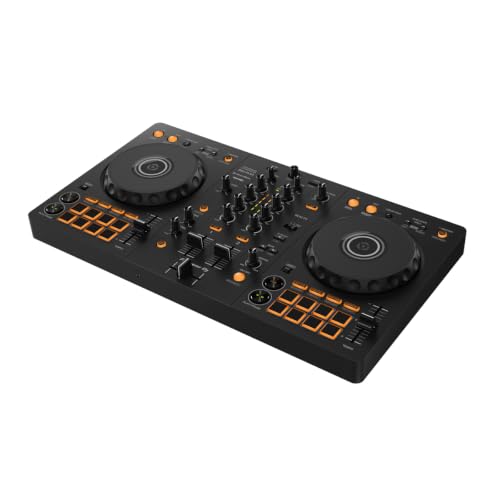
- Easy two-deck layout with Smart Fader
- Supports multiple DJ apps and devices
- Streaming-ready with mic input
Best For: Beginners seeking a versatile controller for learning and streaming
Best 4-Deck Value

- Four-deck Serato DJ Lite control
- Jog-wheel displays show key mix data
- Dedicated effects, loops, and performance pads
Best For: DJs wanting expanded control and visual feedback
Best for Scratch Beginners

- Battle-style layout for scratch practice
- Tracking Scratch simplifies routine triggering
- Includes Serato DJ Lite for PC and Mac
Best For: Beginners focused on hip-hop and scratch techniques
Best for Creative Sampling

- Built-in Roland-style drum kits
- 16-step sequencer and Serato sampler control
- Compact USB-powered design
Best For: Performers adding live beats, samples, and sequencing
Best Feature-Rich Pick
Hercules DJControl Inpulse 500

- Built-in audio interface and input mixer
- Large touch-sensitive jog wheels
- RGB pads and fold-out feet
Best For: Hands-on home mixing and skill development
Best Versatile Software Pick

- Works with rekordbox and Serato
- USB bus powered and lightweight
- Supports multiple compatible devices
Best For: Portable beginner-friendly DJ setups
Best Beginner Value
Hercules DJControl Inpulse 300 MK2

- Light guides support manual beatmatching
- Two-deck full-featured design
- Works with several streaming services
Best For: Learning fundamentals on Mac or PC
Best Beginner Pick

- Smart Fader assists with basic beatmatching
- USB-C bus-powered and weighs 2.7 pounds
- Supports compatible streaming and DJ apps
Best For: New DJs seeking a compact, easy-to-use controller
Best All-Rounder

- 16 Performance Pads expand creative control
- Smart Fader and Smart CFX aid beginners
- Supports rekordbox, Serato, and djay
Best For: Learners who want features for practice and streaming
Best Club-Style Upgrade

- Four-channel layout modeled after club gear
- Full-size jog wheels and eight pads per deck area
- Includes rekordbox and Serato DJ Pro support
Best For: Developing DJs preparing for club-style performance
Best All-Around Beginner Pick – Pioneer DJ DDJ-FLX4
If you want a versatile dj controller under 1000 that is easy to learn and leaves room to improve, the Pioneer DJ DDJ-FLX4 is a strong choice. Its familiar two-deck layout, Smart Fader, performance pads, and broad device compatibility make it practical for home mixing, streaming, and early live sets.
Best For: Beginners who want an approachable controller with streaming support and room to grow.
Pros:
- User-friendly layout modeled after professional Pioneer DJ gear.
- Smart Fader can help blend tracks without manual beatmatching.
- Works with Rekordbox, Serato DJ Pro, and djay across PC, Mac, iOS, and Android.
- Built-in sound card, mic input, and streaming features simplify setup.
Cons:
- It is limited to two channels and two decks.
- Its beginner-focused automation may be less appealing to advanced users seeking fully manual control.
The DDJ-FLX4 stands out as the most flexible learning platform here. Choose it if easy first mixes, mobile connectivity, and livestreaming matter more than battle-style controls or built-in performance instruments.
Best 4-Deck Value – Numark Mixtrack Platinum FX
The Numark Mixtrack Platinum FX is a compelling dj controller under 1000 for users who want four-deck control and clear visual feedback. Large jog wheels, color displays, performance pads, and dedicated effects provide substantial hands-on control in a Serato DJ Lite package.
Best For: DJs who want four-deck mixing, visual jog-wheel information, and quick-access effects.
Pros:
- Provides four decks of control with included Serato DJ Lite.
- Six-inch capacitive jog wheels include high-resolution displays for BPM, platter position, and pitch information.
- Offers dedicated loop controls, eight performance pads per deck, and six effects with paddle triggers.
- Includes microphone, headphone, and RCA connections plus a built-in 24-bit audio interface.
Cons:
- It is relatively heavy compared with more compact controllers.
- Its listed platform support focuses on Mac and Windows rather than mobile devices.
With four-deck capability and informative jog displays, the Mixtrack Platinum FX is aimed at DJs who have outgrown basic two-deck layouts. It is especially attractive when effects and visual track information are priorities.
Best for Scratch Beginners – Pioneer DJ DDJ-REV1
For scratch-focused beginners comparing a dj controller under 1000, the Pioneer DJ DDJ-REV1 offers a battle-style starting point. Its open layout, tall pitch faders, quick effects, and Tracking Scratch feature focus on learning hip-hop and performance-oriented techniques.
Best For: New DJs interested in scratching, battle-style layouts, hip-hop, and open-format mixing.
Pros:
- Battle-style design mirrors a turntable and battle-mixer setup.
- Tall pitch faders and accessible effects suit scratch practice.
- Tracking Scratch can trigger scratch routines with a single motion.
- Serato DJ Lite is unlocked for immediate PC or Mac use.
Cons:
- It is a two-deck controller rather than a four-deck system.
- Its platform compatibility is limited to PC and Mac.
The DDJ-REV1 makes the most sense when scratch technique is the deciding factor. Its specialized layout is less universally oriented than the DDJ-FLX4, but it gives beginners a clearer path into battle-style performance.
Best for Creative Sampling – Roland DJ-202
Roland DJ-202 Compact DJ Controller | A two-channel, four-deck controller that's powered via USB
Check Price On AmazonThe Roland DJ-202 is a distinctive dj controller under 1000 for performers who want more than straightforward track blending. Its built-in Roland drum kits, 16-step sequencer, sampler controls, and Serato integration support beat creation while keeping the controller compact and USB powered.
Best For: DJs who want portable mixing with live sampling, sequencing, and drum-machine-style sounds.
Pros:
- Includes Roland TR-808, TR-909, and TR-606-inspired drum kits.
- 16-step sequencer controls Serato DJ Lite’s sampler for on-the-fly beat creation.
- Offers four-deck control, dedicated pads, sampler modes, and independent sampler volume.
- Compact, lightweight design includes RCA outputs and a microphone input with effects.
Cons:
- It uses a two-channel layout despite offering four-deck software control.
- Its software and hardware feature set may be more specialized than needed for basic mixing.
The DJ-202 is the creative specialist in this group. Pick it if sequencing, sampling, and Roland-style drum sounds are central to your sets; for a simpler all-purpose learning experience, another controller may be easier to approach.
Best Feature-Rich Pick – Hercules DJControl Inpulse 500
If you want a dj controller under 1000 with room to develop your mixing skills, the Hercules DJControl Inpulse 500 combines two-deck control with a built-in audio interface, hardware input mixer, and practical performance features. Its large touch-sensitive jog wheels, RGB pads, and fold-out feet make it a capable home-DJ setup.
Best For: New and intermediate DJs who want hands-on controls, scratching capability, and extra protection from spills.
Pros:
- Built-in audio interface and hardware input mixer for audio inputs
- Large jog wheels with touch detection for scratching
- 16 backlit RGB pads plus vinyl and loop controls
- Retractable feet lift the controller above the surface
Cons:
- Its 11.6-pound weight is less convenient for frequent transport
- Only two channels are available
- Software update support is listed as unknown
The Inpulse 500 is a strong choice when tactile control and useful hardware features matter more than portability. Its Serato and DJUCED compatibility also gives beginners flexibility as they learn.
Best Versatile Software Pick – Pioneer DJ DDJ-FLX4
The Pioneer DJ DDJ-FLX4 is a practical dj controller under 1000 for users who want a simple two-channel layout and broad software compatibility. It supports rekordbox and Serato, can run from USB bus power, and is designed to work with multiple devices.
Best For: Beginners and mobile DJs who want a lightweight controller with flexible software and device support.
Pros:
- Compatible with rekordbox, Serato DJ Lite, and Serato DJ Pro
- Supports Mac, Windows, and compatible iOS/Android use
- USB bus powered through a PC or Mac
- Includes SMART CFX and SMART FADER functions
Cons:
- It has only two mixer channels
- USB connectivity is the primary listed connection
- Noise control is listed as none
The DDJ-FLX4 stands out for its approachable layout and software flexibility. Its 2.1-kilogram weight and USB power make it especially convenient for bedroom setups, practice sessions, and smaller mobile rigs.
Best Beginner Value – Hercules DJControl Inpulse 300 MK2
For shoppers seeking a dj controller under 1000 that focuses on learning fundamentals, the Hercules DJControl Inpulse 300 MK2 offers a full-featured two-deck layout with built-in light guides for manual beatmatching. It also supports music stored on a computer and several streaming services.
Best For: Beginners learning beatmatching and practicing with computer-based or streaming music libraries.
Pros:
- Built-in light guides assist with manual beatmatching
- Two-deck, full-featured controller for learning core techniques
- Supports Beatport ADVANCED, Beatsource, SoundCloud Go+, and TIDAL
- Compatible with Mac and PC through USB
Cons:
- Uses a plastic construction
- DJUCED is the listed supported software
- Its feature set is focused on two-deck operation
The Inpulse 300 MK2 is a sensible starting point for aspiring DJs who value guided practice and access to streaming sources. At 5.6 pounds, it also offers a more manageable alternative to heavier controllers.
Best Beginner Pick – Pioneer DJ DDJ-FLX2
The Pioneer DJ DDJ-FLX2 is a practical choice if you want a lightweight DJ controller under 1000 for learning basic mixing. Its Smart Fader can automatically adjust volume, BPM, and bass as you move the crossfader, while USB-C bus power makes it easy to use with a phone, tablet, or computer.
Best For: Beginners who want a compact, portable controller with streaming support and simple beatmatching assistance.
Pros:
- Lightweight 2.7-pound design with USB-C bus power
- Smart Fader helps match volume, BPM, and bass
- Works with compatible Apple Music, Spotify, Tidal, rekordbox, djay, and Serato DJ Lite setups
Cons:
- Two-channel layout is aimed at beginners rather than advanced multi-deck performance
- Uses a 3.5 mm output for external speakers
The DDJ-FLX2 prioritizes accessibility and portability. It is a strong starting point for casual mixing, mobile setups, and users who want to learn without immediately managing complex controls.
Best All-Rounder – Pioneer DJ DDJ-FLX4 White
The Pioneer DJ DDJ-FLX4 is a versatile DJ controller under 1000 for learners who want room to develop. Its two-deck layout includes 16 Performance Pads, Smart Fader, Smart CFX, a built-in sound card, and connections for computers, mobile devices, speakers, and headphones.
Best For: Beginners and improving DJs who want a flexible controller for home practice, streaming, and gradual skill building.
Pros:
- User-friendly layout based on professional Pioneer DJ equipment
- 16 pads support Hot Cues, Pad FX, Beat Jump, and Sampler functions
- Compatible with rekordbox, Serato, and djay across PC, Mac, iPhone, iPad, and Android
Cons:
- Two-channel, two-deck design may limit more advanced setups
- At 2.8 kg, it is less lightweight than the DDJ-FLX2
The DDJ-FLX4 offers a balanced feature set for learning and progression. Its pad controls and broad device compatibility make it a particularly adaptable option for practice, streaming, and entry-level performances.
Best Club-Style Upgrade – AlphaTheta DDJ-GRV6
The AlphaTheta DDJ-GRV6 is a larger four-channel DJ controller under 1000 designed for DJs moving toward club-style workflows. Its CDJ-3000 and DJM-A9 inspired layout, full-size jog wheels, Groove Circuit, and support for rekordbox and Serato DJ Pro provide more hands-on control than beginner-focused two-channel models.
Best For: Developing DJs who want club-oriented controls, four-channel flexibility, and live remix or Stems FX capabilities.
Pros:
- Club-standard-inspired layout with full-size jog wheels
- Four-channel control supports more flexible mixing
- Groove Circuit and Serato Stems FX enable live remixing and stem effects
Cons:
- Large 4.6 kg design is less portable than compact beginner controllers
- Its broader feature set may be more than a first-time DJ needs
The DDJ-GRV6 is the most performance-focused option in this group. Choose it when transferable club-style layout and creative live manipulation matter more than minimal size and simplicity.
How We Picked the Best Dj Controller Under 1000
We compared these DJ controllers by looking at the features that most affect everyday use: software compatibility, channel count, control layout, jog-wheel response, performance pads, connectivity, portability, and learning curve. We also considered whether each model suits beginners, mobile DJs, content creators, or experienced users who want more hands-on control.
Because prices and bundles can change, check the current listing for included software, cables, warranty coverage, and retailer-specific accessories before buying. A controller’s long-term value depends as much on its ecosystem and workflow as on its hardware specifications.
Quick Comparison
| Best For | What to Look For |
|---|---|
| First-time DJs | Clear controls, guided software features, and a forgiving layout |
| Serato users | Native Serato compatibility and performance-focused pad controls |
| Streaming and flexible setups | Multi-app support, USB connectivity, and simple computer integration |
| Mobile DJs | Compact construction, useful outputs, and dependable transportability |
| Advanced home mixing | More channels, expanded effects, and room to develop new techniques |
Key Buying Factors for a Dj Controller Under 1000
Software and Compatibility
Start with the DJ application you intend to use. Serato DJ and rekordbox offer different library systems and performance workflows, while DJUCED and other supported platforms may be especially useful for beginners. Multi-app compatibility adds flexibility if you are still deciding on an ecosystem.
Channel Layout and Expansion
Two-channel controllers are generally easier to learn and more portable. A four-channel design can be a better investment if you plan to mix multiple decks, layer samples, or develop more complex transitions. Do not pay for extra channels unless you expect to use them.
Performance Controls
Look at jog-wheel size and response, pad modes, looping controls, effects, faders, and any specialized features such as smart transitions or stem-related workflows. These controls should match the way you actually perform rather than simply adding more features.
Connections and Practical Details
Check the main output type, headphone connection, microphone input, USB format, and whether the controller can work with your computer or mobile device. Weight, build quality, and the availability of a protective case also matter if you plan to travel.
Who Should Buy Which Dj Controller Under 1000?
Beginners should prioritize a straightforward two-channel layout with strong software support and clear visual feedback. DJs who already prefer Serato should choose a controller designed around that workflow, particularly if performance pads and scratch-oriented controls are important.
Choose a multi-app model if you want to experiment with different platforms or share a setup with other DJs. Mobile performers should focus on portability, reliable outputs, and a durable control surface. More experienced home DJs may benefit most from the four-channel option, especially when extra deck control and a broader performance toolkit justify the additional complexity.