
The best DI boxes under $200 can solve common live and studio problems, including impedance mismatches, noisy ground loops, and difficult cable runs. This roundup focuses on practical passive direct boxes for instruments, playback systems, mixers, and stage rigs.
Our selections range from compact single-channel units to stereo and four-channel models, with useful features such as attenuation pads, ground lifts, line mixing, and transformer isolation.
Best 10 Di Boxes Under 200 Picks for 2026
Rugged Passive Pick

- Passive transformer-based mono DI
- Rugged stainless-steel I-beam construction
- Suitable for live and studio instruments
Best For: Musicians needing a durable mono DI
Stereo Rig Specialist

- Dual 1/4-inch inputs for stereo sources
- Ground lift helps reduce hum
- 15 dB pads handle hot signals
Best For: Stereo keyboards and DJ setups
Economical Workhorse
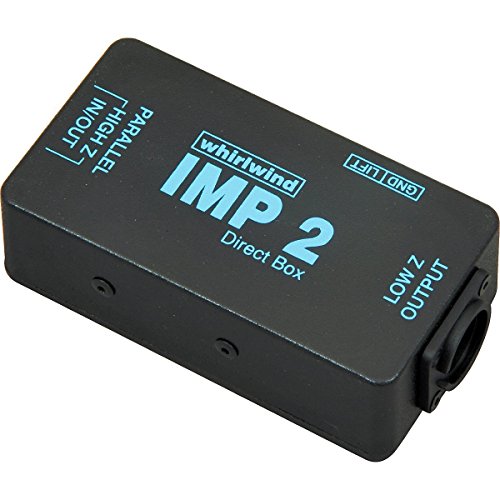
- One-channel passive transformer DI
- Handles line- or instrument-level sources
- Compact and economical design
Best For: Basic mono live audio setups
Flexible Stage Companion

- Passive mono DI with balanced XLR output
- Thru output feeds pedals or an amplifier
- Ground lift and steel chassis for stage use
Best For: Guitar, keyboard, and studio signal routing
Versatile Two-Channel Pick

- Two passive DI channels
- Handles line and speaker levels
- Parallel THRU connections
Best For: Keyboard and computer-based rigs needing two channels
Flexible Input Control
Livewire SPDI Passive Direct Box

- High-impedance 1/4-inch input
- Variable attenuation
- Balanced floating XLR output
Best For: Instrument setups needing attenuation and ground control
Rack-Friendly Mixer Option
dbx DJDI Two-Channel Direct Box

- Two channels in a half-rack format
- Independent 20 dB pads
- Per-channel volume, pan, and ground lift
Best For: DJ and auxiliary setups needing per-channel mixing controls
Best Budget Hum Eliminator

- Converts 1/4-inch sources to balanced or unbalanced XLR
- Includes input attenuation and buzz/hum cancellation
- Compact option for instruments, keyboards, and line-level sources
Best For: Compact live sound and recording setups
Best Multi-Channel Pick
ART PDB4 Four-Channel Passive DI

- Four fully isolated passive DI channels
- Switchable 0dB, -20dB, and -40dB attenuation
- Routes a source to an amplifier and mixer simultaneously
Best For: Bands, venues, and multi-source recording setups
Best Dual-Channel Value
Pyle-Pro PDC22 Dual Passive DI Box
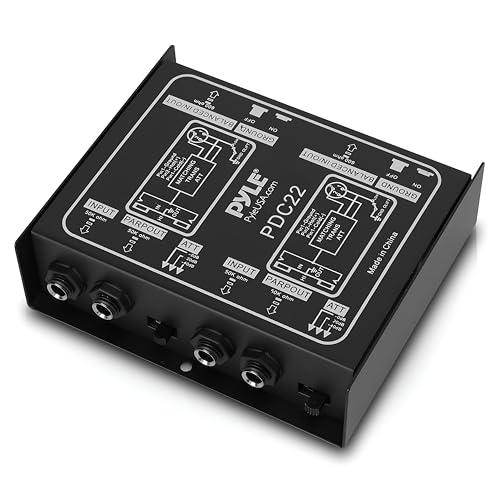
- Two passive DI channels in one unit
- All-steel chassis for a durable build
- Supports instruments, keyboards, processors, and mixer connections
Best For: Two-source live and recording setups
Rugged Passive Pick – Radial Pro DI
The Radial Pro DI is a sturdy passive option for shoppers comparing DI boxes under 200. Its transformer-based design, mono signal path, and XLR connectivity suit acoustic guitars, basses, keyboards, drum machines, and professional console or snake systems.
Best For: Live or studio musicians who want a durable mono DI for a range of instruments.
Pros:
- Passive operation with a built-in transformer
- Rugged stainless-steel I-beam construction
- Works with guitars, basses, keyboards, and drum machines
Cons:
- Mono operation rather than stereo
- No wireless communication or waterproofing
The Radial Pro DI emphasizes durability and broad instrument compatibility. It is a sensible fit when a dependable, straightforward passive box matters more than stereo operation or extra features.
Stereo Rig Specialist – Mackie MDB-2P
The Mackie MDB-2P stands out among DI boxes under 200 for stereo setups. Its dual 1/4-inch inputs accommodate keyboards, DJ controllers, and backing-track rigs, while the passive design requires no power.
Best For: Stereo keyboards, DJ rigs, and other two-channel setups that need hum reduction.
Pros:
- Dual 1/4-inch high-impedance inputs
- Ground lift helps address ground-loop buzz
- 15 dB pads handle hot signals
- Passive design needs no power
Cons:
- Designed for stereo rather than single-channel applications
- Its listed compatibility and connections may be more than a simple mono rig needs
With two channels, ground lift, and input pads, the MDB-2P is tailored to more demanding stereo connections. Choose it when keyboard or DJ output management is a priority.
Economical Workhorse – Whirlwind IMP 2
The Whirlwind IMP 2 is a straightforward choice for shoppers seeking DI boxes under 200 without unnecessary complexity. This one-channel passive transformer converts an unbalanced line- or instrument-level signal to a low-impedance, balanced mic-level output.
Best For: Musicians and live audio users who want an economical, compact mono DI.
Pros:
- Inexpensive one-channel design
- Converts instrument or line signals to balanced mic level
- Compact footprint
- TRHL transformer is riveted to the chassis
Cons:
- One channel only
- Supplied notes do not list features such as ground lift or a thru output
The IMP 2 focuses on the core DI task and a compact, durable build. It is a practical pick for basic mono instrument or line-level connections where value and simplicity come first.
Flexible Stage Companion – Samson S-Max MD1
The Samson S-Max MD1 is a versatile option among DI boxes under 200, combining passive operation with useful stage and studio connections. It accepts a 1/4-inch unbalanced instrument or line signal, provides a balanced mic-level XLR output, and includes a thru output for an amp or pedals.
Best For: Guitarists, keyboard players, and recording users who need ground lift and signal-through flexibility.
Pros:
- Passive operation needs no phantom power or batteries
- Ground lift helps fight buzz and hum
- Thru output supports pedals or an amplifier
- 14-gauge steel chassis with Mu-Metal-shielded circuitry
Cons:
- Mono operation
- Supplied notes list a 0 dB/-15 dB configuration but do not explain its switching details
The MD1 offers more routing flexibility than a basic mono DI because its thru output can feed an amp or pedals while the balanced XLR signal goes to a console or interface. Its passive, steel-housed design also suits mobile stage and studio work.
Versatile Two-Channel Pick – Palmer PAN04 Passive DI Box
If you need DI boxes under 200 for a keyboard, computer, or other setup that may send either line- or speaker-level signals, the Palmer PAN04 is a practical two-channel option. Its parallel THRU jacks can help preserve a signal path while feeding the balanced XLR connection.
Best For: Keyboard and computer-based rigs needing two passive DI channels.
Pros:
- Provides two passive DI channels.
- Accepts line- and speaker-level signals.
- Includes input jacks with parallel THRU connections.
- Backed by a five-year limited manufacturer warranty.
Cons:
- Its passive design may not suit setups specifically requiring an active DI.
- The supplied notes do not specify attenuation or ground-lift controls.
The PAN04 stands out when two-channel coverage and broad signal-level compatibility matter more than extra control features. It is a straightforward choice for compact keyboard, computer, and stage signal-routing setups.
Flexible Input Control – Livewire SPDI Passive Direct Box
Among DI boxes under 200, the Livewire SPDI is useful when input flexibility and basic signal-isolation controls are priorities. It combines a high-impedance 1/4-inch instrument input and throughput with a balanced, floating low-impedance XLR output.
Best For: Instrument setups that need variable attenuation and selectable ground connection behavior.
Pros:
- Offers a 1/4-inch high-impedance input and throughput.
- Provides a balanced, floating low-impedance XLR output.
- Variable attenuation supports a range of input levels.
- Lift mode severs the ground connection between input and XLR output.
Cons:
- It provides one listed instrument input path rather than two channels.
- The supplied notes do not list a warranty or channel count.
The SPDI is a sensible single-source option for players who want attenuation and ground-management choices in a passive direct box. Its parallel 1/4-inch throughput also helps keep the original instrument signal available.
Rack-Friendly Mixer Option – dbx DJDI Two-Channel Direct Box
For shoppers comparing DI boxes under 200, the dbx DJDI adds mixing controls to a compact two-channel direct-box design. It offers independent pad, ground-lift, volume, and pan controls, with the unit packaged in a half-rack format.
Best For: DJ, auxiliary, or line-level setups needing per-channel mixing and signal-control features.
Pros:
- Provides two channels in a 1/2-rack unit.
- Includes an independent 20 dB pad switch per channel.
- Offers independent ground-lift switches per channel.
- Adds independent volume and pan controls for line-mixer output.
Cons:
- Requires corded electric power.
- The supplied frequency specification is listed as 22 kHz.
- Its added mixer controls may be unnecessary for a simple passive DI application.
The DJDI is the most control-oriented choice of these three products. Choose it when per-channel attenuation, ground lifting, and line-mixer volume or pan control are more valuable than a minimal passive box.
Best Budget Hum Eliminator – Pyle Premium Passive DI Unit
If you need DI boxes under 200 for basic instrument, keyboard, or line-level connections, the Pyle Premium Passive DI Unit is a compact option. It converts unbalanced signals to balanced XLR output and includes input attenuation plus buzz and hum cancellation for live sound or recording setups.
Best For: Guitarists, bassists, keyboard players, and home-recording users who need a compact passive DI and hum eliminator.
Pros:
- Connects 1/4-inch sources to balanced or unbalanced XLR equipment.
- Provides ground-lift-based buzz and hum cancellation.
- Works with instruments, keyboards, effects processors, submixers, and consumer stereo outputs.
- Compact 1.8 x 3.3 x 5-inch design.
Cons:
- Single-channel design may not suit stereo or multi-instrument setups.
- Passive operation may offer fewer control features than an active DI.
This Pyle unit is a practical choice when portability and basic signal conversion matter most. Its flexible connections and hum-reduction features make it useful for small live rigs and recording applications.
Best Multi-Channel Pick – ART PDB4 Four-Channel Passive DI
Among DI boxes under 200, the ART PDB4 stands out for setups that need several isolated channels in one unit. Its four passive channels include switchable 0dB, -20dB, and -40dB input attenuation, while its routing supports sending a source to an amplifier and mixer at the same time.
Best For: Bands, venues, and recording systems that need four isolated passive DI channels and flexible signal routing.
Pros:
- Provides four fully isolated passive DI channels.
- Offers three switchable attenuation settings: 0dB, -20dB, and -40dB.
- Can connect a music source to an instrument amplifier while also patching it to a mixer.
Cons:
- At 2.2 pounds and nearly 19 inches wide, it is less portable than compact single-channel boxes.
- Its four-channel format may be more than needed for a simple one-instrument setup.
- The supplied details do not indicate battery operation or active circuitry.
The PDB4 is the strongest fit here for users managing multiple sources. Its isolated channels and selectable attenuation make it a more organized solution for larger live or studio signal paths.
Best Dual-Channel Value – Pyle-Pro PDC22 Dual Passive DI Box
For shoppers comparing DI boxes under 200, the Pyle-Pro PDC22 offers two passive channels in a sturdy steel chassis. It is designed to connect guitars, basses, keyboards, processors, submixers, and other unbalanced sources to a PA or recording mixer while helping reduce buzz and hum.
Best For: Musicians who need two DI channels for live performance, recording, or keyboard and guitar setups.
Pros:
- Provides two channels in one direct box.
- Uses an all-steel chassis for a durable build.
- Supports 1/4-inch device connections and balanced or unbalanced signal paths.
- Includes ground-lift functionality for buzz and hum cancellation.
Cons:
- Its 1.12-pound chassis is less compact than a small single-channel DI.
- Passive design may not provide the added features of an active DI.
- The supplied information does not specify attenuation settings.
The PDC22 is a sensible middle ground between a single-channel compact DI and a larger multi-channel rack-style unit. Choose it when two inputs and a durable steel enclosure are more important than minimal size.
How We Picked the Best Di Boxes Under 200
We selected models based on signal-conversion performance, build quality, connection options, noise-control features, and overall value. Because these are primarily passive DI boxes, we paid particular attention to transformer isolation, input and output flexibility, ground-lift controls, attenuation options, and whether each unit suits mono, stereo, or multi-channel applications.
We also considered practical use cases: connecting guitars and basses to mixers, sending keyboards or DJ equipment to a PA, integrating consumer audio sources, and expanding a studio or live rig without spending more than $200.
Quick Comparison
| Type | Best For | Useful Features |
|---|---|---|
| Single-channel passive | Guitar, bass, and simple stage rigs | Compact design, balanced XLR output, ground isolation |
| Dual-channel or stereo | Keyboards, DJ systems, and playback devices | Two inputs, stereo routing, ground lift |
| Four-channel | Bands, installations, and larger setups | Multiple sources in one enclosure |
| Attenuation-equipped | Hot line-level signals | Input pads for reducing overload |
Key Buying Factors for DI Boxes Under $200
Channel Count and Signal Type
Choose a single-channel box for one instrument or microphone-level feed. Stereo and dual-channel models are more practical for keyboards, DJ controllers, mixers, and other sources where left and right channels must remain separate. A four-channel unit can reduce rack or pedalboard clutter when several sources need balanced outputs.
Passive Design and Input Handling
Passive units generally require no batteries or external power, making them dependable for live use. Check the input impedance and maximum input level if you plan to connect active basses, synthesizers, DJ mixers, or other hot line-level equipment. An attenuation pad is especially useful when a source could overload the transformer or mixer input.
Ground Lift and Isolation
Ground-lift switches can help reduce hum caused by ground loops between powered devices. They do not fix every noise problem, but they are valuable when connecting computers, mixers, amplifiers, and other equipment with separate power connections. Transformer isolation also helps provide a balanced, electrically separated output.
Connections and Construction
Confirm that the box provides the input and output connectors your setup requires, including 1/4-inch inputs, thru outputs, and balanced XLR outputs. A sturdy metal enclosure, protected switches, and strain-resistant connectors matter if the unit will travel regularly or sit on a busy stage.
Who Should Buy Which Di Boxes Under 200?
Guitarists and bassists who need a straightforward feed to a PA should look first at a compact single-channel passive model. Keyboard players and DJs will usually benefit from a stereo or dual-channel box with ground lift and enough headroom for line-level signals. Bands, rehearsal spaces, and installers handling several independent sources should consider a four-channel option.
If hum is your main concern, prioritize transformer isolation and a ground-lift switch. If distortion occurs when connecting a mixer, keyboard, or DJ source, choose a model with attenuation. For occasional home recording or small performances, a basic passive DI can provide the essential balanced connection without unnecessary controls or cost.