
If you drive at night, in rain, or on poorly lit roads, a dash camera with 4K night vision can make the difference between usable evidence and blurry footage.
This roundup focuses on models that balance sharp video, dependable low-light performance, and everyday features like GPS, Wi‑Fi, parking mode, and rear camera coverage.
Best 10 Dash Camera with 4K Night Vision Picks for 2026
Dual-Channel Night Coverage

- 4K front + 1080p rear recording
- Sony STARVIS 2 sensor with F1.5 aperture
- Includes 128GB card, GPS, and WiFi app control
Best For: Drivers wanting dual-channel coverage with strong low-light detail
Triple-View Night Recording

- 4K front plus 1080p rear and cabin recording
- Starlight lens, F1.6 aperture, and HDR
- Built-in GPS with 5.8GHz WiFi app control
Best For: Families and rideshare drivers needing 3-channel coverage
Touch-Control Night Protection
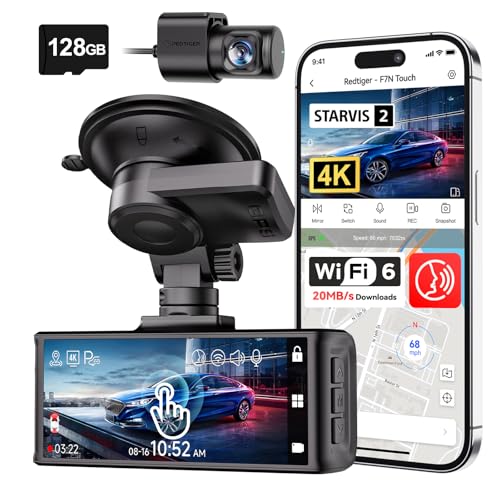
- 4K front + 1080p rear with STARVIS 2 sensor
- WDR and HDR for stronger low-light visibility
- Touch screen, voice control, GPS, and WiFi
Best For: Drivers who want premium controls with night-focused dual recording
Dual-Channel Value Pick
4K Front and 2K Rear with GPS and Wi-Fi

- 4K front and 2K rear recording
- Night vision and WDR for low light
- Built-in GPS plus dual-band Wi-Fi
Best For: Drivers wanting an easy-to-use front/rear dash cam with connected features
Panoramic Coverage Choice
4-Channel 360° Dash Cam with IR Night Vision

- Records front, rear, left, and right views
- 4K front plus three 1080P lenses
- 8 IR lamps and WDR for night use
Best For: Drivers who want maximum all-around vehicle coverage
Premium Night Vision Pick
REDTIGER F7NP 4K with STARVIS 2

- STARVIS 2 sensor with F1.5 aperture
- 4K front and 1080P rear recording
- Fast 5.8GHz Wi-Fi and free card included
Best For: Drivers prioritizing low-light performance and premium image quality
Triple-Coverage Night-Proof Pick

- STARVIS 2 front sensor with HDR/WDR for low-light clarity
- 3-channel front, cabin, and rear coverage
- 5GHz Wi-Fi, GPS, and parking modes add convenience
Best For: drivers wanting all-around protection with cabin recording
Dual 4K Detail Leader

- 4K front and 4K rear capture for strong detail
- WDR night vision improves dark-road footage
- 128GB card included with 5.8GHz Wi-Fi and GPS
Best For: drivers who want the sharpest dual-camera coverage
Dual-Channel Night Coverage – ROVE R2-4K Dual
If you want a dash camera with 4K night vision that covers both the road ahead and behind you, the ROVE R2-4K Dual is built for that use case. It records 4K front footage with a 1080p rear camera, and the STARVIS 2 sensor plus fast apertures are aimed at improving low-light detail when driving after dark or in poor weather.
Best For: Drivers who want dual-camera coverage, strong low-light performance, and included storage.
Pros:
- 4K front and 1080p rear recording for two-way coverage
- Sony STARVIS 2 sensor with F1.5 front aperture for improved night clarity
- Built-in GPS plus 5.8GHz WiFi with app-based downloads and settings control
- Includes a free 128GB microSD card and supports parking mode options
Cons:
- Parking mode requires a hardwire kit, which is not included
- Rear camera records at 1080p rather than 4K
Overall, this is a well-rounded pick if you want a front-and-rear dash cam with reliable night performance, app convenience, and useful travel features like GPS and parking mode. The bundled memory card makes setup easier right away.
Simple 4K Night Road Cam – 70mai M310 Plus
The 70mai M310 Plus is a straightforward dash camera with 4K night vision for drivers who mainly want a clear front-facing view. Its 4K recording, wide angle lens, and low-light tools like the large aperture, WDR, and 3D noise reduction are designed to keep footage usable on dark roads, in tunnels, and in rainy conditions.
Best For: Drivers who want an easy-to-use front-only 4K dash cam with night recording support.
Pros:
- True 4K UHD front recording for sharper detail
- Enhanced night vision with F1.55 aperture, WDR, and 3D noise reduction
- WiFi app control and voice operation for convenient daily use
- Parking mode, time-lapse, loop recording, and G-sensor emergency saving
Cons:
- Front-facing only, with no rear camera included
- Parking mode needs a compatible hardwire kit
This model keeps the feature set focused and practical: strong front footage, solid low-light handling, and simple app control. It makes the most sense if you do not need dual-channel coverage and want an easier install.
Triple-View Night Recording – TERUNSOUl 4K 3-Channel
This dash camera with 4K night vision is a strong fit if you want more than just front-road coverage. The TERUNSOUl 3-channel setup records the front, rear, and cabin at the same time, while the starlight-grade lens, F1.6 aperture, and HDR are meant to help preserve detail in low-light driving.
Best For: Families, rideshare drivers, and anyone who wants front, rear, and cabin coverage.
Pros:
- 3-channel recording with 4K front plus 1080p rear and cabin video
- Starlight-grade lens with F1.6 aperture and HDR for low-light clarity
- Built-in GPS logs speed, route, location, and timestamp data
- 5.8GHz WiFi and app control for quick preview and downloads
Cons:
- Parking mode requires a separate hardwire kit
- More cameras can mean a more involved installation than single-channel models
For drivers who need broad coverage, this model stands out because it captures the road and the cabin at once. The included 128GB card and GPS features add value for anyone who wants evidence-ready footage with minimal extra purchases.
Touch-Control Night Protection – REDTIGER F7N Touch
If you want a dash camera with 4K night vision and a more premium control setup, the REDTIGER F7N Touch blends front-and-rear recording with touch-screen convenience. Its STARVIS 2 sensor, WDR, and HDR are intended to improve visibility in low-light driving, while voice control helps keep operation hands-free.
Best For: Drivers who want a feature-rich dual dash cam with touch control and night-focused recording.
Pros:
- 4K front and 1080p rear recording with STARVIS 2 sensor
- WDR and HDR for improved night visibility
- Touch screen plus voice control for flexible operation
- Built-in GPS, 5.8GHz WiFi, and included 128GB card
Cons:
- Parking monitoring needs a separate hardwire kit
- Touch screen may be more than some buyers need for basic recording
This is a polished option for drivers who want night performance plus easier day-to-day interaction. The mix of dual-channel recording, GPS data, and fast wireless access makes it especially practical for claims and review on the go.
Dual-Channel Value Pick – 4K Front and 2K Rear with GPS and Wi-Fi
If you want a dash camera with 4K night vision that covers both ends of the car without getting too complicated, this front-and-rear setup is a strong fit. It records in 4K up front and 2K in the rear, adds WDR and night vision for low-light clarity, and includes built-in GPS plus dual-band Wi-Fi for everyday use.
Best For: Drivers who want a straightforward 4K front/rear dash cam with GPS, app access, and parking coverage.
Pros:
- 4K front and 2K rear recording with 170° wide-angle coverage
- Night vision and WDR help balance low light and high-contrast scenes
- Built-in GPS and 5.8G/2.4G Wi-Fi support route tracking and app control
- Includes a 64GB memory card and supports up to 256GB
Cons:
- 24H parking monitoring requires a hardwiring kit, which is not included
- Rear camera resolution is 2K, not 4K
Overall, this model balances image quality, storage readiness, and connected features in a clean package. It is a practical choice if you want clear front footage, solid rear coverage, and simple everyday operation.
Panoramic Coverage Choice – 4-Channel 360° Dash Cam with IR Night Vision
For shoppers comparing a dash camera with 4K night vision and broader cabin coverage, this 4-channel system stands out for its all-around recording layout. It pairs a 4K front camera with three 1080P lenses, 8 IR lamps, and WDR, giving you a better chance of capturing what happens around the vehicle in darker conditions.
Best For: Drivers who want near-total vehicle coverage, including front, rear, left, and right angles.
Pros:
- 4-channel setup records front, rear, left, and right views at once
- 4K front camera plus three adjustable 1080P lenses
- 8 IR lamps and WDR support nighttime and difficult lighting
- Includes a 64GB card and supports app control with GPS
Cons:
- Only the front camera records in 4K; the other lenses are 1080P
- Parking monitoring needs a separate hardwire kit
This is the more coverage-focused pick in the group, especially if blind spots matter more than a simple two-camera layout. It is best viewed as a security-oriented system for drivers who want wide, layered visibility.
Premium Night Vision Pick – REDTIGER F7NP 4K with STARVIS 2
If night clarity is your priority, this dash camera with 4K night vision is built around a STARVIS 2 sensor, F1.5 aperture, and WDR/HDR processing. It records 4K front and 1080P rear video, adds fast 5.8GHz Wi-Fi for quick transfers, and includes a free memory card so it is ready to use sooner.
Best For: Drivers who want stronger low-light performance and a more premium feature set.
Pros:
- STARVIS 2 sensor with F1.5 aperture and WDR/HDR for clearer night footage
- 4K front and 1080P rear recording with wide-angle lenses
- 5.8GHz Wi-Fi supports fast downloads and app-based control
- Free memory card included, plus 24/7 parking modes with G-sensor support
Cons:
- 24/7 parking mode requires a hardwire kit
- Rear camera records in 1080P rather than 4K
This is the strongest option here for buyers focused on night performance and image refinement. It also brings a sturdier supercapacitor design, which is a good fit if you want heat resistance and long-term reliability.
Triple-Coverage Night-Proof Pick – REDTIGER F17 4K 3CH Dash Cam
If you want a dash camera with 4K night vision that covers more than just the road ahead, the REDTIGER F17 is built for full cabin and rear protection. Its STARVIS 2 IMX675 front sensor, HDR/WDR processing, and 4 IR lights are aimed at keeping footage clearer in dim streets and nighttime driving, while the 3-channel setup adds interior and rear monitoring.
Best For: Drivers who want a 3-channel dash cam with strong low-light performance, cabin coverage, and GPS/app convenience.
Pros:
- 4K front recording with STARVIS 2 IMX675 for improved low-light detail
- Three cameras cover front, cabin, and rear with wide viewing angles
- 5GHz Wi-Fi and GPS make transfers and route tracking easier
- Parking modes add time-lapse and collision-based protection
Cons:
- To use parking mode, the extra hardwire kit is required
- Rear and interior views record at 1080P, not 4K
Overall, the F17 stands out if you want broad coverage rather than just a front-facing upgrade. It combines 4K front capture with useful nighttime tools and connected features, making it a strong option for daily driving, rideshare use, or family trips.
Dual 4K Detail Leader – 4K+4K Front and Rear Dash Cam
This dash camera with 4K night vision focuses on maximum front-and-rear clarity, making it a strong fit if license plates and incident details matter most. With 4K recording on both cameras plus WDR night vision, it is designed to hold detail in darker conditions and reduce headlight glare on unlit roads.
Best For: Drivers who want matching 4K front and rear recording with a large included memory card.
Pros:
- 4K front and 4K rear recording for very sharp coverage
- WDR night vision helps balance glare and shadows after dark
- Includes a 128GB card, reducing setup hassle
- 5.8GHz Wi-Fi and GPS support fast downloads and route tracking
Cons:
- Parking mode needs a separate hardwire kit
- Only supports car use, not broader vehicle compatibility listed by some rivals
If your priority is crisp evidence from both ends of the vehicle, this model is easy to narrow down. The included 128GB card and fast Wi-Fi make it practical for everyday use, while the dual-4K setup gives it a clear edge for detail-focused buyers.
Fast-Transfer Night Vision Choice – Jzones V620 4K Dash Cam
If you are comparing a dash camera with 4K night vision for quick sharing and practical everyday recording, the Jzones V620 is a well-rounded option. It records 4K front and 1080P rear video, uses HDR plus an F1.5 large-aperture lens for low-light scenes, and adds WiFi 6 for faster file transfers.
Best For: Drivers who want a balanced 4K front/rear dash cam with quick app-based downloads.
Pros:
- 4K front and 1080P rear recording for everyday incident capture
- HDR and F1.5 lens are aimed at clearer night footage
- WiFi 6 supports up to 20MB/s transfers through the app
- Built-in GPS, G-sensor, and 24H parking mode add useful protection
Cons:
- Rear camera is 1080P, not 4K
- A 2.0 aperture is listed in the details, so the low-light hardware specs are mixed
The V620 is best viewed as a convenience-first option with solid core recording specs. It gives you 4K front coverage, helpful night-focused processing, and faster wireless transfers, which makes it easy to manage footage after a commute or roadside event.
How We Picked the Best Dash Camera with 4K Night Vision
We focused on dash cams that combine 4K front recording with night-friendly imaging features such as STARVIS sensors, HDR, WDR, IR illumination, or enhanced low-light processing. We also looked for practical ownership details: included memory cards, fast Wi‑Fi transfers, app support, GPS, parking mode, and multi-channel coverage.
Since buyers often want more than just daytime clarity, we prioritized models that can capture plates, lane position, and incident details after dark without making setup overly complicated.
Quick Comparison
Most options in this roundup fall into one of four buckets: front-and-rear 4K systems for broad everyday coverage, 3-channel models for inside-cabin or rideshare use, multi-channel 360° systems for maximum visibility, and value-focused single-front or dual-channel units for simpler installs.
If you want the best all-around balance, a front-and-rear Dash Camera with 4K Night Vision is usually the sweet spot. If you need cabin recording or full-surround monitoring, a 3CH or 4-channel setup makes more sense.
Key Buying Factors for a Dash Camera with 4K Night Vision
Sensor and Low-Light Processing
Look for STARVIS or STARVIS 2 sensors, HDR, and WDR when comparing a Dash Camera with 4K Night Vision. These features improve contrast and help preserve detail in headlights, streetlights, and shadow-heavy scenes.
Channel Count
Front-only units are simplest, but dual-channel and 3-channel cameras offer far better incident coverage. Rear cameras are especially useful for parking impacts and rear-end claims, while cabin-facing and 360° systems help if you drive for rideshare, taxis, or fleet work.
Connectivity and Storage
5GHz Wi‑Fi, fast app downloads, and included high-capacity cards can save time and frustration. Loop recording and reliable file locking are also important so key footage is preserved after an event.
Parking Mode and GPS
Parking mode adds value if your car is left in public or apartment parking lots, while GPS helps document route, speed, and location. These features are not required for everyone, but they are worth prioritizing if you want stronger incident context.
Who Should Buy Which Dash Camera with 4K Night Vision?
Choose a front-and-rear model if you want the best everyday protection for commuting and road trips. Pick a 3-channel option if you need interior recording for rideshare or family vehicles. Go with a 4-channel system if maximum coverage matters more than simplicity.
If you want the easiest setup and the lowest learning curve, a value-oriented dual-channel camera is often the best starting point. If your main concern is nighttime evidence quality, focus first on the sensor and lens specs rather than headline resolution alone.