
A compact film camera makes it easy to take 35mm photography on a trip, to a party, or out for the day. The right choice depends on whether you want simple snapshots, more frames per roll, or the flexibility of autofocus and zoom.
These nine picks span reusable cameras, a one-time-use option, and vintage point-and-shoots. Here’s what to check before you choose.
Best 9 Compact Film Camera Picks for 2026
Best for Stretching a Film Roll
KODAK EKTAR H35 Half-Frame Camera
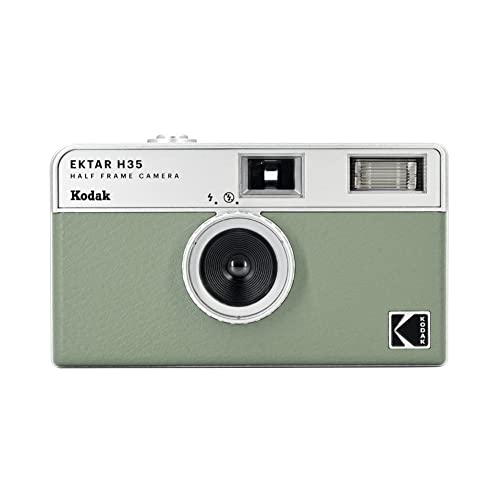
- Around 72 half-frame shots from a 36-exposure roll
- Lightweight, pocket-size, focus-free design
- Built-in flash; film and AAA battery not included
Best For: Beginners seeking more shots per roll
Best Ready-to-Shoot Pick

- Pre-loaded ISO 400 film with 27 exposures
- Built-in flash with stated 10-foot range
- One-time-use design
Best For: Simple travel and event photos without loading film
Best for Creative Controls

- Two-zone focus and three-element glass lens
- Multiple exposure and selectable auto flash
- Film and AAA battery not included
Best For: Simple 35mm shooting with creative options
Best for Simple Zoom Shooting

- 38–60mm optical zoom
- Autofocus and auto exposure
- Automatic film handling and built-in flash
Best For: Beginners wanting an automatic vintage Canon zoom camera
Best for Stretching a Roll

- Around 72 half-frames from a 36-exposure roll
- Lightweight, focus-free design
- Film and AAA battery sold separately
Best For: Beginners wanting more snapshots per roll
Best for Longer Zoom Reach

- Versatile 38–105mm zoom
- Autofocus and auto exposure
- Built-in automatic flash
Best For: Casual shooters wanting longer zoom reach
Best for Comfort

- Around 48 half-frame shots from a 24-exposure roll
- Includes Kodak UltraMax 400 film
- Focus-free with built-in flash
Best For: Beginners who want more shots per roll
Best with a Sliding Lens Cover

- Sliding cover protects the lens
- 25mm wide-angle lens
- Film and AA battery sold separately
Best For: Beginners seeking a simple everyday camera
Best Heavy-Duty Pick

- Two-zone focus
- Three-element glass lens
- Multiple exposure and selectable auto flash
Best For: Beginners interested in focus choices and layered photos
Best for Stretching a Film Roll – KODAK EKTAR H35 Half-Frame Camera
The KODAK EKTAR H35 is a compact film camera that makes each 35mm roll go further: a 36-exposure roll can yield around 72 half-frame photos. Its focus-free operation and light, pocket-size body make it an approachable everyday option.
Best For: Beginners who want more shots per roll with minimal setup.
Pros:
- Half-frame format yields around twice as many images per roll.
- Lightweight, pocket-size design is easy to carry.
- Built-in flash can be switched on using the ring around the lens.
Cons:
- Film and AAA battery are not included.
- Focus-free design offers no manual focus adjustment.
Choose the H35 if shooting more frames matters more to you than adjusting focus. Remember to add film and an AAA battery before your first outing.
Best Ready-to-Shoot Pick – Fujifilm QuickSnap Flash 400
The Fujifilm QuickSnap Flash 400 is a compact film camera for occasions when you do not want to load film. It comes pre-loaded with ISO 400 film for 27 exposures and has a built-in flash for nearby subjects.
Best For: Travel and events where a simple, one-time-use camera is convenient.
Pros:
- Pre-loaded with 27 exposures of ISO 400 film.
- Built-in flash has a stated 10-foot range.
- Continuous flash switch simplifies taking several flash photos.
Cons:
- One-time-use design is not a reusable camera.
- Stated flash range is limited to 10 feet.
This is the straightforward choice when having film already loaded matters most. Keep the flash’s stated range in mind when photographing people or scenes farther away.
Best for Creative Controls – KODAK Snapic A1 35mm Camera
The KODAK Snapic A1 is a compact film camera with more shooting options than a basic focus-free model. Its two-zone focus, three-element glass lens, selectable auto flash and multiple-exposure feature give you a few ways to adapt or experiment.
Best For: Shooters who want a reusable 35mm camera with simple focus and creative options.
Pros:
- Two-zone focus lets you switch between focus settings.
- Three-element glass lens is designed for sharpness and detail.
- Multiple exposure allows two scenes to be layered on one photo.
- Selectable auto flash includes red-eye reduction.
Cons:
- Film and AAA battery are not included.
- Two focus zones offer fewer choices than continuously adjustable focus.
The Snapic A1 makes sense if you want to try layered images or select a focus zone without taking on a more involved camera. Budget for film and an AAA battery separately.
Best for Simple Zoom Shooting – Canon Sure Shot Zoom-S
The renewed Canon Sure Shot Zoom-S is a compact film camera for shoppers who want automatic 35mm shooting with some framing flexibility. Its 38–60mm zoom, autofocus, and automatic exposure keep everyday photos straightforward.
Best For: Beginners and casual photographers who want a vintage Canon point-and-shoot with a modest zoom range.
Pros:
- 38–60mm optical zoom offers more framing options than a fixed lens.
- Autofocus and automatic exposure simplify shooting.
- Built-in flash, automatic film advance and rewind, and a film counter add convenience.
Cons:
- The 38–60mm zoom range is relatively limited.
- Automatic operation offers less hands-on control for photographers seeking manual settings.
Choose this one if ease of use matters more than a long zoom. The listing describes it as renewed and includes a 90-day limited warranty.
Best for Stretching a Roll – Kodak EKTAR H35
The Kodak EKTAR H35 is a compact film camera that shoots half-frame images on standard 35mm film. A 36-exposure roll can yield around 72 photos, making it appealing if you want more shots from each roll.
Best For: Beginners and casual shooters who prioritize a lightweight camera and more exposures per roll.
Pros:
- Half-frame format can roughly double the number of photos per roll.
- Focus-free operation keeps shooting simple.
- Lightweight, pocket-size body has a built-in flash.
Cons:
- Each photo uses half a standard 35mm frame.
- Film and the AAA battery are not included.
Pick the H35 for simple, high-volume snapshots rather than full-frame negatives or adjustable focus. Remember to budget for film and a battery before you head out.
Best for Longer Zoom Reach – Olympus Superzoom 105G
The renewed Olympus Superzoom 105G is a compact film camera for anyone who wants more reach from an automatic 35mm point-and-shoot. Its 38–105mm zoom covers wider everyday scenes and tighter portrait framing.
Best For: Travel and casual photography when a longer zoom matters more than manual controls.
Pros:
- 38–105mm zoom provides versatile framing.
- Autofocus and automatic exposure make it approachable for beginners.
- Built-in automatic flash adds convenience in lower light.
Cons:
- Automatic controls may not suit photographers who want manual exposure.
- The listing identifies it as a renewed camera rather than a new one.
This is the strongest fit of the three if zoom range is your deciding factor. The supplied listing also specifies a 90-day limited warranty.
Best for Comfort – Kodak EKTAR H35 Half-Frame
The Kodak EKTAR H35 is a compact film camera for anyone who wants more shots from each roll. Its half-frame format can turn the included 24-exposure roll of Kodak UltraMax 400 into around 48 photos.
Best For: Beginners who want a small, straightforward camera and more images per roll.
Pros:
- Half-frame format yields around twice the photos of standard frames.
- Includes one 24-exposure roll of Kodak UltraMax 400.
- Focus-free operation and a built-in flash keep shooting simple.
Cons:
- AAA battery is not included.
- Focus-free design offers no manual focusing choice.
Choose the H35 if shot count matters more to you than focus control. Its small size makes it an easy camera to carry regularly.
Best with a Sliding Lens Cover – KODAK EC35
The KODAK EC35 is a compact film camera with a sliding cover to protect its lens between shots. Its focus-free setup and 25mm wide-angle lens suit casual street scenes and portraits.
Best For: New film shooters who want a simple camera with a covered lens for everyday carrying.
Pros:
- Sliding cover protects the lens.
- 25mm wide-angle lens suits street photography and portraits.
- Built-in flash and included strap add everyday convenience.
Cons:
- Film and AA battery are not included.
- Focus-free operation does not offer manual focus selection.
The EC35 keeps the shooting process uncomplicated. Budget for film and an AA battery before taking it out.
Best Heavy-Duty Pick – KODAK Snapic A1
The KODAK Snapic A1 is a compact film camera for shooters who want a few more choices than a focus-free model provides. It pairs two-zone focus with a three-element glass lens and a multiple-exposure option.
Best For: Film beginners who want simple focus choices and room to experiment with layered images.
Pros:
- Two-zone focus lets you switch between two focus settings.
- Three-element glass lens is designed for sharpness and detail.
- Multiple exposure and selectable auto flash with red-eye reduction expand shooting options.
Cons:
- Film and AAA battery are not included.
- Two-zone focus provides only two settings.
The Snapic A1 is the more hands-on pick here without requiring full manual focusing. Its multiple-exposure feature is a practical reason to choose it if you want to try layered frames.
How We Picked These Compact Film Cameras
We compared the nine selected listings by shooting format, focusing method, lens flexibility, flash, film and battery requirements, and ease of use. The selection includes three KODAK EKTAR H35 variants and two KODAK Snapic A1 colors; those differences may matter for what you buy, but they do not represent five distinct shooting systems. We also considered the practical trade-offs between a new reusable camera, a one-time-use camera, and an older electronic point-and-shoot. Camera condition matters especially for the vintage models, so inspect the specific listing rather than relying on a model name alone.
Quick Comparison: Which Type Fits Your Plans?
- For more pictures per roll: The EKTAR H35 models make half-frame images, giving you roughly twice as many exposures as standard 35mm frames on the same roll, with smaller individual negatives.
- For the simplest one-off outing: The Fujifilm QuickSnap Flash 400 comes preloaded for 27 exposures. It is a one-time-use camera, not a reusable alternative.
- For reusable, straightforward shooting: The KODAK EC35 is focus-free with a built-in flash. The Snapic A1 adds two-zone focus, so you need to choose the appropriate setting for your subject.
- For framing flexibility: The Canon Sure Shot Zoom-S and Olympus Superzoom 105G are vintage zoom point-and-shoots with electronic features. Their usefulness depends on working condition.
Key Buying Factors for a Compact Film Camera
Frame Size and Film Costs
All these options use 35mm film, but the H35 records two half-frame pictures in the space of one standard frame. That can stretch a roll further, though each image has less negative area for enlargements. Factor in film, developing, and scanning costs—not just the camera price. The QuickSnap includes film; the reusable KODAK listings specify that film is not included.
Focus, Zoom, and Flash
Focus-free cameras minimize decisions but offer limited control over subject distance. Two-zone focus requires a quick setting change; autofocus can be more convenient when it works. A zoom helps you reframe without moving, but adds mechanical and electronic complexity. If you plan to shoot indoors, check the flash and its required battery before ordering. Do not assume a camera works without one simply because the shutter can fire.
Condition and Ongoing Use
For a used Compact Film Camera, look for confirmation that film advances and rewinds, the flash charges, the lens moves freely, and the battery compartment is clean. If you cannot verify operation, allow for the risk of a faulty camera or wasted roll. For any model, check whether the listing includes accessories, and choose a lab that can develop and scan your film; ask how it handles half-frame shots if you buy an H35.
Who Should Buy Which Compact Film Camera?
Choose an H35 if you value extra shots per roll and an uncomplicated camera. Pick the EC35 for simple reusable full-frame snapshots, or the Snapic A1 if you are comfortable selecting between two focus zones. Take a QuickSnap when you want a preloaded camera for a single event without keeping the camera afterward. Consider the Canon or Olympus zoom models if adjustable framing appeals to you and you can buy a tested example. For the duplicate H35 and Snapic A1 listings, compare color, bundle contents, and total price rather than expecting a different core camera.