
Self portraits are easier when you can frame the shot, step into position, and trigger the camera without rushing back to it. The right intervalometer adds hands-free control while helping you manage delays, repeated exposures, and longer creative setups.
We selected 10 camera intervalometers for self portraits across Canon, Nikon, and Sony systems, including rechargeable remotes and models with LCD displays. Use the guide below to narrow your choices by camera compatibility, shooting style, and control features.
Best 10 Camera Intervalometers for Self Portraits Picks for 2026
Flexible Wireless Pick
AODELAN Rechargeable Canon Intervalometer

- Wireless range up to approximately 60 meters
- Rechargeable transmitter and receiver
- Supports interval, bulb, delay, and long exposure
Best For: Wireless self-portraits with compatible Canon and other supported cameras
Dual-Connection Canon Pick
Hanpusen Rechargeable Canon Intervalometer
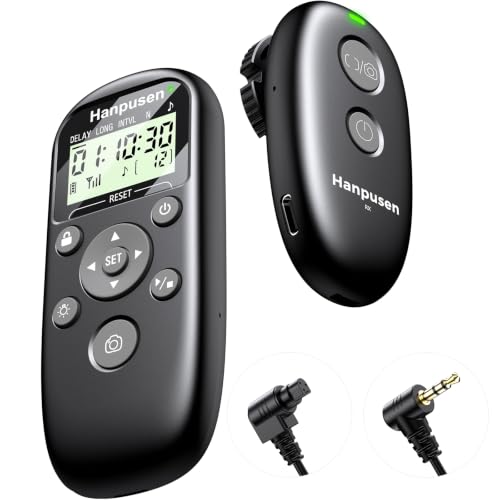
- Wireless or wired triggering
- Rechargeable battery and OLED display
- Up to 60 meters of wireless transmission
Best For: Canon self-portraits requiring flexible wired or wireless control
Budget Wired Canon Pick
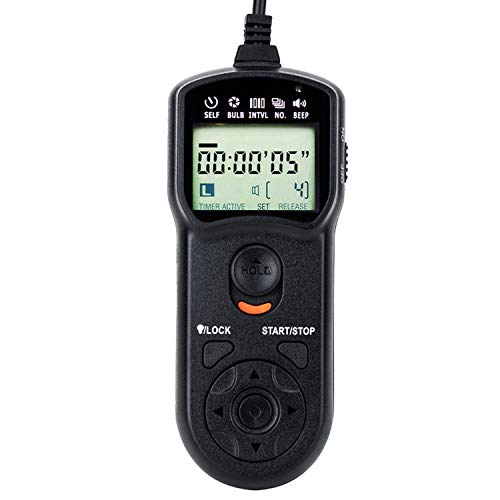
- Self-timer and interval controls
- Long timer range up to nearly 100 hours
- Compact 90-centimeter wired design
Best For: Close-range Canon self-portraits with straightforward timer control
Sony Wireless Pick
Rechargeable Timer Intervalometer

- Wireless range of approximately 60 meters
- Rechargeable USB-C battery
- Interval, bulb, delay, and count settings
Best For: Sony users shooting self-portraits, time-lapses, and long exposures
Simple Canon Wired Pick
- Timer range from 1 second to nearly 100 hours
- Backlit LCD for low-light setup
- Compact wired 90-centimeter design
Best For: Canon photographers who want simple wired timer control
Multi-System Choice
Rechargeable Wireless Canon Timer Remote
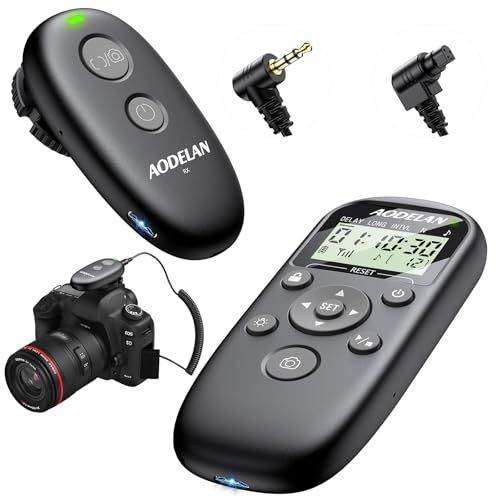
- Wireless range of approximately 60 meters
- Supports wired and wireless shooting
- Works with many listed camera systems
Best For: Multi-camera owners needing flexible interval and shutter control
Best Multi-Brand Wired Pick
AODELAN Rechargeable LCD Intervalometer

- Programmable delay, intervals, and shot counts
- USB-C rechargeable battery with LCD display
- Supports many Canon and selected other cameras
Best For: Multi-camera users planning self portraits, time-lapses, or long exposures
Best Budget Canon Option

- Includes self-timer and interval modes
- Backlit LCD for low-light setting checks
- Runs on two AAA batteries
Best For: Canon DSLR users shooting self portraits and simple time-lapses
Best Wireless Nikon Pick
AODELAN Wireless Intervalometer

- Wireless range of approximately 60 meters
- Supports bulb, delay, interval, and count modes
- USB-C rechargeable transmitter and receiver
Best For: Nikon users needing flexible wireless self-portrait control
Flexible Wireless Pick – AODELAN Rechargeable Canon Intervalometer
For photographers comparing camera intervalometers for self portraits, the AODELAN is a flexible option when you want wireless freedom, rechargeable power, and broad camera compatibility. Its timer supports delay, interval, long-exposure, bulb, and count settings, while the 60-meter radio range helps you get into position without returning to the camera.
Best For: Canon users and photographers who need wireless self-portrait control across multiple compatible camera brands.
Pros:
- Supports delay, interval, bulb, long-exposure, and count settings.
- Rechargeable transmitter and receiver with included USB-C charging cable.
- Up to approximately 60 meters of wireless range with no stated directionality requirement.
- Includes two connecting cables for use with different compatible camera models.
Cons:
- Compatibility depends on using the correct included camera cable.
- The supplied specifications list a single supported device at a time.
Choose this model when wireless range and rechargeable convenience matter more than a simple wired trigger. The LCD and broad compatibility make it especially versatile for planned self-portraits and timed creative work.
Simple Wired Nikon Choice – JJC TM-F2 Nikon Intervalometer
The JJC TM-F2 is a practical choice among camera intervalometers for self portraits when your Nikon setup is close by and you prefer a straightforward wired connection. It combines self-timer, interval, long-exposure, and exposure-count functions with a backlit LCD that remains readable in dark conditions.
Best For: Nikon photographers who want dependable near-camera control for self-portraits and time-lapse work.
Pros:
- Timer settings range from 1 second to 99 hours, 59 minutes, and 59 seconds.
- Includes self-timer, interval, long-exposure, and exposure-count modes.
- Backlit LCD helps with setup in the dark.
- Compact 90-centimeter wired remote design.
Cons:
- Wired operation limits placement to the 90-centimeter cable length.
- Requires two AAA alkaline batteries.
This is a sensible pick if your camera stays within arm’s reach and you value simple timer controls over wireless flexibility. Confirm your Nikon model is supported before ordering.
Dual-Connection Canon Pick – Hanpusen Rechargeable Canon Intervalometer
For camera intervalometers for self portraits, this Hanpusen remote stands out for combining wireless and wired operation. It offers a rechargeable battery, OLED display, interval and bulb controls, and a claimed wireless range of up to 60 meters, giving Canon users flexibility for both close and distant setups.
Best For: Canon users who want rechargeable power plus the option of wireless or zero-latency wired triggering.
Pros:
- Offers both 2.4GHz wireless and wired connection modes.
- Rechargeable lithium-ion battery with included Type-C cable.
- Supports self-timer, interval, bulb, long-exposure, and continuous shooting uses.
- OLED display is designed for quick setup in low-light conditions.
Cons:
- Designed for compatible Canon cameras rather than a broad mix of brands.
- Wireless range depends on unobstructed conditions.
The dual-connection design makes this a strong all-around Canon option. Use wireless control when you need distance for a self-portrait, or switch to the cable when a direct connection is preferable.
Budget Wired Canon Pick – JJC TM-C Canon Intervalometer
The JJC TM-C is a compact wired option for photographers seeking camera intervalometers for self portraits without adding a wireless receiver. Its timer provides self-timer, interval, long-exposure, and exposure-count settings, while the backlit LCD helps with operation in low light.
Best For: Canon users who keep the camera nearby and want an uncomplicated wired timer for self-portraits.
Pros:
- Supports self-timer, interval, long-exposure, and exposure-count settings.
- Timer can be set from 1 second to 99 hours, 59 minutes, and 59 seconds.
- Compact body with a 90-centimeter cable.
- Backlit LCD supports setup in dark conditions.
Cons:
- Limited to wired operation and a 90-centimeter reach.
- Requires two AAA alkaline batteries.
This model makes sense for tabletop, studio, or other close-range self-portraits where wireless distance is unnecessary. Check the listed Canon compatibility carefully, as the remote is camera-specific.
Sony Wireless Pick – Rechargeable Timer Intervalometer
For Sony shooters comparing camera intervalometers for self portraits, this wireless rechargeable remote combines interval timing with a generous operating range. It supports delay, long-exposure, bulb, interval, and count settings, making it useful when you want hands-free shooting without returning to the camera.
Best For: Sony camera owners who want wireless control for self-portraits, time-lapse work, or long exposures.
Pros:
- Compatible with a broad list of Sony cameras, including the ZV-E10 II, ZV-1, A6700, A7 IV, A7C II, and RX100 VII.
- Offers interval, delay, bulb, long-exposure, and shot-count settings.
- Wireless 2.4GHz operation reaches approximately 60 meters and does not require directional aiming.
- Built-in rechargeable battery with USB-C charging and an LCD backlight.
Cons:
- Compatibility depends on using the correct camera connecting cable.
- The supplied notes identify support for one device at a time.
This is a flexible choice for Sony users who prioritize wireless range and rechargeable convenience. Its interval controls also make it more capable than a basic shutter release for planned self-portraits and creative sequences.
Simple Canon Wired Pick – JJC TC-80N3 Timer Remote
The JJC TC-80N3 is a straightforward wired option for Canon photographers choosing camera intervalometers for self portraits. Its timer supports delayed shooting, repeating intervals, long exposures, and exposure counts, while the cable connection helps avoid camera shake during setup.
Best For: Canon users who prefer a compact wired intervalometer for self-portraits and time-lapse photography.
Pros:
- Includes self-timer, interval timer, long-exposure timer, and exposure-count functions.
- Timer settings can be configured from 1 second to 99 hours, 59 minutes, and 59 seconds.
- Backlit LCD makes settings easier to view in dark conditions.
- Compact 76-gram design with a 90-centimeter cable.
Cons:
- Wired operation limits the working distance to the 90-centimeter cable length.
- Requires two AAA alkaline batteries.
- Compatibility is listed for Canon cameras using the appropriate connection.
This JJC remote is best when you want dependable timer controls without managing a wireless receiver. It is less convenient for distant self-portraits, but its broad timing range and backlit display suit stationary setups well.
Multi-System Choice – Rechargeable Wireless Canon Timer Remote
For shoppers seeking camera intervalometers for self portraits across more than one camera system, this rechargeable remote offers both wireless and wired shooting modes. It includes interval timing, shot counts, bulb support, and a display for reviewing settings before starting a hands-free session.
Best For: Photographers using compatible Canon, Fujifilm, Olympus, Pentax, or other listed systems who want flexible remote operation.
Pros:
- Supports many listed Canon models plus selected Fujifilm, Olympus, Pentax, Contax, Hasselblad, Samsung, and Sigma cameras.
- Provides wireless operation up to approximately 60 meters or wired control through the included cable.
- Rechargeable design with a clear LCD showing interval, count, and delay settings.
- Supports single shooting, continuous shooting, bulb mode, and interval timing for time-lapse projects.
Cons:
- Video recording is not supported through the intervalometer.
- Camera compatibility varies by model and required cable.
- Some wired receiver use is limited to shutter release according to the supplied notes.
This model stands out for photographers who value system flexibility and the choice between wireless and wired triggering. Verify your exact camera model before buying, especially if you plan to use interval features rather than basic shutter release.
Best Multi-Brand Wired Pick – AODELAN Rechargeable LCD Intervalometer
For photographers comparing camera intervalometers for self portraits, the AODELAN offers programmable delay, interval, and shot-count controls in a wired design. Its LCD screen and rechargeable battery make it practical for repeated portrait sessions, time-lapses, and long exposures.
Best For: Canon users and photographers who want broad camera compatibility, precise timing, and rechargeable operation.
Pros:
- Supports delay shooting, bulb/long exposure, interval shooting, and exposure-count control.
- Programmable settings range from 0 seconds to 99 hours, 59 minutes, and 59 seconds, with up to 399 or unlimited shots.
- Rechargeable via USB-C and includes a clear LCD showing battery level and timer settings.
- Works with many Canon models plus selected Fujifilm, Hasselblad, Olympus, Pentax, and Samsung cameras.
Cons:
- It is a wired remote, so movement is limited by the connecting cable.
- Camera compatibility must be checked carefully because supported models vary by cable and brand.
This is a versatile choice when precise scheduling matters more than wireless operation. The rechargeable battery and extensive compatibility make it especially useful for photographers who use multiple supported camera bodies.
Best Budget Canon Option – JINTU LCD Timer Remote
The JINTU timer remote is a straightforward option for Canon owners seeking camera intervalometers for self portraits. It combines a backlit LCD with self-timer, interval, long-exposure, and exposure-count modes, making it useful for solo portraits and scheduled shooting.
Best For: Canon DSLR users who want a compact, battery-powered wired intervalometer for portraits and time-lapse work.
Pros:
- Offers self-timer, interval timer, long-exposure timer, and exposure-count settings.
- Delay and timer settings can be adjusted from 1 second to 99 hours, 59 minutes, and 59 seconds.
- Backlit LCD is designed for viewing settings in the dark.
- Compatible with a broad selection of Canon EOS and Rebel cameras listed by the manufacturer.
Cons:
- Requires two AAA alkaline batteries, which are not included.
- Its 10 cm wired controller cable limits placement flexibility.
- Compatibility is focused on Canon cameras.
The JINTU keeps the controls focused on essential timed-shooting functions. It is a practical pick for Canon photographers who do not need wireless control or a rechargeable power system.
Best Wireless Nikon Pick – AODELAN Wireless Intervalometer
For Nikon photographers looking at camera intervalometers for self portraits, this AODELAN model adds wireless control to programmable timing functions. The transmitter and receiver use 2.4GHz radio technology, allowing shutter control from up to approximately 60 meters when positioning the camera away from the subject.
Best For: Nikon users who want wireless self-portrait control, LCD timing information, and support for long exposures or interval sequences.
Pros:
- Provides delay, bulb, long-exposure, interval, and shot-count settings.
- 2.4GHz wireless operation reaches approximately 60 meters or 200 feet.
- Rechargeable transmitter and receiver use USB-C charging.
- Supports a wide range of Nikon Z, D-series, and selected Coolpix cameras.
Cons:
- Both a transmitter and receiver must be charged before extended use.
- It is designed around Nikon compatibility, so other camera systems require careful verification.
- The supplied notes list different approximate continuous-use times for the transmitter and receiver.
The wireless range is the main advantage for self portraits, especially when the camera needs to be placed well away from the subject. Nikon users also get the timing controls needed for repeatable sequences, astrophotography, and long exposures.
How We Picked the Best Camera Intervalometers for Self Portraits
We focused on remotes that support the practical demands of self-portrait photography: reliable shutter triggering, programmable delays, interval shooting, exposure counts, and a design that is easy to operate while setting up alone. Compatibility was a major consideration because intervalometers are often tied to specific camera brands, connector types, or model families.
The selection includes AODELAN, JJC, JINTU, and generic rechargeable options covering Canon, Nikon, and Sony cameras. We also considered rechargeable power, LCD readouts, wireless operation, stated range, and whether the control layout appears suitable for quick adjustments before stepping in front of the lens.
Quick Comparison
- Best for Canon users: Choose a remote explicitly listing your exact Canon model and connector.
- Best for Nikon users: A Nikon-specific JJC or AODELAN intervalometer can simplify setup and reduce compatibility uncertainty.
- Best for Sony users: Select the Sony-compatible rechargeable option and confirm your camera’s remote-control requirements.
- Best for repeated shots: Look for programmable interval, delay, and exposure-count controls.
- Best for low-maintenance use: A rechargeable model avoids repeatedly buying disposable batteries.
- Best for clear setup: An LCD screen makes timing and shooting parameters easier to verify.
Key Buying Factors for Camera Intervalometers for Self Portraits
Camera Compatibility
Check the full compatibility list before buying. Camera names can span several generations, but similar-looking models may use different ports or electronic requirements. Confirm both the exact camera model and the required connector, especially if you use an adapter, battery grip, or multiple camera bodies.
Timer and Interval Controls
For simple portraits, a delayed shutter release may be enough. For movement, outfit changes, or varied expressions, prioritize adjustable delay, interval length, exposure count, and long-exposure settings. More control is useful only if the buttons and display make programming straightforward.
Wireless Range and Line of Sight
Wireless range matters when you want to hide the remote, move across a room, or work outdoors. Real-world performance can vary with walls, interference, and battery level, so treat advertised range as a guideline rather than a guarantee.
Power, Display, and Handling
Rechargeable models are convenient for regular use, while an LCD helps prevent timing mistakes. Also consider charging time, standby behavior, button size, cable length if applicable, and whether the remote can be operated without looking down constantly.
Who Should Buy Which Camera Intervalometers for Self Portraits?
Choose a brand-specific JJC, AODELAN, or JINTU model if you want the clearest compatibility path for a Canon or Nikon body. A Sony-specific rechargeable remote is the sensible choice for compatible Sony users. If you own several cameras, compare connector requirements carefully before choosing a broadly labeled model. For casual self portraits, prioritize dependable shutter release and simple delay settings; for creative sequences or long sessions, choose an LCD-equipped rechargeable intervalometer with programmable intervals and exposure counts.