
The right intervalometer can make long exposures, timelapses, and scheduled DSLR shooting far easier by combining precise timing with remote shutter control. The products in this roundup cover popular Canon, Nikon, and Sony systems, including wireless and rechargeable options.
Before choosing, verify your camera’s connector and compatibility list, then consider whether you need wireless operation, a built-in display, or advanced interval settings.
Best 10 Camera Intervalometers for Dslr Cameras Picks for 2026
Best Wireless Nikon Pick
Pixel TW-283 DC2 Wireless Intervalometer

- 2.4GHz wireless control with 80m+ stated range
- Programmable delay, interval, bulb, and repeat shooting
- LCD displays and 30 channels for easier operation
Best For: Compatible Nikon cameras needing wireless time-lapse control
Best Simple Canon Timer
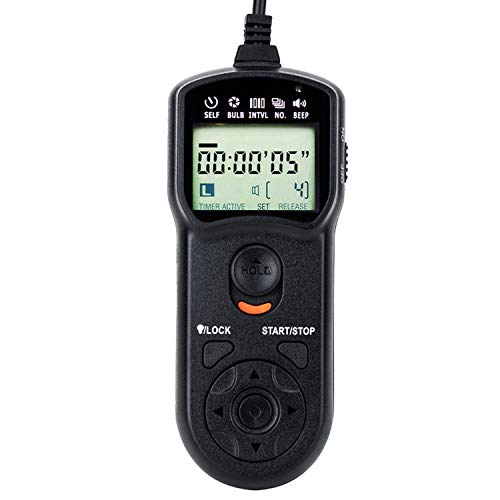
- Wired Canon remote with 90cm cable
- Includes interval, long-exposure, and self-timer modes
- Backlit LCD supports low-light setup
Best For: Canon users wanting dependable wired time-lapse control
Best Advanced Canon Wireless Pick
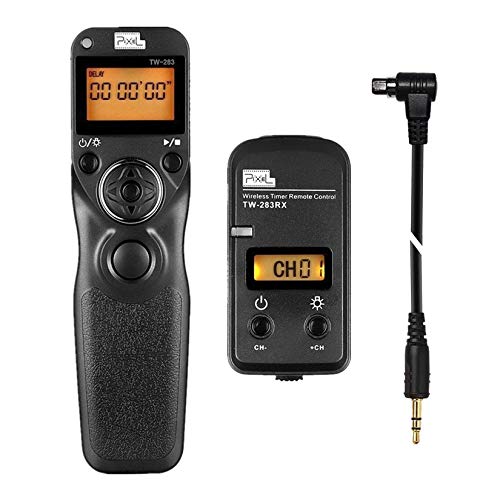
- Wireless Canon control with 80m+ stated range
- Supports up to 999 shots and repeat scheduling
- Combines interval timing with long-exposure control
Best For: Extended Canon time-lapse and remote exposure sequences
Best Sony Wired Option
- Wired Sony remote with 90cm cable
- Supports interval, self-timer, and long-exposure modes
- Backlit LCD with lock and two-stage release
Best For: Sony photographers shooting time-lapse or long exposures nearby
Versatile Wired Choice
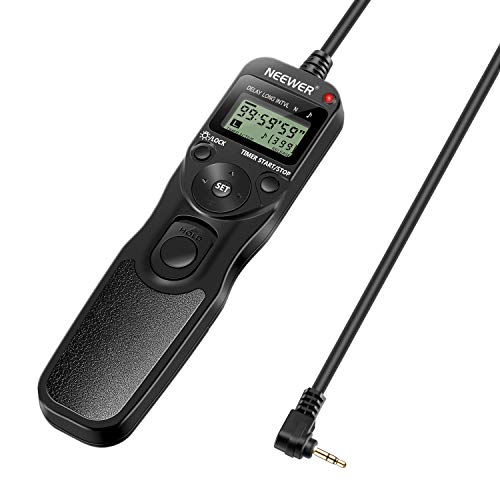
- Delay settings from 0 seconds to 99 hours, 59 minutes, 59 seconds
- Compatible with select Canon, Pentax, and Samsung cameras
- 10-meter stated range and two-AAA battery power
Best For: Canon and Pentax DSLR owners needing precise long-delay control
Most Flexible Connectivity
Rechargeable Multi-Camera Interval Remote
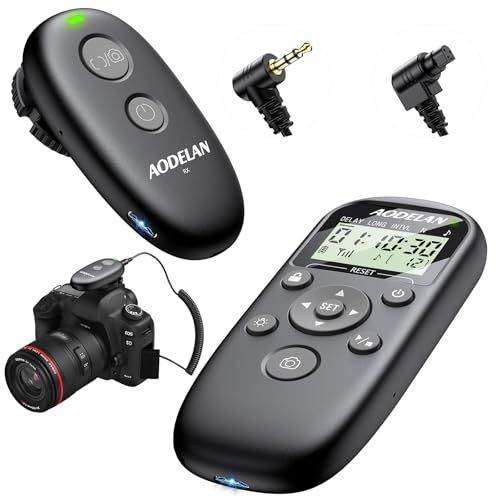
- Wireless triggering up to a stated 60 meters plus wired operation
- One-second interval timing with shot-count control
- Rechargeable battery and LCD display across many supported brands
Best For: Multi-camera users wanting flexible wireless and wired triggering
Best Compact Wired Pick
- Interval, long-exposure, and count settings
- Timing range from 1 second to nearly 100 hours
- Compact wired design with backlit LCD
Best For: Canon photographers wanting simple wired time-lapse control
Best Wireless Nikon Range
AODELAN Rechargeable Timer Remote

- Wireless range up to approximately 200 feet
- Supports interval, bulb, delay, and long exposure
- USB-C rechargeable transmitter and receiver
Best For: Nikon users needing long-range wireless control
Best Multi-Brand Wireless Option

- Wireless range up to approximately 200 feet
- Supports wired and wireless operation
- Rechargeable with 1-second timing precision
Best For: Multi-camera owners needing flexible control
Best Wireless Nikon Pick – Pixel TW-283 DC2 Wireless Intervalometer
For photographers comparing camera intervalometers for DSLR cameras, the Pixel TW-283 DC2 is a flexible wireless option for compatible Nikon models. Its 2.4GHz connection, LCD displays, 30 channels, and stated 80-meter-plus range are useful for time-lapse work, long exposures, and remote shooting.
Best For: Nikon users who want wireless control for time-lapse sequences, delayed shooting, or bulb exposures.
Pros:
- Supports delay, interval, bulb, continuous, and timer-schedule shooting modes.
- Offers adjustable delay, exposure, interval, shot count, and repeat settings.
- Uses 30 channels and an 80-meter-plus range to help reduce interference.
- LCD screens on the transmitter and receiver simplify setup.
Cons:
- Compatibility is cable- and model-specific, so confirm your Nikon camera before ordering.
- Requires two AAA batteries.
- The wireless kit is less compact than a basic wired release.
The TW-283 DC2 is a strong choice when wireless range and programmable shooting matter more than minimal size. Verify the included DC2 connection matches your camera.
Best Simple Canon Timer – JJC TM-C Wired Intervalometer
The JJC TM-C is a straightforward wired choice among camera intervalometers for DSLR cameras. Designed for compatible Canon models, it provides self-timer, interval, long-exposure, and exposure-count functions through a backlit LCD remote.
Best For: Canon photographers who prefer a simple wired controller for time-lapse photography and shake-free shooting.
Pros:
- Supports self-timer, interval timer, long-exposure timer, and exposure-count settings.
- Timer settings span from one second to 99 hours, 59 minutes, and 59 seconds.
- Backlit LCD helps with operation in dark conditions.
- Compact 90cm wired design is powered by two AAA alkaline batteries.
Cons:
- Its 90cm cable limits placement compared with wireless remotes.
- Compatibility is limited to supported Canon cameras and the correct connection.
- It does not provide wireless remote operation.
This JJC remote focuses on the essential intervalometer controls without adding wireless complexity. It is a practical pick for Canon users who usually shoot close to the camera.
Best Advanced Canon Wireless Pick – Pixel TW283-N3 Intervalometer
For Canon photographers seeking camera intervalometers for DSLR cameras with more scheduling control, the Pixel TW283-N3 combines wireless operation with detailed timer programming. It supports interval shooting, long exposures, repeat schedules, and up to 999 shots on compatible Canon cameras.
Best For: Canon users creating extended time-lapse sequences, sunrise or sunset captures, and remote long-exposure sessions.
Pros:
- Supports autofocus, single, continuous, bulb, delay, and timer-schedule shooting.
- Timer settings can reach 99 hours, 59 minutes, and 59 seconds in one-second increments.
- Allows up to 999 shots and repeat times from one to 99, with an unlimited option.
- Provides wireless operation, backlit controls, 30 channels, and an 80-meter-plus stated range.
Cons:
- Requires four AAA alkaline batteries.
- Its broader controls may take more setup than a basic shutter release.
- Confirm the Canon model and connector compatibility before purchase.
The TW283-N3 is the more feature-rich Canon option in this roundup. Choose it when programmable schedules and extended wireless shooting are priorities.
Best Sony Wired Option – JJC TM-F2 Intervalometer
The JJC TM-F2 offers core timer functions for compatible Sony cameras in a compact wired controller. As one of the camera intervalometers for DSLR cameras and interchangeable-lens systems, it is suited to shake-free shooting, time-lapse work, self-timed captures, and long exposures.
Best For: Sony users who want a compact wired intervalometer with a backlit display and broad timer settings.
Pros:
- Includes self-timer, interval, long-exposure, and exposure-count functions.
- Timer range runs from one second to 99 hours, 59 minutes, and 59 seconds.
- Backlit LCD, lock function, and two-stage release button improve handling.
- Compact 90cm cable design is powered by two AAA alkaline batteries.
Cons:
- Wired operation limits the maximum distance to the 90cm cable length.
- Compatibility varies by Sony model and connector, so check the supplied list.
- It lacks the wireless range of the Pixel intervalometers.
The TM-F2 is a sensible Sony-focused choice for photographers who value simple controls and a compact design. It works best when the camera remains within reach of the wired remote.
Versatile Wired Choice – Neewer TC-2 LCD Timer Remote
If you need camera intervalometers for DSLR cameras, the Neewer TC-2 offers programmable timing in a straightforward remote-control format. Its delay can be set from 0 seconds to 99 hours, 59 minutes, and 59 seconds in one-second increments, with compatibility covering select Canon and Pentax cameras.
Best For: Canon and Pentax DSLR owners who want long, precisely adjustable delays.
Pros:
- Timer delay adjusts in one-second increments up to nearly 100 hours.
- Supports a broad selection of listed Canon and Pentax models, plus select Samsung cameras.
- Compact button-control design with a stated 10-meter range.
Cons:
- Compatibility is limited to the camera models listed by the manufacturer.
- Requires two AAA batteries.
- Supports one device at a time.
The TC-2 is a practical pick when precise delay control matters more than advanced shooting modes. Confirm your camera model before ordering, particularly if you use an older DSLR.
Backlit Nikon Specialist – JJC TM-F2 Intervalometer
For photographers comparing camera intervalometers for DSLR cameras, the JJC TM-F2 is a wired Nikon-focused option with several useful timing modes. It combines self-timer, interval, long-exposure, and exposure-count settings with a backlit LCD for easier operation in dark conditions.
Best For: Nikon DSLR and compatible mirrorless users shooting time-lapses, long exposures, or shake-free stills.
Pros:
- Includes self-timer, interval timer, long-exposure timer, and exposure-count functions.
- Timer range spans 1 second to 99 hours, 59 minutes, 59 seconds.
- Backlit LCD helps with setting adjustments in low light.
- Uses a 90-centimeter wired connection and two AAA alkaline batteries.
Cons:
- Wired operation limits working distance to the 90-centimeter cable length.
- Designed for one compatible camera at a time.
- Compatibility should be checked against the listed Nikon models.
The TM-F2 is well suited to controlled tripod work where a wired connection is acceptable. Its dedicated exposure-count and long-exposure functions make it more flexible than a basic shutter-release cable.
Most Flexible Connectivity – Rechargeable Multi-Camera Interval Remote
This rechargeable remote is a versatile option among camera intervalometers for DSLR cameras, combining interval timing with both wireless and wired shooting. The supplied compatibility list spans many Canon models and select Fujifilm, Pentax, Olympus, Hasselblad, Samsung, Sigma, and Contax cameras.
Best For: Photographers who use supported cameras across brands and want wireless or cable-based triggering.
Pros:
- Built-in intervalometer supports shot intervals and counts with one-second timing accuracy.
- Offers wireless triggering up to a stated 60 meters or wired operation.
- Rechargeable design with LCD display for interval, count, and delay settings.
- Supports single shooting, continuous shooting, and Bulb mode when the camera is set appropriately.
Cons:
- Video recording is not supported according to the supplied notes.
- Operation depends on using the correct cable and a listed compatible camera.
- Wireless and wired functions may differ; the receiver’s direct cable connection is for shutter release only.
This remote stands out for its broad listed compatibility and dual connection options. It is a strong choice for time-lapses, star trails, and light painting, provided your camera and required connection are supported.
Best Compact Wired Pick – JJC Timer Remote for Canon
For photographers seeking practical camera intervalometers for DSLR cameras, the JJC TC-80N3 offers a compact wired design with essential timing controls. It supports self-timer, interval, long-exposure, and exposure-count settings, with timing adjustable from 1 second to nearly 100 hours.
Best For: Canon photographers who want a straightforward wired intervalometer for time-lapse and long-exposure work.
Pros:
- Supports self-timer, interval, long-exposure, and exposure-count functions.
- Settings can be programmed from 1 second to 99 hours, 59 minutes, and 59 seconds.
- Compact 90cm wired design helps reduce camera shake during shooting.
- Backlit LCD is useful for adjusting settings in low light.
Cons:
- Wired range is limited to approximately 0.9 meters.
- Requires two AAA alkaline batteries.
- Compatibility is focused on Canon cameras using the supported connection.
The JJC is a sensible choice when you value simplicity, portability, and precise timing over wireless freedom. Its compact body and broad timing range make it well suited to controlled, tripod-based shooting.
Best Wireless Nikon Range – AODELAN Rechargeable Timer Remote
The AODELAN rechargeable remote is one of the more flexible camera intervalometers for DSLR cameras and compatible Nikon mirrorless models. Its transmitter-and-receiver system provides interval, bulb, delay, long-exposure, and shot-count controls, with a stated wireless range of up to 200 feet.
Best For: Nikon users who need long-range wireless intervalometer control and rechargeable power.
Pros:
- Supports bulb, delay, long-exposure, interval, and count settings.
- 2.4GHz wireless connection reaches approximately 60 meters or 200 feet.
- Built-in rechargeable battery charges through USB-C.
- LCD display helps show shooting settings in bright or dark conditions.
Cons:
- Requires checking the extensive camera compatibility list before purchase.
- Uses a separate transmitter and receiver rather than a single wired unit.
- Charging takes approximately two hours for each unit.
With its long operating distance and rechargeable design, this AODELAN model is a strong fit for photographers who want to position themselves away from the camera. The broad Nikon compatibility list and multiple timing modes add useful flexibility for time-lapse and long-exposure setups.
Best Multi-Brand Wireless Option – AODELAN USB-C Intervalometer
For shoppers comparing camera intervalometers for DSLR cameras across several brands, the AODELAN WTR-2 II offers unusually broad compatibility. It combines 1-second timing precision, wireless and wired operation, rechargeable power, and support for single, continuous, bulb, and delayed shooting.
Best For: Multi-camera owners who want one rechargeable intervalometer for compatible Canon, Fujifilm, Olympus, Pentax, Samsung, and Hasselblad equipment.
Pros:
- Supports delay, exposure, interval, and shot-count adjustments with 1-second precision.
- Works wirelessly up to approximately 60 meters or 200 feet.
- Can also function as a wired shutter remote.
- USB-C rechargeable design includes an LCD for settings and battery status.
Cons:
- Camera compatibility depends on using the correct included connecting cable.
- The transmitter and receiver each require charging.
- Its multi-part setup may be more involved than a basic wired remote.
The WTR-2 II is particularly appealing when flexibility matters more than minimal equipment. Its wired fallback, wireless range, and extensive compatibility list make it a versatile option for time-lapse, astrophotography, and long-exposure work.
How We Picked These Camera Intervalometers for Dslr Cameras
We selected models based on camera compatibility, trigger functionality, timing flexibility, connection type, power design, and practical use cases. The list includes wired and wireless remotes, traditional battery-powered units, and rechargeable USB-C options. Because intervalometers are connector-specific, compatibility was treated as a priority rather than assuming one remote works across every camera brand or generation.
We also looked for useful controls such as programmable delays, exposure duration, interval spacing, repeat counts, bulb support, and lockable shutter operation. These features matter for timelapse photography, star trails, long exposures, self-portraits, and studio work.
Quick Comparison
| Type | Best for | What to check |
|---|---|---|
| Wireless intervalometer | Remote shooting and reduced camera movement | Receiver range, frequency, and camera compatibility |
| Wired timer remote | Reliable long exposures and travel | Correct plug, cable length, and battery type |
| Rechargeable model | Frequent use and convenient charging | USB connector, battery life, and charging status |
| Basic shutter remote | Simple hands-free triggering | Whether it supports programmed intervals |
Key Buying Factors for Camera Intervalometers for Dslr Cameras
Camera and Connector Compatibility
Check the exact camera model and remote port before buying. Even cameras from the same brand may use different connectors, and a Canon-compatible intervalometer is not automatically suitable for Nikon or Sony. Pay attention to regional model names and included adapters as well.
Timer Functions
For timelapse work, look for adjustable delay, exposure time, interval, and shot count. Bulb and long-exposure support are valuable for night photography. If you only need a remote shutter button, a simpler unit may be smaller and easier to operate.
Wireless Versus Wired Operation
Wireless remotes are useful when the camera is positioned away from you or in a difficult-to-reach location. Wired models generally avoid pairing concerns and do not require a separate receiver battery, making them dependable for extended sessions.
Power and Controls
LCD screens can make programming easier in low light, while rechargeable batteries reduce disposable-cell costs. Consider button layout, screen readability, lock functions, and whether the remote retains settings between uses.
Who Should Buy Which Camera Intervalometers for Dslr Cameras?
Choose a wireless Pixel or similar remote if you want distance and flexibility for wildlife, self-portraits, or staged scenes. JJC timer remotes are a practical choice for photographers who want a straightforward wired intervalometer matched to a specific Canon, Nikon, or Sony body. Neewer models suit buyers seeking a broadly compatible LCD timer for older Canon cameras.
A rechargeable AODELAN or Canon-focused rechargeable remote is worth considering for frequent shooters who prefer USB charging. For astrophotography, architecture, and long exposures, prioritize precise interval and bulb controls over wireless range. Casual users who only need vibration-free triggering can save money with a basic wired shutter release, provided it supports the camera’s exact connector.