
A dependable field monitor can make a major difference when you need accurate focus, exposure, framing, and color information on a cinema camera. The right model gives you a clearer view than the built-in display while adding practical tools such as 3D LUT support, waveform monitoring, focus peaking, and HDMI or SDI connectivity.
We selected 10 camera field monitors for cinema cameras across several sizes, brightness levels, input types, and budgets. Use the guide below to narrow the list based on your camera rig, shooting environment, and preferred workflow.
Best 10 Camera Field Monitors for Cinema Cameras Picks for 2026
Bright Outdoor Monitoring
NEEWER F700 7-inch 2000nit Monitor
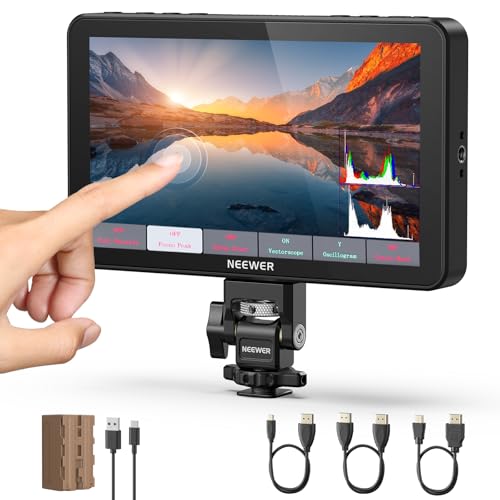
- 2000nit 7-inch touchscreen for bright locations
- 4K HDMI loop-through with extensive scopes
- Custom LUT support and included 5200mAh battery
Best For: Outdoor shoots and full-featured HDMI monitoring
SDI Production Flexibility
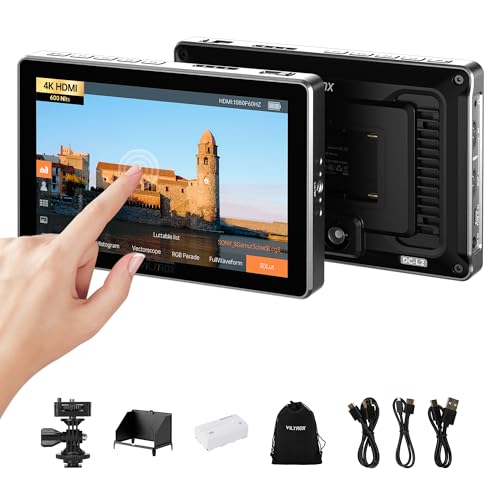
- SDI and HDMI input/output for professional rigs
- Waveform, false color, de-squeeze, and LUT preview
- Includes battery, hood, cables, mount, and case
Best For: SDI/HDMI cinema and broadcast-style setups
Lightweight Sunlight Viewing
FEELWORLD FW568 PRO 6-inch Monitor

- 1200nit full-HD display for outdoor shooting
- Waveform, vectorscope, RGB histogram, and focus assist
- NP-F or USB-C power with camera DC output
Best For: Mobile outdoor rigs, gimbals, and stabilizers
Compact Scopes and LUT Control
Portkeys PT5 II 5-inch Monitor

- Lightweight 5-inch full-HD touchscreen
- Luma/RGB waveform, histogram, false color, and peaking
- 4K30P HDMI I/O with 3D LUT and anamorphic tools
Best For: Compact DSLR, mirrorless, and gimbal rigs
Best for Long Shoots
FEELWORLD P6XL 6" 1200nit Monitor

- 1200-nit touchscreen with physical controls
- Five-level fan and USB-C power support
- Scopes, LUTs, and screenshot overlay tools
Best For: Extended outdoor shoots and solo camera operators
Best Complete Bundle
FEELWORLD S55 V3 6" Monitor Kit
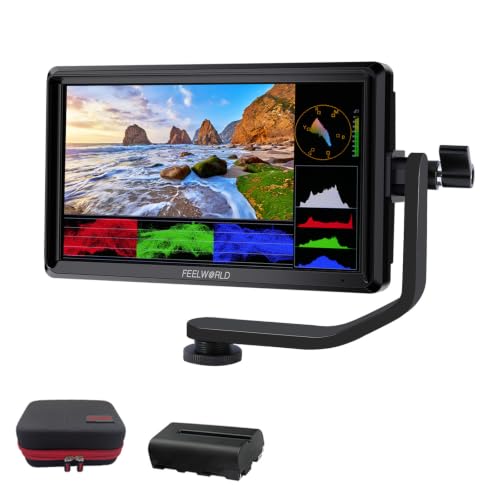
- Full HD screen with 4K HDMI loop-out
- Battery, case, sunshade, and tilt arm included
- Monitoring tools plus headphone and audio-level support
Best For: Ready-to-shoot handheld, gimbal, and starter rigs
Best Bright Compact Monitor
FEELWORLD F5 Prox 5.5" Monitor

- 1600-nit Full HD IPS screen
- Lightweight 245-gram body for gimbals
- Waveform, false color, peaking, and LUT preview
Best For: Outdoor filming and lightweight stabilized rigs
Bright-Daylight Pick

- 1200-nit 5.5-inch touchscreen
- 4K HDMI input/output with custom 3D LUT
- Waveform, false color, and focus-assist tools
Best For: Outdoor filmmakers needing a bright, compact monitoring setup
Lightweight Beginner Pick

- 7-inch touchscreen for easier framing
- Histogram, zebra, focus assist, and false color
- 300g design with NP-F, DC, and Type-C power
Best For: Beginners and mobile creators needing a larger on-camera view
SDI Production Pick

- 7-inch 1920x1200 Rec.709 display
- HDMI 4K and 3G-SDI connectivity
- Waveform, vectorscope, peaking, and custom 3D LUT
Best For: Cinema and multi-camera teams needing HDMI and SDI
Bright Outdoor Monitoring – NEEWER F700 7-inch 2000nit Monitor
For camera field monitors for cinema cameras, the NEEWER F700 stands out when strong ambient light makes smaller displays difficult to see. Its 7-inch 1920×1080 IPS touchscreen combines 2000nit brightness with exposure, focus, waveform, and LUT tools for detailed on-set monitoring.
Best For: Outdoor productions, filmmakers who want a large bright display, and users who need extensive monitoring tools and custom LUT support.
Pros:
- Very bright 2000nit 7-inch IPS touchscreen with manual and automatic backlight control.
- Supports 4K HDMI loop-through and includes waveform, vectorscope, false color, zebras, histogram, and focus peaking.
- Accepts up to 60 custom 3D LUT files and offers NP-F, USB-C, and DC power options.
- Includes a 5200mAh NP-F750 battery and can provide DC power to a camera.
Cons:
- At 654g with the battery, it is relatively heavy for compact rigs and gimbals.
- Its cooling fans may be a consideration for especially quiet recording environments.
- The monitor uses HDMI connectivity rather than SDI.
The F700 is a feature-rich choice when brightness and monitoring depth matter more than minimal weight. Its large screen, custom LUT capacity, and multiple power choices make it well suited to demanding field setups.
SDI Production Flexibility – VILTROX DC-L2 7-inch Monitor
Among camera field monitors for cinema cameras, the VILTROX DC-L2 is a practical option for productions that need both SDI and HDMI connectivity. Its 7-inch IPS touchscreen provides a 1280×800 display, 600nit brightness, and professional tools for exposure, focus, framing, and LUT preview.
Best For: Broadcast-style workflows, cinema rigs using SDI or HDMI, and crews that want a ready-to-use monitor kit with a sun hood and carrying case.
Pros:
- Provides SDI and HDMI input/output with support for up to 4K 60Hz HDMI signals.
- Includes waveform, histogram, false color, zebras, focus peaking, de-squeeze, and frame guides.
- 600nit IPS touchscreen has a 170-degree viewing angle and a detachable sun hood for outdoor use.
- Supports NP-F battery, USB-C, and DC power, with a battery, cables, mount, hood, and case included.
Cons:
- Its 1280×800 resolution is lower than the 1920×1080 panels on some competing monitors.
- 600nit brightness may be less effective in direct sunlight than higher-brightness alternatives.
- The 16:10 aspect ratio may require adjustment for some 16:9 monitoring workflows.
The DC-L2 is especially appealing when SDI compatibility is essential. It balances professional signal connectivity and useful scopes with a complete accessory package for efficient setup on location.
Lightweight Sunlight Viewing – FEELWORLD FW568 PRO 6-inch Monitor
The FEELWORLD FW568 PRO is a compact choice among camera field monitors for cinema cameras when you need a bright, full-HD display without adding much bulk. Its 6-inch 1920×1080 IPS screen reaches 1200nits and includes waveform, vectorscope, RGB histogram, focus assist, and LUT preview tools.
Best For: Outdoor filmmakers, gimbal and stabilizer users, and creators who want a lightweight monitor with practical exposure and focus aids.
Pros:
- 1200nit brightness helps maintain visibility during outdoor filming.
- Full HD 1920×1080 display with 4K HDMI input/output.
- Includes waveform, vectorscope, RGB histogram, focus assist, and LUT preview.
- Supports NP-F battery or USB-C power and offers DC 8.4V output for a camera.
Cons:
- The supplied notes do not specify SDI connectivity.
- Its 6-inch screen is smaller than the 7-inch displays in this roundup.
- Its listed item weight is 1.76 pounds, while the product description also emphasizes a lightweight 204g design; verify the packaged configuration before purchase.
The FW568 PRO offers a useful balance of sunlight visibility, full-HD detail, and monitoring scopes. It is a sensible fit for mobile productions where HDMI compatibility and manageable rig size are priorities.
Compact Scopes and LUT Control – Portkeys PT5 II 5-inch Monitor
For filmmakers seeking compact camera field monitors for cinema cameras, the Portkeys PT5 II delivers a full-HD touchscreen in a lightweight 5-inch form. It combines 4K30P HDMI input/output with luma and RGB waveform tools, histogram, false color, focus peaking, anamorphic support, and 3D LUT functions.
Best For: Lightweight DSLR and mirrorless rigs, gimbal setups, and shooters who want detailed scopes and LUT controls in a small monitor.
Pros:
- 1920×1080 screen with 178-degree viewing angle and a slim 0.28-pound design claim.
- Provides luma and RGB waveform, histogram, false color, new peaking, and audio meter tools.
- Supports 4K30P HDMI input/output, 3D LUTs, anamorphic viewing, image flip, and framing guides.
- Compatible with NP-F batteries and Canon LP-E6 batteries.
Cons:
- The supplied notes state that batteries are not included.
- It is limited to 4K30P HDMI rather than the higher-frame-rate 4K support offered by some alternatives.
- The 5-inch display is smaller than the 6- and 7-inch options in this selection.
The PT5 II makes a strong case for compact rigs that still need serious image-analysis tools. Its full-HD panel and broad feature set are useful when portability matters more than screen size or SDI connectivity.
Best for Long Shoots – FEELWORLD P6XL 6" 1200nit Monitor
For creators comparing camera field monitors for cinema cameras, the FEELWORLD P6XL stands out with a bright 6-inch touchscreen, flexible power options, and active cooling. It supports compatible HDMI signals up to 4K 30P and 1080P 60P, making it a practical fit for many modern mirrorless and compact cinema-camera setups.
Best For: Long outdoor shoots, solo operators, and productions that benefit from LUT preview and repeatable framing.
Pros:
- 1200-nit display with touchscreen and physical control wheel.
- Five-level adjustable fan and aluminum housing help manage heat during extended use.
- Built-in 22.2Wh battery plus USB-C charging support.
- Offers custom 3D LUT loading, scopes, false color, focus peaking, and screenshot overlays.
Cons:
- Camera HDMI output must be configured to a supported resolution and frame rate.
- Maximum-brightness use with the fan at level 5 provides approximately two hours of battery life.
- The feature-rich design may be more than casual shooters need.
The P6XL is a strong choice when monitoring tools, visibility, cooling, and framing consistency matter more than having the smallest possible on-camera display. Verify your camera’s HDMI settings before purchase.
Best Complete Bundle – FEELWORLD S55 V3 6" Monitor Kit
The FEELWORLD S55 V3 is a convenient option for shoppers seeking camera field monitors for cinema cameras without assembling every accessory separately. Its Full HD screen, 4K HDMI input and loop-out, included battery, carry case, sunshade, and tilt arm make it especially practical for handheld rigs, gimbals, and basic field setups.
Best For: Beginners and mobile shooters who want an accessory-ready monitor bundle with loop-out and audio monitoring.
Pros:
- 6-inch 1920×1080 display with a wide 160-degree viewing angle.
- Supports compatible 4K HDMI input and real-time loop-out to another monitor.
- Includes rechargeable battery, case, sunshade, tilt arm, cables, and charging cable.
- Provides focus peaking, false color, zebra, histogram, zoom, and image flip tools.
Cons:
- Its 500 cd/m² brightness may be less suitable for strong direct sunlight than brighter monitors.
- The included camera-power output requires a separate dummy battery or coupler.
- The bundle weighs 1.9 pounds according to the supplied details.
Choose the S55 V3 when convenience and included accessories are priorities. It offers useful monitoring and signal-routing features, though outdoor users may want to consider its moderate brightness and overall kit weight.
Best Bright Compact Monitor – FEELWORLD F5 Prox 5.5" Monitor
For filmmakers wanting camera field monitors for cinema cameras in a compact form, the FEELWORLD F5 Prox combines a 5.5-inch Full HD IPS screen with focus and exposure aids. Its lightweight design and standard mounting points make it suitable for cages, gimbals, tripods, and handheld camera rigs.
Best For: Outdoor filmmakers, gimbal users, and creators who need a lightweight monitor with a bright display and essential exposure tools.
Pros:
- 1600-nit brightness is designed for clearer viewing in direct sunlight.
- Compact 245-gram design supports handheld and gimbal setups.
- Includes waveform, histogram, false color, focus peaking, and 3D LUT preview.
- Supports 4K HDMI loop-in/loop-out and standard 1/4-inch mounting.
Cons:
- The native display resolution is 1920×1080 rather than 4K.
- Only one HDMI port is listed in the supplied specifications.
- Battery capacity and runtime are not specified in the supplied notes.
The F5 Prox is a sensible compact pick when sunlight visibility and essential monitoring aids are more important than a larger screen. Its lightweight build also makes it a good match for stabilized camera setups.
Bright-Daylight Pick – VILTROX DC-550 Pro II
For camera field monitors for cinema cameras, the VILTROX DC-550 Pro II stands out when you need a compact screen that remains visible outdoors. Its 5.5-inch 1200-nit touchscreen combines 4K HDMI input/output with exposure, focus, waveform, HDR, and custom 3D LUT tools.
Best For: Filmmakers and camera operators who need a bright, compact monitor for outdoor shooting, Log workflows, and detailed exposure or focus checks.
Pros:
- 1200-nit IPS display with included sunshade for improved daylight viewing.
- Supports HDMI signals up to 4K 30Hz and provides HDMI loop-through output.
- Includes waveform, vector graph, false color, histogram, focus assist, HDR, and custom 3D LUT support.
- Offers NP-F, DC input, and USB-C power options; an NP-F550 battery is included.
Cons:
- The 5.5-inch screen is smaller than a 7-inch alternative for shared viewing.
- Its 1.1-pound weight and included accessories may be more than a minimalist rig requires.
The DC-550 Pro II is a well-equipped choice when visibility and monitoring tools matter more than having the largest screen. Its included battery, hood, cables, and case also make it convenient for mobile production.
Lightweight Beginner Pick – FEELWORLD FW759 PRO
Among camera field monitors for cinema cameras, the FEELWORLD FW759 PRO offers a straightforward 7-inch touchscreen for clearer framing than a built-in camera display. Its 1280×800 IPS panel pairs with practical exposure and focus aids, HDMI connectivity, and flexible power options.
Best For: Beginners, vloggers, interview shooters, and mobile operators who want a larger on-camera view without a complicated monitoring setup.
Pros:
- 7-inch IPS touchscreen provides a larger viewing area for composition and framing.
- Includes histogram, zebra, focus assist, and false color monitoring tools.
- Slim, lightweight 300g design suits handheld rigs and gimbals.
- Supports NP-F battery, DC, and Type-C power through an HDMI connection.
Cons:
- The 400-nit display is less bright than the 1200-nit option in this roundup.
- Its 1280×800 resolution is below the Full HD resolution offered by some competing monitors.
- The supplied notes do not specify 4K signal support or custom 3D LUT capability.
The FW759 PRO prioritizes a larger, accessible display and a light form factor. It is a sensible fit for creators who mainly need easier framing and basic exposure or focus verification rather than advanced cinema-monitoring features.
SDI Production Pick – FEELWORLD FW703
For camera field monitors for cinema cameras used on more involved sets, the FEELWORLD FW703 adds 3G-SDI alongside HDMI. Its 7-inch 1920×1200 Rec.709 display and broad monitoring toolkit make it suited to cinema, studio, interview, commercial, and multi-camera workflows.
Best For: Filmmakers, broadcasters, and production teams that need both HDMI and SDI connectivity with Full HD monitoring and professional exposure tools.
Pros:
- 7-inch Full HD 1920×1200 IPS screen with Rec.709 color standard.
- Combines HDMI 4K and 3G-SDI connectivity for flexible camera and video-system integration.
- Provides waveform, vectorscope, RGB histogram, focus peaking, false color, and custom 3D LUT support.
- Works with cinema cameras, camcorders, switchers, tripods, cages, hot-shoe mounts, and headphones.
Cons:
- At 2.42 pounds, it is heavier than the compact VILTROX and lightweight FW759 PRO.
- The 450-nit brightness may be less suitable for strong daylight than a high-brightness monitor.
- Its SDI-focused feature set may be unnecessary for simple HDMI-only setups.
The FW703 is the strongest fit here for production environments that depend on SDI as well as HDMI. It trades portability for connectivity, a larger Full HD screen, and tools aimed at repeatable on-set monitoring.
How We Picked These Camera Field Monitors for Cinema Cameras
We focused on specifications that matter during real production rather than treating resolution alone as the deciding factor. The selection covers compact 5- to 5.5-inch monitors, larger 6- and 7-inch displays, HDMI and SDI connectivity, touch and button-based controls, and brightness levels suited to different locations.
We also considered useful monitoring tools, including 3D LUT support, focus peaking, false color, zebra patterns, waveform or histogram displays, and HDMI loop-through where listed. These features can help operators judge focus and exposure more confidently, although exact tool availability should be confirmed before purchase.
Quick Comparison
For daylight work, prioritize a monitor rated at 1,200 nits or higher; the 1,600- and 2,000-nit options are especially useful in bright outdoor conditions. A 7-inch display generally provides a more comfortable viewing area, while a 5- or 5.5-inch monitor keeps a compact gimbal, cage, or handheld rig easier to balance.
Choose SDI when your cinema camera and set workflow depend on locking connectors and longer cable runs. HDMI is common on DSLR, mirrorless, and many compact cinema cameras, but cable strain and connector security deserve attention. Loop-through output is useful when sending the camera signal to another display or recorder.
Key Buying Factors
Brightness and Outdoor Visibility
Nit ratings indicate how much light the screen can produce, but a sun hood and screen coating also affect usability. For interiors or controlled sets, a 400- to 800-nit display may be adequate. For exterior production, look for at least 1,200 nits and use a hood whenever possible.
Inputs, Outputs, and Compatibility
Check the camera’s actual output format, including resolution and frame rate, before ordering. Confirm whether you need HDMI, SDI, or both, and verify that the monitor’s input and output functions match your routing plan. A monitor cannot replace a converter if the camera and display use incompatible connections.
Monitoring Tools and Color
Focus peaking, magnification, false color, zebras, and waveform tools are often more valuable than a modest resolution difference. 3D LUT support can provide a useful preview for log footage, but it is a viewing aid rather than a replacement for properly exposed recording and calibrated color management.
Power, Mounting, and Handling
Check the supported battery type, expected runtime, charging arrangement, and DC input. Also consider mounting points, weight, touchscreen accessibility, and whether the monitor includes a sunshade or carry case. A bright monitor is less useful if it makes the rig too heavy or cannot be securely mounted.
Who Should Buy Which Camera Field Monitors for Cinema Cameras?
Choose a compact 5-inch or 5.5-inch model for lightweight handheld cameras, gimbals, travel kits, and operators who work close to the screen. A 6-inch monitor is a practical middle ground for many documentary, commercial, and independent film rigs.
Pick a 7-inch monitor when detailed focus checking, client viewing, or tripod and shoulder-mounted operation matters more than compactness. Outdoor cinematographers should favor the brightest models, while controlled-stage users may save money and weight with a lower-brightness display.
Finally, prioritize SDI-equipped options for professional cinema cameras and multi-device sets, and HDMI-focused models for DSLR, mirrorless, and compact cinema systems. Before buying, confirm the camera output, mounting hardware, battery availability, and the specific monitoring tools you rely on most.