
Choosing a 3D scanner for small objects comes down to precision, stability, and how much post-processing you’re willing to do. The best models can capture fine details on miniatures, jewelry, mechanical parts, and other compact items without turning setup into a chore.
In this roundup, we focus on scanners that balance accuracy, ease of use, and real-world scanning performance for makers, hobbyists, and small studios in 2026.
Best 10 3d Scanner for Small Objects Picks for 2026
Mini-Detail Precision Pick
Revopoint MINI 2 for Tiny Parts
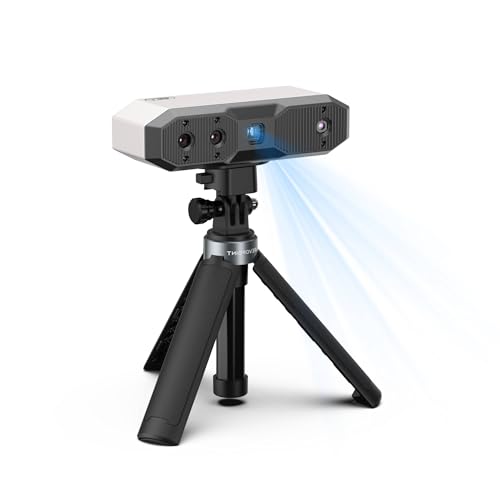
- 0.02 mm single-frame precision
- Blue light, IMU, and 6 Flash LEDs
- USB or Wi-Fi 6 with print-ready exports
Best For: Small-object scanning with high detail and portable operation
Beginner-Friendly Tracking Choice
3DMakerpro Fox Medium-Format Scanner

- 0.07 mm accuracy, 0.10 mm resolution
- Markerless AI visual tracking
- JMStudio handles scanning and optimization
Best For: Beginners who want easy handheld scanning with dependable relocking
Wireless All-Rounder
Creality Pika Portable Scanner

- 0.03 mm blue-laser accuracy
- Scans 5 mm to 2000 mm objects
- Wi‑Fi 6, AI tools, and dual batteries
Best For: Users who want one scanner for small parts and much larger objects
Quiet Detail Scanner
3DMakerpro Moose Lite Premium Kit

- 0.05 mm accuracy, 0.10 mm resolution
- AI tracking with JMStudio workflow
- Lightweight, quiet handheld design
Best For: Detailed small and medium object scanning with a lightweight handheld
Portable Precision Pick
Fox 3D Scanner for Small Objects

- 0.07mm accuracy with 0.10mm resolution
- Marker-free AI SLAM tracking
- Scans 40mm to 1200mm objects
Best For: Beginners and hobbyists scanning small parts, collectibles, and mixed-size items
Pro-Grade Detail Leader

- Up to 0.03 mm single-frame accuracy
- Minimum scan volume of 10x10x10 mm
- Five modes for small, dark, and reflective objects
Best For: Users scanning tiny parts, reflective surfaces, and precision models
Budget-Friendly Mobile Option

- Up to 0.1mm precision in high-accuracy mode
- Firmware update improves smaller-object capture
- Built-in RGB camera for full-color scans
Best For: Makers wanting portable scanning with Android and PC support
Pro Scan Pick
Revopoint INSPIRE 2 3D Scanner

- 0.05 mm accuracy and 0.03 mm precision
- Laser lines help with dark or reflective surfaces
- Wi-Fi 6 and optical zoom add flexibility
Best For: Detailed small-object scanning with strong surface-handling flexibility
Beginner-Friendly Choice

- WiFi 6 wireless scanning across major platforms
- 105 g portable design with included accessories
- Not meant for very small or highly detailed items
Best For: Entry-level users scanning larger small-to-medium objects
Most Versatile
Revopoint POP3 Plus 3D Scanner
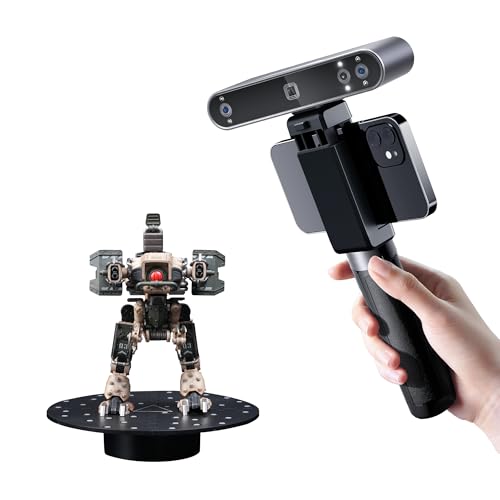
- Up to 20-micron accuracy with calibration support
- Optical zoom adds more point cloud detail
- Wi-Fi 6, USB-C, and full-color capture
Best For: Portable all-round scanning for small and medium objects
Mini-Detail Precision Pick – Revopoint MINI 2 for Tiny Parts
If you need a 3d scanner for small objects, the Revopoint MINI 2 is built around fine detail capture and stable handheld use. Its blue-light system, 0.02 mm single-frame precision, and 16 fps capture speed make it a strong fit for intricate parts, miniatures, and other small items that need careful surface reproduction.
Best For: Small-object scanning where precision, portability, and scan-to-print workflows matter most.
Pros:
- Up to 0.02 mm single-frame precision for fine details
- Blue-light tech and 6 Flash LEDs help with featureless objects and marker recognition
- IMU, tactile buttons, and USB or Wi-Fi 6 connections make scanning easier
- Supports export formats used in 3D printing and modeling software
Cons:
- Scanning results can vary depending on material and color
- Scanning spray may be needed for better results on some objects
- Not intended for very large or extremely tiny objects outside its stated range
The MINI 2 stands out when your priority is capturing small parts with as much usable detail as possible. It is a practical choice if you want a portable scanner that can move from capture to post-processing without a complicated setup.
Beginner-Friendly Tracking Choice – 3DMakerpro Fox Medium-Format Scanner
The 3DMakerpro Fox is a practical 3d scanner for small objects if you want an easier entry into handheld scanning without giving up useful detail. With 0.07 mm accuracy, 0.10 mm resolution, and markerless AI visual tracking, it is designed to keep scans moving smoothly for hobby projects, printing, and measurement work.
Best For: Beginners who want straightforward handheld scanning with solid detail and automatic relocking.
Pros:
- 0.07 mm accuracy and 0.10 mm resolution for detailed scans
- Markerless AI visual tracking relocks if you move too fast
- JMStudio combines scanning, editing, and optimization
- Positioned as an accessible entry-level option for hobbyists
Cons:
- Medium-format design is less specialized than ultra-fine precision scanners
- No speed or connectivity specs are highlighted in the supplied notes
Fox is best when you want a beginner-friendly scanner that helps reduce workflow friction. It offers enough accuracy for useful small-object scans while keeping the software and tracking approach simple.
Wireless All-Rounder – Creality Pika Portable Scanner
The Creality Pika is a versatile 3d scanner for small objects, but it also stretches far beyond that with a 5 mm to 2000 mm scanning range. Its 0.03 mm blue-laser accuracy, wireless Wi‑Fi 6 design, and AI tools make it a strong pick if you want one scanner that can handle tiny parts, larger items, and faster scan-to-print workflows.
Best For: Users who want a wireless scanner that can handle small parts and much larger objects too.
Pros:
- 0.03 mm accuracy from a 7-parallel blue laser system
- Scans objects from 5 mm up to 2000 mm
- AI retexturing, body completion, and hole-filling streamline output
- Wi‑Fi 6, dual batteries, and one-click export support mobile use
Cons:
- Best performance depends on fairly demanding device specs
- Broad feature set may be more than needed for very simple small-object work
- Some workflows may still benefit from careful setup despite anti-shake tools
Pika is the most flexible option here if you want more than a niche small-object scanner. It blends strong precision with wireless convenience and broad size coverage, making it suitable for mixed-use scanning.
Quiet Detail Scanner – 3DMakerpro Moose Lite Premium Kit
If you are shopping for a 3d scanner for small objects with a balance of detail and ease of use, the Moose Lite is a sensible handheld option. It offers 0.05 mm accuracy, 0.10 mm resolution, and AI visual tracking, with a scan range from 15 mm to 1500 mm for small parts and medium objects.
Best For: Makers who want a lightweight scanner for detailed small and medium object capture.
Pros:
- 0.05 mm accuracy and 0.10 mm resolution for refined models
- AI visual tracking and point cloud processing support easier scanning
- Enhanced depth exploration improves vertical scanning on complex shapes
- Lightweight design with no fan noise and good heat dissipation
Cons:
- Precision is lower than the most detail-focused scanners in this group
- Best results still depend on the object staying within the 15 mm to 1500 mm range
Moose Lite is a practical middle ground for users who want solid detail without jumping to the most specialized scanner. Its lightweight, quiet design and integrated software workflow make it easy to use for everyday scanning projects.
Portable Precision Pick – Fox 3D Scanner for Small Objects
If you want a 3d scanner for small objects that still handles larger items, the Fox is built around versatility and ease of use. It combines up to 0.07mm accuracy with marker-free AI SLAM tracking, so you can scan collectibles, figurines, mechanical parts, and other compact items without a heavy setup.
Best For: Beginners and hobbyists who want a lightweight handheld scanner for small parts, models, and mixed-size objects.
Pros:
- Up to 0.07mm accuracy and 0.10mm resolution for detailed capture
- Scans objects from 40mm to 1200mm, covering small parts and larger subjects
- Marker-free AI tracking reduces prep work and helps keep scans moving
- One-click processing in JMStudio simplifies point cloud alignment, fusion, and mesh optimization
Cons:
- Requires a computer and JMStudio workflow to operate
- Best results still depend on stable handheld tracking during capture
The Fox stands out if you want detail without a complicated learning curve. It is especially appealing for users who scan small objects regularly but also want enough range for broader creative or repair projects.
Pro-Grade Detail Leader – Revopoint POP 4 3D Scanner
The Revopoint POP 4 is a strong pick if you need a 3d scanner for small objects and want professional-level detail. Its minimum scan volume starts at 10x10x10 mm, and the scanner offers multiple modes for fine features, reflective surfaces, and even deep holes, making it a flexible choice for precision work.
Best For: Users who need high-end accuracy for tiny parts, reflective objects, and demanding 3D printing or reverse-engineering projects.
Pros:
- Single-frame accuracy up to 0.03 mm for fine detail capture
- Minimum scan volume of 10x10x10 mm suits very small objects
- Five scanning modes cover small parts, dark surfaces, metals, and deep holes
- AI segmentation helps isolate the subject and reduce background noise
Cons:
- Some features are limited by mode or platform, such as Windows-only AI segmentation
- Advanced capability may be more than casual users need
POP 4 is the most technically capable option in this set for small-object scanning. If your priority is accuracy and flexibility across tricky surfaces, it offers the broadest toolset.
Budget-Friendly Mobile Option – Creality CR-Scan Ferret
The Creality CR-Scan Ferret is worth considering if you need a 3d scanner for small objects and want flexible, portable scanning. Its firmware update improves tracking and output quality, and high-accuracy mode reaches 0.1mm precision, which is useful for detailed parts, models, and other compact items.
Best For: Makers who want a portable handheld scanner with color capture and support for Android or PC workflows.
Pros:
- High-accuracy mode reaches up to 0.1mm precision and 0.16mm resolution
- Firmware updates improve tracking stability and smaller-object capture
- Built-in RGB camera captures full-color textures
- Can be powered by a 5V power bank for more flexible scanning
Cons:
- Mobile scanning support is limited to Android devices
- Requires compatible hardware and software versions for best performance
Ferret is a practical choice if portability matters as much as detail. It is not the most specialized small-object scanner here, but it offers a balanced feature set for everyday 3D capture.
Pro Scan Pick – Revopoint INSPIRE 2 3D Scanner
If you want a 3d scanner for small objects that can still handle tricky finishes, the Revopoint INSPIRE 2 is built around flexibility. Its dual scanning modules, adjustable optical zoom, and infrared laser lines make it easier to capture compact parts, mixed materials, and surfaces that are dark or reflective without relying on scanning spray.
Best For: Users who need a portable, more advanced scanner for small objects, detailed parts, and mixed-surface captures.
Pros:
- Up to 0.05 mm accuracy and 0.03 mm precision for detailed models
- Infrared laser lines help scan reflective or dark surfaces without spray
- Dual scan modes and 1.5x/2x optical zoom add flexibility for different object sizes
- Lightweight 190 g body with Wi-Fi 6 for mobile or PC-to-mobile workflow
Cons:
- Revo Design scan-to-CAD software is sold separately
- Requires relatively strong system specs for best performance
Overall, the INSPIRE 2 stands out if precision and capture flexibility matter more than simplicity. It looks especially useful for makers who scan small objects for 3D printing, reverse engineering, or detailed digital archiving.
Beginner-Friendly Choice – Creality CR-Scan Ferret Pro
The Creality CR-Scan Ferret Pro is a practical 3d scanner for small objects if you are working in the easier end of the size range and want a simple wireless setup. It is designed for entry-level users and offers full-color scanning, anti-shake tracking, and broad device support, but Creality notes it is not suitable for very small or highly detailed items like jewelry or precision parts.
Best For: Beginners and DIY creators scanning larger small-to-medium objects, not fine-detail miniatures or jewelry.
Pros:
- WiFi 6 wireless scanning with Windows, macOS, Android, and iOS support
- Lightweight 105 g design makes it easy to carry and use on the go
- Full-color 24-bit scanning with anti-shake tracking
- Includes a complete kit with tripod, power bank, phone holder, and carrying case
Cons:
- Not suitable for very small or highly detailed objects like jewelry
- Best results depend on avoiding reflective, transparent, or very dark surfaces
In short, the Ferret Pro is appealing for users who want wireless convenience and an easy learning curve. Just make sure your target objects are large enough for the scanner’s stated range.
Most Versatile – Revopoint POP3 Plus 3D Scanner
The Revopoint POP3 Plus is a strong 3d scanner for small objects when you need more precision than a basic handheld model and still want a portable workflow. Its 20-micron accuracy claim, 1.5x/2x optical zoom, and stable scanning features make it a good fit for compact items, product work, and other detail-focused scans.
Best For: Makers and designers who want a lightweight scanner for small objects, medium objects, and general-purpose 3D work.
Pros:
- Up to 20-micron accuracy with improved calibration board
- Optical zoom adds up to 30% more point cloud detail
- 18 fps scanning and 9-axis IMU help keep scans stable
- Full-color capture with Wi-Fi 6 or USB-C connectivity
Cons:
- Revo Scan software is only compatible with x86_64 architecture
- Like most portable scanners, it is better suited to medium-sized items than extremely tiny parts
For buyers who want a balanced scanner that can handle small objects without giving up broader versatility, the POP3 Plus is easy to recommend. It combines portability, color capture, and a solid software ecosystem for practical everyday scanning.
How We Picked the Best 3d Scanner for Small Objects
We prioritized scanners that are well-suited to compact subjects, where detail loss, edge distortion, and tracking issues show up fast. That means favoring better stated accuracy, stable handheld performance, useful color capture, and software that makes alignment and cleanup manageable.
We also weighed portability, scan speed, device compatibility, and whether the scanner is practical for beginners or better suited to experienced users.
Quick Comparison
If you want the cleanest detail on tiny parts, look first at higher-precision models such as the Revopoint MINI 2 and Creality Pika. If you want a more flexible all-rounder, the Revopoint POP series and 3DMakerpro options are strong middle-ground choices. For budget-conscious buyers or those scanning slightly larger compact items, the Creality CR-Scan Ferret line can be attractive.
Key Buying Factors for a 3d Scanner for Small Objects
Accuracy and Detail Capture
For small objects, accuracy matters more than raw speed. Look for fine point spacing, strong edge definition, and repeatable results. If you plan to scan coins, figurines, watch parts, or miniature components, a scanner built for close-range detail is usually the better fit.
Tracking and Stability
Small objects can be difficult because the scanner has fewer features to lock onto. Marker-free tracking, AI-assisted alignment, and anti-shake features help, but a turntable, mat, or added markers can still improve results.
Color, Texture, and Lighting
Full-color scanning is useful for collectibles and presentation models, but surface finish matters too. Glossy, transparent, or very dark objects often need prep work, regardless of the scanner.
Software and Workflow
Good software can save more time than a tiny bump in accuracy. Check whether the scanner supports easy meshing, editing, and export formats that fit your 3D printing or CAD workflow.
Who Should Buy Which 3d Scanner for Small Objects?
If you need maximum detail for very small parts, choose a high-precision model first. If you want the easiest path from scan to print, prioritize software and tracking stability. If you plan to scan a mix of small and medium objects, a versatile handheld scanner may be the smartest long-term buy.
For most buyers, the best 3d Scanner for Small Objects is the one that matches both the size of your subjects and how much setup time you’re willing to tolerate. A slightly more expensive scanner can be worth it if it reduces rescans, cleanup, and failed captures.