
Choosing the right 3D scanner for jewelry can make the difference between a clean CAD-ready model and a frustrating rescan. Small pieces, reflective surfaces, and fine prongs demand higher precision than general-purpose scanning.
Below, we’ve focused on scanners that are better suited to rings, pendants, wax models, and detailed components, with an emphasis on accuracy, usability, and real-world jewelry workflows.
Best 10 3d Scanner for Jewelry Picks for 2026
Precision Desktop Scanner
Matter and Form Three 3D Scanner

- 33 micron accuracy with dual 13MP autofocus cameras
- No tracking dots required for a cleaner workflow
- Works across Windows, Mac, Linux, iOS, Android, and Chromebooks
Best For: Jewelry, coins, and small parts with high-detail capture
Handheld Detail Scanner

- 0.05mm accuracy with 0.1mm resolution
- AI visual tracking and integrated JMStudio processing
- Lightweight 250g design with quiet operation
Best For: Portable detail scanning for small-to-medium objects
Metrology Power Scanner

- 0.01mm single-frame precision and certified measurement workflow
- Five scan modes for detail, holes, marker-free scans, and turntable use
- Scans shiny and metallic surfaces without spray
Best For: Industrial inspection and certified precision measurement
Fine-Detail Small Scanner

- 0.02mm accuracy for tiny surface details
- Blue LED light source for fine structured-light capture
- Built for small objects from 10 to 300mm
Best For: Small jewelry and indoor close-range detail scanning
Precision Starter Pick
Revopoint POP3 Plus 3D Scanner
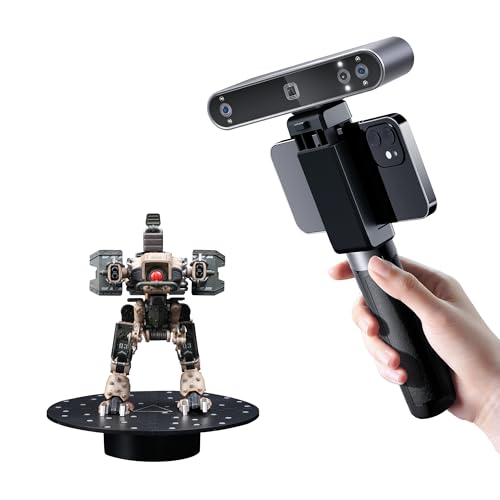
- 20-micron claimed accuracy with updated calibration
- Optical zoom adds more point-cloud detail
- Lightweight 190g body with Wi‑Fi 6 and USB-C
Best For: Jewelry makers and small studios needing a portable detail-focused scanner
Industrial Detail Pick
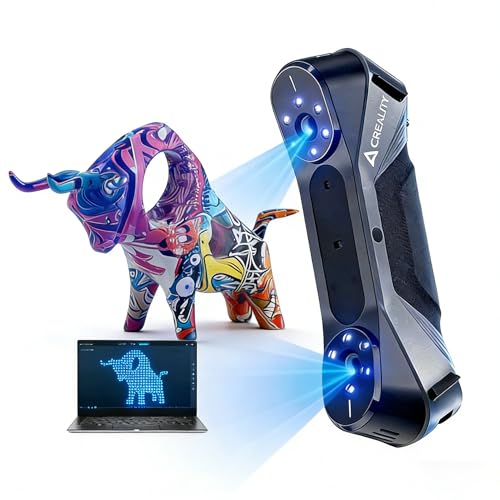
- Claims 0.02 mm max accuracy for fine detail
- Blue laser plus infrared structured light modes
- 60 fps scanning with 24-bit RGB texture capture
Best For: Advanced users scanning intricate parts, textures, and mixed materials
Outdoor Flexible Pick
Revopoint INSPIRE 2 3D Scanner

- Wireless WiFi 6 scanning with mobile streaming
- Handles reflective and dark surfaces without spray
- 0.05 mm accuracy and outdoor use up to 20,000 lux
Best For: Portable workflows that need flexibility across surfaces and environments
Creality Raptor
Versatile handheld scanner for mixed-size objects

- 0.02 mm accuracy with blue laser and NIR modes
- Marker-free handheld scanning with anti-shake tracking
- 24-bit color capture for detailed textured models
Best For: Users who want one scanner for jewelry and larger objects
Revopoint MetroX Pro
High-precision blue-laser scanner for fine detail

- Up to 0.01 mm single-frame precision
- Multiple modes for shiny, dark, and feature-rich objects
- Auto turntable and real-time streaming support
Best For: Precision scanning of jewelry and other challenging surfaces
Revopoint MINI 2
Compact scanner for small detailed items
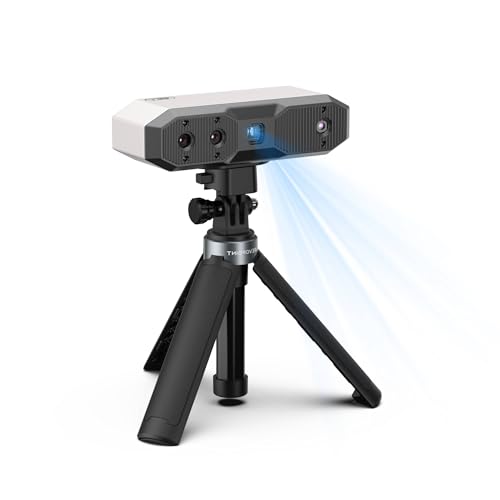
- Up to 0.02 mm single-frame precision
- Built for small objects with a 10 mm to 0.5 m range
- Lightweight 175 g design with USB-C and Wi-Fi 6
Best For: Small, intricate objects like jewelry and miniatures
Precision Desktop Scanner – Matter and Form Three 3D Scanner
If you want a 3d scanner for jewelry that also scales up to larger objects, the Matter and Form Three is built for flexible, high-detail capture. Its dual 13MP autofocus cameras, 33 micron accuracy, and no-dot workflow make it a practical pick for users who want clean scans without extra setup.
Best For: Jewelry, coins, figurines, and other small-to-medium objects where accurate detail and easy workflow matter.
Pros:
- Dual 13MP autofocus cameras help keep tiny jewelry details sharp at different distances.
- No tracking dots are needed, which makes scanning cleaner and faster.
- 0.033mm accuracy is aimed at precision-focused work like engineering and reverse engineering.
- Works with Windows, Mac, Linux, iOS, Android, and Chromebooks without a powerful GPU.
Cons:
- The 9.46-pound scanner is not especially portable.
- Its wide scan range is useful, but the unit is more of a desktop-style system than a grab-and-go option.
Overall, this is a strong choice if you need a jewelry scanner that prioritizes accurate detail, simple setup, and broad device compatibility. It is especially appealing for users who want one scanner that can handle both delicate small items and much larger parts.
Handheld Detail Scanner – 3DMakerpro Moose Lite
For buyers looking for a 3d scanner for jewelry with handheld flexibility, the 3DMakerpro Moose Lite focuses on fine detail and easier tracking. It combines 0.05mm accuracy, 0.1mm resolution, and AI visual tracking, making it a practical option for detailed model capture and print prep.
Best For: Users who want a lightweight handheld scanner for detailed small-to-medium objects and printing workflows.
Pros:
- 0.05mm accuracy and 0.1mm resolution support detailed point clouds.
- AI visual tracking and point-cloud processing are designed to make scanning smarter and more manageable.
- Scans from 15mm to 1500mm, so it can handle a broad range of object sizes.
- Lightweight at 250g and quiet, with no fan noise.
Cons:
- It is positioned as a handheld workflow, which can take more practice than a turntable-style setup.
- While it supports multiple platforms, performance depends on the JMStudio software workflow.
This is a smart pick if you want a portable scanner that still aims for fine detail on small objects like jewelry components or display pieces. Its software and tracking features make it more approachable for users who want a balance of precision and convenience.
Metrology Power Scanner – Revopoint MetroY Ultra
The Revopoint MetroY Ultra is aimed at buyers who need a 3d scanner for jewelry-adjacent precision work and broader metrology tasks. With 0.01mm single-frame precision, multiple scan modes, and PTB-certified measurement software, it is designed more like a professional inspection tool than a casual hobby scanner.
Best For: Industrial inspection, certified measurement workflows, and users who need verified accuracy for small precision parts.
Pros:
- 0.01mm single-frame precision and 0.015mm + 0.04mm/m volumetric accuracy.
- Five scanning modes help handle fine detail, deep holes, marker-free scans, and turntable workflows.
- Can scan black, high-gloss, and metallic surfaces without spray.
- Revo Measure software supports PTB-certified reporting and GD&T analysis on Windows 10/11.
Cons:
- The software/reporting workflow is Windows-only for Revo Measure.
- System requirements are high, especially for Windows users.
For users who need a scanner with serious measurement credentials, the MetroY Ultra stands out. It is best suited to technical buyers who care more about certified results and industrial workflow than simple consumer convenience.
Fine-Detail Small Scanner – 3DMakerpro Seal Lite
If your main goal is a 3d scanner for jewelry and other small objects, the 3DMakerpro Seal Lite is built around close-range detail capture. Its blue LED light source, 0.02mm accuracy, and 10 to 300mm scan range make it a focused option for small-format scanning indoors.
Best For: Small jewelry, tiny parts, and indoor scans where maximum fine detail is the priority.
Pros:
- 0.02mm accuracy is the highest in this group and is ideal for tiny surface details.
- Blue LED structured light helps capture dents and edge textures more finely.
- Designed specifically for small-format objects from 10 to 300mm.
- JMStudio includes visual tracking, error correction, auto-alignment, and free lifetime updates.
Cons:
- Indoor use is suggested, so it is not the best choice for outdoor work.
- It has a learning curve and may require a relatively powerful PC.
This is the most specialized option here for tiny objects and close-up detail. If your priority is capturing small jewelry pieces as accurately as possible and you are comfortable with a more hands-on setup, the Seal Lite is a compelling choice.
Precision Starter Pick – Revopoint POP3 Plus 3D Scanner
If you want a practical 3d scanner for jewelry that leans toward portability and fine detail, the Revopoint POP3 Plus is a strong entry point. It focuses on improved accuracy, stable handheld scanning, and full-color capture, which can be useful when documenting small decorative pieces and design references.
Best For: Jewelry makers and small studios that want a lightweight scanner for detailed models and scan-to-CAD workflows.
Pros:
- Up to 20 microns of accuracy with a refined calibration board
- Optical zoom helps capture more point cloud detail on smaller features
- 18 fps scanning with a 9-axis IMU for steadier handheld use
- Full-color RGB capture and wide file export support
Cons:
- Revo Scan software is only compatible with x86_64 architecture
- Best suited to medium-sized objects rather than very tiny parts
The POP3 Plus is a well-rounded choice if you want a compact scanner that balances usability, color capture, and improved precision. For jewelry-related workflows, it is most compelling when you need dependable scans without moving into heavier industrial hardware.
Industrial Detail Pick – Creality CR-Scan Raptor
The Creality CR-Scan Raptor is a high-precision 3d scanner for jewelry users who also need industrial-grade flexibility. Its 0.02 mm stated maximum accuracy, multi-mode scanning, and strong anti-shake performance make it a serious option for capturing intricate surfaces and mixed-material objects.
Best For: Advanced users who need a metrology-leaning scanner for detailed parts, textured surfaces, and mixed scanning tasks.
Pros:
- Maximum accuracy of 0.02 mm with metrological positioning
- Blue 7-line laser and infrared structured light for multiple scan modes
- 60 fps maximum frame rate with anti-shake performance
- 24-bit RGB texture capture and support for dark or metal objects
Cons:
- Requires a capable Windows or macOS system with higher CPU specs
- More advanced features may be more than casual users need
If precision is your priority, the Raptor stands out for its blend of speed, accuracy, and multi-surface handling. It is a stronger fit for technical workflows where consistent data quality matters more than simplicity.
Outdoor Flexible Pick – Revopoint INSPIRE 2 3D Scanner
The Revopoint INSPIRE 2 is a versatile 3d scanner for jewelry if you want a lightweight system that can handle different lighting conditions and surface types. With dual scanning modules, wireless operation, and full-color capture, it is built for flexible scanning sessions both indoors and in shaded outdoor environments.
Best For: Users who want a portable scanner for varied environments, reflective surfaces, and scan-to-CAD work.
Pros:
- 11 infrared laser lines help scan reflective or dark surfaces without spray
- Accuracy up to 0.05 mm and precision up to 0.03 mm
- Built-in WiFi 6 supports wireless scanning and mobile streaming
- Lightweight 190g design with outdoor scanning support up to 20,000 lux
Cons:
- Revo Design is sold separately and supports Windows only
- Best results will still depend on careful setup and calibration
For users who value portability and adaptability, the INSPIRE 2 offers a balanced mix of scan modes and workflow tools. It is especially appealing when you need one scanner that can move between desktop, mobile, and outdoor use.
Creality Raptor – Versatile handheld scanner for mixed-size objects
If you want a 3d scanner for jewelry that can also handle much larger subjects, the Creality CR-Scan Raptor is built for flexible capture. Its blue laser and NIR modes, 0.02 mm accuracy, and marker-free workflow make it a strong option for detailed objects with fine edges and reflective textures, while the 24-bit color scan helps preserve surface appearance.
Best For: Users who need one scanner for jewelry, miniatures, parts, and other small-to-large objects.
Pros:
- 0.02 mm accuracy and 0.1 mm fine-detail resolution for sharp geometry.
- Blue laser and NIR scanning support a wide object range from tiny items to large pieces.
- Marker-free scanning and anti-shake tracking help streamline handheld use.
- 24-bit full-color capture adds realistic texture detail.
Cons:
- May be more scanner than needed if you only work with very small jewelry items.
- Requires a capable Windows or macOS setup for recommended performance.
Overall, the Raptor is a practical pick if your workflow goes beyond jewelry and you want a scanner that balances detail, speed, and versatility. It is especially appealing when you need polished scans without spending time on heavy setup.
Revopoint MetroX Pro – High-precision blue-laser scanner for fine detail
For buyers comparing a 3d scanner for jewelry, the Revopoint MetroX Pro stands out with industrial-grade blue laser scanning and precision-focused modes. Its single-frame precision up to 0.01 mm, marker-free structured-light mode, and support for shiny or dark surfaces make it a compelling choice when fine detail and surface behavior matter.
Best For: Precision users who need detailed scans of jewelry, prototypes, and other challenging surfaces.
Pros:
- Up to 0.01 mm single-frame precision and 0.02 mm single-frame accuracy.
- Multiple scan modes, including parallel lines, cross-line lasers, and structured light.
- Can scan shiny or dark surfaces without spray in certain modes.
- Auto turntable and real-time streaming can simplify the workflow.
Cons:
- Paid software options are sold separately for some advanced workflows.
- Large, heavier system may be less convenient than a lightweight handheld scanner.
MetroX Pro is the most precision-oriented option in this group, making it well suited to users who care about measurement-level detail. If your priority is controlled scanning of small, reflective, or complex objects, it offers a strong feature set.
Revopoint MINI 2 – Compact scanner for small detailed items
If you need a 3d scanner for jewelry and other small objects, the Revopoint MINI 2 is the most clearly size-focused option here. It uses industrial-grade blue light, offers up to 0.02 mm single-frame precision, and includes an RGB camera plus flash LEDs to help capture texture, color, and marker recognition on detailed pieces.
Best For: Scanning small, intricate items like jewelry, miniatures, and compact parts.
Pros:
- Up to 0.02 mm single-frame precision for intricate detail.
- Designed for small objects, with a 10 mm to 0.5 m scanning range.
- IMU, tactile buttons, and Wi-Fi 6 or USB-C improve ease of use.
- Lightweight 175 g body makes it easy to carry and hold.
Cons:
- Not ideal for very large objects outside its stated scan volume.
- Blue-light scanning may benefit from scanning spray on some materials.
The MINI 2 is the most targeted pick for small, detail-heavy work and is especially appealing if jewelry is a primary use case. It focuses on precision and portability rather than broad object-size flexibility.
How We Picked the Best 3d Scanner for Jewelry
We prioritized models with the precision, close-range performance, and stability needed for jewelry capture. That means favoring strong published accuracy, small-object support, good texture/color handling where useful, and scanning modes that reduce frustration on reflective or intricate surfaces.
We also considered ease of use, software workflow, and whether the scanner is more suitable for studio work, bench-side inspection, or portable field use.
Quick Comparison
For ultra-fine detail, small-format scanners are usually the best fit for rings, stones, and wax patterns. For larger pieces or faster turnaround, handheld scanners can be more flexible, especially when you need to capture mounted jewelry, display pieces, or related components. If you need color reference for documentation or presentation, look for full-color capture; if dimensional fidelity matters most, prioritize accuracy over extras.
Key Buying Factors for a 3d Scanner for Jewelry
Accuracy and Resolution
Look for sub-0.05 mm accuracy if you want dependable results on prongs, edges, and pavé detail. For delicate jewelry work, published precision matters more than scan speed or marketing terms.
Object Size and Working Distance
Jewelry scanners should handle very small objects at close range without losing alignment. Make sure the device can focus well on rings, clasps, and small settings, not just medium-sized props.
Surface Handling
Polished metal can be difficult for any 3d Scanner for Jewelry. Models with blue light, laser, or strong close-range optics often perform better, but you may still need matte spray or a prep workflow for highly reflective pieces.
Color and Texture Capture
Color is helpful for documentation, repair notes, and presentation models. It is less important than geometry for CAD, casting, or stone-setting analysis, so don’t overpay for texture if your workflow is purely dimensional.
Software and Export Compatibility
Choose a scanner with clean mesh output and support for common file formats your CAD or printing software accepts. Smooth post-processing can save more time than a slightly faster scan.
Who Should Buy Which 3d Scanner for Jewelry?
If you need the highest detail for small jewelry components, a compact high-accuracy scanner is usually the smartest choice. If you scan a mix of jewelry and other objects, a versatile handheld model offers more flexibility. If presentation, archiving, or client review matters, a full-color option can be worth it.
In short, the best 3d Scanner for Jewelry is the one that matches your smallest object size, required accuracy, and post-scan workflow. Tight tolerance work should always favor precision first, then speed, then extras.