
Dash cam usage statistics: a market moving into the mainstream
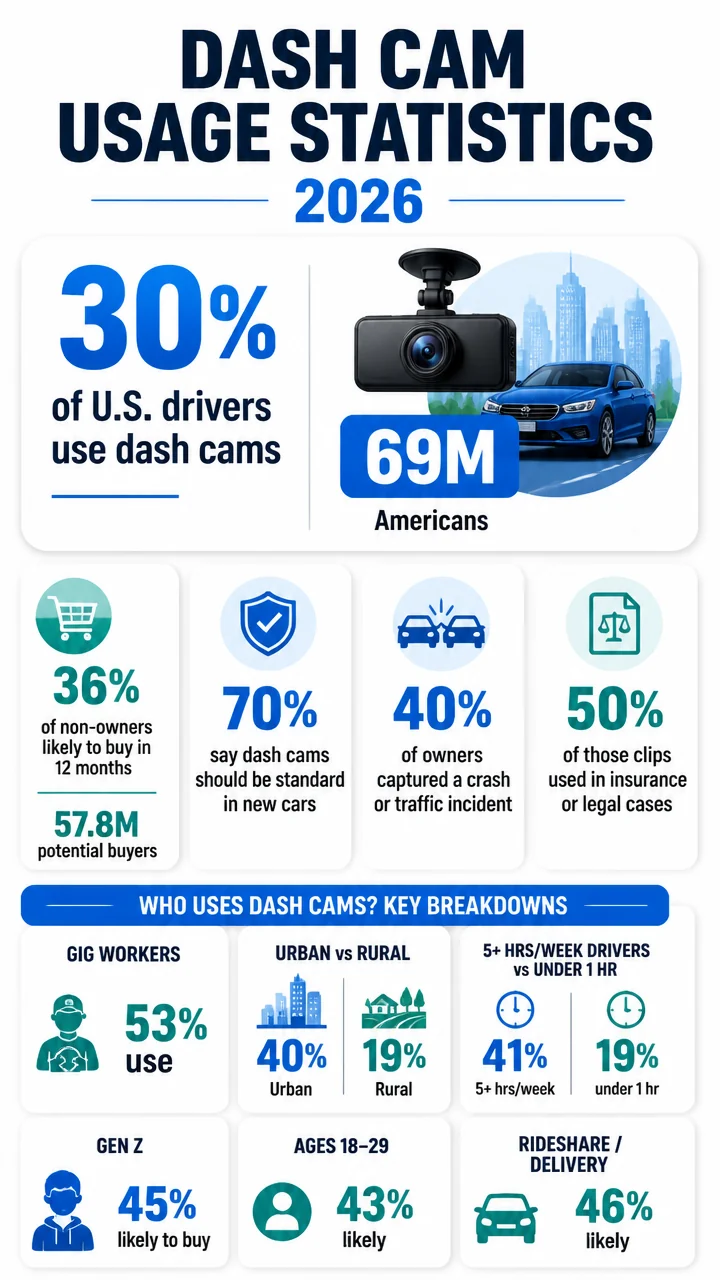
Dash cams are no longer a niche gadget for car enthusiasts. In the U.S., 30% of drivers, equal to 69 million Americans, already use them, while another 36% of non-owners say they are likely to buy one within the next year.
That combination of current adoption, purchase intent, and broad support for factory installation shows a category shifting from optional accessory to expected vehicle technology.
At a glance
- 30% of U.S. drivers already use a dash cam
- 69 million Americans currently record their trips
- 36% of non-owners say they are likely to buy one in the next 12 months
- 40% of dash cam owners have captured a crash or traffic incident
- 70% of drivers think dash cams should be standard in new cars
- 53% of gig workers already use a dash cam
Table of contents
- Key dash cam usage statistics
- Dash cam adoption trends and growth signals
- Dash cam usage statistics by driver type and demographics
- Dash cam purchase intent statistics
- Dash cam footage, crashes, and insurance use
- Dash cam setup and feature statistics
- Dash cam market data and price benchmarks
- Fleet, privacy, and driver acceptance statistics
Key dash cam usage statistics
30% of all U.S. drivers already use dash cams. That works out to 69 million Americans, according to AutoInsurance.com.
Urban drivers are far more likely to own a dash cam than rural drivers. Ownership stands at 40% in urban areas versus 19% in rural areas, a 21-point gap.
Gig workers are one of the most invested groups. Their dash cam adoption rate reaches 53%, the highest major usage figure in the dataset.
Driving exposure matters. Motorists who drive 5 or more hours per week have a 41% adoption rate, compared with just 19% among those who drive less than 1 hour weekly.
Dash cams are proving useful in real incidents. 40% of owners say they have captured a crash or traffic incident on video, and half of those clips were later used in an insurance claim or legal matter.
Big number: 69 million. That is the estimated number of Americans already recording their trips with a dash cam.
Dash cam adoption trends and growth signals
The clearest story in dash cam usage statistics is scale. When nearly one-third of U.S. drivers already own a device and more than one-third of non-owners plan to buy one, the category has moved well beyond early adopters.
The international comparison in the dataset points in the same direction.
In Sony Life’s 2024 car-life survey, dash cams were already installed in 51.9% of vehicles.
That is notably higher than the 31.6% installation rate for adaptive cruise control in the same survey, suggesting dash cams can outperform even well-known convenience technologies in actual in-car penetration.
There is one nuance worth noting: Sony’s reported installation rate slipped slightly from 52.5% in 2023 to 51.9% in 2024, a decline of 0.6 percentage points.
That does not erase the high baseline, but it does suggest mature markets can level off after reaching broad adoption.
Why it matters
Dash cams are increasingly behaving like a mainstream automotive safety purchase rather than a specialty electronics add-on.
High ownership, strong purchase intent, and widespread support for standard installation all point in the same direction.
| Adoption benchmark | Statistic |
|---|---|
| U.S. drivers using dash cams | 30% |
| Americans currently using dash cams | 69 million |
| Vehicles with dash cams in Sony 2024 survey | 51.9% |
| Vehicles with adaptive cruise control in Sony 2024 survey | 31.6% |
| Sony dash cam installation rate, 2023 | 52.5% |
| Sony dash cam installation rate, 2024 | 51.9% |
Dash cam usage statistics by driver type and demographics
Not all drivers adopt dash cams at the same rate. The strongest usage skews show up among urban drivers, gig workers, and people who spend more time behind the wheel.
Urban ownership sits at 40%, more than double the 19% seen among rural drivers.
That gap likely reflects denser traffic, higher parking exposure, and more frequent interactions with other motorists.
Gig workers stand out even more.
53% already use a dash cam, making them the most adoption-heavy group in the dataset.
For drivers whose income depends on time on the road, video evidence can serve both safety and business interests.
Usage also climbs with time spent driving.
Those logging at least 5 hours per week have a 41% adoption rate, compared with only 19% among drivers who spend less than 1 hour per week on the road.
Fast facts
- 53% of gig workers use dash cams
- 41% of high-mileage motorists use dash cams
- 40% of urban drivers use dash cams
- 19% of rural drivers use dash cams
- 19% of drivers with less than 1 hour of weekly driving use dash cams
| Driver group | Dash cam adoption rate |
|---|---|
| Gig workers | 53% |
| Drivers who drive 5+ hours per week | 41% |
| Urban drivers | 40% |
| Rural drivers | 19% |
| Drivers who drive less than 1 hour per week | 19% |
Stat highlight: Gig workers are nearly three times as likely to use a dash cam as the lowest-exposure driving group in the dataset.
Dash cam purchase intent statistics
Future demand looks almost as compelling as current ownership. Among drivers without dash cams, 36% say they will likely buy one in the next 12 months.
AutoInsurance.com translates that into 57.8 million Americans.
The strongest purchase intent comes from younger and road-intensive audiences.
Gen Z drivers are 45% likely to buy a dash cam, and drivers ages 18 to 29 are close behind at 43%.
Location and occupation matter here too.
42% of urban residents say they are likely to buy one in the next year, while 46% of rideshare and delivery workers express the same intention.
Even among drivers who already spend a lot of time driving, demand is still growing.
Those on the road at least 5 hours a week show a 38% likelihood of buying a dash cam in the next year.
Key takeaways
- 36% of non-owners are likely buyers within 12 months
- 57.8 million Americans fall into that likely-buyer group
- 45% of Gen Z drivers say they are likely to buy
- 46% of rideshare and delivery workers say they are likely to buy
- 42% of urban residents say they are likely to buy
| Likely buyer group | Likely to buy a dash cam in next year |
|---|---|
| Rideshare and delivery workers | 46% |
| Gen Z drivers | 45% |
| Drivers ages 18-29 | 43% |
| Urban residents | 42% |
| Drivers who drive at least 5 hours per week | 38% |
| All non-owners | 36% |
Dash cam footage, crashes, and insurance use
One of the strongest practical arguments for dash cams is that they actually capture meaningful events. According to AutoInsurance.com, 40% of dash cam owners have recorded a crash or traffic incident.
That alone is striking.
But the next figure is even more telling: half of the clips that captured a crash or incident were used in an insurance claim or other legal matter.
This means dash cams are not just recording routine drives.
A large share of owners are collecting footage that becomes relevant after a real-world event, and a substantial portion of that evidence is then used formally.
Why it matters
- 40% of owners have captured an incident
- 50% of those clips were used in a claim or legal matter
- The data supports dash cams as evidence tools, not just passive recording devices
Pull quote: Four in 10 dash cam owners have already recorded a crash or traffic incident.
Dash cam setup and feature statistics
Most drivers keep their setup simple, but feature preferences show where demand is expanding. Among current users, the front-facing camera dominates with a 90% share of setups.
After that, coverage broadens quickly.
56% have rear-facing cameras, 30% have interior cabin cameras, 19% have side-facing cameras, and 8% have cargo or trunk cameras.
That progression suggests most users start with the road ahead, then add broader coverage depending on need, especially for rideshare work, parking concerns, or multi-angle evidence.
| Dash cam setup type | Share of users with setup |
|---|---|
| Front-facing camera | 90% |
| Rear-facing camera | 56% |
| Interior cabin camera | 30% |
| Side-facing camera | 19% |
| Cargo or trunk camera | 8% |
The Sony survey also shows what shoppers care about when choosing a device.
Price leads by a wide margin at 49.9%, followed by image quality at 38.3%.
After those top factors, buyers still place meaningful value on coverage and recording conditions:
- 25.2% want recording from all directions
- 25.0% want front and rear footage recording
- 22.7% want night recording capability
- 19.5% want clear signal-light recording
- 18.7% consider appearance or design important
- 16.0% want backlit or glare-resistant recording
- 15.8% value parking monitoring
- 15.6% care about the camera’s size
Lower-priority but still notable features include LCD screens (13.1%), built-in GPS (12.9%), cabin video recording (9.8%), insurer communication features (9.1%), and safety-assist features (8.7%).
Connectivity features appear to matter less to buyers than core recording performance.
Only 7.5% prioritize Wi-Fi, 7.3% want an accelerometer, and 6.4% each prioritize a companion app, a wide operating temperature range, or a high frame rate.
Big number
90% of dash cam users have a front-facing camera setup, making it the overwhelming standard configuration.
Dash cam market data and price benchmarks
Price is the single biggest selection factor in the dataset. Nearly half of respondents in Sony’s survey, 49.9%, said price mattered most when choosing a dash cam.
The average price of the dash cam installed in respondents’ current cars was 26,576 yen.
Combined with the high importance placed on image quality and broad-angle recording, that figure offers a useful benchmark for what buyers are actually spending in a market with widespread adoption.
| Selection factor | Share of respondents |
|---|---|
| Price | 49.9% |
| Image quality | 38.3% |
| All-direction recording | 25.2% |
| Front and rear recording | 25.0% |
| Night recording | 22.7% |
| Clear signal-light recording | 19.5% |
For brands, retailers, and affiliate publishers, these figures suggest a straightforward buyer hierarchy:
- Keep pricing competitive
- Lead with image clarity
- Emphasize better coverage and night performance
- Treat extra smart features as secondary selling points
Fleet, privacy, and driver acceptance statistics
Dash cam acceptance in professional driving environments appears stronger than many assume. In Samsara’s privacy report, 76% of executives said their drivers were mostly or completely accepting of dash cams.
At the opposite end, only 1% of executives said their drivers were not at all accepting.
That leaves relatively little evidence in this dataset of outright rejection.
The most actionable insight may be what improves buy-in.
40% of executives said clear transparency about data collection, storage, and use would improve driver acceptance of dash cams.
Key takeaways
- 76% of executives report drivers are mostly or completely accepting of dash cams
- 1% say drivers are not at all accepting
- 40% say transparency around data practices would improve acceptance
That finding fits neatly with the broader adoption story.
As dash cams become more common in personal vehicles, fleets and employers still have to manage a separate issue: not whether cameras are useful, but how clearly they explain what the footage is for and how it is handled.
Dash cams as a standard vehicle feature: what drivers think
Support for factory-installed dash cams is one of the most striking numbers in the entire dataset. Among all drivers, 70% say dash cams should be standard on new cars, while only 17% say they should not be a standard feature.
Younger, urban, and professional-driver groups are even more supportive:
- 76% of drivers ages 18 to 29 say dash cams should be standard
- 78% of urban drivers say dash cams should be standard
- 80% of rideshare drivers say dash cams should be standard
| Group | Say dash cams should be standard on new cars |
|---|---|
| Rideshare drivers | 80% |
| Urban drivers | 78% |
| Drivers ages 18-29 | 76% |
| All drivers | 70% |
| Drivers who say dash cams should not be standard | 17% |
Stat highlight: Four out of five rideshare drivers want dash cams to come standard in new vehicles.
The AutoInsurance.com findings came from a survey of 989 licensed drivers in the United States, giving a clear snapshot of how consumers currently view adoption, demand, and standardization.