
Vehicle cameras are no longer a niche safety add-on—they now sit at the center of driver assistance, hands-free highway systems, and robotaxi-scale autonomy.
The numbers show a market splitting into two big paths: consumer vehicles with camera-heavy assistance stacks and autonomous platforms with increasingly sophisticated multi-sensor suites.
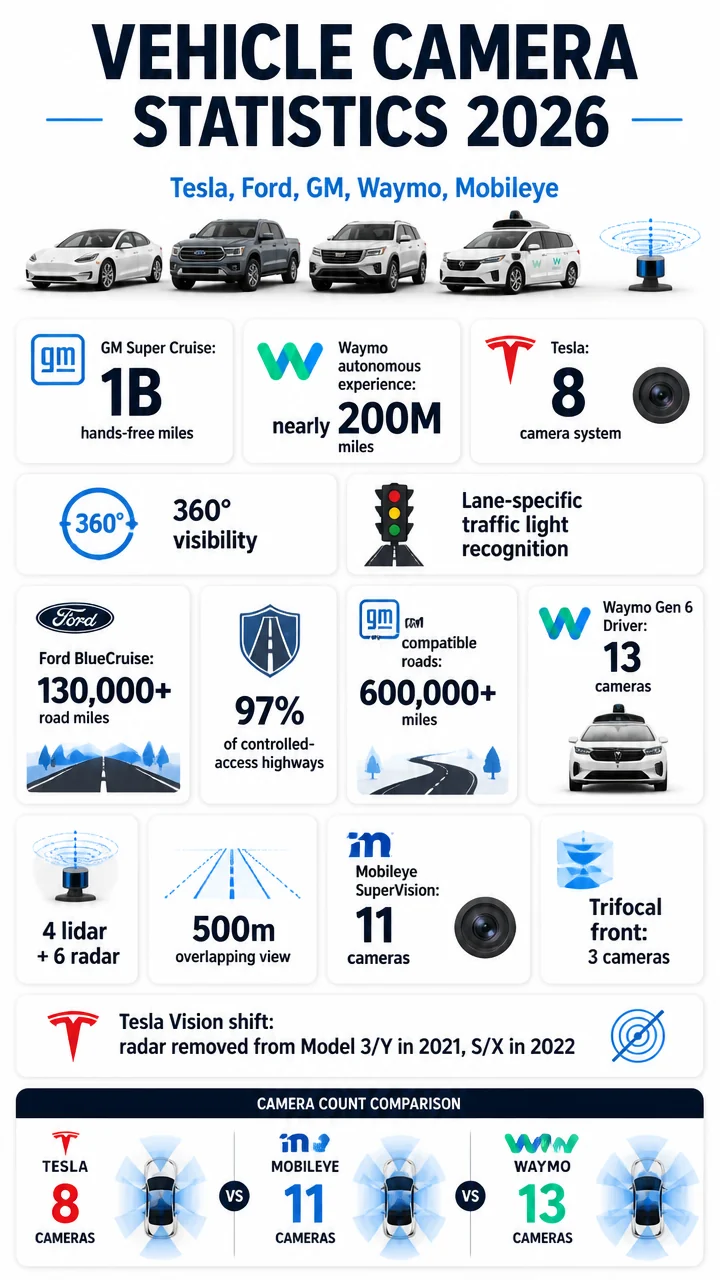
Big number: GM says customers have driven 1 billion hands-free miles with Super Cruise as of April 2026, while Waymo says its 6th-generation Driver is backed by nearly 200 million fully autonomous miles of experience.
Table of Contents
- Key vehicle camera statistics
- Vehicle camera statistics at a glance
- Tesla vehicle camera statistics
- Hands-free driving camera statistics: Ford vs GM
- Autonomous vehicle camera statistics: Waymo
- Automotive camera industry statistics: Mobileye
- Vehicle camera benchmarks and configuration comparisons
- Notable vehicle camera trends
Key vehicle camera statistics
Key takeaways
- Tesla uses an eight-camera system and says it enables 360-degree visibility and vehicle-lane-specific traffic light recognition.
- Ford BlueCruise covers 130,000+ miles of North American roads and 97% of controlled-access highways in the U.S. and Canada.
- GM Super Cruise covers 600,000+ miles of compatible roads across the U.S. and Canada.
- Waymo’s 6th-generation Driver uses 13 cameras, plus 4 lidar units and 6 radar units.
- Waymo’s camera system reaches 500 meters of overlapping field of view around the vehicle day and night.
- Mobileye SuperVision uses 11 cameras, while its trifocal forward setup uses 3 side-by-side cameras.
- Mobileye technology is installed in about 1,400 vehicle models and its SoCs have been deployed in more than 230 million vehicles.
Vehicle camera statistics at a glance
| Company / System | Key camera statistic | Scale statistic |
|---|---|---|
| Tesla | 8-camera system | Tesla Vision transition began in 2021 for Model 3 and Model Y |
| Ford BlueCruise | Hands-free system across 130,000+ miles in North America | 1 million+ BlueCruise-equipped vehicles globally in 2025 |
| GM Super Cruise | Available on 600,000+ miles of roads | 1 billion hands-free miles by April 2026 |
| Waymo Driver Gen 6 | 13 cameras and 17-megapixel imagers | Nearly 200 million fully autonomous miles |
| Mobileye SuperVision | 11-camera configuration | 35.7 million EyeQ and SuperVision systems shipped in 2025 |
Fast facts
- Ford says BlueCruise was approved in 15 European countries in 2024.
- That approval opened access to 133,000 kilometers, or 82,744 miles, of designated highways.
- GM says nearly 750,000 Super Cruise-enabled vehicles across 23 models helped reach the 1 billion-mile milestone.
- Waymo says its vehicles drive millions of miles a week.
- Mobileye works with 50+ OEMs worldwide.
Tesla vehicle camera statistics: camera coverage, cabin monitoring, and Tesla Vision
Tesla’s camera footprint now spans both the cabin and the exterior. The company says the cabin camera is installed in Model S vehicles from 2021 or later, Model 3, Model X vehicles from 2021 or later, Model Y, and Cybertruck.
The cabin camera is not just for recording. Tesla says it can capture the entire cabin and is used to detect driver inattentiveness when Autopilot or FSD (Supervised) is engaged.
That makes cabin monitoring one of the clearest examples of interior cameras being tied directly to active safety and driver supervision.
Why it matters: In vehicle camera statistics, exterior cameras tend to get the spotlight, but interior monitoring is becoming just as important because advanced driver assistance increasingly requires driver attention checks.
Tesla’s exterior camera story is built around an eight-camera architecture. Tesla says its vehicles are equipped with exterior cameras that enable 360-degree visibility, and its 2021 Impact Report says the eight-camera system lets each vehicle recognize a traffic light specific to the vehicle’s lane or direction of travel.
Tesla also ties camera capability to crash prevention. The company says that thanks to its eight-camera system, Pedal Misapplication Mitigation can help prevent or mitigate hundreds of collisions every month.
Tesla camera placement statistics
The Model Y offers one of the clearest snapshots of Tesla’s layout.
Tesla says the Model Y camera system includes:
- 1 front camera above the front grille
- 1 rear camera above the rear license plate
- 1 camera on each door pillar
- 2 cameras above the rear-view mirror on the windshield
- 1 camera on each front fender
That adds up to 8 cameras, consistent with Tesla’s broader system design.
Rear camera functionality is also deeply integrated into routine driving. Tesla says the rear-facing camera view is shown whenever the vehicle is shifted into Reverse, and the Model Y’s rear view camera is located on the liftgate.
Tesla also says Model Y uses side camera views in Park Assist if equipped.
Tesla recording and live access statistics
Tesla has expanded from passive viewing to onboard storage and remote live access. The company says Sentry Mode recordings on 2018-and-newer vehicles with software version 2020.48.5 or newer are saved to onboard memory and can be viewed on the vehicle touchscreen.
Live Camera access is app-based. Tesla says it is available on iOS and Android devices with Tesla app version 4.2.1 or later, and that Live Camera requires Premium Connectivity.
Battery thresholds also shape real-world camera usage. Tesla says Sentry Mode remains active until the vehicle battery is at or below 20%, unless the car is at a Supercharger.
| Tesla vehicle camera feature | Statistic |
|---|---|
| Exterior camera count | 8 cameras |
| Cabin camera availability | Model 3, Model Y, Cybertruck, Model S (2021+), Model X (2021+) |
| Sentry Mode onboard recording | 2018+ vehicles with software 2020.48.5+ |
| Live Camera app requirement | Tesla app 4.2.1+ |
| Sentry Mode battery cutoff | 20% |
| Rear camera recording availability | Vehicles made after approximately February 2018 |
Tesla Vision is the bigger strategic shift behind these statistics. Tesla says the transition to Tesla Vision began in 2021 on Model 3 and Model Y by removing radar, and Model S and Model X followed in 2022.
According to Tesla, most regions now rely on Tesla Vision for Model 3, Model Y, Model S, and Model X.
Pull quote: Tesla’s move from radar to camera-first perception started in 2021 and expanded to Model S and Model X in 2022.
Hands-free driving camera statistics: Ford vs GM road coverage and adoption
Ford and GM show how camera-linked driver assistance has gone mainstream. While neither dataset here gives total camera counts for each system, the road coverage and miles-driven figures show how large the assisted-driving footprint has become.
Ford BlueCruise is built for broad highway availability. Ford says BlueCruise is available across more than 130,000 miles of North American roads in Hands-Free Blue Zones, covering 97% of controlled-access highways in the U.S. and Canada.
Ford also has a strong third-party ranking claim. The company says BlueCruise was the Consumer Reports top-ranked active driving assistance system for the second time in a row out of 17 systems tested.
BlueCruise is also expanding internationally. Ford says it was approved in 15 European countries in 2024, opening access to more than 133,000 kilometers, or 82,744 miles, of designated highways.
One of Ford’s most eye-catching statistics is trip length. The company says a Sweden-to-Italy BlueCruise trip spans almost 3,000 kilometers, or 1,864 miles, and can include 25+ hours of hands-free driving.
Vehicle parc growth is steep. Ford says more than 420,000 BlueCruise-equipped Ford and Lincoln vehicles were on the road globally in 2024, rising to more than 1 million globally in 2025.
Usage is scaling with fleet growth. Ford says owners had driven more than 888 million kilometers, or 552 million miles, hands-free with BlueCruise by November 2025.
GM’s Super Cruise numbers are even larger on total miles. GM says customers have driven 1 billion hands-free miles with Super Cruise as of April 2026.
That milestone came from a sizable installed base. GM says nearly 750,000 Super Cruise-enabled vehicles across 23 models in North America contributed to the 1 billion-mile mark.
Road-network coverage is also much larger than Ford’s disclosed North American total. GM says Super Cruise is available on over 600,000 miles of compatible roads across the U.S. and Canada.
| Hands-free system | Coverage / road access | Vehicles | Miles driven |
|---|---|---|---|
| Ford BlueCruise | 130,000+ miles in North America; 97% of controlled-access highways in U.S. and Canada | 420,000+ in 2024; 1 million+ in 2025 | 552 million miles by Nov. 2025 |
| GM Super Cruise | 600,000+ miles in U.S. and Canada | Nearly 750,000 across 23 models | 1 billion miles by Apr. 2026 |
At a glance
- GM’s disclosed compatible-road network is about 4.6 times Ford’s stated North American BlueCruise mileage.
- Ford crossed 1 million equipped vehicles globally in 2025.
- GM crossed 1 billion hands-free miles in 2026.
GM’s longer-term roadmap hints at where vehicle camera systems may go next. Super Cruise was introduced in 2017, is available on more than 20 models from Chevrolet, Cadillac, Buick, and GMC, and GM says Escalade IQ is the starting point for eyes-off capability in 2028.
Pull quote: Hands-free, camera-enabled driving is no longer experimental—Ford reported 552 million miles by late 2025, and GM hit 1 billion miles by April 2026.
Autonomous vehicle camera statistics: Waymo’s sensor stack and imaging performance
Waymo’s numbers show what happens when vehicle cameras move from driver assistance to full autonomy. The company says the 6th-generation Waymo Driver uses 13 cameras, 4 lidar units, 6 radar units, and an array of external audio receivers.
The camera performance figure that stands out most is range. Waymo says the 6th-generation camera system reaches 500 meters of overlapping field of view around the vehicle, day and night.
Image quality is also a key stat. Waymo says its next-gen camera imager is 17 megapixels.
What makes these vehicle camera statistics especially notable is efficiency. Waymo says the new camera suite reduces the number of cameras to less than half of the prior generation while improving capability.
The company also says its 5th-generation Driver used a larger camera count than the 6th-generation system.
Big number: Waymo says its 6th-generation Driver has nearly 200 million fully autonomous miles of experience across 10+ major cities and is backed by 7 years of safety-proven service.
Operational scale reinforces the camera-stack story. Waymo says its vehicles drive millions of miles a week, which means its camera systems are gathering real-world edge cases at a pace most consumer systems cannot match.
| Waymo Gen 6 statistic | Figure |
|---|---|
| Camera count | 13 |
| Lidar units | 4 |
| Radar units | 6 |
| Camera system range | 500 meters |
| Camera imager resolution | 17 megapixels |
| Fully autonomous miles | Nearly 200 million |
| City footprint | 10+ major cities |
| Safety-proven service | 7 years |
Automotive camera industry statistics: Mobileye scale, OEM reach, and shipment growth
If Tesla, Ford, GM, and Waymo show how vehicle cameras are used, Mobileye shows how widely the technology has spread across the automotive supply chain. Mobileye says its trifocal camera configuration uses 3 cameras with different fields of view placed side-by-side facing forward.
Its more advanced SuperVision setup goes much further. Mobileye says SuperVision uses an 11-camera configuration.
The scale figures are the real headline. Mobileye says its solutions are installed in approximately 1,400 vehicle models as of December 27, 2025, and its SoCs have been deployed in more than 230 million vehicles.
The company’s partner network is equally broad. Mobileye says it works with more than 50 OEMs worldwide.
Shipments are rising fast. Mobileye says it shipped approximately 35.7 million EyeQ and SuperVision systems in 2025, up from about 29.0 million in 2024.
| Mobileye statistic | Figure |
|---|---|
| Trifocal forward camera setup | 3 cameras |
| SuperVision camera setup | 11 cameras |
| Vehicle models installed | ~1,400 |
| Vehicles with deployed SoCs | 230 million+ |
| OEM partners | 50+ |
| 2025 shipments | 35.7 million |
| 2024 shipments | 29.0 million |
That shipment increase equals roughly 6.7 million additional systems year over year. Even without broader market totals, that single-company gain highlights how quickly camera-enabled ADAS hardware is being deployed.
Vehicle camera benchmarks and configuration comparisons
One of the clearest patterns in these vehicle camera statistics is the huge variation in camera counts depending on use case.
- Mobileye trifocal: 3 forward-facing cameras
- Tesla exterior system: 8 cameras
- Mobileye SuperVision: 11 cameras
- Waymo Gen 6: 13 cameras
The progression is revealing. A narrower forward-vision assistance setup can use just 3 cameras.
A consumer vehicle designed for full-surround perception can use 8 cameras.
More advanced premium ADAS and autonomous stacks climb to 11 or 13 cameras, often alongside radar and lidar.
| System | Camera count | Context |
|---|---|---|
| Mobileye trifocal | 3 | Forward-facing cameras with different fields of view |
| Tesla | 8 | 360-degree vehicle exterior visibility |
| Mobileye SuperVision | 11 | Advanced ADAS configuration |
| Waymo Gen 6 | 13 | Autonomous stack with lidar and radar support |
Pull quote: Across the dataset, camera counts run from 3 in a focused forward-vision system to 13 in a full autonomous stack.
Notable vehicle camera trends from the data
Fast facts
- Camera-first design is expanding: Tesla’s radar removal began in 2021, while Mobileye and Waymo continue pushing multi-camera perception.
- Interior cameras are becoming standard safety tools: Tesla uses its cabin camera for inattentiveness detection during Autopilot or FSD (Supervised).
- Road-mapped hands-free driving is scaling fast: Ford covers 130,000+ miles; GM covers 600,000+ miles.
- Installed bases are now massive: Ford passed 1 million BlueCruise-equipped vehicles in 2025, and Mobileye says its chips are in 230 million+ vehicles.
- Autonomy stacks are getting more efficient: Waymo cut camera count to less than half of its prior generation while improving capability.
The most surprising split is between consumer ADAS scale and autonomous experience depth. GM’s 1 billion hands-free miles and Ford’s 552 million hands-free miles show mainstream use at enormous volume, while Waymo’s nearly 200 million fully autonomous miles highlight a smaller but more advanced operating mode.
Another standout trend is geographic reach. Ford’s BlueCruise approval in 15 European countries, plus nearly complete controlled-access highway coverage in the U.S. and Canada at 97%, suggests camera-based driving assistance is increasingly becoming a cross-border feature rather than a regional novelty.
Finally, the supply-chain numbers suggest the camera economy is bigger than any one automaker. Mobileye’s 35.7 million systems shipped in 2025 and deployment across 1,400 vehicle models show that vehicle camera technology is no longer defined only by premium EV brands or robotaxi developers—it is embedded deep into the broader auto market.