
A cellular trail camera can send photos to your phone without a trip to the camera, making it useful for monitoring game, gates, and remote property. The catch: coverage, data plans, and power needs can matter as much as image quality.
These 10 options include live-view and solar-equipped models, established camera systems, and multipacks. Here is how to narrow the field to the setup that fits your location and budget.
Best 10 Trail Camera with Cellular Connection Picks for 2026
Best for Wide-Area Viewing
SEHMUA 360° Solar Trail Camera

- Remote 355° pan and 100° tilt
- 2K live feed and 0.2-second trigger
- 6W solar panel; per-camera data plan
Best For: Scanning pastures and food plots remotely
Best for Detailed Wildlife Photos
SEHMUA 48MP Solar Trail Camera

- 48MP photos and 2K video
- 120° view and no-glow infrared
- 4W solar panel; subscription required
Best For: Detailed stills across a wide game trail
Best for Flexible Storage
Loatos 2K Cellular Trail Camera

- 2K live view and adjustable alerts
- Records locally without active data
- Up to four simultaneous live viewers
Best For: Scouting with a local-recording fallback
Best for Simple Setup

- Auto-connect AT&T/Verizon LTE
- Built-in GPS and storage
- Three-shot burst; 60° field of view
Best For: Quick deployment on hunting or rural property
Best for Easy Setup

- Automatic U.S. network connection
- 36MP photos and 1080p video
- 8GB built-in memory; no SD card needed
Best For: Straightforward app-based scouting
Best for Advanced Scouting

- AI buck detection and alerts
- 40MP photos; 0.5-second trigger
- Live Aim and built-in GPS
Best For: Buck-focused scouting and camera placement
Best Two-Camera Option

- Two cameras for separate sites
- Automatic dual-SIM carrier selection
- Photo, video, and time-lapse modes
Best For: Covering two locations with app-managed cameras
Best for Deer Scouting
Moultrie Edge 3 Cellular Trail Camera 2-Pack
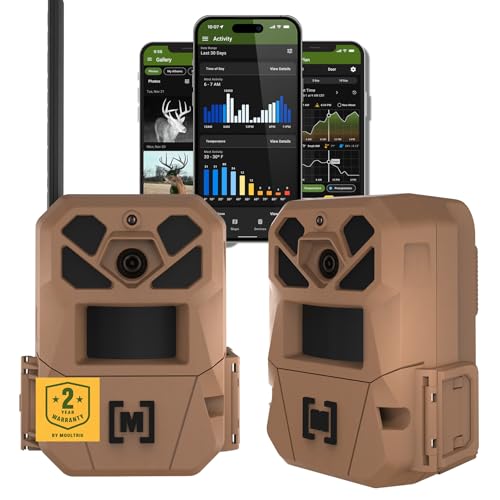
- AI buck detection with alerts
- Four-carrier auto-connect
- 40MP photos and 0.5-second trigger
Best For: Remote deer scouting across two locations
Best for Fast Triggers

- Listed 0.35-second trigger
- 80-foot detection and IR range
- Dual pre-installed SIM cards
Best For: Capturing fast-moving game at two sites
Best for Live Monitoring
VOOPEAK 4G LTE 360° Trail Camera

- 2.5K live video over 4G
- 360° pan-and-tilt with auto-tracking
- Solar panel and rechargeable battery
Best For: Live wildlife and remote-property monitoring
Best for Wide-Area Viewing – SEHMUA 360° Solar Trail Camera
If you want a trail camera with cellular connection that you can aim from your phone, this SEHMUA model combines 355° pan, 100° tilt, 4X digital zoom, and a 2K live feed. Its built-in U.S. SIM connects over supported Verizon, AT&T, and T-Mobile coverage without Wi-Fi.
Best For: Monitoring broad areas such as pastures, food plots, and remote property from one camera position.
Pros:
- Remote pan, tilt, and zoom through the UBox app.
- 6W solar panel and IP65-rated housing suit outdoor placement.
- 0.2-second PIR trigger, phone alerts, and low-glow night vision.
Cons:
- After the seven-day trial, each camera needs its own data plan; listed options are $19.90 monthly or $169.90 yearly.
- Cellular service is U.S.-only and requires coverage at the installation site.
The movable view is the main reason to choose this camera over a fixed-angle model. Budget for its ongoing data plan, and place the solar panel where it can receive adequate sun.
Best for Detailed Wildlife Photos – SEHMUA 48MP Solar Trail Camera
This trail camera with cellular connection prioritizes detailed wildlife captures: SEHMUA lists 48MP photos, 2K video and live streaming, and 940nm no-glow infrared for nighttime observation. A pre-installed SIM works on supported Verizon, AT&T, and T-Mobile networks in the U.S., with no Wi-Fi required.
Best For: Wildlife observers who want high-resolution stills and a wide, fixed view of a trail.
Pros:
- 48MP photos, 2K video, and app-based remote viewing.
- 120° field of view, up to 65-foot PIR detection, and a listed 0.1-second response time.
- 4W solar panel, IP66-rated housing, and no-glow infrared.
Cons:
- A subscription is needed after the seven-day data trial; listed rates include $19.90 monthly or $299.90 for two years per camera.
- Solar charging depends on placing the panel where it receives sufficient light.
Choose this model for its still-photo resolution and broad coverage rather than remote pan-and-tilt control. At night, color capture depends on available natural light; in full darkness, it switches to black-and-white infrared.
Best for Flexible Storage – Loatos 2K Cellular Trail Camera
The Loatos is a trail camera with cellular connection for buyers who want both remote access and an offline recording option. Its built-in SIM supports 4G LTE service on major U.S. networks, while the Ucon app offers a 2K live feed, alerts, adjustable detection zones, and recording schedules.
Best For: Scouting locations where you want app alerts but also want to keep recordings on a memory card if cellular data lapses.
Pros:
- 0.2-second trigger and 940nm infrared for nighttime footage.
- Local recording can continue without an active data plan using a memory card of up to 128GB.
- Live viewing supports up to four simultaneous users; a solar panel supplies power.
Cons:
- The memory card is not included.
- Remote cellular features need a paid plan after the seven-day data trial; the advertised $12.49 monthly rate is tied to a two-year plan.
The local-storage fallback makes this a practical choice if uninterrupted remote access is not essential. Verify LTE coverage before installation and factor the plan term into the total cost.
Best for Simple Setup – Tactacam REVEAL X 3.0
For a trail camera with cellular connection that minimizes setup steps, the Tactacam REVEAL X 3.0 includes a pre-installed antenna and SIM, auto-connect LTE service across AT&T and Verizon, and built-in storage. You can set it up through the REVEAL app without buying or formatting a separate SD card.
Best For: Hunters and rural property owners who prefer straightforward deployment and app-delivered activity updates.
Pros:
- Automatically selects between supported AT&T and Verizon signals at the camera location.
- Built-in GPS helps locate the camera, while onboard storage removes the need for an SD card.
- Sub-half-second trigger, three-shot burst mode, and a stated battery life of up to six-plus months.
Cons:
- Its listed 60° field of view covers less width than the wider-angle models here.
- Solar panels and the lithium cartridge are presented as optional power pairings, not included accessories.
This is the convenient pick if you value quick activation, onboard storage, and multi-carrier selection over a panoramic view. Actual battery life will depend on deployment conditions and usage.
Best for Easy Setup – Moultrie Edge 2
The Moultrie Edge 2 is a trail camera with cellular connection that keeps setup straightforward: it automatically connects across major U.S. networks, and its 8GB built-in memory means you don’t need an SD card.
Best For: Buyers who want app-based scouting without managing SIM cards or memory cards.
Pros:
- Captures 36MP photos and 1080p video with audio.
- Offers a 100-foot detection range and low-glow infrared flash.
- Moultrie Mobile supports remote viewing, alerts, and camera settings.
Cons:
- Cellular service requires a Moultrie plan, starting at $9.99 per month.
- Compatible solar and alternative power accessories are sold separately.
Choose this model if easy activation and everyday remote monitoring matter more than the Edge 3’s additional AI and placement tools.
Best for Advanced Scouting – Moultrie Edge 3
The Moultrie Edge 3 is a trail camera with cellular connection for hunters who want more than photo delivery. It pairs automatic four-carrier connectivity with AI buck detection, placement tools, and app alerts.
Best For: Deer hunters who want buck alerts and help positioning cameras on their property.
Pros:
- AI buck detection can send real-time photo alerts.
- Captures 40MP photos and 1080p video, with a 0.5-second trigger and 100-foot detection range.
- Live Aim helps frame the view, while built-in GPS maps camera locations.
Cons:
- Cellular plans start at $9.99 per month.
- Compatible rechargeable battery packs and solar panels are separate power options.
Its standout value is the combination of buck-focused alerts and easier camera placement; those extras are most useful if you plan to use the app regularly.
Best Two-Camera Option – SPYPOINT Flex-M Twin
The SPYPOINT Flex-M Twin gives you two units when you need a trail camera with cellular connection at more than one location. Its dual-SIM system selects a carrier signal automatically, and the SPYPOINT app supports remote management.
Best For: Monitoring two trails or sites with cellular cameras and flexible capture modes.
Pros:
- Includes two cameras with installation straps and preactivated SIM cards.
- Offers photo, video, Time-Lapse, and Time-Lapse+ modes.
- Supports over-the-air updates, GPS location in the app, and simultaneous capture and sending.
Cons:
- A memory card is not included.
- The supplied notes conflict on image specifications: the bullets cite 32MP photos and 1080p video, while the details list 28MP and 720p.
The two-camera package and capture options make this a practical choice for broader coverage. Verify the photo and video specifications before buying if resolution is a deciding factor.
Best for Deer Scouting – Moultrie Edge 3 Cellular Trail Camera 2-Pack
If you want a trail camera with cellular connection for scouting two locations, the Moultrie Edge 3 two-pack pairs app-delivered images with buck detection and alerts. Its four-carrier auto-connect selects the strongest available network without a separate SIM setup.
Best For: Deer hunters who want remote buck alerts and two-camera coverage.
Pros:
- 40MP photos, 1080p video, and a low-glow infrared flash.
- 0.5-second trigger and 100-foot detection range.
- Live Aim helps with placement; built-in GPS maps camera locations.
Cons:
- Cellular plans start at $9.99.
- Rechargeable lithium packs and solar panels are compatible options, not listed as included.
This is the scouting-focused choice if buck-specific alerts matter more to you than live video. Factor the cellular plan and your preferred power setup into the total cost.
Best for Fast Triggers – Stealth Cam Fusion Max 2-Pack
The Stealth Cam Fusion Max is a trail camera with cellular connection suited to capturing game moving through a wide detection area. This two-pack uses pre-installed AT&T and Verizon SIM cards, with QR-code setup and remote viewing through the COMMAND Pro app.
Best For: Hunters who prioritize quick captures and app access at two camera sites.
Pros:
- Listed 0.35-second trigger and 80-foot detection and infrared flash range.
- Burst mode captures one to six images per trigger; photo settings range from 4MP to 36MP.
- 1080p video and app-based viewing, sharing, and settings control.
Cons:
- Requires 16 AAA batteries, which are not included.
- Rechargeable battery cartridge is sold separately.
The quick trigger and burst options make this a practical pick for trails where animals may pass through rapidly. Plan for the substantial battery requirement before placing both cameras.
Best for Live Monitoring – VOOPEAK 4G LTE 360° Trail Camera
For buyers who want to watch a location rather than just receive snapshots, this VOOPEAK trail camera with cellular connection offers 2.5K live video over 4G. Its motorized pan-and-tilt view and automatic tracking are geared toward monitoring wildlife or activity around a remote property.
Best For: Property owners who want live, movable views of remote areas.
Pros:
- 360° pan-and-tilt coverage with AI tracking of people, animals, or vehicles.
- Switchable infrared black-and-white and white-light color night vision.
- 7800mAh rechargeable battery with a 3W solar panel; supports local microSD recording.
Cons:
- Live streaming requires a cellular data subscription; cloud storage is also paid.
- MicroSD card is not included.
This model makes the most sense when live viewing and changing the camera angle are priorities. Budget for cellular service, and add a microSD card if you want local recordings.
How We Picked the Best Trail Camera with Cellular Connection
We focused on practical differences among the selected models: cellular features, stated image and trigger specifications, power options, camera coverage, and whether a listing includes one camera or a multipack. We also considered the ongoing decisions buyers face, such as app access and data-plan costs. Listed specifications are a starting point, not a guarantee of real-world performance; check current plan terms, network compatibility, and user feedback before ordering.
Quick Comparison: Match the Camera to the Job
Start by deciding whether you need scheduled photo uploads or live viewing. The SEHMUA and other 4G LTE live-view listings are worth comparing if checking a scene on demand is a priority; the 360° models may appeal where a wider view could reduce blind spots. Tactacam REVEAL X 3.0, Moultrie Edge 2 and Edge 3, SPYPOINT Flex-M Twin, and Stealth Cam Fusion Max offer other choices for buyers comparing established camera ecosystems. If you need several locations covered, compare the total cost of the Moultrie Edge 3 and Stealth Cam two-packs against buying individual units, including any per-camera plan charges.
Key Buying Factors for a Trail Camera with Cellular Connection
Coverage and Data Plans
Check which carrier network the camera uses and confirm usable signal at the exact mounting spot. A phone showing service nearby does not guarantee reliable uploads under dense foliage or in a valley. Compare monthly fees, photo limits, video charges, free-plan restrictions, and whether live viewing uses additional data. Also check whether the camera requires a brand-specific SIM or subscription.
Power and Placement
Live streaming, frequent uploads, and cold weather can shorten battery life. Solar-assisted models can reduce battery changes, but the panel needs adequate light and may still require backup power. For any camera, plan for accessible mounting, a clear field of view, and enough height to discourage tampering without making maintenance difficult.
Image Detail, Detection, and App Experience
Do not judge photo quality by megapixels alone. Compare sample daytime and nighttime images, detection range, infrared flash visibility, and trigger speed for your intended distance. A wide-angle or rotating view can help monitor open areas, while a fixed view may be simpler for a narrow trail. Look for an app that makes it easy to adjust settings, manage notifications, and retrieve the images you actually need.
Who Should Buy Which Trail Camera with Cellular Connection?
Choose a live-view model if on-demand checks matter more than maximizing battery life. Consider a solar-equipped SEHMUA option for a sunny, hard-to-reach site, but verify coverage and power requirements first. Compare Tactacam, Moultrie, and SPYPOINT if app workflow and plan structure are central to your decision. For monitoring multiple trails or property entrances, start with the two-packs, then calculate the full cost of cameras, batteries, accessories, and service. The best choice is the one that reliably connects where you will mount it and fits your ongoing budget.