
The best HDMI matrix switches for projectors make it easier to route multiple sources to one or more projectors, TVs, and audio systems without constantly swapping cables. The right model can also simplify 4K or 8K signal management, HDR compatibility, and sound extraction.
We selected 10 matrix switches with different input and output counts, control methods, video specifications, and audio features. Use the guide below to narrow your choices based on your projector setup, sources, resolution requirements, and installation plans.
Best 10 Hdmi Matrix Switches for Projectors Picks for 2026
Best Flexible 4K Pick

- 4K@60Hz, HDR, and HDCP 2.2 support
- Downscales 4K to 1080p
- Independent or identical output content
Best For: Mixed-resolution home theater and multi-display setups
Best Large-Installation Control Pick

- Eight HDMI inputs and eight outputs
- Per-output 4K-to-1080p downscaling
- WebGUI, LAN, RS-232, IR, and presets
Best For: Commercial or large multi-projector AV installations
Best 4K60 Professional Pick

- 4K@60Hz, HDR, and 4:4:4 color
- Four inputs and four outputs
- Stores up to 12 routing scenes
Best For: Professional 4K projector, signage, and home theater systems
Best 8K Pick
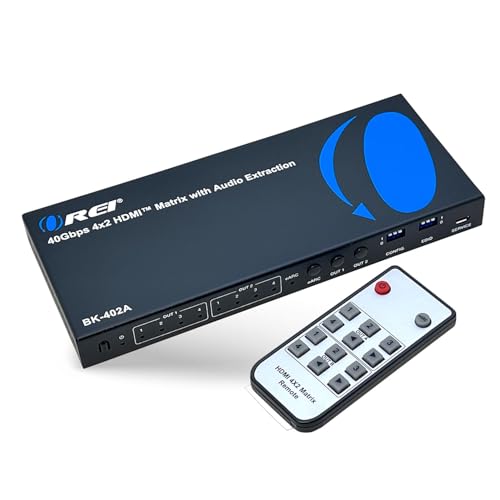
- 40Gbps HDMI 2.1 performance
- Supports 8K and 4K/120Hz
- eARC and audio extraction
Best For: Home theaters and gaming projector systems
Best for Large Installations
J-Tech Digital 8x8 HDMI Matrix

- Routes 8 sources to 8 displays
- 4K/60Hz HDR and 18Gbps support
- IP, web, and RS-232 control
Best For: Commercial AV and multi-projector systems
Best Rack-Mount Value

- Routes 4 sources to 4 displays
- Web, LAN, RS-232, app, and API control
- Rack-mountable with custom EDID
Best For: Conference rooms and 4K/30Hz projector installations
Best for Large AV Systems

- Routes eight sources to eight displays
- Supports 4K@60Hz, HDR, and 18Gbps
- Includes downscaling and multiple controls
Best For: Large multi-projector or multi-display installations
Best for Feature-Rich Home Theaters
OREI 4x2 HDMI Matrix with Audio

- Switches four sources across two displays
- Supports 4K@60Hz and major HDR formats
- Includes optical and analog audio extraction
Best For: Two-display projector systems with external audio
Best Compact Downscaling Option

- Routes four sources to two displays
- Supports 4K@60Hz, HDR, and 18Gbps
- Downscales 4K for a 1080p projector
Best For: Compact mixed-resolution projector systems
Best Flexible 4K Pick – OREI 4×4 HDMI Matrix
If you need HDMI matrix switches for projectors that can handle several sources and displays, the OREI UHD-404 offers four HDMI inputs and four outputs. Its 4K-to-1080p downscaling is useful when a setup mixes newer 4K equipment with Full HD projectors or monitors.
Best For: Home theaters and multi-display systems using mixed 4K and 1080p screens.
Pros:
- Supports 4K at 60Hz, HDR, HDCP 2.2, and up to 18Gbps bandwidth.
- Downscales 4K content to 1080p for compatible displays.
- Supports independent or identical content on the connected displays.
- Handles up to 7.1-channel audio, including Dolby Digital and DTS-HD Master Audio.
Cons:
- It has four inputs and four outputs, so larger installations need a higher-capacity matrix.
- Only a one-year warranty is included.
The UHD-404 is a practical choice when projector compatibility matters across different display resolutions. Its combination of downscaling, HDR support, and broad audio compatibility makes it especially adaptable for home entertainment installations.
Best Compact Audio-Extraction Pick – FERRISA 4×2 HDMI Matrix
For smaller projector systems, this FERRISA model is one of the more compact HDMI matrix switches for projectors, with four inputs and two outputs. It also extracts audio through optical or 3.5mm outputs, which can simplify connections to a sound system or headphones.
Best For: Home theaters, classrooms, and offices that need two display outputs plus flexible audio extraction.
Pros:
- Connects four HDMI sources to two displays.
- Provides optical and stereo headphone audio outputs.
- Includes EDID management and an IR remote control.
- Supports 4K, 3D, 1080p, and LPCM/DTS 5.1-channel audio.
Cons:
- Both displays must use the same resolution at the same time.
- It does not support Dolby DD, DD+, or Dolby Vision.
- The required AAA battery is not included with the remote.
This 4×2 matrix makes sense when two projector or monitor outputs are enough and audio routing is a priority. Its resolution limitation and stated Dolby compatibility exclusions should be checked against your source and display equipment before purchase.
Best Large-Installation Control Pick – OREI 8×8 HDMI Matrix
For larger projector deployments, the OREI HDS-808 provides eight HDMI inputs and eight outputs with multiple control methods. It supports mixed 4K and 1080p displays through output downscaling and adds rack mounting, presets, RS-232, LAN, and WebGUI control.
Best For: Commercial AV systems, conference spaces, classrooms, and larger multi-projector installations.
Pros:
- Routes up to eight HDMI sources to eight displays.
- Each output can downscale 4K content to 1080p.
- Supports Dolby Atmos, DTS:X, and up to 7.1-channel LPCM.
- Offers eight scene presets plus front-panel, IR, RS-232, LAN, and WebGUI control.
Cons:
- 4K video support is limited to 30Hz.
- Its 1U rack-mountable design and larger footprint may be excessive for a basic home setup.
- It carries a one-year warranty.
The HDS-808 is built around capacity and installation control rather than maximum 4K refresh rate. It is a strong fit when many sources and projectors must be managed centrally, especially where preset scenes and network control are valuable.
Best 4K60 Professional Pick – Tripp Lite 4×4 HDMI Matrix
Tripp Lite 4x4 HDMI Matrix Switch/Splitter w Audio Extractor 4K 60Hz HDR (B302-4HX4H-4K)
Check Price On AmazonThe Tripp Lite B302-4HX4H-4K is a capable option among HDMI matrix switches for projectors when true 4K at 60Hz, HDR, and 4:4:4 color are important. Its four-by-four routing supports identical or different content across up to four displays, with several control options for installed systems.
Best For: Home theaters, digital signage, training rooms, and installations that need detailed 4K video support.
Pros:
- Supports 4K up to 4096 x 2160 at 60Hz, HDR, and 4:4:4 chroma.
- Routes four HDMI sources to four projectors, monitors, or televisions.
- Offers front-panel, IR, RS-232, and GUI control options.
- Stores up to 12 display or source combinations for quick recall.
Cons:
- RS-232 control requires a cable sold separately.
- At 7.7 pounds, it is relatively substantial for a four-by-four matrix.
- The supplied notes do not specify audio-format support.
This Tripp Lite model is a well-rounded choice when high-refresh-rate 4K video and repeatable scene management are more important than a compact design. Its three-year limited warranty and included rack hardware also suit more permanent installations.
Best 8K Pick – OREI 4×2 HDMI Matrix Switch
For shoppers comparing hdmi matrix switches for projectors, the OREI 4×2 is a strong choice when you need modern HDMI 2.1 bandwidth, two independently routed displays, and flexible audio handling. It accepts four sources and supports up to 8K video.
Best For: Home theaters, gaming setups, and projector systems using 8K or 4K/120Hz sources.
Pros:
- Routes four HDMI inputs independently to two displays.
- Supports 40Gbps bandwidth, 8K, 4K/120Hz, VRR, ALLM, and FVA.
- Offers eARC plus optical and 3.5mm audio extraction.
Cons:
- Audio extraction and eARC depend on compatible connected equipment.
- Its two-output design may be limiting for larger installations.
The OREI stands out for projector owners who want current-generation gaming and cinema features in a compact 4×2 layout. Its 8K and eARC capabilities provide more headroom than many basic matrix switches.
Best for Large Installations – J-Tech Digital 8×8 HDMI Matrix
If you need hdmi matrix switches for projectors across multiple rooms or displays, the J-Tech Digital 8×8 provides extensive routing capacity. It can connect eight HDMI sources to eight displays and includes network, web, and RS-232 control.
Best For: Commercial AV systems, conference rooms, digital signage, and installations with many projectors or displays.
Pros:
- Routes any of eight HDMI sources to any of eight HDMI outputs.
- Supports 4K at 60Hz, HDR, YUV 4:4:4, and 18Gbps bandwidth.
- Provides EDID management, IP/Ethernet, web, and RS-232 control.
- Includes SPDIF audio output for each HDMI output.
Cons:
- It is more equipment than needed for a small two-display setup.
- Its listed video support is HDMI 2.0 rather than HDMI 2.1.
This J-Tech model is a practical fit when independent routing and centralized control matter more than 8K support. Its 8×8 capacity and installation-oriented controls make it suitable for complex projector deployments.
Best Rack-Mount Value – MT-VIKI 4×4 HDMI Matrix
The MT-VIKI 4×4 is worth considering among hdmi matrix switches for projectors when you need four-way routing, rack installation, and several control options without moving to an 8×8 system. It supports simultaneous 4K and 1080P output.
Best For: Conference rooms, churches, retail displays, sports bars, and rack-mounted home theater systems.
Pros:
- Independently routes four HDMI sources to four displays.
- Offers web, LAN, RS-232, app, API, IR, and front-panel control.
- Supports 4K at 30Hz, 3D, deep color, and custom EDID writing.
- Fits a standard 1U 19-inch rack cabinet.
Cons:
- Its maximum listed resolution is 4K at 30Hz.
- 3.5mm audio extraction works through OUT4 only.
Choose the MT-VIKI when installation flexibility and control integration are priorities. The 4×4 layout suits multi-display projector systems, while the rack ears and custom EDID support help with organized, varied AV environments.
Best for Large AV Systems – OREI 8×8 4K HDMI Matrix
For demanding installations, this 8×8 HDMI matrix switch for projectors connects up to eight sources and routes them independently to eight displays. It supports 4K at 60Hz, HDR, 18Gbps bandwidth, mixed 4K and 1080p screens, and several control options.
Best For: Large home theaters, conference rooms, classrooms, and professional AV systems using multiple projectors or displays.
Pros:
- Eight HDMI inputs and eight independently routable outputs.
- Supports 4K@60Hz, HDR, HDCP 2.2, and 18Gbps bandwidth.
- Downscales outputs for mixed 4K and 1080p displays.
- Offers analog, SPDIF, RS-232, LAN, web GUI, and IR control options.
Cons:
- Its 8×8 design may be more capacity than a smaller setup requires.
- It does not list support for 4K@120Hz, VRR, or ALLM.
The OREI UHD-808 is the most flexible option here for installations that need many sources, displays, and audio zones. Its extensive routing and control features come with a larger system footprint than a compact 4×2 switch.
Best for Feature-Rich Home Theaters – OREI 4×2 HDMI Matrix with Audio
This 4×2 HDMI matrix switch for projectors is designed for systems with up to four sources and two displays. It combines 4K@60Hz switching with Dolby Vision, HDR10+, HLG, audio extraction, ARC, EDID modes, and independent 4K-to-1080p downscaling.
Best For: Home theaters, conference rooms, and projector setups that need two displays plus optical or analog audio output.
Pros:
- Connects four HDMI sources to two displays with independent switching.
- Supports 4K@60Hz, 18Gbps bandwidth, Dolby Vision, HDR10+, and HLG.
- Extracts audio through optical SPDIF and analog left/right outputs.
- Supports mixed-resolution displays with 4K-to-1080p downscaling.
Cons:
- Does not support 4K@120Hz, VRR, or ALLM.
- Requires high-quality HDMI 2.0 or 2.1 cables under 30 feet for stable 4K@60Hz performance.
The UHDS-402A is a practical middle ground for projector systems that need strong HDR compatibility and flexible audio handling without the size of an 8×8 matrix. Its two-output limit makes it less suitable for larger distributed-video installations.
Best Compact Downscaling Option – OREI UHD-402D 4K HDMI Matrix
For a compact setup, this 4×2 HDMI matrix switch for projectors connects four sources to two displays and supports 4K@60Hz, HDR, and 18Gbps bandwidth. Its downscaler allows a 4K display and a 1080p projector or screen to operate together.
Best For: Smaller home theater or presentation systems pairing a 4K display with a 1080p projector.
Pros:
- Supports four HDMI sources and two displays.
- Handles 4K@60Hz, HDR, 12-bit deep color, and 18Gbps bandwidth.
- Downscales 4K to 1080p while preserving the main 4K output.
- Includes ARC and optical and 3.5mm audio outputs.
Cons:
- Control is limited to front-panel buttons and the included IR remote.
- It has fewer outputs and control options than the 8×8 model.
The UHD-402D is a straightforward choice when two-display routing and mixed-resolution support matter more than extensive installation controls. Its compact size and included USB power accessories suit smaller AV setups.
How We Picked These Hdmi Matrix Switches for Projectors
We focused on the features that matter most in projector-based AV systems: input and output capacity, supported resolution and refresh rate, HDR and HDCP compatibility, EDID management, audio extraction, and installation control. The lineup includes compact 4×2 models for simple rooms, 4×4 units for more flexible systems, and 8×8 switches for multi-display or commercial-style installations.
We also considered practical features such as downscaling, ARC or eARC support, optical and analog audio outputs, IR remotes, RS-232, WebGUI, and Ethernet control. These functions can make a significant difference when a switch is installed in a cabinet, ceiling-mounted projector system, or whole-home AV setup.
Quick Comparison
- Best for basic projector systems: A 4×2 switch provides several sources and two independently routed displays.
- Best for multiple rooms or displays: Choose a 4×4 or 8×8 model with strong EDID and control options.
- Best for modern 4K gaming and streaming: Look for 4K at 60Hz, HDMI 2.0, 18Gbps bandwidth, HDR, and YUV 4:4:4 support.
- Best for advanced installations: Web, Ethernet, RS-232, custom EDID, and reliable remote-control options simplify system management.
Key Buying Factors for Hdmi Matrix Switches for Projectors
Inputs, Outputs, and Routing
Count every source and display you expect to connect now, then allow room for expansion. A 4×2 switch can send different sources to a projector and television, while 4×4 and 8×8 designs are better suited to multiple projectors, displays, zones, or distributed video systems.
Resolution, Refresh Rate, and Bandwidth
For most current home theater systems, 4K at 60Hz is a useful baseline. Check for HDMI 2.0 and up to 18Gbps bandwidth if you need HDR, 4:4:4 color, or high-quality gaming signals. An 8K model may provide more future-proofing, but confirm that your projector, cables, and source devices support the desired 8K format.
EDID, Downscaling, and Compatibility
EDID management helps the switch and connected devices agree on a usable video format. Downscaling is especially helpful when a 4K source must feed both a newer projector and an older television or receiver. These features can prevent blank screens, resolution switching, and handshake problems.
Audio Extraction and Control
If your projector lacks convenient audio connections, choose a switch with optical, analog, ARC, or eARC output as appropriate. For hidden or permanently installed equipment, Ethernet, WebGUI, RS-232, or dependable IR control is usually more practical than a front-panel button.
Who Should Buy Which Hdmi Matrix Switches for Projectors?
Choose a 4×2 model if you have a single projector, a second display, and a small collection of sources. It is usually the simplest and most economical arrangement.
Choose a 4×4 model if you need independent routing to several displays or want more flexibility for future upgrades. Prioritize 4K at 60Hz, HDR, audio extraction, and EDID control for a mixed home theater system.
Choose an 8×8 model for a large media room, multi-projector installation, classroom, business, or whole-home distribution system. Network or serial control is particularly valuable when the switch will be operated remotely.
Finally, verify cable lengths, HDCP versions, projector input limits, and audio-device compatibility before buying. A matrix switch cannot exceed the capabilities of the weakest connected component.