
Compact HDMI matrix switches make it easier to connect several video sources to multiple displays without constantly swapping cables. The right model can also simplify audio routing, support 4K or 8K signals, and improve compatibility across older and newer devices.
We selected 10 compact options for different setups, from straightforward 2×2 and 4×2 systems to higher-capacity 4×4 and 8×8 matrices with downscaling, ARC or eARC, EDID management, and audio extraction.
Best 10 Compact Hdmi Matrix Switches Picks for 2026
Best Feature-Rich 4x4
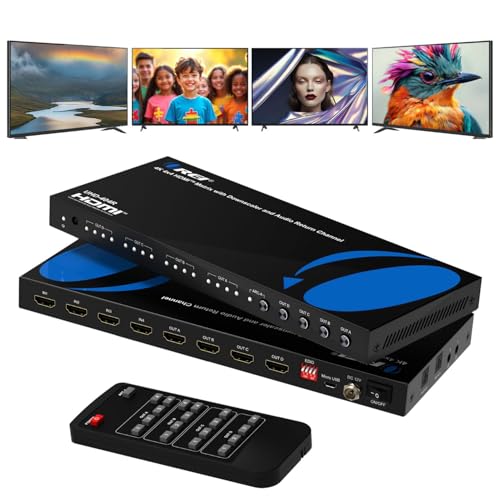
- Four inputs and four outputs
- 4K60, HDR, and 18Gbps support
- ARC plus optical and 3.5mm extraction
Best For: Multi-display home and commercial AV systems
Best for Mixed-Resolution Displays

- Downscales 4K to 1080p
- Four inputs and four outputs
- 4K60, HDR, and 18Gbps support
Best For: Multi-screen systems mixing 4K and 1080p displays
Best for Large-Scale AV Routing
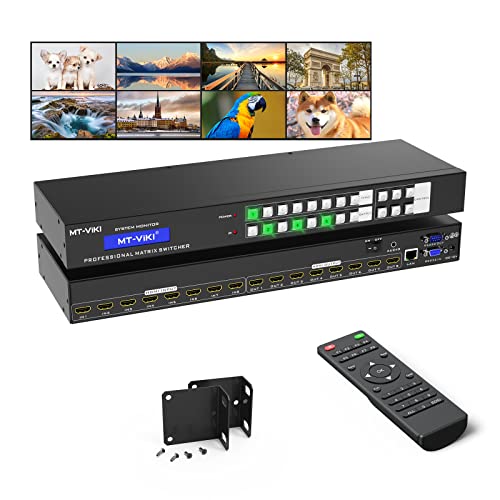
- Routes 8 sources to 8 displays
- Web, LAN, app, API, and RS-232 control
- Custom EDID and OUT8 audio extraction
Best For: Commercial AV systems and large multi-display installations
Best 4K60 Compact Pick
ENBUER 4x2 HDMI Matrix with Audio

- Supports 4K60, HDR, and HDCP 2.2
- Four inputs and two HDMI outputs
- Optical and 3.5mm audio extraction
Best For: Gaming and home theater setups with two displays
Best Mid-Size Rackmount Option

- Routes 4 sources to 4 displays
- Custom EDID and broad control support
- Fits a standard 1U 19-inch rack
Best For: Conference rooms and mid-size multi-display installations
Best 8K Upgrade
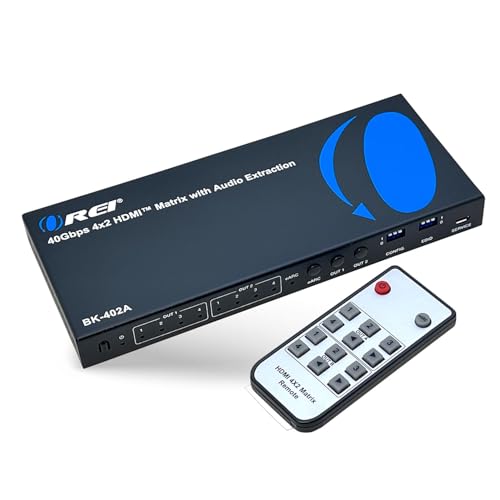
- 40Gbps HDMI 2.1 bandwidth
- Supports 8K@60Hz and 4K@120Hz
- eARC, optical, and 3.5mm audio outputs
Best For: Gaming and future-ready home theater systems
Best Mixed-Display Value
OREI 4x2 4K Matrix with Downscaler

- 18Gbps 4K@60Hz performance
- Converts 4K to 1080p for a second display
- ARC, optical, and 3.5mm audio outputs
Best For: Mixed 4K and 1080p display setups
Best Flexible 4K Routing

- 4K@60Hz with 18Gbps bandwidth
- HDR, Dolby Vision, and HDR10+ support
- EDID, ARC, audio extraction, and downscaling
Best For: Flexible 4K home theater and professional AV installations
Best Compact 2×2 Pick – OREI 2×2 4K HDMI Matrix
For shoppers comparing compact HDMI matrix switches, this OREI 2×2 model offers a practical balance of 4K performance, flexible routing, and audio extraction. Its two inputs and two outputs suit smaller home theater or monitor setups, while EDID management and IR remote control simplify switching.
Best For: Small home theater systems and users who need 4K60 routing with separate digital or analog audio.
Pros:
- Supports 4K at 60Hz, 18Gbps bandwidth, HDR, HDCP 2.2, and 4:4:4 color.
- Extracts digital and analog audio, including support for up to 7.1-channel formats.
- Includes EDID bypass, IR remote control, and a dual-voltage power supply with international adapter.
Cons:
- Only provides two HDMI inputs and two outputs.
- Will not extend PC monitors.
This is a strong compact choice when you want current 4K60 capabilities without the larger footprint of a 4×4 matrix. Confirm that two inputs and two outputs meet your system needs before buying.
Best Feature-Rich 4×4 – OREI 4×4 Matrix with ARC
This OREI model is a capable option among compact HDMI matrix switches for systems that need four sources and four displays. It combines 4K60 switching with HDR, ARC, and dedicated optical and 3.5mm audio outputs, making it suitable for more involved home or commercial AV installations.
Best For: Home theaters, conference rooms, classrooms, and multi-display installations requiring ARC and audio extraction.
Pros:
- Routes up to four HDMI sources independently to four displays.
- Supports 4K60, 18Gbps bandwidth, HDR, HDCP 2.2, and up to 12-bit color.
- Offers optical and 3.5mm audio extraction, plus ARC on output A.
- Metal enclosure supports durability and heat dissipation.
Cons:
- Its 4×4 configuration may be more than needed for a small setup.
- Requires an AC adapter and multiple HDMI connections for full use.
Choose this matrix when flexible four-source, four-display routing matters more than having the smallest possible switch. ARC and dual audio-output options add useful integration flexibility for compatible systems.
Best Value 4×2 – FERRISA 4×2 4K HDMI Matrix
This FERRISA unit gives buyers a straightforward way to connect four HDMI sources to two displays. As compact HDMI matrix switches go, it is geared toward practical switching and audio extraction, with an IR remote, optical output, and stereo output for compatible home theater or office equipment.
Best For: Budget-conscious users with four sources and two displays that share the same resolution.
Pros:
- Connects four HDMI sources to two HDMI displays.
- Supports 4K, 3D, 1080p, deep color, and HDMI 1.4b/HDCP 1.4.
- Provides optical and 3.5mm stereo audio extraction with EDID management.
- Includes IR remote switching and automatic equalization and amplification.
Cons:
- Both displays cannot show different resolutions at the same time.
- Does not support Dolby DD, DD+, or Dolby Vision according to the supplied notes.
- The listing notes that the power adapter is not included.
This model makes sense for a simpler 4K setup where HDMI 1.4-era compatibility is sufficient. Check your audio formats, display resolutions, and power-adapter requirements before ordering.
Best for Mixed-Resolution Displays – OREI 4×4 Downscaling Matrix
For larger systems using a mix of 4K and 1080p screens, this OREI matrix stands out among compact HDMI matrix switches because it can downscale 4K content to 1080p. It also supports independent or identical display content, 18Gbps bandwidth, HDR, and high-resolution multichannel audio.
Best For: Multi-screen systems that combine 4K and 1080p televisions, monitors, or projectors.
Pros:
- Connects four HDMI sources to four displays with independent or identical routing.
- Downscales 4K content to 1080p for mixed-resolution display systems.
- Supports 4K60, HDMI 2.0a, 18Gbps bandwidth, HDR, and HDCP 2.2.
- Handles up to 7.1-channel audio, including Dolby Digital and DTS-HD Master Audio.
Cons:
- Its 4×4 capacity may be unnecessary for smaller installations.
- Audio extraction outputs are not identified in the supplied notes.
The downscale function is the key reason to consider this model: it helps accommodate displays with different capabilities without limiting the entire system to 1080p. It is a particularly practical fit for multi-screen home theater or presentation setups.
Best for Large-Scale AV Routing – MT-VIKI 4K 8×8 HDMI Matrix
Among compact HDMI matrix switches, the MT-VIKI HD88L is designed for systems that need extensive source and display routing. It can send any of eight HDMI inputs to any of eight outputs independently or simultaneously, with web, LAN, RS-232, app, API, IR, and front-panel control.
Best For: Commercial AV distribution, conference rooms, churches, and large home theater systems with multiple sources and displays.
Pros:
- Routes eight sources to eight displays independently or simultaneously.
- Supports 4K x 2K at 30Hz, 1080p, 3D video, and deep color.
- Offers custom EDID writing and broad control options, including web, LAN, RS-232, app, and API.
- Includes rack ears and supports simultaneous 4K and 1080p output.
Cons:
- 4K support is limited to 30Hz.
- Audio extraction is available only through OUT8 and only when the source is assigned to that output.
- Stable transmission is specified for up to 30 feet on the input and each output.
This is the most capable option here for high-device-count installations, but its 8×8 capacity may be more than needed for a small setup. Check cable quality and the 30Hz 4K limitation before buying.
Best 4K60 Compact Pick – ENBUER 4×2 HDMI Matrix with Audio
This ENBUER 4×2 is a practical choice among compact HDMI matrix switches for connecting several modern sources to two displays. It supports 4K at 60Hz, HDR, HDMI 2.0b, HDCP 2.2, and audio extraction through both optical and 3.5mm outputs.
Best For: Home theaters, gaming setups, and small AV systems using consoles, streaming devices, projectors, or two monitors.
Pros:
- Connects four HDMI sources to two displays.
- Supports 4K at 60Hz, HDR, RGB 4:4:4, 18.5Gbps, and HDCP 2.2.
- Provides two optical and two 3.5mm audio outputs for LPCM, Dolby, and DTS 5.1-channel audio.
- Includes smart EDID management and an IR remote.
Cons:
- EDID settings apply to Output A, and the switch must be restarted after setting EDID.
- It has only two HDMI outputs, making it less suitable for larger distribution systems.
- The supplied dimensions are 8 x 4 x 2 inches, so it may require more shelf space than ultra-compact units.
For users who prioritize 4K60 and flexible audio over a high output count, this is the strongest fit in the group. Its EDID workflow requires a little setup, especially when using two displays with different capabilities.
Best Mid-Size Rackmount Option – MT-VIKI 4K 4×4 HDMI Matrix
The MT-VIKI MT-HD44L-DE balances routing capacity and installation control for buyers comparing compact HDMI matrix switches. Its 4×4 design can route four sources to four displays, while web, LAN, RS-232, app, API, IR, and front-panel controls support both local and integrated AV operation.
Best For: Conference rooms, retail displays, sports bars, churches, and home theaters needing four-source, four-display routing.
Pros:
- Routes four HDMI sources to four displays independently or simultaneously.
- Supports 4K x 2K at 30Hz, 1080p, 3D video, and deep color.
- Includes custom EDID writing and multiple control methods for system integration.
- Fits a standard 1U 19-inch rack and includes rack ears.
Cons:
- 4K output is limited to 30Hz.
- Audio extraction is available only through OUT4 when the desired source is routed there.
- Its rackmount dimensions may be less convenient for casual desktop use.
This model is a sensible middle ground for installations that need more outputs than a 4×2 switch but do not require the MT-VIKI 8×8 model. Choose it when rack integration and flexible control matter more than 4K60 support.
Best 8K Upgrade – OREI 4×2 HDMI 2.1 Matrix
For shoppers comparing compact HDMI matrix switches, this OREI 4×2 model is a high-bandwidth option for routing four HDMI sources to two displays. It supports HDMI 2.1 features, including up to 8K video, 4K at 120Hz, VRR, and ALLM.
Best For: Gaming and home theater setups that need 8K support, high refresh rates, and flexible audio extraction.
Pros:
- Supports up to 8K@60Hz and 4K@120Hz with 40Gbps bandwidth.
- Provides independent routing from four sources to two displays.
- Includes eARC support plus optical and 3.5mm audio outputs.
- Supports VRR, ALLM, FVA, and multiple Dolby and DTS audio formats.
Cons:
- eARC requires compatible eARC support from both the TV and soundbar.
- Its HDMI 2.1 capabilities may exceed the needs of basic 4K systems.
This is the most advanced option in the group for next-generation sources and displays. Its audio features and gaming support make it particularly versatile, while the 8K and 4K/120Hz specifications provide room for future upgrades.
Best Mixed-Display Value – OREI 4×2 4K Matrix with Downscaler
This compact HDMI matrix switch is designed for connecting four sources to two displays in a 4K system. Its 18Gbps HDMI 2.0 performance, HDR support, and built-in downscaler make it practical for setups using both 4K and 1080p screens.
Best For: Home theaters and AV setups that need 4K output on one display and 1080p compatibility on another.
Pros:
- Supports 4K@60Hz with YUV 4:4:4, HDR, and up to 12-bit deep color.
- Downscales 4K to 1080p for compatibility with older displays.
- Offers ARC, optical, and 3.5mm audio output options.
- Can be controlled with front-panel buttons or the included IR remote.
Cons:
- Uses HDMI 2.0 rather than HDMI 2.1.
- Its maximum listed video output is 4K@60Hz.
The downscaler is the standout feature here, allowing mixed-resolution displays without sacrificing the main 4K output. It is a sensible middle ground for users who want flexible switching and audio extraction without moving to an 8K-class matrix.
Best Flexible 4K Routing – OREI UHDS-402A HDMI Matrix
Among compact HDMI matrix switches, the OREI UHDS-402A offers dependable 4K switching with audio extraction, ARC, EDID controls, and mixed-resolution support. It routes four sources to two displays while maintaining up to 4K@60Hz on HDMI 2.0 connections.
Best For: Home theaters, classrooms, conference rooms, and installations using 4K and 1080p displays together.
Pros:
- Supports 4K@60Hz, 18Gbps bandwidth, and HDR formats including Dolby Vision and HDR10+.
- Provides independent switching for four inputs and two outputs.
- Offers optical SPDIF and analog L/R audio extraction with ARC.
- Includes EDID modes and 4K-to-1080p downscaling for compatibility.
Cons:
- Does not support 4K@120Hz, VRR, or ALLM.
- Stable 4K@60Hz performance requires suitable HDMI 2.0 or 2.1 cables under 30 feet.
This model is a strong fit when broad 4K compatibility matters more than HDMI 2.1 gaming features. Its EDID settings, downscaling, and multiple audio outputs give it useful flexibility for more varied AV systems.
How We Picked These Compact Hdmi Matrix Switches
We compared the selected models by looking at port capacity, supported resolutions, refresh rates, HDR and HDCP compatibility, audio features, control methods, and installation flexibility. We also considered practical features such as EDID management, downscaling, IR remotes, web control, and optical or analog audio outputs.
Because a matrix switch must work reliably with every connected source and display, compatibility mattered as much as headline resolution. A feature-rich model is not automatically the best choice if your system only needs two sources and two screens.
Quick Comparison
- 2×2 models: Best for small living rooms, offices, and simple dual-display systems.
- 4×2 models: A flexible choice when several sources feed one or two displays.
- 4×4 models: Better for distributing multiple sources independently across several screens.
- 8×8 models: Designed for larger installations, whole-home video distribution, or commercial use.
- Audio extraction models: Useful when sound must be sent to a soundbar, receiver, amplifier, or powered speakers separately from the display.
Key Buying Factors for Compact Hdmi Matrix Switches
Inputs and Outputs
Count both current devices and likely additions. Inputs connect sources such as game consoles, streaming players, Blu-ray players, and computers. Outputs connect TVs, projectors, receivers, or capture devices. A 4×2 switch can route any of four sources to either of two displays, while a 4×4 model offers more independent routing options.
Resolution, Refresh Rate, and HDR
For modern 4K gaming or smooth PC use, look for 4K at 60Hz and sufficient bandwidth. Check support for HDR formats and HDCP versions if you use protected streaming content. An 8K-rated model may be worthwhile for a new system, but only if the connected sources, displays, and cables support the required standards.
EDID and Downscaling
EDID management helps sources and displays agree on a compatible signal. Downscaling is especially valuable when one output supports 4K and another is limited to 1080p, reducing blank screens and handshake problems.
Audio Routing
Audio extraction, ARC, eARC, optical, and left/right analog outputs serve different systems. Confirm the output type your sound equipment accepts, and check whether the switch supports the audio formats you use.
Control and Installation
IR remotes are convenient for basic switching, while web control is better for equipment racks or integrated setups. Also verify included power supplies, ventilation needs, cable length, and whether the unit will fit your shelf or mounting location.
Who Should Buy Which Compact Hdmi Matrix Switches?
Choose a 2×2 model if you need simple source sharing between two displays. Pick a 4×2 switch for a home theater with several sources and one primary TV or projector. A 4×4 model is better when multiple rooms or displays need independent access to several sources. For larger distributed-video systems, an 8×8 unit provides the necessary capacity and centralized control.
Buy a model with audio extraction if your display does not provide the connections you need for external sound. Choose ARC or eARC support when your television and audio system are built around HDMI return audio. If your setup mixes 4K and 1080p displays, prioritize EDID controls and downscaling over simply choosing the highest advertised resolution.