
Choosing among 4K HDMI converters is easier when you first identify the signal, resolution, and output your setup actually needs. Some models convert HDMI to component video, while others connect DisplayPort devices, extract audio, or distribute one source to multiple displays.
This roundup focuses on practical compatibility details, including refresh rates, HDCP support, audio outputs, cable direction, and installation limits, so you can choose a converter that works with your specific equipment rather than relying on the 4K label alone.
Best 10 4K Hdmi Converters Picks for 2026
Best Analog TV Upgrade
4K HDMI to Component Converter

- Accepts HDMI input up to 4K/60Hz
- Scales to multiple component resolutions
- Adds YPbPr video and stereo audio output
Best For: Older TVs and projectors with component inputs
Best Compact DP Adapter

- Converts DisplayPort output to HDMI input
- Supports 4K at 30Hz
- Latching plug and 18-month warranty
Best For: Portable computer-to-HDMI display connections
Best Long-Warranty DP Adapter

- Supports 4K/30Hz and 1440p/60Hz
- Passes multichannel digital audio
- Includes five-year warranty and latching plug
Best For: Durable desktop and laptop display connections
Best Audio Extractor

- 4K 50/60Hz pass-through with HDR
- Optical and 3.5mm audio outputs
- Supports Dolby and DTS formats
Best For: Separating HDMI audio for home theater systems
Best DisplayPort Cable
4K DisplayPort to HDMI Adapter

- Supports 4K at 30Hz
- Carries multichannel digital audio
- Braided cable with 18-month warranty
Best For: Connecting a DisplayPort computer to an HDMI display
Best Multi-Display Extender
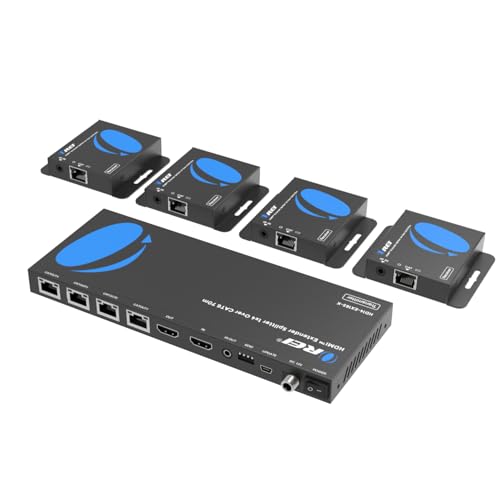
- Sends one source to four displays
- Uses Cat6/6a/7 cabling up to 165 feet
- Includes IR pass-back and local loop-out
Best For: Distributing HDMI video across meeting rooms and venues
Best Heavy-Duty Pick

- Optical and 3.5mm audio outputs
- Supports 2.0, 5.1, and pass modes
- Up to 4K at 30Hz video support
Best For: HDMI systems requiring separate audio output
Best High-Refresh Pick
8K60 DisplayPort to HDMI 2.1 Adapter

- Up to 8K at 60Hz
- 4K support up to 240Hz
- HDR and eARC compatibility
Best For: High-refresh gaming and multimedia from DisplayPort PCs
Best Analog TV Upgrade – 4K HDMI to Component Converter
If you need 4k hdmi converters for an older television or projector, this model converts an HDMI source into analog YPbPr component video with stereo audio. It accepts signals up to 4K/60Hz and includes scaling controls for choosing a compatible component output resolution.
Best For: Connecting modern HDMI devices such as game consoles, Blu-ray players, streaming sticks, or PCs to televisions and projectors with component inputs.
Pros:
- Supports HDMI input up to 4K/60Hz.
- Offers 480i and 576i component output among multiple resolutions.
- Built-in scaling, five zoom modes, and on-screen resolution display improve setup flexibility.
- Provides separate YPbPr video and left/right stereo audio output.
Cons:
- It converts HDMI to component rather than component to HDMI.
- Output is analog component video, so it is intended for displays with compatible inputs.
This is the most suitable choice here for preserving the usefulness of an older component-equipped display. Its scaling function is especially helpful when the HDMI source resolution exceeds what the television or projector can accept.
Best Compact DP Adapter – BENFEI 4K DisplayPort to HDMI
For computer users comparing 4k hdmi converters, this compact BENFEI adapter converts a DisplayPort output to an HDMI display input. It supports up to 3840×2160 at 30Hz and includes a latching connector for a more secure connection during presentations or everyday desktop use.
Best For: Connecting a DisplayPort computer or laptop to an HDMI monitor, projector, or TV.
Pros:
- Supports 4K resolution at up to 30Hz and 1080p at 60Hz.
- Compact, lightweight design fits easily in a pocket or laptop bag.
- Gold-plated connectors help resist corrosion and abrasion.
- Includes a latching DisplayPort connector and an 18-month warranty.
Cons:
- It is uni-directional and cannot convert HDMI output to DisplayPort input.
- 4K operation is limited to 30Hz.
- It is an adapter rather than a multi-input converter or switch.
This is a straightforward option when the source is a DisplayPort-equipped computer and the display uses HDMI. Confirm the direction and the display’s desired refresh rate before buying, particularly for 4K desktop use.
Best Audio Extraction Option – 4K HDMI ARC Audio Extractor
This avedio links unit stands out among 4k hdmi converters when the main goal is separating audio from a 4K HDMI signal. It passes video to an HDMI display while providing optical Toslink and 3.5mm stereo outputs, with selectable pass-through, 2-channel, and 5.1-channel audio modes.
Best For: Adding a soundbar, amplifier, headphones, or other external audio equipment to an HDMI setup, including compatible ARC/eARC television connections.
Pros:
- Supports HDMI video up to 4K/60Hz with HDCP 2.2.
- Provides HDMI output plus optical and 3.5mm audio outputs.
- Offers pass, 2CH, and 5.1CH audio mode settings.
- Works with sources including consoles, streaming devices, Blu-ray players, PCs, and cable boxes.
Cons:
- It does not support Dolby Digital Plus or CEC.
- Optical and 3.5mm outputs cannot both provide audio unless the source is set to PCM/stereo.
- ARC functionality applies to compatible ARC/eARC television interfaces.
This is a practical pick for upgrading audio without replacing an existing HDMI display. Its output choices cover both digital optical systems and basic analog headphones or speakers, though audio-format settings require attention.
Best Long-Warranty DP Adapter – Moread 4K DisplayPort to HDMI
If you are searching for 4k hdmi converters for a desktop, laptop, or graphics card, this Moread adapter provides a compact DisplayPort-to-HDMI connection. It supports 4K at 30Hz, 1440p at 60Hz, and 1080p at up to 120Hz, while its reinforced housing is designed for repeated use.
Best For: Extending or mirroring a DisplayPort computer to an HDMI monitor, TV, projector, or compatible VR headset.
Pros:
- Supports 4K/30Hz, 2K/60Hz, and 1080p/120Hz video modes.
- Passes uncompressed 7.1, 5.1, or 2-channel audio.
- Latching DisplayPort connector helps prevent accidental disconnection.
- Reinforced construction and a five-year warranty support long-term use.
Cons:
- It is uni-directional and cannot connect an HDMI source to a DisplayPort monitor.
- It is passive and requires a DisplayPort dual-mode source, such as a compatible docking station or hub.
- 4K refresh rate is limited to 30Hz.
Choose this adapter when durability and warranty coverage matter for a recurring DisplayPort-to-HDMI setup. Its higher refresh support at 1080p and 1440p is useful for everyday work and entertainment, but verify source compatibility first.
Best Audio Extractor – 4K HDMI Audio Converter
If you need 4k hdmi converters for separating sound from a compatible HDMI source, the OREI HDA-912 combines 4K video pass-through with optical and 3.5mm stereo outputs. It supports up to 4K at 50/60Hz, HDR pass-through, HDCP 2.2, and several Dolby and DTS formats, making it a practical fit for home theater setups.
Best For: Extracting HDMI audio for optical or stereo home theater equipment.
Pros:
- Passes through up to 4K at 50/60Hz with 18Gbps bandwidth and HDR support.
- Supports optical and 3.5mm audio outputs, including Dolby Digital and DTS formats.
- Offers broad compatibility with devices such as PS5, Xbox, Blu-ray players, and streaming sticks.
- Metal housing, CEC bypass, and a one-year warranty add practical convenience.
Cons:
- Does not support ARC.
- Not compatible with several modes, including 1440p at 120Hz, 4K at 30Hz, and 1080p at 120Hz.
- Uses a US-plug power supply, though an international adapter is included.
This is a strong choice when audio extraction matters more than advanced gaming refresh rates. Confirm your source and display formats before buying, particularly if you need 120Hz support or ARC.
Best DisplayPort Cable – 4K DisplayPort to HDMI Adapter
For connecting a DisplayPort computer to an HDMI display, the BENFEI adapter cable is a straightforward option among 4k hdmi converters. It supports up to 3840×2160 at 30Hz, passes through multichannel digital audio, and uses a durable braided cable with a latches-free connector.
Best For: Connecting a DisplayPort-equipped computer to an HDMI monitor or display.
Pros:
- Supports 4K resolution at 30Hz and 1080p at 60Hz.
- Passes uncompressed 7.1, 5.1, and 2-channel digital audio.
- Braided nylon cable, aluminum housing, and gold-plated contacts support durability.
- Includes an 18-month unconditional warranty.
Cons:
- Uni-directional: it converts DisplayPort to HDMI, not HDMI to DisplayPort.
- Maximum listed 4K refresh rate is 30Hz.
- It is a DisplayPort cable, not a USB adapter.
This cable is best for a simple, direct connection from a compatible computer to an HDMI display. Check the direction and the display’s supported refresh rate before purchase.
Best Multi-Display Extender – 1×4 HDMI over Cat6
When a single HDMI source needs to reach several screens, the OREI HD14-EX165-K offers a distribution-focused approach to 4k hdmi converters. It sends one source to four remote displays over Cat6, includes a local HDMI loop-out, and supports power over cable for the receivers.
Best For: Meeting rooms, exhibits, bars, and other multi-display installations.
Pros:
- Distributes one HDMI source to four displays over Cat6, Cat6a, or Cat7 cable.
- Supports 4K at 30Hz over distances up to 165 feet according to the supplied specifications.
- Includes a local HDMI output, IR pass-back, EDID, and one-way plug-and-play setup.
- Only one power adapter is required because the receivers support power over cable.
Cons:
- The highest listed resolution in the specifications is 1920×1080 at 60Hz, so 4K compatibility should be verified for the full installation.
- Requires Cat6-class network cabling between the transmitter and receivers.
- It is designed for one-way distribution rather than switching multiple sources.
This extender makes sense for installations that need the same HDMI content on several remote screens. Because the supplied specifications list both 4K at 30Hz and 1080p at 60Hz, verify the desired resolution and cable distance before deploying it.
Best 4K DisplayPort Pick – 4K60 DisplayPort to HDMI Adapter
For shoppers comparing 4k hdmi converters, this active DisplayPort-to-HDMI adapter is a practical choice for connecting a DisplayPort computer or graphics card to an HDMI monitor, TV, or projector. It supports 4K at 60Hz without requiring drivers or external power, but it works in only one direction.
Best For: Office setups, home entertainment, and secondary HDMI displays connected to DisplayPort desktops, laptops, or graphics cards.
Pros:
- Supports 4K at 60Hz along with several lower-resolution, high-refresh modes.
- Plug-and-play active conversion requires no driver installation or external power.
- Compact, durable build with an aluminum shell, gold-plated connector, and braided shielding.
Cons:
- Unidirectional: it cannot convert HDMI to DisplayPort.
- Not compatible with Mini DisplayPort, USB ports, macOS, hubs, docking stations, or game consoles.
- Requires a DisplayPort source capable of the required bandwidth for 4K at 60Hz.
This is a focused 4K converter for standard DisplayPort-source setups. Confirm your source has DisplayPort output and check the compatibility exclusions before buying.
Best Heavy-Duty Pick – 4K HDMI Audio Extractor
Among 4k hdmi converters, this model is designed for a different job: extracting audio from an HDMI source while passing video to a display. It provides optical and 3.5mm outputs, supports up to 4K at 30Hz through HDMI 1.4, and needs USB power.
Best For: HDMI setups that need separate optical or 3.5mm stereo audio for a receiver, speakers, or headphones.
Pros:
- Offers optical and 3.5mm audio outputs from an HDMI signal.
- Includes 2.0-channel, 5.1-channel, and pass-through modes.
- Supports up to 4K at 30Hz and HDCP 1.4 with up to 10.2Gbps bandwidth.
- Works with sources such as Blu-ray players, PCs, cable boxes, and consoles.
Cons:
- Does not support ARC or eARC, and a TV cannot be used as the input source.
- Does not support 7.1-channel audio.
- Some listed sources, including Fire TV, Apple TV, and PS4/PS5, are limited to 1080p according to the notes.
This is best viewed as an audio-routing accessory rather than a high-refresh 4K video upgrade. Choose it when separate optical or analog audio is the main requirement.
Best High-Refresh Pick – 8K60 DisplayPort to HDMI 2.1 Adapter
For buyers seeking versatile 4k hdmi converters with extra headroom, this active DisplayPort 1.4-to-HDMI 2.1 adapter supports up to 8K at 60Hz and 4K at up to 240Hz. It is a one-way, plug-and-play solution for DisplayPort computers and graphics cards connecting to HDMI displays.
Best For: High-refresh gaming, HDR-capable multimedia, and DisplayPort PCs connected to HDMI 2.1 monitors, TVs, projectors, or VR displays.
Pros:
- Supports 8K at 60Hz and 4K at up to 240Hz, with additional high-refresh modes.
- Provides up to 32.4Gbps bandwidth without drivers or external power.
- Supports HDR, eARC, and various surround sound formats.
- Durable aluminum construction, gold-plated connectors, and braided shielding.
Cons:
- Unidirectional: HDMI sources cannot be converted to DisplayPort displays.
- Not compatible with Mini DisplayPort, USB ports, macOS, hubs, docking stations, or major game consoles.
- Actual resolution and refresh rate depend on the source, display, and connection capabilities.
This is the strongest option here for demanding refresh rates and newer HDMI displays, provided your source device has a suitable DisplayPort output. Verify compatibility before using it with a Mac, dock, or console.
How We Picked These 4K Hdmi Converters
We selected products across the main converter categories represented in this roundup: HDMI-to-component scaling, DisplayPort-to-HDMI connectivity, HDMI audio extraction, and HDMI signal distribution. We prioritized clearly stated resolution and refresh-rate support, useful output options, directional compatibility, HDCP handling, and installation features such as EDID, ARC/eARC support, IR control, and power over cable.
Because “4K” does not guarantee universal compatibility, we also considered whether each product’s specifications make its intended use clear. A converter should match both the source device and the display or audio equipment receiving the signal.
Quick Comparison
- For legacy component displays: Choose an HDMI-to-YPbPr converter with scaling and explicit 480i/576i output support.
- For computers with DisplayPort: Use a unidirectional DisplayPort-to-HDMI adapter, checking whether you need 4K at 30Hz, 60Hz, or higher.
- For optical or analog audio: Choose an HDMI audio extractor with Toslink, 3.5mm, ARC/eARC, or the combination your system requires.
- For multiple displays: Use an HDMI splitter or extender, and verify its maximum distance, refresh rate, EDID options, and power requirements.
- For newer high-refresh setups: Consider an active DisplayPort 1.4-to-HDMI 2.1 adapter, but confirm the source’s DisplayPort version and the target display’s HDMI capabilities.
Key Buying Factors for 4K Hdmi Converters
Signal Direction and Connector Type
Check which port is the input and which is the output. DisplayPort-to-HDMI adapters are commonly unidirectional and will not convert HDMI back to DisplayPort. Also distinguish a male-to-female adapter from a complete cable, especially when planning cable length and strain relief.
Resolution and Refresh Rate
Look beyond the phrase “4K.” A device rated for 4K at 30Hz may be unsuitable for gaming, desktop work, or smooth video. For responsive 4K use, verify 4K at 60Hz support; for newer equipment, check whether HDMI 2.1 or 8K specifications are relevant. The source, converter, cable, and display must all support the desired mode.
Audio Compatibility
Audio extractors vary considerably. Confirm whether you need optical Toslink, 3.5mm stereo, ARC/eARC, PCM, Dolby, DTS, or multichannel pass-through. Some systems require manually selecting a compatible output format in the source device to prevent silence or dropouts.
HDCP, Power, and Distance
HDCP 2.2 support can matter when using protected 4K streaming content. For splitters and extenders, review maximum cable distance, supported refresh rate at that distance, IR features, EDID behavior, and whether the unit needs external power.
Who Should Buy Which 4K Hdmi Converters?
Buy an HDMI-to-component converter if you are preserving an older projector, receiver, or television with YPbPr inputs. Choose a basic DisplayPort-to-HDMI adapter for a computer or dock connecting to a standard HDMI monitor, while selecting a 4K/60Hz or active HDMI 2.1 model for higher-performance displays.
An HDMI audio extractor is the better fit when a television or source lacks the audio output needed by a soundbar, amplifier, headphones, or powered speakers. Choose an ARC/eARC model when the TV is central to the system. For presentations, signage, or multi-room viewing, an HDMI splitter extender offers broader distribution, but it requires the most careful checking of distance, resolution, and display compatibility.