
Schools often need to prepare identical USB drives for software installs, instructional materials, testing environments, recovery tools, or media distribution. The right duplicator can reduce repetitive setup work while helping staff maintain consistent, usable copies.
This roundup compares 10 standalone USB duplicators across different target counts, speeds, interfaces, and erasure features, so IT teams can choose equipment that fits their workflow and budget.
Best 10 USB Duplicators for Schools Picks for 2026
Best Portable Pick
- Standalone operation with no computer
- Duplicates up to four USB drives
- Compact design with asynchronous copying
Best For: Portable classroom and small-team duplication
Best High-Volume Pick

- Handles up to 15 target drives
- Bit-by-bit standalone duplication
- Offers synchronous and asynchronous modes
Best For: Large school or district-wide drive batches
Best Sanitizing Pick

- Copies and erases up to seven drives
- Includes copy-and-compare verification
- Supports overwrite and sector-copy modes
Best For: IT teams needing duplication and drive sanitization
Best Mid-Size Workhorse

- Duplicates up to seven USB drives
- Standalone bit-by-bit copying
- Supports synchronous and asynchronous modes
Best For: Medium-volume school technology offices
Best All-Rounder

- Duplicates up to 15 drives without a computer
- Includes erase, sector-copy, and verification modes
- LCD monitoring and 2-year warranty
Best For: School IT teams with varied USB duplication and sanitization needs
Best for Flexible Copy Modes

- Supports flash drives and USB external HDDs
- Offers four copy and four erase modes
- Standalone operation with independent channel bandwidth
Best For: Schools managing varied USB media and transfer requirements
Best 7-Target Option
- Copies to seven USB targets without a PC
- Supports USB 1.0, 2.0, and 3.0 devices
- Includes source prescan and secure erase
Best For: Schools with moderate-volume USB preparation and mixed device generations
Best Touchscreen Pick
EZ Dupe SOHO Touch 1-to-10 USB Duplicator
- Touchscreen controls for copy, compare, format, and erase
- Duplicates at up to 35MB per second
- Supports USB 2.0, 3.0, and 3.1 flash media
Best For: Schools wanting simple, guided USB duplication
Best Heavy-Duty Pick
Vinpower USBDBL 15-Target Duplicator

- Copies to 15 USB drives without a PC
- Independent asynchronous duplication
- Includes Smart Copy, Raw Mode, and Secure Erase
Best For: Schools preparing large batches of USB drives
Best Compact Choice
StarTech 1-to-5 USB Duplicator and Eraser

- Standalone copying and erasing for up to five drives
- LCD monitoring with Copy & Compare verification
- Supports multiple copy modes and overwrite options
Best For: School IT teams needing a portable five-drive unit
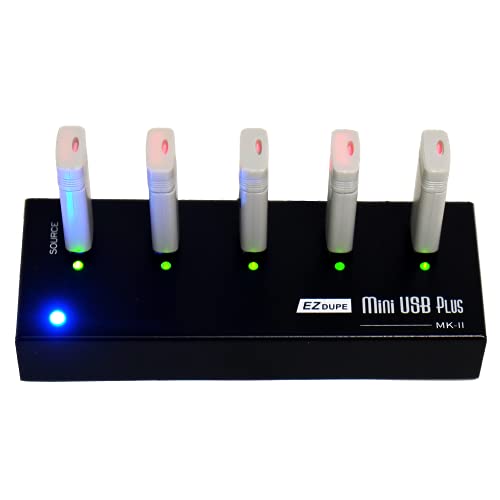
Best Portable Pick – EZ Dupe Mini USB Plus MK II
For schools that need USB duplicators for schools without dedicating a computer, the EZ Dupe Mini USB Plus MK II offers a compact standalone option. It copies to up to four USB drives simultaneously and supports USB 1.0, 2.0, and 3.0 media.
Best For: Classrooms, small IT teams, and schools that need portable four-drive duplication.
Pros:
- Standalone plug-and-use operation requires no computer.
- Copies to up to four USB drives at once.
- Supports asynchronous copying and drives above 2TB.
- Can use a power bank or USB power source.
Cons:
- Its four-drive capacity is lower than larger desktop models.
- External USB devices with their own power source need outlet power.
With a listed speed of up to 2.5GB per minute, this model is a practical choice when portability and moderate batch sizes matter more than maximum output.
Best High-Volume Pick – Systor 1 to 15 USB Duplicator
Schools preparing larger batches of USB drives may benefit from the Systor 1 to 15 USB Duplicator. Its 15-drive capacity and standalone design are suited to recurring distribution tasks without requiring a computer or software.
Best For: District IT departments and schools duplicating many drives per batch.
Pros:
- Supports up to 15 target USB drives.
- Standalone operation needs no computer or software.
- Performs bit-by-bit copying from the source drive.
- Supports synchronous and asynchronous copy modes.
Cons:
- Its listed transfer rate is up to 2GB per minute, slower than the compact EZ Dupe’s stated maximum.
- USB Type-C drives require an adapter.
The large target capacity makes this a strong fit for school-wide deployments, while the selectable copy modes provide flexibility for different workflows.
Best Sanitizing Pick – StarTech 1:7 USB Duplicator
The StarTech 1:7 USB Flash Drive Duplicator is a versatile choice for schools that need to copy, verify, and erase USB media. It works independently of a computer and includes LCD monitoring plus multiple erase options.
Best For: School IT staff managing boot drives, secure reuse, and copy verification.
Pros:
- Duplicates and erases up to seven USB drives.
- Supports file, sector-by-sector, and multiple overwrite modes.
- Copy-and-compare can verify cloned drives against the source.
- LCD and LED indicators show drive activity and errors.
Cons:
- Its listed copy speed is up to 1.5GB per minute.
- Asynchronous copying is limited to source content under 128MB.
- It has fewer target ports than the 15-drive Systor model.
This model stands out when sanitizing and verification are as important as duplication, though its lower speed and seven-port capacity may not suit the largest deployments.
Best Mid-Size Workhorse – Systor 1 to 7 USB Duplicator
For schools that need more capacity than a four-port portable unit but do not require a 15-port tower, the Systor 1 to 7 USB Duplicator provides a balanced standalone setup. It supports bit-by-bit copying and both synchronous and asynchronous modes.
Best For: School technology offices handling regular medium-sized USB distributions.
Pros:
- Duplicates up to seven USB drives in one batch.
- Requires no computer or software.
- Copies at speeds up to 2GB per minute.
- Supports USB 1.1, 2.0, and 3.0 flash drives.
Cons:
- USB Type-C drives require an adapter.
- It has fewer target ports than the 15-drive Systor model.
- The unit weighs 10 pounds, limiting portability.
This is a sensible middle-ground option for schools that want repeatable batch duplication and a desktop form factor without moving up to a 15-target system.
Best All-Rounder – StarTech 1:15 USB Duplicator
For schools managing classroom installers, boot drives, or shared USB media, this StarTech unit is a practical choice among USB duplicators for schools. It works without a computer and can duplicate up to 15 USB devices simultaneously, while its LCD and verification features make routine IT tasks easier to monitor.
Best For: School IT teams that need high-volume USB duplication, drive wiping, and copy verification.
Pros:
- Duplicates or erases up to 15 USB drives without a computer.
- Supports USB 3.0 and 2.0 media, external USB storage, and multiple file systems.
- Offers sector-by-sector copying, quick erase, overwrite options, and Copy & Compare verification.
- Asynchronous copying allows finished drives to be replaced without interrupting the process when source content is under 128 MB.
Cons:
- The listed 1.5 GB/min speed may be slower than some newer dedicated systems.
- External USB devices may need their own power source.
- Asynchronous mode is limited to source content under 128 MB.
With its broad format support, erasing tools, LCD status display, and 2-year warranty, the StarTech is a flexible fit for school technology departments handling varied USB workflows.
Best for Flexible Copy Modes – EZ DUPE USB Cyclone 1:15
The EZ DUPE USB Cyclone is designed for schools that need to copy different types of media and choose how much data to transfer. As one of the USB duplicators for schools with multiple copy and erase modes, it supports flash drives and USB external hard drives in a standalone design.
Best For: School technology departments that need flexible copying, formatting, and secure-erasure options across USB media.
Pros:
- Supports USB 1.0 through 3.1 flash memory and USB external HDDs.
- Provides four copy modes, including essential files, full, partitioned, and percentage copying.
- Offers quick, full, DoD 3-pass, and DoD 7-pass erase modes.
- Independent bandwidth design helps preserve speed across channels, with automatic alerts for slow drives.
Cons:
- Its listed transfer speed is up to 45 MB/s, depending on the USB device.
- The unit weighs 7 pounds, making it less portable than smaller duplicators.
- It carries a 1-year manufacturer warranty.
Its broad capacity and file-format support, combined with configurable copy and erase methods, make the USB Cyclone a useful option when a school’s media-management needs vary from project to project.
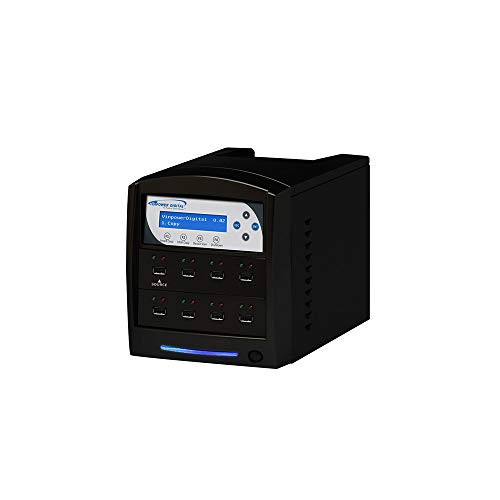
Best 7-Target Option – Vinpower Digital USBShark
Vinpower Digital USBShark Standalone USB Flash Drive Duplicator - 7 Targets (High Speed)
Check Price On AmazonSchools that usually need smaller duplication runs may prefer the Vinpower Digital USBShark. This standalone unit copies to seven USB targets, supports USB 1.0, 2.0, and 3.0 devices, and includes source scanning and secure-erasure features for routine campus IT work.
Best For: Schools needing a seven-target duplicator for mixed-generation USB devices and repeatable media preparation.
Pros:
- Operates independently without a PC.
- Supports USB 3.0, 2.0, and 1.0 devices and all data formats with bit-by-bit duplication.
- Smart Copy quickly copies accessible source content.
- Prescan checks for physical reading errors, while Secure Erase is intended to prevent data recovery.
Cons:
- With seven targets, it has lower simultaneous capacity than 15-target alternatives.
- The unit weighs 10 pounds.
- No warranty is specified in the supplied details.
The USBShark is a straightforward fit for schools that value broad compatibility and source-media checking but do not need a 15-target production capacity.
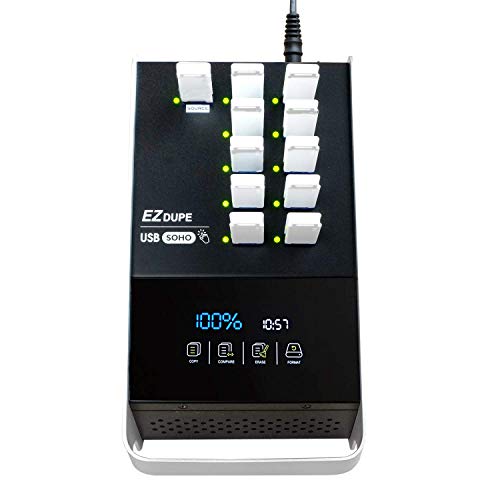
Best Touchscreen Pick – EZ Dupe SOHO Touch 1-to-10 USB Duplicator
For schools looking for usb duplicators for schools that are simple to operate, the EZ Dupe SOHO Touch combines a touchscreen menu with copy, compare, format, and erase functions. Its 1-to-10 design can support routine classroom, lab, or IT workflows without requiring a separate computer.
Best For: Schools that prioritize straightforward controls and frequent USB duplication or erasure.
Pros:
- Touchscreen interface simplifies copy, compare, format, and erase tasks.
- Duplicates USB flash media at up to 35MB per second.
- Supports USB 2.0, 3.0, and 3.1 media, with broad file-format and capacity support.
- Built for daily operation with a lightweight, ergonomic design.
Cons:
- Designed for USB flash media rather than the broader range of formats supported by some larger duplicators.
- Its listed capacity and performance may be more than needed for occasional, small-scale use.
The touchscreen and dedicated functions make this a practical choice when different staff members need to duplicate or sanitize drives with minimal training. A one-year manufacturer warranty is included.
Best Heavy-Duty Pick – Vinpower USBDBL 15-Target Duplicator
For schools that need to prepare many drives at once, the Vinpower USBDBL provides 15 target slots and operates as a standalone unit. Its asynchronous duplication system lets target drives copy independently, while Smart Copy and Raw Mode accommodate different duplication needs.
Best For: District IT teams, media labs, and schools distributing large batches of USB drives.
Pros:
- Copies to up to 15 USB drives without requiring a PC.
- Asynchronous duplication allows target drives to copy independently.
- Smart Copy and Raw Mode support quick accessible-content copying or bit-by-bit duplication.
- Secure Erase is designed to prevent recovery of erased content.
Cons:
- At 11 pounds, it is less convenient to move between classrooms or offices.
- Additional interface adaptor modules are needed for SD, microSD, CF, and other alternative flash formats.
- The 15-target capacity may be excessive for smaller schools with occasional duplication needs.
This is the strongest fit when throughput matters more than portability. Standalone operation also makes it easier to set up in an IT workspace, and the unit includes a one-year warranty.
Best Compact Choice – StarTech 1-to-5 USB Duplicator and Eraser
The StarTech 1-to-5 standalone duplicator is a practical option for schools that need routine USB cloning, drive wiping, and verification without connecting a computer. Its LCD menu, status indicators, and support for several copy and erase modes make it useful for school IT technicians.
Best For: Schools needing a smaller five-target unit for boot-drive preparation, sharing files, or sanitizing USB media.
Pros:
- Standalone operation duplicates or erases up to five USB drives at a time.
- Supports system-and-file copying and sector-by-sector copying across multiple formats.
- Offers Quick Erase, single-pass, and three-pass overwrite options.
- LCD monitoring, error scanning, and Copy & Compare help verify results.
Cons:
- Its five-target capacity is lower than larger multi-drive duplicators.
- Asynchronous copying is limited to source content under 64MB.
- External USB devices may require their own power source.
With a compact 6.6-by-4.7-by-1-inch form factor and a two-year warranty, this model balances basic batch capacity with portability. It is especially useful when erasure standards and post-copy verification are important.
How We Picked the Best USB Duplicators for Schools
We focused on standalone duplicators that can copy USB media without requiring a computer for every batch. Selection criteria included the number of simultaneous target drives, advertised transfer speed, support for common USB formats and generations, display or menu usability, and built-in verification or erasure functions.
For school environments, we also considered practical deployment factors: whether the unit is portable, how easily staff can repeat a standardized process, and whether its capacity matches occasional classroom use or larger district-wide rollouts. A higher target count is not automatically better if the device will be used only for small batches or stored between projects.
Quick Comparison
These products generally fall into three useful groups. Compact one-to-four and one-to-five models suit teachers, labs, and small IT departments that create limited batches. Seven- and 10-target units provide a balance between throughput and manageable size. Fifteen-target duplicators are better suited to district IT teams, testing departments, and recurring deployments where many drives must be prepared at once.
Speed ratings also need context. A duplicator’s advertised rate can depend on the source drive, target-drive performance, file sizes, USB generation, and the number of active targets. When comparing models, treat the rated speed as a useful benchmark rather than a guaranteed classroom result.
Key Buying Factors for USB Duplicators for Schools
Target Count and Workload
Estimate how many drives staff typically need per session. More targets can shorten large production runs, but smaller units may cost less, take up less storage space, and be easier to move between classrooms.
Drive Compatibility
Check support for the USB drive types your school already buys. Confirm whether the duplicator handles the capacities, connectors, and USB standards required for current flash media. Mixing very different target drives can affect performance or cause compatibility issues.
Copy Verification and Sanitization
Verification helps confirm that files copied correctly before drives are distributed. Sanitization or erasure modes are valuable when drives are reused for exams, student projects, recovery media, or sensitive administrative files. Review the available erase methods and ensure they match your data-handling policy.
Ease of Operation
LCDs, touchscreens, clear menus, and standalone operation can reduce training time. This matters when multiple staff members share the equipment or when teachers need to perform routine duplication without advanced technical support.
Portability and Support
A compact unit may be preferable for schools that share equipment across buildings. For permanent IT workstations, prioritize sturdy construction, accessible ports, warranty coverage, and vendor support over portability alone.
Who Should Buy Which USB Duplicators for Schools?
Choose a compact model for occasional batches, teacher-created resources, or a small computer lab. A seven- or 10-target duplicator is a strong middle ground for schools that regularly prepare several classes’ worth of drives. District IT departments and testing teams should consider 15-target models when high-volume duplication is routine.
If reused media may contain confidential information, prioritize a model with dedicated sanitization or erasure features. If the main goal is simple distribution of identical instructional files, prioritize dependable copying, verification, and straightforward controls. Before purchasing, test the preferred duplicator with the exact USB drives and file images your school plans to use.