
The right lighting controller can make a mobile DJ setup look polished without adding unnecessary complexity. Whether you run a few LED fixtures at private parties or coordinate multiple moving lights, the best controller should match your fixture count, programming style, and travel needs.
Our roundup covers ten practical options, including standalone touchscreen controllers, wireless app-based systems, MIDI-capable consoles, and straightforward DMX boards for budget-conscious setups.
Best 10 Dmx Controllers for Mobile Djs Picks for 2026
Best Protected Pro Setup

- Standalone control with touchscreen and physical controls
- Two universes, four outputs, and extensive fixture support
- Decksaver cover and Magma case included
Best For: Mobile DJs running larger, mixed-brand lighting rigs
Best Simple RGB Controller

- Compact DMX controller for three-channel LED fixtures
- Automated, sound-activated, and manual RGB modes
- Adjustable fade, dimmer, audio, and strobe controls
Best For: Mobile DJs with a small, compatible RGB LED setup
Best App-Based Control

- Tablet-based control over Wi-Fi or USB
- 15,000-plus fixture profiles and two-universe support
- Presets and automatic effects reduce programming demands
Best For: Mobile DJs who prefer lightweight tablet-based lighting control
Best Scene-and-Chase Console

- 384 DMX channels for up to 12 intelligent lights
- Stores up to 240 scenes in 30 banks
- Six programmable chases with per-step timing
Best For: DJs who prefer structured scenes and chase playback
Compact 384-Channel Pick

- Controls up to 24 fixtures at 16 channels each
- Stores 30 banks of eight programmable scenes
- Compact housing with LED gooseneck light
Best For: Mobile DJs needing high channel capacity and programmed scenes
MIDI-Ready Show Controller

- Controls up to 24 intelligent lights
- Stores 240 scenes and six programmable chases
- Adds MIDI and built-in microphone operation
Best For: Mobile DJs wanting programmable shows with MIDI and music mode
Beginner-Friendly 192-Channel Pick

- Controls up to 12 intelligent lights
- Supports up to 240 scenes with 40 steps per scene
- Includes voice control and 3-pin DMX output
Best For: Beginners and mobile DJs with smaller lighting rigs
Flexible Show Control

- Controls up to 12 fixtures and 240 scenes
- Three-pin connectivity for compatible stage equipment
- Voice control and hands-on sliders
Best For: Mobile DJs running multi-fixture lighting shows
Beginner-Friendly Programming
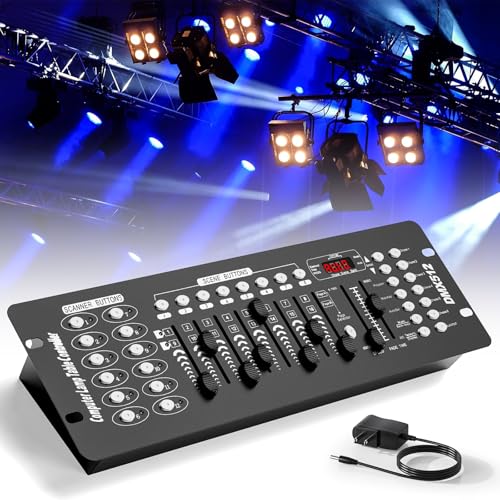
- 192 channels for up to 12 devices
- Eight sliders for manual channel control
- Includes programmable scenes and chases
Best For: Beginners and mobile DJs with small lighting rigs
Hands-On Chase Programming
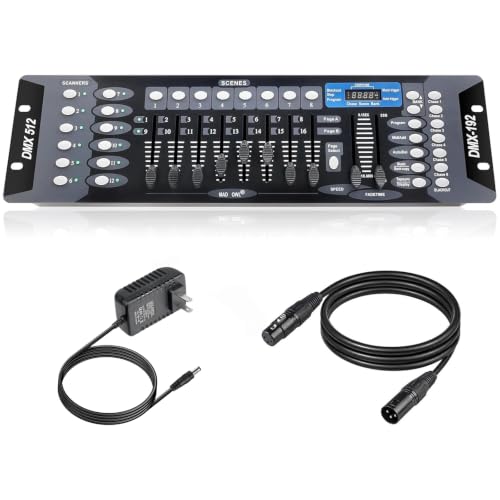
- Controls 12 fixtures with up to 16 channels each
- Stores 240-step scenes in six chases
- Includes a 6.6-foot DMX cable
Best For: DJs who prefer manual scene and chase programming
Best Protected Pro Setup – ADJ WMX1 MK2 Wolfmix Bundle
For mobile DJs who want hands-on control without a laptop, the ADJ WMX1 MK2 bundle is a powerful choice among dmx controllers for mobile djs. Its touchscreen, physical controls, broad fixture support, music-sync options, and included Decksaver and Magma case make it suited to regular gigging.
Best For: Mobile DJs, event lighting operators, bands, and users running mixed-brand DMX fixtures without a computer.
Pros:
- 4.3-inch touchscreen, 37 backlit buttons, and four encoders provide tactile control.
- Supports two DMX universes, four outputs, and up to 680 fixture beams across 50 fixture types.
- Includes music sync through the built-in mic, line input, Ableton Link, OS2L, and BPM Tap.
- Decksaver cover and Magma case add practical protection for transport and storage.
Cons:
- Its extensive controls and fixture options may require more setup time than a basic controller.
- The bundle is substantially larger and heavier than compact interface-based options.
The WMX1 MK2 is the most complete option here for mobile lighting rigs that need standalone operation, expansion room, and road protection. It is particularly compelling when you regularly use several fixture types or want automated effects tied to music.
Best Simple RGB Controller – CHAUVET DJ Obey3
The CHAUVET DJ Obey3 is a compact, straightforward option for mobile DJs who need basic RGB fixture control. As dmx controllers for mobile djs go, it focuses on accessible playback rather than advanced programming, with automated, sound-activated, and manual modes.
Best For: DJs using compatible LED fixtures in three-channel mode who want simple color, dimmer, fade, and strobe control.
Pros:
- Compact DMX-512 controller designed for LED fixtures in three-channel mode.
- Offers automated, sound-activated, and manual RGB playback.
- Includes adjustable audio sensitivity, master dimmer, fade times, and strobe speed.
Cons:
- Three-channel mode limits compatibility and control depth compared with universal controllers.
- It does not provide the broader fixture-management features of larger controllers.
The Obey3 makes sense when your lighting rig is centered on compatible RGB LED fixtures and you value quick operation. Choose a more capable controller if you need multi-channel intelligent-light programming or extensive scene storage.
Best App-Based Control – ADJ MyDMX Go
The ADJ MyDMX Go brings lighting control to an iPad or Android tablet, making it a flexible pick among dmx controllers for mobile djs who prefer a lightweight setup. It offers Wi-Fi and USB connectivity, a large fixture library, presets, and automatic effects without requiring traditional programming.
Best For: Mobile DJs who want tablet-based control, wireless integration, and quick access to presets and effects.
Pros:
- 256-channel DMX app works with iPad and Android tablets.
- 15,000-plus fixture profiles support a wide range of lighting brands.
- Provides 50 user presets, 21 automatic effects, and adjustable effect controls.
- Compact interface includes mounting brackets and supports two lighting universes.
Cons:
- Operation depends on a compatible tablet and the app-based workflow.
- It may be less tactile than a controller with dedicated physical faders and buttons.
- Additional upgrades are available separately through DMXsoft.
MyDMX Go is a practical middle ground for DJs who want more flexibility than a basic RGB controller but less hardware than a full standalone console. Its preset-driven approach is especially useful when fast setup matters.
Best Scene-and-Chase Console – CHAUVET DJ Obey 70
The CHAUVET DJ Obey 70 is a traditional universal DMX console for mobile DJs who want structured scene and chase playback. It provides 384 DMX channels, control for up to 12 intelligent lights, and substantial scene storage for programmed event shows.
Best For: Mobile DJs and lighting operators who need repeatable scenes, timed steps, and chase playback for multiple intelligent fixtures.
Pros:
- Controls up to 12 intelligent lights with as many as 32 channels each.
- Stores 30 banks of eight scenes, for up to 240 scenes.
- Provides six chases containing up to 240 scenes and 384 DMX channels.
- Fade and speed times can be programmed into each step.
Cons:
- Its scene-based workflow is less immediate than app or touchscreen control.
- It is a corded, rack-mount-style console and weighs 6.9 pounds.
- It lacks the supplied notes’ mention of wireless control or built-in music sync.
The Obey 70 is a solid fit for DJs who prefer planning a show in advance and triggering reliable banks and chases during an event. It is less suited to operators seeking wireless, tablet-based, or highly visual programming.
Compact 384-Channel Pick – 384CH DMX Controller
For mobile DJs who need substantial fixture capacity without a bulky console, this 384-channel DMX controller offers hands-on control for programmed lighting scenes. It supports 30 banks of eight scenes and includes an LED gooseneck light for easier operation in dim venues.
Best For: Mobile DJs running multiple stage lights and building repeatable scene-based shows.
Pros:
- 384 channels can control up to 24 fixtures at 16 channels each.
- Stores 30 banks of eight programmable scenes.
- Compact design with side handles and an included LED gooseneck light.
Cons:
- Its manual programming layout may take time to learn.
- The supplied notes do not mention MIDI or built-in music-triggered operation.
This is a practical choice when fixture capacity and programmed scenes matter more than automated features. Its compact construction and broad 110–240V power specification also suit portable event setups.
MIDI-Ready Show Controller – Rockville ROCKFORCE 384
The Rockville ROCKFORCE 384 is a strong option among dmx controllers for mobile djs who want manual controls plus MIDI and music-triggered operation. Its 384 channels, scene banks, chases, and sturdy metal housing are suited to recurring club, event, and stage setups.
Best For: Mobile DJs who want MIDI control, music mode, and detailed programming for up to 24 intelligent lights.
Pros:
- Controls up to 24 intelligent lights with 16 channels each.
- Stores 240 scenes across 30 banks and includes six programmable chases.
- Offers MIDI control, a built-in microphone, manual override, and power-failure memory.
- Metal housing, LED display, and included gooseneck lamp support portable use.
Cons:
- The many sliders and programming functions may be more than beginners need.
- It is heavier than a basic compact controller at 5.3 pounds.
For DJs who want more than simple scene playback, the ROCKFORCE 384 stands out for its MIDI integration and built-in microphone. It combines extensive programming with practical dark-room features and universal 110–240V power.
Beginner-Friendly 192-Channel Pick – 192CH Stage Console
For mobile DJs managing a smaller lighting rig, this 192-channel DMX512 console provides an approachable way to control scenes, fixtures, fog machines, and other compatible equipment. Its organized controls and voice-control feature can simplify operation at weddings, parties, and other events.
Best For: Beginners and mobile DJs controlling up to 12 intelligent lights with scene-based effects.
Pros:
- Controls up to 12 fixtures with up to 16 channels each.
- Supports up to 240 scenes and up to 40 steps per scene.
- Includes a 3-pin DMX output for compatible lights and fog machines.
- Voice control and clearly separated operating sections support easier use.
Cons:
- Its 192-channel capacity is lower than the 384-channel alternatives.
- The supplied notes do not specify built-in MIDI support.
This console is a sensible entry point for DJs who prioritize straightforward controls and flexible scene programming. It offers enough capacity for smaller mobile rigs while adding voice control and compatibility with common 3-pin DMX equipment.
Flexible Show Control – CO-Z 192 DMX 512 Controller
For mobile DJs who want broad fixture support without an overly complicated console, the CO-Z 192 DMX 512 controller offers hands-on control for up to 12 intelligent lights with up to 16 channels each. Its layout combines scene controls, channel sliders, display functions, and voice control for practical operation at events.
Best For: Mobile DJs, weddings, parties, churches, and small venues using multiple DMX fixtures.
Pros:
- Controls up to 12 fixtures and up to 240 scenes.
- Supports fixtures with up to 16 channels each across 192 channel groups.
- Includes a three-pin cable connection for compatible fog machines and stage lights.
- Voice control can help switch between lighting scenes quickly.
Cons:
- The corded design requires access to power during events.
- Its 19.1-inch width may be less convenient for compact mobile setups.
With upgraded buttons, precision control sticks, and a straightforward seven-section layout, this is a capable choice for DJs who want physical control and scene capacity in one console.
Beginner-Friendly Programming – 192 DMX Stage Controller
This 192-channel console is a practical option for mobile DJs seeking a beginner-friendly way to edit lighting programs. It supports up to 12 devices, provides eight manual channel sliders, and includes programmable scenes and chases for party, holiday, and small-show lighting.
Best For: Beginners and mobile DJs programming smaller lighting systems for parties, concerts, festivals, and seasonal events.
Pros:
- Controls up to 12 smart devices with 16 channels each.
- Offers 23 sets of programmable scenarios and six programmable chases.
- Includes speed, fade, and manual channel controls for show adjustments.
- Comes with a controller, manual, and power adapter.
Cons:
- The listed warranty details are inconsistent: the notes mention both 360-day repair coverage and a 90-day manufacturer warranty.
- Its 7-by-6-by-12-inch listed dimensions may require careful confirmation before transport or rack placement.
The clearly divided control layout and included power adapter make this a useful entry point for DJs learning scene programming, while its 192-channel capacity leaves room for a modest lighting rig.
Hands-On Chase Programming – DMX512 192-Channel DJ Board
For mobile DJs who prefer tactile programming, this DMX512 lighting console combines 192 channels with physical faders and buttons for real-time adjustments. It can control up to 12 fixtures, store programmable scenes, and build chase sequences for dynamic stage or dance-floor lighting.
Best For: DJs and performers who want hands-on scene editing and chase control for stages, clubs, and venues.
Pros:
- Controls up to 12 fixtures with up to 16 channels each.
- Provides 23 banks of eight programmable scenes.
- Supports 240-step scenes across six programmable chases.
- Includes a 6.6-foot DMX cable.
Cons:
- The 22.44-inch width may be cumbersome for very compact mobile DJ tables.
- The notes do not specify voice control or an included power adapter.
This board is a strong fit when direct fader access matters more than automated operation. Its scene banks and chase capacity give experienced users useful room to build repeatable lighting sequences.
How We Picked the Best Dmx Controllers for Mobile Djs
We focused on the factors that matter most in mobile entertainment: fixture capacity, scene and chase programming, portability, control layout, compatibility with common DMX lighting, and setup speed. We also considered whether each controller suits beginners, working DJs, or larger event rigs. A compact controller can be ideal for weddings and private parties, while a higher-capacity console or touchscreen system may be a better fit for frequent shows with varied lighting packages.
Because mobile setups often change from venue to venue, we favored controllers that offer accessible programming, dependable manual control, and practical transport options. Wireless and app-based systems were considered for users who value flexible placement, while traditional consoles remain useful when tactile faders and dedicated buttons are priorities.
Quick Comparison
| Controller type | Best for | Main advantage |
|---|---|---|
| Standalone touchscreen | Professional mobile rigs | Fast visual programming without a computer |
| App or wireless controller | Flexible, compact setups | Remote control and reduced cable clutter |
| DMX-512 console | Traditional hands-on operation | Dedicated faders, buttons, and repeatable control |
| 192-channel controller | Small to medium lighting packages | Affordable access to scenes and chases |
| 384-channel controller | Larger or expanding rigs | More fixture and programming headroom |
Key Buying Factors for Dmx Controllers for Mobile Djs
Channel and Fixture Capacity
Check both the controller’s total channels and the number of fixtures it can address. A fixture may use several channels for dimming, color, pan, tilt, and effects, so capacity can disappear quickly as your rig grows. Leave room for future additions rather than buying only for today’s setup.
Programming and Live Operation
Look for the control method you can operate confidently during a show. Touchscreens and apps can simplify fixture setup and scene creation, while physical faders provide immediate hands-on adjustments. Confirm that the unit supports the scene, bank, chase, and fixture controls you actually use.
Portability and Reliability
Mobile DJs should consider footprint, weight, protective cases, cable connections, and how quickly the controller can be deployed. A rugged case or cover is valuable when equipment travels frequently. Also verify power requirements and DMX cable compatibility before arriving at a venue.
Compatibility and Expansion
Most standard DMX fixtures can work with these controllers, but channel assignments and fixture profiles still matter. Check whether the controller supports your lights’ modes and whether it offers MIDI, wireless DMX, or app integration if those features are important to your workflow.
Who Should Buy Which Dmx Controllers for Mobile Djs?
Choose a touchscreen standalone system if you want modern programming, portability, and a controller that can manage a growing professional rig. An app-based or wireless model suits DJs who value compact gear and flexible control positions. Traditional 192-channel boards are sensible for beginners and small event packages that use a predictable selection of fixtures.
Move to a 384-channel controller when you operate more fixtures, use complex scenes, or want additional room for expansion. A MIDI-compatible model is especially useful if lighting is part of a broader DJ and production workflow. Before buying, list every fixture, calculate its DMX channel usage, and select a controller with enough capacity and controls to run the show comfortably.