
Small venues need lighting control that is practical, dependable, and easy to operate during busy shows. The right DMX controller can simplify scene changes, give a DJ hands-on control, or automate a compact rig without adding unnecessary complexity.
We selected 10 options spanning app-based, wireless, fader-based, and programmable consoles so you can match your controller to your fixtures, venue layout, and technical experience.
Best 10 Dmx Controllers for Small Venues Picks for 2026
Best App-Based Pick

- 256-channel tablet-based DMX control
- 15,000+ fixture library
- 50 presets and 21 automatic effects
Best For: Small venues wanting fast, app-based lighting control
Best Hardware Show Controller

- 192 DMX channels for up to 12 fixtures
- Stores up to 240 scenes
- Includes chases, fog, strobe, and MIDI control
Best For: Small venues with multiple fixtures and programmed shows
Best for DJ and Live Audio Integration

- Two DMX universes with thru option
- Music-synced control with live BPM detection
- Tactile controls and customizable RGB pads
Best For: DJs and live performers syncing lights to music
Best Simple Compact Controller

- Controls six fixtures individually
- Quick Color buttons for fast changes
- Compact control for LED fixtures
Best For: Small LED setups needing straightforward manual control
Best Wireless Setup
JERRAY Wireless DMX Transmitter and Receivers

- Cable-free 2.4G DMX transmission
- Seven independent group IDs
- Includes two receivers and power adapters
Best For: Mobile DJs and quick small-stage installations
Best for Scene Programming
CO-Z 192-Channel DMX Controller

- Controls up to 12 intelligent fixtures
- Supports up to 240 scenes
- Includes voice-control scene switching
Best For: Small venues running programmed multi-light shows
Best Simple Dimmer
ADJ SDC12 12-Channel DMX Controller

- 12 channel faders plus master control
- Compact and portable design
- Supports 3-pin and 5-pin DMX outputs
Best For: Basic manual dimming and small portable lighting rigs
Compact Scene Builder
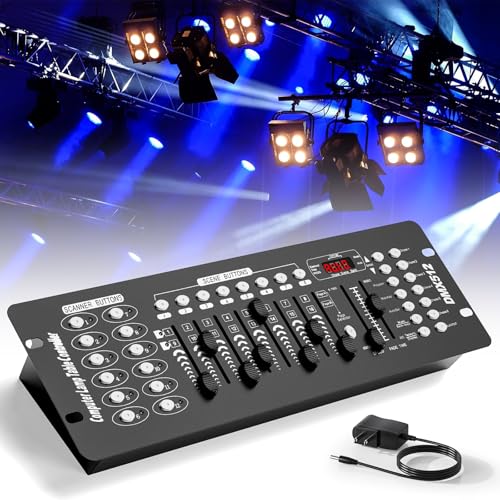
- Controls 12 fixtures with 16 channels each
- Stores programmable scenes and chases
- Beginner-friendly controls with eight sliders
Best For: Small gatherings and beginner lighting operators
Expandable Show Desk

- Offers 384 channels for detailed control
- Includes 30 banks of eight scenes
- Has side handles and an LED gooseneck light
Best For: Bars, clubs, and growing live-lighting setups
Value Scene Console

- Controls up to 12 fixtures with 16 channels each
- Includes 30 scene banks and six programmable chases
- Adds eight sliders for live manual adjustments
Best For: DJs, parties, weddings, and small venue events
Best App-Based Pick – ADJ MyDMX Go
For small venues seeking flexible dmx controllers for small venues, the ADJ MyDMX Go offers app-based control from an iPad or Android tablet. Its 256-channel capacity, broad fixture library, and wireless or USB connectivity make it a practical choice for compact systems that need quick setup without traditional programming.
Best For: Small venues wanting tablet-based control, automatic effects, and compatibility with a wide range of existing fixtures.
Pros:
- Controls up to 256 DMX channels through an iPad or Android app.
- Includes a library of more than 15,000 fixtures.
- Offers 50 user presets and 21 automatic effects without requiring programming.
- Compact, lightweight design includes O-Clamp mounting brackets.
Cons:
- Requires a compatible tablet for app-based operation.
- Its control approach may be less appealing to operators who prefer physical faders.
- Additional upgrades are available separately.
The MyDMX Go is a strong fit when ease of use and fixture flexibility matter more than a traditional hardware interface. Its two-universe connectivity and preset-based workflow can help small production teams create shows quickly.
Best Hardware Show Controller – CHAUVET DJ Obey 40
The CHAUVET DJ Obey 40 is a hardware-focused option for small venues with multiple intelligent fixtures. Among dmx controllers for small venues, it stands out for its 192 channels, substantial scene storage, chase playback, and dedicated fog and strobe controls.
Best For: Operators managing several fixtures who want physical controls, stored scenes, and structured chase playback.
Pros:
- Controls up to 12 fixtures with up to 16 channels each.
- Provides 192 DMX channels and storage for up to 240 scenes.
- Includes six chase sets, plus fog and strobe control.
- Supports MIDI compatibility and reversible sliders.
Cons:
- At 6.7 pounds, it is less lightweight than compact alternatives.
- Its extensive programming features may be more than a very small setup requires.
- The supplied notes identify USB connectivity but do not specify wireless control.
Choose the Obey 40 when repeatable scenes and hands-on operation are priorities. It offers room for more complex small-venue rigs while retaining dedicated controls for live adjustments.
Best for DJ and Live Audio Integration – SoundSwitch Control One
The SoundSwitch Control One is designed for music-driven lighting workflows, making it a compelling option among dmx controllers for small venues that host DJs or live performers. It provides tactile control, two DMX universes, and audio-BPM synchronization through SoundSwitch software or supported Engine DJ devices.
Best For: DJs and live performers who want hands-on lighting adjustments synchronized to music.
Pros:
- Provides two DMX universe inputs and outputs with a thru option.
- Works directly with compatible Denon DJ and Numark Engine DJ hardware without a computer.
- Offers a touch strip, encoders, and customizable RGB performance pads.
- Supports live audio BPM detection for external audio sources.
Cons:
- Its core control is designed around SoundSwitch software.
- Some AlphaTheta and PRO DJ LINK Bridge workflows require a laptop.
- It is more specialized for music-synced shows than general standalone scene programming.
Control One is a practical match for venues where lighting follows the performance. Its combination of tactile controls, audio detection, and DJ hardware integration makes on-the-fly effects easier to manage.
Best Simple Compact Controller – CHAUVET DJ Obey 6
The CHAUVET DJ Obey 6 keeps lighting control straightforward for small systems. As one of the most compact dmx controllers for small venues, it controls up to six fixtures and provides quick color selection for LED lighting without the feature load of a larger console.
Best For: Small venues with a limited number of LED fixtures that need quick manual color and effect control.
Pros:
- Controls up to six fixtures individually.
- Supports up to six channels per fixture.
- Preset and Quick Color buttons enable fast color changes.
- Allows layered effects and variable fade times across playback modes.
Cons:
- Its six-fixture and six-channel-per-fixture capacity limits expansion.
- It is less suited to larger or highly complex lighting rigs.
- The supplied notes do not mention wireless, app, or MIDI control.
The Obey 6 is a sensible choice when a venue needs basic, direct control rather than extensive scene programming. Its compact design and dedicated color controls suit small LED installations and simple live operation.
Best Wireless Setup – JERRAY Wireless DMX Transmitter and Receivers
For small venues that need fast installation, the JERRAY wireless DMX set replaces DMX cable runs with a 2.4G transmitter-and-receiver system. Its automatic frequency hopping and seven group IDs are useful when multiple lighting rigs share the same space.
Best For: Mobile DJs, weddings, and small stage events that prioritize quick, cable-free setup.
Pros:
- Includes one transmitter, two receivers, and three power adapters.
- 126-channel frequency hopping is designed for stable, low-delay transmission.
- Seven group IDs allow separate lighting rigs to be controlled independently.
- Up to a stated 1,000-foot range supports flexible fixture placement.
Cons:
- Each unit requires a power adapter; the system is not battery-powered.
- It is a wireless DMX link rather than a full scene-programming console.
This is a practical choice for small-venue setups where minimizing cabling matters more than hands-on scene programming. The included receivers make it especially convenient for spreading control across multiple fixtures.
Best for Scene Programming – CO-Z 192-Channel DMX Controller
The CO-Z 192 DMX controller suits small venues that want more hands-on control than a simple dimmer board. It can manage up to 12 intelligent lights with up to 16 channels each, while supporting up to 240 scenes for more involved shows.
Best For: DJs, clubs, weddings, churches, and small venues building repeatable multi-light scenes.
Pros:
- Controls up to 12 fixtures with as many as 16 channels per fixture.
- Supports up to 240 scenes for creating more complex lighting shows.
- Includes channel controls, scene switching, speed/time selection, and function controls.
- Voice control can help switch between lighting scenes.
Cons:
- Its larger control layout may be more than needed for basic lighting tasks.
- The corded-electric design is less convenient for handheld, battery-powered use.
- The supplied notes specify a three-pin cable, so connector compatibility should be checked before purchase.
Choose the CO-Z when scene capacity and fixture control are priorities. Its 192-channel layout offers room to grow, though users seeking only straightforward dimming may prefer a simpler controller.
Best Simple Dimmer – ADJ SDC12 12-Channel DMX Controller
ADJ Products SDC12, 12 Channel Basic DMX Controller, Easily Fade and Dim Multiple Lights
Check Price On AmazonThe ADJ SDC12 is a straightforward option among DMX controllers for small venues, with 12 channel faders plus a master fader for fading and dimming multiple lights. Its compact design works for portable operation or a basic permanent installation.
Best For: Demos, compact lighting rigs, and operators who want direct manual control without complex programming.
Pros:
- Provides 12 channel faders and one master fader for direct adjustments.
- Compact, lightweight design is suitable for travel or handheld use.
- Supports both 3-pin and 5-pin DMX connections.
- Can be wall-mounted using the included brackets.
Cons:
- The 9V battery is not included.
- Its 12-channel layout is less suited to large or highly complex rigs.
- A 12V DC power supply is required for standard powered operation.
The SDC12 makes sense when ease of use matters more than extensive scene storage. It gives small-venue operators a familiar fader-based workflow and flexible mounting options in a compact format.
Compact Scene Builder – 192-Channel DMX Controller
For small venues needing straightforward control, this 192-channel console offers a practical starting point for programming stage lighting. It supports up to 12 fixtures with 16 channels each, plus programmable scenes and chases.
Best For: Small gatherings, beginner operators, parties, and compact stage-lighting setups.
Pros:
- Controls up to 12 intelligent devices across 192 channels.
- Offers 23 sets of programmable scenarios and six chases with up to 240 scenes.
- Includes eight sliders for manual channel control and a 3-pin cable.
- Beginner-oriented layout with fixture selection, scene, display, and function sections.
Cons:
- Limited to 12 fixtures with 16 channels each.
- Its feature set is aimed at smaller systems rather than large, complex productions.
This is a sensible option among DMX controllers for small venues when accessible programming and scene capacity matter more than advanced system expansion.
Expandable Show Desk – 384-Channel DMX Controller
Among DMX controllers for small venues, this 384-channel model is suited to setups that may outgrow a basic console. It provides 30 banks of eight programmable scenes and is designed for bar, club, and live-show lighting.
Best For: Bars, clubs, live-lighting shows, and operators who want more channel capacity.
Pros:
- Provides 384 DMX channels for more detailed fixture control.
- Includes 30 banks with eight programmable scenes each.
- Compact, lightweight design with side handles for easier handling.
- LED gooseneck light supports operation in darker environments.
Cons:
- The supplied notes do not specify the number of fixtures supported.
- Its larger channel count may be more than needed for very simple setups.
Choose this console if your small venue uses several fixtures or you want additional programming headroom. Its higher channel count makes it the most expandable-looking option in this group.
Value Scene Console – 192-Channel DMX Controller
This 192-channel console balances programming features and hands-on control, making it a practical choice for DMX controllers for small venues. It can operate up to 12 intelligent lights and includes multiple scene banks, chases, and real-time sliders.
Best For: DJs, parties, weddings, churches, nightclubs, and users seeking a cost-conscious control console.
Pros:
- Controls up to 12 lights with up to 16 channels each.
- Provides 30 banks of eight programmable scenes and six chases with 240 scenes.
- Eight sliders allow real-time manual channel adjustments.
- Works with common 3-pin fixtures such as fog machines, par lights, and strobes.
Cons:
- Limited to 192 channels and 12 intelligent lights.
- Power input is specified at DC 9–12V and 300mA minimum, so the included power setup should be checked for compatibility.
With a strong mix of scene storage and manual fader control, this model fits buyers who want useful programming tools without moving to a higher-capacity console.
How We Picked the Best Dmx Controllers for Small Venues
We focused on controllers suited to compact clubs, bars, rehearsal rooms, mobile DJ setups, houses of worship, and small performance spaces. Selection criteria included channel and fixture capacity, scene or chase programming, control method, portability, compatibility with common DMX lighting, and the learning curve for new operators.
We also included different control approaches. App-based systems can offer convenient visual control, traditional consoles provide immediate hands-on access, and wireless kits can reduce cable runs when a wired connection is inconvenient. Always confirm fixture compatibility, DMX addressing, and whether the controller requires additional software or hardware.
Quick Comparison
| Controller type | Best suited to | Main advantage |
|---|---|---|
| App-based controller | Flexible small rigs and visual programming | Convenient scene and show control |
| Wireless DMX system | Temporary or hard-to-wire setups | Fewer cables between fixtures |
| Basic fader controller | Simple PARs, dimmers, and manual operation | Fast, direct control |
| Programmable console | Moving heads and multi-fixture shows | More scenes, banks, and fixture control |
Key Buying Factors for Dmx Controllers for Small Venues
Fixture and Channel Capacity
Count your fixtures and the channels each one uses. A controller should have enough channels for your current setup, with some room for expansion. A higher channel count is not automatically better if it makes programming unnecessarily difficult.
Programming and Live Operation
Look for scene, chase, bank, or fixture controls that match your workflow. Faders are useful for immediate manual changes, while programmable scenes are better for repeatable songs, acts, or event cues. If multiple people will operate the system, prioritize clear labeling and an accessible interface.
Wired Versus Wireless Control
Wired DMX remains a dependable choice for permanent installations. Wireless DMX can speed up setup and work well in temporary venues, but check range, interference conditions, power requirements, and whether receivers are needed at each fixture.
Software, Compatibility, and Portability
App-based controllers may require a compatible phone, tablet, computer, or interface. Verify operating-system support before buying. For mobile DJs and touring performers, also consider enclosure size, power supply, connector type, and how easily the controller fits into your existing case.
Who Should Buy Which Dmx Controllers for Small Venues?
Choose a basic fader controller if you operate a few conventional fixtures and want straightforward manual dimming. A programmable 192- or 384-channel console is a better fit for venues using several fixtures, moving heads, or repeatable lighting scenes.
An app-based system suits users who prefer visual programming and flexible control from a mobile device. Choose a wireless DMX kit when cable runs are the main challenge, particularly for temporary event layouts. For frequent shows with changing operators, prioritize intuitive controls and quick access to saved scenes over maximum channel count.