
The right flash can make indoor portraits, events, and everyday snapshots look brighter and more balanced without requiring a complicated lighting setup. For beginners, the best choice depends on camera compatibility, control options, power, size, and whether wireless triggering matters.
These 10 camera flashes for beginners range from simple manual speedlights to compact models and wireless-capable units. Use the guide below to narrow the list by shooting needs, budget, and the features you are most likely to use.
Best 10 Camera Flashes for Beginners Picks for 2026
Best Budget Manual Starter

- GN33 output with 22 manual power levels
- Simple M, S1, and S2 operating modes
- Includes stand, pouch, filters, and 24-month warranty
Best For: Beginners learning manual flash basics on a budget
Best Compact Everyday Flash
- Lightweight 103g design for daily carry
- Built-in battery rated for up to 640 full-power flashes
- Manual, S1, and S2 modes with GN15 output
Best For: Portable close-range fill light and casual shooting
Best for Expanding a Wireless Kit

- GN60 output for flexible manual lighting
- Godox 2.4G wireless range up to 100 meters
- Supports multiple groups and channels
Best For: Beginners building a multi-light Godox setup
Best Compact Pick

- Ultra-light 0.07-pound design
- Over 500 full-power flashes per charge
- Manual four-level output with 6500K light
Best For: Portable, straightforward on-camera lighting
Best Full-Power Value

- GN33 output for portraits and events
- Eight power levels from 1/128 to full
- Includes stand, pouch, and 12 color filters
Best For: Learning stronger manual and optical off-camera lighting
Best with Extra Features
- 45g body with an 85° tilting head
- USB-C battery supports 700–2,000 flashes
- Four manual power levels; no TTL
Best For: Travel, close-up portraits, and simple bounce lighting
Best Simple Rechargeable Pick
- Built-in 2,000mAh battery with up to 500 flashes
- Compact 128g design with a diffuser
- Manual, S1, and S2 modes; no TTL
Best For: Everyday portraits, creator setups, and close-range fill light
Best All-Around Wireless Option – Godox TT600 Thinklite Flash
For beginners comparing camera flashes for beginners, the Godox TT600 offers a strong starting point for learning manual exposure and off-camera lighting. Its GN60 output, tilting and rotating head, diffuser, and built-in 2.4G wireless system give you room to grow from simple bounce flash to multi-light setups.
Best For: Beginners who want powerful manual flash control and a path into Godox wireless lighting.
Pros:
- GN60 output with consistent 5600±200K color temperature across the 1/1 to 1/128 power range.
- Built-in 2.4G wireless X system supports master/slave operation, up to five groups, and 32 channels.
- Tilts from -7° to 90° and rotates 360° for versatile bounce lighting.
- Includes a dedicated diffuser, mini stand, storage bag, and fast 0.1–2.6-second recycle time.
Cons:
- Requires four AA batteries, which are not included.
- HSS requires a compatible Godox wireless trigger when the flash is used off-camera.
- Compatibility exclusions include several camera models, such as Canon R6, R50, and Fujifilm X100F.
The TT600 is a capable choice if you are comfortable learning manual flash settings and may eventually build a larger Godox system. Check your camera model carefully before ordering, especially if you use one of the listed exceptions.
Best Budget Manual Starter – PHOTOOLEX FK300 Flash
The PHOTOOLEX FK300 keeps the controls straightforward for beginners learning manual flash photography. It provides GN33 output, 22 power levels, and simple M, S1, and S2 modes, making it a practical option among camera flashes for beginners who do not need TTL or radio wireless control.
Best For: Beginners seeking an uncomplicated, widely compatible manual hot-shoe flash with useful starter accessories.
Pros:
- GN33 output and a 5500K±200K color temperature provide stable daylight-style illumination.
- Offers 22 levels of manual power adjustment from 1/1 to 1/128.
- S1 and S2 optical slave modes support basic off-camera triggering.
- Includes a pouch, stand, 12 color filters, and a 24-month warranty.
Cons:
- Does not support TTL or camera-menu control.
- No wireless radio system is built in.
- Requires four AA batteries, which are not included.
This flash is best viewed as a hands-on learning tool rather than an automated system. Its manual controls can help you understand flash power and optical triggering, but choose another model if TTL convenience or radio control is important.
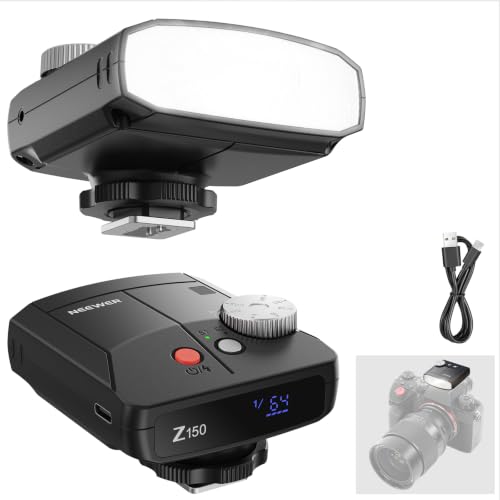
Best Compact Everyday Flash – NEEWER Z150 Mini Flash
For photographers who want a small fill light rather than a full-size speedlight, the NEEWER Z150 is an approachable pick among camera flashes for beginners. This 3.6-ounce manual flash has a built-in 1200mAh battery, a universal single-contact hot shoe, and simple power controls for casual portraits and everyday photography.
Best For: Beginners who prioritize a lightweight, pocket-sized flash for fill light and on-the-go shooting.
Pros:
- Compact 103g design is easy to carry with a daily camera setup.
- Built-in 1200mAh battery supports up to 640 full-power flashes according to the supplied specifications.
- Provides manual output from 1/64 to 1/1 plus S1 and S2 optical slave modes.
- Its 20Ws output and GN15 rating are suited to close-range fill lighting.
Cons:
- No TTL, HSS, automatic exposure, or camera-menu control.
- Maximum sync speed is 1/200 second.
- Fujifilm and other mirrorless cameras may require mechanical shutter mode.
The Z150 makes sense when portability matters more than reach or automation. Its modest GN15 output is better suited to nearby subjects, while users seeking advanced exposure assistance or high-speed sync should consider a more capable flash.
Best for Expanding a Wireless Kit – Godox TT600 Speedlite
The Godox TT600 is a useful entry point for beginners who expect to experiment with off-camera lighting. It combines GN60 output with Godox’s 2.4G X system and up to 100 meters of wireless transmission, making it one of the more expandable camera flashes for beginners who want to grow beyond on-camera use.
Best For: Beginners planning multi-light setups with Godox triggers, flashes, or strobes.
Pros:
- GN60 output provides substantial illumination for portraits and other longer-distance subjects.
- Built-in 2.4G wireless system supports remote control with compatible Godox triggers.
- Offers approximately 230 full-power flashes and 0.1–2.6-second recycling with four AA batteries.
- Supports up to five groups and 32 channels for more organized lighting setups.
Cons:
- Four AA batteries are required and are not included.
- HSS is not available when the flash is mounted directly on the camera hot shoe.
- Advanced wireless functions require a compatible Godox trigger sold separately.
The TT600 is a strong choice for learning manual lighting while retaining a clear upgrade path. It is most rewarding when paired with Godox accessories, but beginners should budget for a trigger if they want remote HSS and expanded wireless control.
Best Compact Pick – ULANZI SL01 Mini Flash
For photographers seeking compact camera flashes for beginners, the ULANZI SL01 is a lightweight manual option with simple four-level power control. Its built-in battery, USB-C charging, and single-contact hotshoe design make it convenient, provided your camera is compatible.
Best For: Beginners who prioritize portability and straightforward on-camera lighting.
Pros:
- Extremely light at 0.07 pounds and easy to carry.
- Built-in 250mAh battery supports over 500 full-power flashes per charge.
- Offers four power levels, 6500K color temperature, and 97+ CRI.
- Can be used while charging via USB-C.
Cons:
- No TTL or automatic exposure control.
- Requires a single-contact hotshoe, and several camera models are specifically excluded.
- Charger and cable are not included.
The SL01 is a practical starter flash for controlled, casual shooting, but compatibility should be confirmed before purchase. Its manual operation is best suited to users ready to learn basic flash-power adjustments.
Best Wireless Starter Kit – Godox TT520II Speedlite
The Godox TT520II is a versatile choice among camera flashes for beginners, combining manual controls with S1 and S2 optical modes. It also includes a transmitter, diffuser, filters, stand, and protective bag, giving new photographers useful accessories for experimenting with lighting.
Best For: Beginners who want an affordable manual flash kit with wireless triggering options.
Pros:
- GN33 output provides more reach than a compact mini flash.
- Includes M, S1, and S2 modes plus eight power levels from 1/128 to full.
- 433MHz wireless transmission offers 16 triggering channels.
- Package includes a transmitter, diffuser, filters, mini stand, and bag.
Cons:
- Uses manual exposure control rather than TTL automation.
- Compatibility should be checked against the specific camera model and hotshoe.
- It is not water resistant.
With its included accessories and multiple triggering modes, the TT520II gives beginners room to practice both on-camera and off-camera techniques. It is a stronger fit for learning lighting setups than for photographers seeking automatic exposure.
Best Full-Power Value – PHOTOOLEX FK300 Speedlite
The PHOTOOLEX FK300 is a capable manual option for camera flashes for beginners who want stronger output and broad camera compatibility. Its GN33 rating, eight-step power range, and S1/S2 optical triggering support both basic portraits and more creative off-camera setups.
Best For: New photographers who want a full-size flash with broad hotshoe compatibility and useful starter accessories.
Pros:
- GN33 output suits indoor portraits, events, and studio photography.
- Eight power settings range from 1/128 to full power.
- Manual, S1, and S2 modes support on-camera and optical off-camera use.
- Includes a pouch, stand, and 12 color filters, with a 24-month warranty.
Cons:
- Manual operation does not provide TTL automation.
- The listed FK300 configuration does not include a trigger.
- It is not water resistant.
The FK300 balances strong output, broad single-contact hotshoe compatibility, and a useful accessory bundle. It is a solid learning tool for beginners who expect to move beyond simple fill flash and practice controlled lighting.
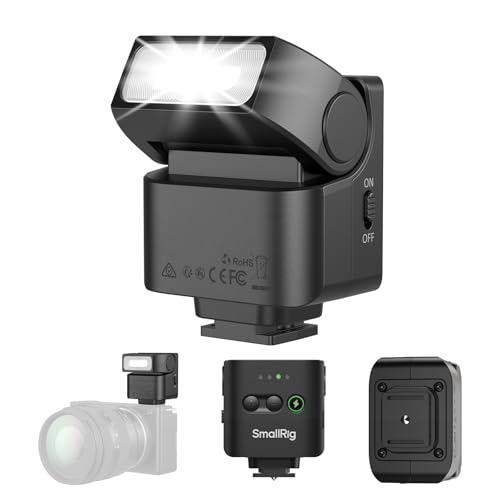
Best with Extra Features – SmallRig RS-22 Mini Flash
For beginners looking at camera flashes for beginners, the SmallRig RS-22 is a notably compact option for travel, everyday photography, and simple low-light work. Its manual controls keep operation straightforward, while the tilting head adds useful bounce-flash flexibility.
Best For: Travel photographers and beginners who want a lightweight rechargeable flash for close-up portraits, night scenes, and casual shooting.
Pros:
- Very light at about 45g and easy to carry.
- 85° tilting head supports softer bounce lighting.
- Built-in USB-C rechargeable battery provides 700–2,000 flashes per charge.
- Four manual power levels and recycling times from 0.1–4 seconds.
Cons:
- No TTL, so flash power must be set manually.
- GN8 output is best suited to close-range or modest fill lighting.
- Compatibility is limited to cameras with a suitable single-contact hot shoe; several camera models are specifically excluded.
The RS-22 is a convenient entry point if portability matters more than power or automation. Confirm your camera’s hot-shoe compatibility before ordering, then use the four power settings to learn basic flash exposure.
Best Learning Flash – NEEWER TT560 Speedlite
The NEEWER TT560 is a practical choice for beginners exploring camera flashes for beginners and learning manual exposure. It offers substantially more output than a mini flash, plus a tilting and rotating head for bounce and off-camera lighting practice.
Best For: Beginners who want a versatile, higher-output manual flash for portraits, bounce lighting, and experimenting with optical slave modes.
Pros:
- GN38 output and eight power levels from 1/128 to full power.
- Head tilts 0°–90° and rotates 0°–270°.
- S1/S2 optical slave modes and PC sync support off-camera setups.
- Works with four AA batteries and includes power-saving and overheating protection.
Cons:
- No TTL, HSS, automatic flash exposure, or camera-menu control.
- Four AA batteries are required and not included.
- Fujifilm and other compatible mirrorless cameras must use mechanical shutter mode.
The TT560 gives beginners room to grow because its adjustable head, broad power range, and slave modes support more advanced lighting exercises. Its manual-only design requires practice, but that can make exposure fundamentals easier to understand.
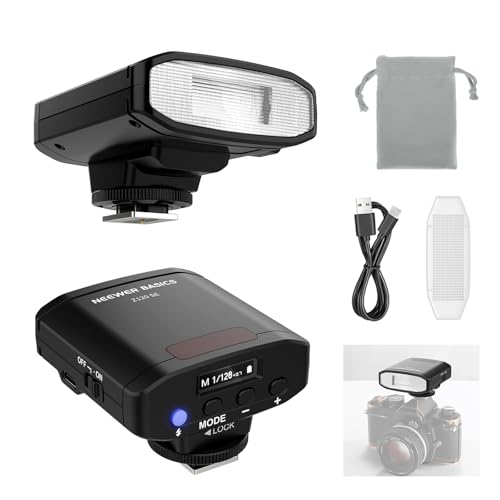
Best Simple Rechargeable Pick – NEEWER Basics Z120 SE
For beginners comparing camera flashes for beginners, the NEEWER Basics Z120 SE offers a simple, compact design with a built-in battery. It provides manual output control, a diffuser for softer fill light, and optical slave modes without adding TTL or menu-driven complexity.
Best For: Everyday portraits, creator setups, and on-the-go fill lighting with a rechargeable flash that is simple to operate.
Pros:
- Compact 128g body with a built-in 2,000mAh battery.
- Up to 500 full-power flashes and 0.1–1.8-second recycling.
- Manual output ranges from 1/128 to full power, with S1 and S2 modes.
- Translucent diffuser helps soften fill light and reduce harsh shadows.
Cons:
- No TTL, HSS, automatic exposure, or camera-menu control.
- GN12 output and the diffuser are best suited to relatively close subjects; the product recommends lenses 88mm or shorter.
- Compatible mirrorless cameras may need mechanical shutter mode, and shutter speeds should be 1/200 second or slower for reliable sync.
The Z120 SE is a friendly option for beginners who prefer rechargeable convenience and uncomplicated controls. It is especially suitable for nearby subjects and fill light, but users needing long-distance reach or automatic exposure should consider a more powerful or TTL-equipped flash.
How We Picked These Camera Flashes for Beginners
We focused on accessible flash units with straightforward controls, broad camera compatibility, useful power levels, and practical designs for learning. The selection includes manual speedlights for low-cost experimentation, compact flashes for travel and casual photography, and wireless models for off-camera lighting.
Because compatibility varies, we also considered hot-shoe support, trigger systems, recycle performance, battery capacity, flash head adjustment, and whether each model is better suited to on-camera or off-camera use. Always confirm the product listing for your camera brand and required functions before buying.
Quick Comparison
| Type | Best For | What to Expect |
|---|---|---|
| Basic manual speedlight | Learning flash fundamentals | Simple controls and good value, but more hands-on exposure adjustment |
| Wireless-capable flash | Off-camera portraits and creative lighting | More flexibility, provided the flash and trigger system are compatible |
| Mini flash | Travel, compact cameras, and casual use | Lightweight and convenient, with less output than full-size units |
| Higher-output speedlight | Events, larger rooms, and bounced light | More reach and flexibility, usually with a larger body and greater battery demand |
Key Buying Factors for Camera Flashes for Beginners
Camera and Trigger Compatibility
Check the exact camera mount, hot-shoe layout, and supported wireless frequency before ordering. A flash may physically attach to several brands while offering only manual firing or limited automation on some cameras.
Manual Versus Automatic Control
Manual flashes are often the most affordable and are excellent for learning power, distance, aperture, and bounce techniques. If you want the camera to help calculate exposure, look for a model that explicitly supports your camera system’s TTL standard.
Power and Flash-Head Movement
Guide number ratings provide a general indication of output, but real-world performance depends on zoom, ISO, modifiers, and room size. A tilting or swiveling head is especially useful because bouncing light from a ceiling or wall can produce softer results than direct flash.
Recycle Time, Batteries, and Size
Fast recycle times help when photographing people or events, while larger batteries or rechargeable designs can reduce interruptions. Mini flashes are easier to carry, but full-size speedlights generally offer more reach and bounce flexibility.
Who Should Buy Which Camera Flashes for Beginners?
- First-time flash buyers: Choose a straightforward manual speedlight such as the NEEWER TT560 or PHOTOOLEX FK300 if you want an affordable way to practice.
- Beginners planning off-camera lighting: Consider a Godox TT600 or another model with a built-in receiver, then verify transmitter compatibility before purchase.
- Travel and compact-camera users: Mini options such as the ULANZI SL01, NEEWER Z150, or NEEWER Z120 SE are convenient when portability matters most.
- Photographers needing more reach: A full-size unit with a higher guide number, such as the Godox TT600, is better suited to bounced light and larger spaces.
- Sony, Canon, Nikon, and multi-brand users: Confirm the exact version, shoe design, and supported functions rather than relying only on a broad compatibility label.
If you are unsure, prioritize reliable mounting, adjustable power, a tilting head, and clear compatibility information. Those features give beginners room to learn without paying for advanced functions they may not use.