
Choosing a DJ controller for four decks gives you more room for layered transitions, stems, samples, and creative live sets. The right model depends on whether you prioritize club-style software control, standalone operation, portability, or hands-on performance features.
Our roundup compares 10 options across Pioneer DJ, RANE, Denon DJ, Roland, AlphaTheta, and Numark to help you match features and workflow to your setup.
Best 10 Dj Controller for Four Decks Picks for 2026
Flagship Open-Format Pick

- Track Separation for live mashups
- Club-style four-channel workflow
- Rekordbox, Serato, and DMX support
Best For: Serious hobbyists, mobile DJs, and open-format performers
Stems Performance Pick

- Dedicated Serato Stems controls
- Large jog-wheel displays
- Dual USB and DVS support
Best For: Creative Serato performers and professional setups
Standalone Streaming Pick
- Laptop-free Engine DJ operation
- Seven-inch touchscreen and streaming
- Built-in speakers and flexible I/O
Best For: Mobile, streaming, and practice-focused DJs
Motorized-Platter Pick

- Seven-inch motorized aluminum platters
- Advanced Serato Stems controls
- Professional faders, FX, and I/O
Best For: Experienced DJs seeking tactile, expressive performance
Premium Standalone Choice

- Standalone four-channel control with onboard Stems
- 10.1-inch touchscreen and 8-inch jog wheels
- Professional outputs, DMX, Wi-Fi, and extensive FX
Best For: Feature-focused DJs seeking laptop-free four-deck performance
Creative Serato Pick

- Two-channel controller with four-deck Serato control
- Built-in TR drum machine and 16-step sequencer
- Portable design with balanced XLR and booth outputs
Best For: Serato DJs adding drum-machine performance to their sets
Portable Streaming Option
- Standalone four-channel control with onboard Stems
- Wi-Fi streaming, SD input, and two USB inputs
- Built-in speakers and Serato/Virtual DJ compatibility
Best For: Mobile and home DJs wanting flexible standalone streaming
Club-Ready Choice

- Club-inspired four-channel layout
- Groove Circuit and Serato Stems FX
- Rekordbox and Serato DJ Pro support
Best For: DJs building club-style skills with live remix options
Budget Four-Deck Starter

- Four-channel controls with built-in audio interface
- USB-powered for simple setup
- Sixteen pads for loops, samples, and hot cues
Best For: Beginners and mobile DJs exploring four-deck mixing
Visual Performance Pick

- Four-deck Serato DJ Lite system
- Jog wheels display key mix information
- Effects, pads, loops, and paddle triggers
Best For: Serato users who want visual feedback and quick effects
Flagship Open-Format Pick – Pioneer DJ DDJ-FLX10
For DJs seeking a serious dj controller for four decks, the Pioneer DJ DDJ-FLX10 combines a club-style four-channel layout with track separation for live mashups. Its rekordbox and Serato DJ Pro compatibility also makes it a flexible choice for open-format sets.
Best For: Serious hobbyists, mobile DJs, and performers who want a future-ready controller with club-standard controls.
Pros:
- Track Separation splits songs into vocals, drums, and instruments for on-the-fly remixing.
- Four-channel design and pro FX support a workflow familiar from CDJ and DJM setups.
- Large jog wheels feature multicolor displays with waveforms, artwork, and performance information.
- Built-in DMX output supports lighting control, while rekordbox and Serato DJ Pro compatibility adds flexibility.
Cons:
- At 14.8 pounds, it is less convenient to transport than a compact controller.
- Its advanced feature set may be more than beginners need.
The DDJ-FLX10 is a strong all-around choice when you want four-deck control, software flexibility, and performance-focused features in one controller.
Stems Performance Pick – RANE FOUR
The RANE FOUR is a performance-focused dj controller for four decks built around Serato Stems. Dedicated stem controls, robust mixer features, and dual laptop connections make it well suited to creative sets and demanding live use.
Best For: DJs who prioritize Serato Stems, hands-on FX, durable construction, and professional connectivity.
Pros:
- Dedicated controls provide instant access to vocals and instrumentals, plus Stem Level EQ and Stem-Split.
- Its four-channel mixer includes full EQ control, FX assignment, and enhanced sampler routing.
- Eight-and-a-half-inch jog wheels include central displays for BPM, waveforms, cues, loops, and other details.
- Dual USB laptop connections, DVS support, multiple outputs, and microphone inputs suit professional setups.
Cons:
- At 18.25 pounds, it is a substantial piece of gear for mobile transport.
- Its Serato-centered feature set may be less appealing to DJs committed to other platforms.
Choose the RANE FOUR if stem manipulation and hands-on Serato performance matter more than portability. Its connection options and solid construction support serious booth and mobile work.
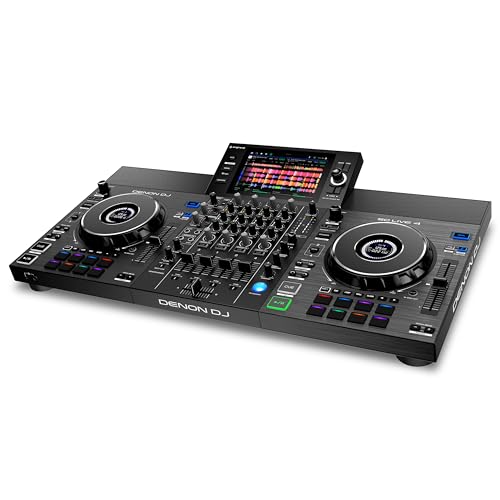
Standalone Streaming Pick – Denon DJ SC LIVE 4
The Denon DJ SC LIVE 4 stands out as a dj controller for four decks that can operate without a laptop. Its touchscreen, media slots, wireless streaming, and built-in speakers make it especially practical for mobile, streaming, and practice-focused setups.
Best For: Mobile and streaming DJs who want standalone operation, broad music access, and built-in monitoring.
Pros:
- Engine DJ OS enables laptop-free performances using an SD card and two USB inputs.
- Seven-inch touchscreen simplifies browsing and track selection.
- Wi-Fi streaming supports services including Amazon Music Unlimited, Apple Music, TIDAL, and others.
- Built-in speakers, Bluetooth audio input, microphone inputs, and multiple outputs support flexible use.
Cons:
- At 13.6 pounds, it is portable but still a full-size four-channel controller.
- Its feature-rich standalone workflow may require time to learn.
The SC LIVE 4 is a convenient choice when you want four-deck control without always carrying a computer. Streaming access and built-in speakers add versatility for practice and mobile events.
Motorized-Platter Pick – RANE PERFORMER
The RANE PERFORMER brings motorized platters and advanced stem controls to the dj controller for four decks category. Its professional faders, customizable FX, and substantial metal construction are aimed at DJs who want tactile control for expressive Serato performances.
Best For: Experienced DJs who want motorized platter control, detailed FX, and a robust professional mixer section.
Pros:
- Seven-inch high-torque motorized aluminum platters provide a tactile performance feel.
- Stem-Split, Stem Level, Stem Pad Mode, and dedicated acapella/instrumental buttons expand creative options.
- Adjustable-tension volume faders and the MAG FOUR crossfader support precise mixing.
- Includes extensive outputs and inputs, DVS support, 29 paddle-triggered FX, and OLED pad displays.
Cons:
- At 28.2 pounds, it is notably heavy for transport.
- Its advanced controls and motorized platters may be excessive for casual beginners.
The PERFORMER is best suited to DJs who value physical feedback and professional control over lightweight portability. Its motorized platters and broad FX toolkit make it a distinctive choice for expressive sets.
Premium Standalone Choice – PRIME 4 G2
The Denon DJ PRIME 4 G2 is a powerful dj controller for four decks, designed for laptop-free performances and demanding mobile or club setups. Its four-channel layout, onboard Stems rendering, Wi-Fi streaming, large touchscreen, and professional outputs make it a feature-rich centerpiece.
Best For: DJs who want a full-featured standalone four-deck system with advanced performance tools.
Pros:
- Standalone four-channel control with onboard Stems rendering and Wi-Fi streaming.
- Large 10.1-inch HD touchscreen and full-size 8-inch jog wheels.
- Extensive FX, pressure-sensitive MPCe pads, DMX output, and balanced professional I/O.
Cons:
- Its 21.8-pound weight and large footprint may be less convenient for frequent transport.
- The broad feature set may be more than beginners need.
Choose the PRIME 4 G2 when standalone flexibility and deep performance control matter more than portability. It is the most complete option here for four-deck performance without relying on a laptop.
Creative Serato Pick – Roland DJ-505
The Roland DJ-505 combines two-channel hardware with four-deck Serato control, making it a compact dj controller for four decks. It adds large low-latency platters, dedicated performance pads, built-in TR drum sounds, and a 16-step sequencer for DJs who want to blend mixing with live rhythm creation.
Best For: Serato DJs who want portable four-deck control and hands-on drum-machine creativity.
Pros:
- Deck Select functionality controls up to four decks from a two-channel layout.
- Includes Serato DJ Pro and several Serato expansion licenses.
- Built-in Roland TR sounds and sequencer add live performance possibilities.
- Balanced XLR outputs, booth output, and standalone mixer functionality support varied setups.
Cons:
- It requires a computer for its primary Serato DJ workflow.
- The two-channel design is less direct than a dedicated four-channel mixer layout.
The DJ-505 is a strong fit for producers and Serato users who value portability and creative sequencing. It is less suitable for DJs seeking a standalone system or four independent mixer channels.
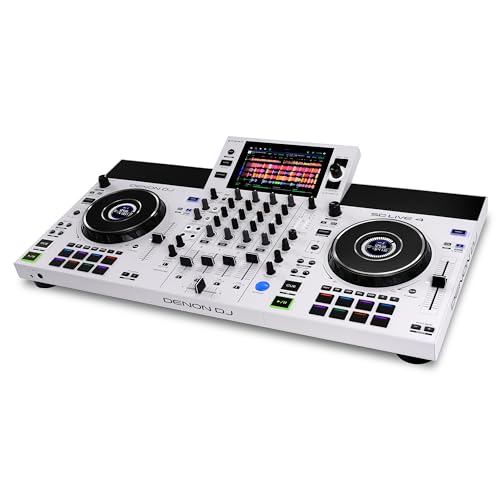
Portable Streaming Option – Denon SC LIVE 4 White
The Denon DJ SC LIVE 4 White is a practical dj controller for four decks with standalone Engine DJ operation, onboard Stems, Wi-Fi streaming, and Bluetooth connectivity. Its built-in speakers and lighter 13.6-pound design make it especially convenient for practice, streaming, and mobile gigs.
Best For: Mobile DJs and home users who want standalone four-deck control with streaming and built-in audio.
Pros:
- Four-channel standalone mixer with onboard Stems and a 7-inch screen.
- Wi-Fi access to multiple streaming services, plus SD and USB track importing.
- Built-in speakers support practice, track previewing, and casual mixing without external speakers.
- Works with Serato DJ Pro and Virtual DJ for laptop-based workflows.
Cons:
- The 7-inch display is smaller than the PRIME 4 G2’s screen.
- Built-in speakers are convenient but not a substitute for a professional PA system.
The SC LIVE 4 is a versatile middle ground: more self-contained than a traditional laptop controller and easier to carry than a larger flagship unit. Its streaming access and built-in speakers are particularly useful for flexible, informal setups.
Club-Ready Choice – AlphaTheta DDJ-GRV6
If you want a DJ controller for four decks that also helps build club-ready habits, the AlphaTheta DDJ-GRV6 is the most advanced option in this group. Its CDJ-3000 and DJM-A9-inspired layout, full-size jog wheels, and support for both rekordbox and Serato DJ Pro make it a flexible choice for home practice and performance.
Best For: DJs who want club-style controls, live remix tools, and compatibility with two major DJ platforms.
Pros:
- Club-standard-inspired layout can help develop transferable muscle memory.
- Groove Circuit enables live loop-based genre changes, while Serato offers Stems FX.
- Full-size jog wheels and eight pads above each jog provide hands-on control.
- Works with rekordbox and Serato DJ Pro out of the box.
Cons:
- Its large form factor may be less convenient for limited desk space.
- Advanced features may be more than a beginner needs.
The DDJ-GRV6 stands out when you value a modern four-channel workflow and room to grow. Choose it over the older, simpler controllers here if club-oriented layout and creative performance features are priorities.
Budget Four-Deck Starter – Numark Mixtrack Quad
Numark Mixtrack Quad Four Deck USB DJ Controller with Integrated Audio Interface and Trigger Pads
Check Price On AmazonThe Numark Mixtrack Quad is a straightforward DJ controller for four decks aimed at beginners and mobile DJs who want more mixing complexity without a separate audio interface. It combines four-channel controls, USB power, headphone cueing, and performance pads in a practical package.
Best For: Beginner and mobile DJs learning four-deck mixing with loop, sample, and hot-cue controls.
Pros:
- Provides four channels with an integrated audio interface.
- USB-powered connection keeps setup simple.
- Sixteen multicolor trigger pads support loops, samples, and hot cues.
- Includes Virtual DJ LE and the Numark Remix Toolkit download.
Cons:
- Its listed software and operating-system compatibility are dated.
- It lacks the newer club-oriented features and jog displays found on more recent models.
- The supplied notes list no noise-control feature.
The Mixtrack Quad makes sense as an inexpensive entry into four-deck control, especially if you already have a compatible computer. Its age and dated software requirements are important considerations before buying.
Visual Performance Pick – Numark Mixtrack Platinum FX
The Numark Mixtrack Platinum FX is a practical DJ controller for four decks with a built-in 24-bit audio interface and Serato DJ Lite included. Its large jog wheels, high-resolution displays, performance pads, and dedicated effects make it suited to DJs who want visual feedback and quick performance controls.
Best For: Serato users who want jog-wheel displays, accessible effects, and a ready-to-connect home setup.
Pros:
- Offers four-deck control with plug-and-play USB connectivity for Mac and Windows.
- Jog-wheel displays show BPM, platter position, beats remaining, and pitch or key information.
- Includes six effects, dual paddle triggers, loop controls, and eight pads per deck.
- Provides microphone, headphone, and RCA outputs plus mixer EQ and filter controls.
Cons:
- Serato DJ Lite is the included software, rather than Serato DJ Pro.
- The 21.61-inch width may require a reasonably spacious setup.
- Its USB bus power means operation depends on the connected computer.
The Mixtrack Platinum FX offers a strong balance of four-deck access and performance-focused feedback. It is especially appealing if you prefer Serato and want useful information directly on the jog wheels without moving to a more club-oriented controller.
How We Picked the Best Dj Controller for Four Decks
We focused on controllers that offer genuine four-deck workflows or meaningful access to four software decks, while considering layout, software compatibility, performance controls, audio connectivity, portability, and overall value. We also included standalone systems for DJs who want to perform without a laptop, plus models with stem separation, sampler controls, and integrated displays where those features can improve live mixing.
Because four-channel hardware varies widely, the best choice is not necessarily the most expensive model. A controller should match your preferred DJ software, monitoring setup, performance style, and willingness to manage a laptop or standalone library.
Quick Comparison
| Best For | Recommended Type | What to Prioritize |
|---|---|---|
| Club-style software mixing | Four-channel performance controller | Deck layout, jog wheels, mixer section, software integration |
| Laptop-free performance | Standalone DJ system | Screen, storage access, streaming support, onboard processing |
| Stem-based sets | Stem-enabled controller | Real-time separation, dedicated controls, processor performance |
| Mobile or entry-level setups | Compact USB controller | Weight, included software, audio interface, price |
Key Buying Factors for a Dj Controller for Four Decks
Four-Channel Layout and Deck Control
Check how the controller handles deck switching. Some units provide four physical channels with software deck selection, while others offer a more direct four-deck workflow. Look for clear channel labeling, accessible cue and loop controls, and enough mixer space to avoid accidental adjustments during busy transitions.
Software and Operating Mode
Confirm compatibility with your preferred platform, such as rekordbox, Serato DJ, or Engine DJ. Standalone controllers use their own operating system and music library workflow, while laptop-based units may offer deeper software integration. If you regularly play from prepared USB drives, streaming services, or a computer, choose hardware built around that source.
Stems, Effects, and Performance Controls
Stems can make vocals, drums, bass, and instruments independently playable, but the feature depends on processing power and software support. Dedicated pads, beat effects, loop controls, and touch-sensitive jog wheels are also important if you perform mashups, remixes, or open-format sets.
Connectivity and Portability
Review the main, booth, headphone, microphone, and auxiliary outputs before buying. Balanced outputs are preferable for professional sound systems. Also consider dimensions and weight: a full-size four-channel controller may offer a better club-style experience, while a compact model is easier to transport and set up.
Who Should Buy Which Dj Controller for Four Decks?
Choose a Full-Size Performance Controller If…
You want a traditional mixer layout, responsive jog wheels, extensive effects, and detailed control from a laptop. These models suit club practice, serious home setups, and DJs who frequently mix four software decks.
Choose a Standalone Controller If…
You want to leave the computer at home or prefer an integrated touchscreen workflow. Standalone units are especially useful for mobile DJs, event performers, and anyone who values fast library browsing and self-contained operation.
Choose a Compact or Budget Model If…
You are learning four-deck concepts, need a portable backup, or want to keep costs controlled. Verify the actual software deck support and output configuration, since some affordable controllers provide fewer physical channels or rely more heavily on deck-layer switching.