
The best DJ controllers make it easier to mix confidently, whether you are learning your first transitions, preparing club-style sets, or performing without a laptop. The right model depends on your software, preferred workflow, portability needs, and budget.
We compared 10 standout options across entry-level, performance-focused, four-channel, and standalone designs to help you choose a controller that fits the way you actually DJ.
Best 10 Dj Controllers Picks for 2026
Best Overall

- Four-channel layout with club-style workflow
- Track Separation for live vocals, drums, and instruments
- Works with rekordbox, Serato DJ Pro, and DMX lighting
Best For: Serious hobbyists, mobile DJs, and professionals
Best Standalone Powerhouse

- Laptop-free four-deck performance with onboard stems
- 10.1-inch touchscreen and 8-inch jog wheels
- Streaming, USB, SD, SATA, Bluetooth, and DMX support
Best For: Professional and mobile DJs needing an all-in-one system
Best for Scratching

- Battle-style two-channel layout for scratch performance
- Full-size jog wheels with playback-position displays
- Supports rekordbox and Serato DJ Pro
Best For: Scratch DJs and open-format performers
Best for Mobile Streaming

- Standalone four-deck performance with 7-inch touchscreen
- Built-in speakers and wireless music streaming
- USB, SD, Serato DJ Pro, and VirtualDJ compatibility
Best For: Mobile, streaming, and club DJs
Best Beginner DJ Controller
- Beginner-friendly two-deck layout
- Smart Fader simplifies blends
- Supports streaming and mobile devices
Best For: New DJs building skills at home or streaming
Best Practical DJ Controller

- Two-deck control for Serato and DJUCED
- Large jog wheels and 16 RGB pads
- Retractable feet and metal backing plate
Best For: Learning DJs who value sturdy, guided hardware
Best Four-Deck DJ Controller

- Four-deck Serato DJ Lite system
- Six-inch jog wheels with color displays
- Dedicated FX paddles and loop controls
Best For: DJs creating layered mixes with visual feedback
Best Beginner Pick

- Smart Fader assists with volume, BPM, and bass matching
- USB-C bus-powered and weighs 2.7 pounds
- Works with rekordbox, djay, and Serato DJ Lite
Best For: First-time DJs seeking guided, portable mixing
Best for Learning
Hercules DJControl Inpulse 200 MK3
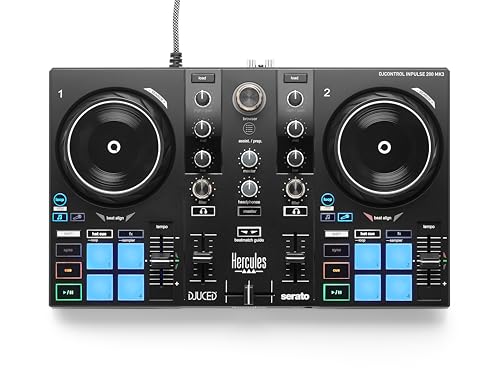
- Includes DJ Academy tutorials and Serato Lite
- Beatmatch Guide LEDs support manual transitions
- Compact 2.2-pound design with streaming support
Best For: New DJs who prefer guided lessons and visual cues
Best Party Features

- Beat-synchronized built-in LED light show
- Bluetooth MIDI and USB-C portable operation
- Performance pads, stems control, and included software
Best For: Casual DJs adding visual effects to small parties
Best Overall – Pioneer DJ DDJ-FLX10
The Pioneer DJ DDJ-FLX10 is a strong choice for serious hobbyists, mobile DJs, and professionals seeking a future-ready set of dj controllers. Its four-channel layout, track-separation features, and support for both rekordbox and Serato DJ Pro make it well suited to open-format performance and club-style workflows.
Best For: DJs who want a professional four-channel controller with live stems-style track separation and lighting control.
Pros:
- Track Separation can split vocals, drums, and instruments for live mashups.
- Four-channel layout and pro FX mirror a CDJ/DJM booth workflow.
- Supports rekordbox and Serato DJ Pro, with built-in DMX lighting output.
- Large jog wheels include multicolor displays for track and playback information.
Cons:
- At 14.8 pounds, it is less convenient to carry than smaller controllers.
- Its advanced feature set may be more than beginners need.
The DDJ-FLX10 stands out when you want one controller for open-format sets, software flexibility, and venue-style performance. It is especially compelling for DJs who expect to use stems and lighting features regularly.
Best Standalone Powerhouse – Denon DJ PRIME 4 G2
The Denon DJ PRIME 4 G2 is a professional standalone option for DJs who want laptop-free performance. Among dj controllers, it offers a particularly extensive feature set, including onboard stems rendering, a large touchscreen, streaming support, multiple media inputs, and four-deck control.
Best For: Professional and mobile DJs who need a comprehensive standalone system with flexible media, audio, and lighting connectivity.
Pros:
- Runs without a laptop and supports streaming from services including Beatport, TIDAL, and Amazon Music Unlimited.
- Onboard Stems Rendering includes dedicated Acapella and Instrumental controls.
- Large 10.1-inch touchscreen and high-resolution 8-inch jog-wheel displays aid browsing and mixing.
- Offers balanced professional outputs, microphone inputs, an instrument mode, and integrated DMX lighting.
Cons:
- Its 21.8-pound weight and large footprint may challenge portable setups.
- The broad feature set can require more time to learn.
The PRIME 4 G2 is built for DJs who want an all-in-one performance hub rather than a basic computer interface. Its connectivity and standalone design make it particularly suitable for demanding mobile or venue work.
Best for Scratching – Pioneer DJ DDJ-REV5
The Pioneer DJ DDJ-REV5 is a battle-style two-channel controller designed for scratch-focused and open-format performance. For shoppers comparing dj controllers, its full-size jog wheels, on-jog displays, DJM-style controls, and compatibility with both rekordbox and Serato DJ Pro create a familiar performance setup.
Best For: Scratch DJs and open-format performers who prefer a battle-style layout with full-size jog wheels.
Pros:
- Scratch-style two-channel layout is tailored to battle-oriented performance.
- Full-size jog wheels feature displays showing playback position.
- Includes rekordbox and Serato DJ Pro support without requiring a software license.
- Performance pads support samples and Hot Cues, with compatible streaming options.
Cons:
- Two channels provide less deck capacity than four-channel alternatives.
- It requires a laptop or computer for its listed software-based workflow.
The DDJ-REV5 makes the most sense when scratch control and a battle-style arrangement matter more than standalone operation or maximum channel count. It is a focused choice for DJs building a hands-on performance setup.
Best for Mobile Streaming – Denon DJ SC LIVE 4
The Denon DJ SC LIVE 4 combines standalone four-deck control with built-in speakers, wireless streaming, and a touchscreen. It is one of the more flexible dj controllers for mobile, streaming, and casual performance setups, especially when you want to work without carrying a laptop.
Best For: Mobile, streaming, and club DJs who want standalone operation with built-in speakers and broad media connectivity.
Pros:
- Engine DJ OS supports laptop-free performance through USB drives and an SD card.
- Streams from services including Amazon Music Unlimited, Apple Music, TIDAL, Beatport, and SoundCloud Go+.
- Built-in speakers make it convenient for practice and portable setups.
- Supports Serato DJ Pro and VirtualDJ, plus Bluetooth, microphone, RCA, booth, and XLR connections.
Cons:
- The built-in speakers may not replace a dedicated sound system for larger venues.
- Its 15.9-by-28.3-inch footprint still requires substantial setup space.
The SC LIVE 4 is a practical option for DJs who value flexibility and quick setup. Its standalone features and speakers are particularly useful for mobile work, practice sessions, and streaming-oriented performances.
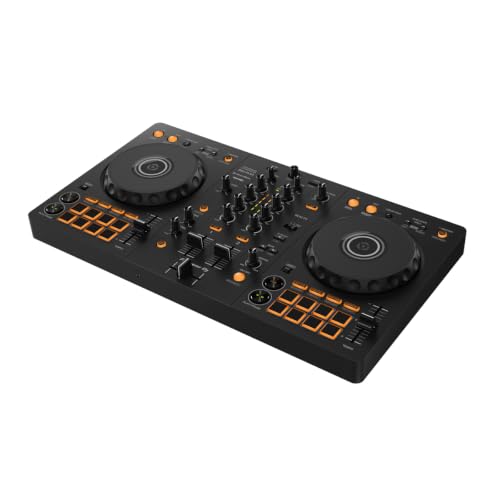
Best Beginner DJ Controller – DDJ-FLX4
The Pioneer DJ DDJ-FLX4 is one of the most approachable dj controllers for learning core mixing skills while keeping room to advance. Its simple two-deck layout, Smart Fader, performance pads, and broad device compatibility make it practical for home practice, streaming, and first live sets.
Best For: Beginners who want an easy-to-use, portable controller with streaming support and a clear upgrade path.
Pros:
- User-friendly Pioneer-style layout with two-deck control.
- Smart Fader can automatically adjust volume, bass, and BPM for easier blends.
- Sixteen performance pads support hot cues, Pad FX, Beat Jump, and sampler functions.
- Works with PC, Mac, iPhone, iPad, and Android, with a built-in sound card and mic input.
Cons:
- Limited to two channels and two decks.
- Some advanced users may outgrow its beginner-oriented feature set.
The DDJ-FLX4 stands out as a flexible first controller: it simplifies early mixes without removing useful hands-on controls. Support for Rekordbox, Serato DJ Pro, DJay, and music streaming services adds versatility as your setup develops.
Best Practical DJ Controller – DJControl Inpulse 500
The Hercules DJControl Inpulse 500 is a sturdy option among dj controllers for users who want two-deck control, guided practice features, and hands-on mixing hardware. Its built-in audio interface, large jog wheels, RGB pads, and retractable feet suit home sessions and casual performances.
Best For: Beginners and intermediate DJs who want guided mixing features and a durable, elevated controller design.
Pros:
- Two-deck controller compatible with Serato and DJUCED.
- Built-in audio interface and hardware input mixer for audio inputs.
- Large touch-sensitive jog wheels support scratching.
- Retractable feet help lift the controller above spilled drinks, while 16 RGB pads add performance control.
Cons:
- Requires corded electric power rather than USB bus power alone.
- Its larger 20.26-inch width may be less convenient for compact setups.
With a metal backing plate, Beatmatch Guide, filter/FX area, and dedicated loop controls, the Inpulse 500 balances instruction with tactile control. It is a sensible choice when durability and guided learning matter as much as portability.
Best Four-Deck DJ Controller – Mixtrack Platinum FX
The Numark Mixtrack Platinum FX is a strong pick among dj controllers for DJs who want four-deck control and detailed visual feedback without a complicated setup. Its six-inch jog wheels, built-in displays, FX paddles, and included Serato DJ Lite software provide a broad set of tools for mixing on Mac or Windows.
Best For: DJs who want four-deck flexibility, visible jog-wheel information, and quick access to effects and loops.
Pros:
- Provides four decks of control with included Serato DJ Lite.
- Six-inch capacitive jog wheels display BPM, platter position, beats remaining, and pitch information.
- Six effects, dual paddle triggers, instant loops, and eight performance pads per deck support creative sets.
- Includes microphone, headphone, and RCA connections plus a three-band EQ mixer.
Cons:
- Designed for Mac and Windows rather than mobile platforms.
- Its larger feature set may take longer for beginners to learn.
The Mixtrack Platinum FX is the most performance-oriented choice of these three controllers. Four-deck access and jog-wheel displays make it especially useful for layered mixes, while USB bus power and plug-and-play Serato support keep setup straightforward.
Best Beginner Pick – Pioneer DJ DDJ-FLX2
The AlphaTheta Pioneer DJ DDJ-FLX2 is one of the most approachable dj controllers for learning basic mixing. Its Smart Fader can automatically match volume, BPM, and bass, while USB-C bus power and streaming compatibility make it easy to start with a phone, tablet, or computer.
Best For: First-time DJs who want portable hardware and guided beatmatching.
Pros:
- Smart Fader helps automate key beatmatching adjustments.
- Supports music from services including Apple Music, Spotify, and Tidal through compatible apps.
- Lightweight 2.7-pound design runs from USB-C bus power.
- Includes support for rekordbox, djay, and Serato DJ Lite.
Cons:
- Its two-channel layout is aimed at beginners rather than advanced multi-deck setups.
- External speaker connection is limited to a 3.5 mm output.
The DDJ-FLX2 is a practical entry point if simplicity and portability matter most. Smart Fader reduces the initial learning curve without removing the option to practice hands-on mixing.
Best for Learning – Hercules DJControl Inpulse 200 MK3
The Hercules DJControl Inpulse 200 MK3 stands out among dj controllers for structured beginner practice. Serato Lite, DJ Academy tutorials, Beatmatch Guide LEDs, and Intelligent Music Assistant features are designed to help new DJs build confidence while keeping the setup compact.
Best For: Beginners who want step-by-step instruction and visual beatmatching guidance.
Pros:
- Includes professional software and DJ Academy tutorials.
- Beatmatch Guide LEDs indicate when tracks are aligned.
- Intelligent Music Assistant suggests tracks based on BPM and energy.
- Supports streaming from Spotify, Apple Music, TIDAL, and other listed services.
Cons:
- The feature set is centered on a compact two-channel beginner controller.
- Some streaming and stem features may depend on compatible software or services.
Choose the Inpulse 200 MK3 if learning support is more important than a broad hardware layout. Its tutorials and visual aids provide a clear path from first setup to more confident transitions.
Best Party Features – Numark Party Mix III
The Numark Party Mix III is a fun-focused choice among dj controllers, combining two-deck mixing with built-in beat-synchronized lights. It also adds Bluetooth MIDI, performance pads, stems control, and included access to Serato DJ Lite and Algoriddim djay.
Best For: Casual DJs and small parties where visual effects and quick setup are priorities.
Pros:
- Built-in LED light show synchronizes with the music.
- Bluetooth MIDI supports wireless DJing from iOS and Android devices through djay.
- Eight performance pads per deck control cues, loops, samples, and effects.
- Includes a built-in audio interface with RCA speaker output and headphone cueing.
Cons:
- The light show and party-oriented design may be less useful for traditional practice-focused setups.
- It remains a compact two-deck controller rather than a larger professional system.
The Party Mix III is a strong fit when entertainment is part of the brief. Its lighting, automatic transition tools, and portable USB-C design make it easy to bring basic DJ performance to a room, party, or casual gathering.
How We Picked the Best Dj Controllers
We evaluated these Dj Controllers by looking at the features that matter most during real-world mixing: deck count, software compatibility, jog-wheel response, performance pads, connectivity, portability, and room to grow. We also considered whether each model is best suited to beginners, mobile DJs, scratch performers, club-style users, or laptop-free setups.
Feature priorities vary by experience level. A beginner may benefit more from clear controls, guided software, and a manageable price than from advanced stems or four-deck mixing. Experienced DJs may instead prioritize track separation, larger jog wheels, standalone operation, extensive outputs, or professional performance controls.
Quick Comparison
| Best For | Recommended Type | What to Look For |
|---|---|---|
| Beginners | Two-channel controller | Simple layout, tutorials, included software |
| Bedroom and home DJs | Versatile laptop controller | Good jog wheels, pads, effects, USB connectivity |
| Scratch DJs | Performance-focused controller | Responsive platters, crossfader feel, battle layout |
| Mobile performers | Portable controller | Durable construction, flexible outputs, compact size |
| Club-style mixing | Four-channel controller | Expanded mixer section, multiple inputs, professional workflow |
| Laptop-free performance | Standalone DJ system | Built-in screen, storage access, independent operation |
Key Buying Factors for Dj Controllers
Channel Count and Layout
Two-channel models are easier to learn and transport, while four-channel controllers provide more flexibility for layered transitions, live inputs, and longer blends. Choose based on how you mix now and whether you expect your setup to expand.
Software and Compatibility
Check which DJ software is included and whether the controller supports your preferred platform. Serato, rekordbox, DJUCED, and Engine DJ offer different libraries, effects, and performance features. Also verify computer requirements and mobile-device support before buying.
Jog Wheels, Pads, and Performance Tools
Larger jog wheels and responsive platters are valuable for manual beatmatching and scratching. Performance pads add hot cues, samples, loops, and stems control, but a beginner should not pay for advanced features they are unlikely to use.
Connectivity and Portability
Review the master outputs, headphone connection, microphone inputs, USB ports, and device compatibility. If you play outside the home, consider weight, construction, power requirements, and whether a protective case will be easy to transport.
Standalone Features
Standalone controllers can access music and manage sets without a computer, making them appealing for performers who want a cleaner booth setup. They typically cost more, so confirm that the screen, storage workflow, streaming support, and outputs match your needs.
Who Should Buy Which Dj Controllers?
New DJs: Start with a straightforward two-channel model that includes beginner-friendly software and clearly labeled controls.
Growing home DJs: Choose a controller with strong pad functionality, capable jog wheels, and enough effects or deck control to support more advanced mixes.
Scratch and battle DJs: Prioritize platter response, crossfader performance, and a layout designed for quick cuts and cue juggling.
Professional or mobile DJs: Look for dependable outputs, microphone support, durable construction, and a workflow that remains efficient during long sets.
Performers who want independence: A standalone system is worth considering when avoiding a laptop is more important than keeping the initial cost low.