
Portable film scanners make it easier to preserve negatives and slides without sending your originals to a lab. The best models combine broad film-format support, a useful built-in screen, simple controls, and reliable digital capture.
We compared 10 portable options across scan resolution, supported formats, portability, display quality, connectivity, and ease of use to help you choose the right scanner for family archives, creative projects, or occasional home use.
Best 10 Portable Film Scanners Picks for 2026
Best Overall
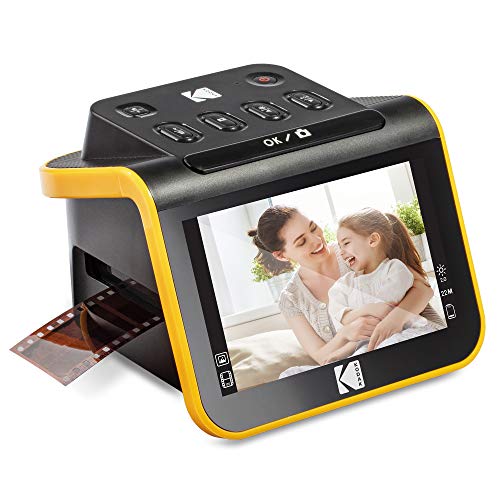
- 5-inch LCD for previewing and editing
- Supports 135, 110, and 126 film formats
- Direct SD/SDHC saving and HDMI output
Best For: Home users wanting an easy, display-equipped film scanner
Best Complete Bundle
DigitPro Photo, Slide & Negative Scanner

- Handles film, slides, photos, and business cards
- Includes an 8GB SD card and accessories
- Standalone operation with a 3-year warranty
Best For: Beginners digitizing varied family media
Best for Fast Scanning

- Scans images in less than five seconds
- Supports Super 8, 35mm, 110, and 126 film
- 24MP output with on-device color controls
Best For: Large collections and mixed film formats
Best for Direct SD Saving

- Smooth tray supports continuous film feeding
- Direct saving to SD/SDHC cards up to 32GB
- Handles 135, 110, and 126 formats
Best For: Computer-free archiving with a simple workflow
Large-Screen Choice

- 7-inch real-time preview screen
- Scans 35mm, 110, and 126 formats
- Standalone operation without a computer
Best For: Large-screen, computer-free film scanning
Touchscreen Pick
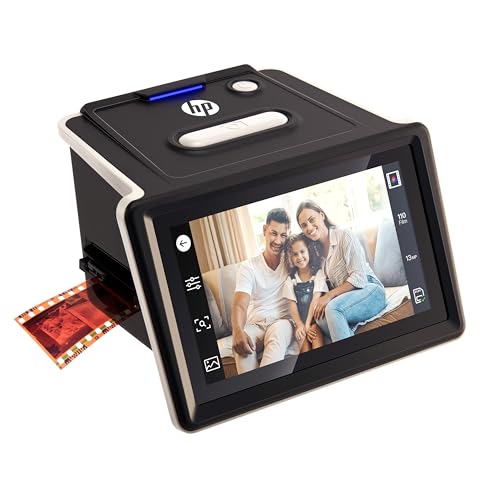
- 5-inch all-angle touchscreen
- Supports 135, 126, and 110 film
- USB-C powered with SD card storage
Best For: Touchscreen control and versatile everyday scanning
Format-Flexible Favorite
KODAK SCANZA Film & Slide Scanner
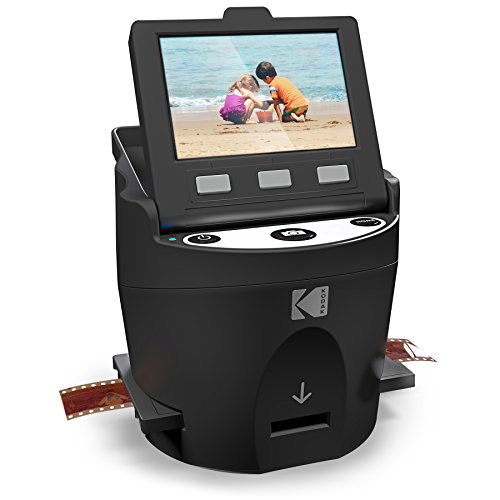
- Supports 35mm, 126, 110, Super 8, and 8mm
- Includes multiple adapters and useful cables
- Tilting 3.5-inch LCD with one-touch scanning
Best For: Digitizing a broad range of supported film formats
Best Smartphone Film Scanner

- Uses a smartphone to capture scans
- Supports 35mm slides and negatives
- Folds compactly for storage and travel
Best For: Casual smartphone-based film digitizing
Best Large-Screen Film Scanner

- Scans multiple negative and slide formats
- Includes a 5-inch LCD for previews
- Offers USB and HDMI output options
Best For: Mixed-format home archiving and family viewing
Best Plug-and-Play Film Scanner

- Scans 135 negatives and slides to JPEG
- Requires no drivers or complex software
- Includes a 2.4-inch preview screen
Best For: Simple 35mm home archiving
Best Overall – KODAK Slide N Scan 22MP
The KODAK Slide N Scan is a practical choice among portable film scanners for digitizing 135, 110, and 126 negatives plus 135, 110, and 126 slides. Its large 5-inch LCD lets you preview and make basic adjustments without relying on a computer.
Best For: Families seeking a simple standalone scanner with a large built-in display and broad film-format support.
Pros:
- Supports several common negative and slide formats.
- 5-inch LCD includes gallery viewing and basic editing.
- Saves directly to SD or SDHC cards up to 32GB.
- Includes film holders, adapters, cables, and a cleaning brush.
Cons:
- SD card is not included.
- Requires a Windows 7-or-newer system for computer use.
- Its supported formats do not include every film type.
With one-touch controls, direct SD saving, and HDMI connectivity, this model balances convenience and flexibility for home archiving.
Best Complete Bundle – DigitPro Photo, Slide & Negative Scanner
This DigitPro model stands out among portable film scanners for its included accessories and standalone operation. It handles film, slides, printed photos, and business cards, then saves scans to the included 8GB SD card.
Best For: Beginners and families who want an all-in-one digitizing kit with a long warranty.
Pros:
- Scans 35mm slides, 135 and 110 negatives, photos, and business cards.
- Large 5-inch HD screen supports wide-angle viewing.
- Works without a computer, software, apps, or drivers.
- Includes an 8GB SD card and a 3-year warranty.
Cons:
- Its listed resolution is 1080P rather than a megapixel figure.
- At 1.5 kg, it is heavier than the other listed options.
- Film-format support is more limited than models that include Super 8.
The bundled card, trays, and accessories make this an especially convenient starting point for mixed photo and film collections.
Best for Fast Scanning – Magnasonic FS71 24MP
The Magnasonic FS71 is one of the more versatile portable film scanners, supporting 35mm, 110, 126, and Super 8 negatives along with 135, 126, and 110 slides. It can capture a scan in less than five seconds and save files directly to an SD card.
Best For: Users scanning large collections who value speed, format flexibility, and on-device controls.
Pros:
- Captures 24MP JPEG files.
- Supports Super 8 as well as 35mm, 110, and 126 film.
- Scans photos in less than five seconds each.
- Offers brightness, RGB correction, flip, and mirror controls without a computer.
Cons:
- SD card is not included.
- HDMI cable is not included.
- Backed by a one-year manufacturer warranty.
Its fast workflow and unusually broad format compatibility make the FS71 a strong option for ambitious home archiving projects.
Best for Direct SD Saving – KODAK Slide N Scan Max
The KODAK Slide N Scan Max is a convenient pick among portable film scanners for users who want a smooth loading process and computer-free saving. It supports 135, 110, and 126 slides and negatives, with direct storage to SD or SDHC cards up to 32GB.
Best For: Users who prioritize streamlined feeding, one-touch adjustments, and straightforward SD-card archiving.
Pros:
- Smooth-moving tray helps feed film continuously.
- Supports 135, 110, and 126 slides and negatives.
- Saves directly to SD or SDHC cards up to 32GB.
- Produces images up to 4208×3120 resolution from its CMOS sensor with interpolation.
Cons:
- SD or SDHC card is not included.
- Does not list HDMI connectivity.
- Its one-year warranty is limited.
The Max is a sensible fit for uncomplicated scanning sessions, especially when avoiding a computer during the initial digitizing workflow matters most.
Large-Screen Choice – ClearClick Virtuoso 3.0
The ClearClick Virtuoso 3.0 is a practical option among portable film scanners for users who want a large preview screen and computer-free operation. It scans 35mm, 110, and 126 negatives, plus 50mm slides, saving images to an SD card.
Best For: Users who prioritize a large 7-inch display and straightforward, standalone scanning.
Pros:
- Large 7-inch screen provides real-time previews while scanning.
- Supports 35mm, 110, and 126 negatives along with 50mm slides.
- Works without a computer or drivers and supports 14MP or interpolated 22MP output.
- Includes a two-year warranty, extendable to three years with registration.
Cons:
- SD card is not included and supports cards of 32GB or less.
- Mini HDMI cable is not included.
Its large display and standalone design make the Virtuoso 3.0 especially convenient for reviewing and digitizing family film collections without setting up a computer.
Touchscreen Pick – HP FilmScan HPFS500
The HPFS500 brings touchscreen controls to portable film scanners, with a 5-inch all-angle display for previewing, editing, and browsing images. Its quick-load tray handles 135, 126, and 110 film strips and positive slides, while scans save directly to an SD card.
Best For: Users who want touchscreen navigation and USB-C-powered scanning for several common film formats.
Pros:
- 5-inch touchscreen supports previewing, editing, and gallery viewing.
- Compatible with 135, 126, and 110 negative strips and positive slides.
- Uses a 13MP CMOS sensor with up to 22MP interpolation.
- Can run from a PC USB connection or an external 5V adapter.
Cons:
- SD card is required for saving scans but is not listed as included.
- Has a one-year limited warranty.
The HPFS500 is a flexible choice if you prefer a touch interface and USB-C power while digitizing a mix of common negatives and slides.
Format-Flexible Favorite – KODAK SCANZA Film & Slide Scanner
The KODAK SCANZA stands out among portable film scanners for its broad format support and included accessories. It converts 35mm, 126, 110, Super 8, and 8mm negatives and slides to JPEG files, with a tilting 3.5-inch display and multiple film adapters.
Best For: Families and hobbyists digitizing several supported film formats with included cables and adapters.
Pros:
- Supports 35mm, 126, 110, Super 8, and 8mm negatives and slides.
- Includes multiple film inserts, a cleaning brush, AC adapter, HDMI cable, and video cable.
- 3.5-inch display has adjustable brightness and a tilting design.
- Offers one-touch scanning and image adjustments for RGB and resolution.
Cons:
- Does not convert film formats beyond those specifically listed.
- SD card is not included, though cards up to 128GB are supported.
- Its display is smaller than the screens on the other listed models.
With its extensive adapter set and support for Super 8 and 8mm, the SCANZA is a strong fit for collections that extend beyond standard 35mm film.
Best Smartphone Film Scanner – Foldable 35mm Digitizer
If you want a simple way to digitize a small collection of 35mm slides and negatives, this portable film scanner uses your smartphone as the camera. Its foldable design is convenient for storage and travel, though final image quality depends on your phone’s camera.
Best For: Smartphone users who want an inexpensive, compact solution for occasional 35mm film scanning.
Pros:
- Works with 35mm slides and film negatives.
- Foldable construction saves space when stored or transported.
- Built-in LED backlight and free editing/sharing app support a straightforward workflow.
Cons:
- Image quality is limited by the resolution of the smartphone camera.
- Requires a smartphone rather than scanning independently.
This is a practical pick for casual digitizing, travel, and family projects. It is less suitable if you need consistent standalone scanning or greater control over capture quality.
Best Large-Screen Film Scanner – 22MP Multi-Format Scanner
For broader media compatibility and a self-contained scanning setup, this portable film scanner includes a 5-inch LCD, one-touch controls, and support for several film formats. It can save scans to internal memory or an SD card and offers USB and HDMI connections for transfer or viewing.
Best For: Families and home archivists digitizing mixed-format film who want a large preview screen and flexible output options.
Pros:
- Supports 35mm/135, 110, 126, 50mm slides, and Super 8 film.
- Large 5-inch LCD enables instant preview, playback, and basic adjustments.
- Includes internal 128MB memory, SD-card support up to 64GB, USB transfer, and HDMI output.
- Comes with multiple holders, cables, power adapter, cleaning brush, and a manual.
Cons:
- SD card is not included.
- Its 0.6 kg weight is higher than the smartphone-based option in this roundup.
With its wide format support and generous display, this model is the most versatile choice here for larger family archives. The included accessories also reduce the need to buy setup essentials separately.
Best Plug-and-Play Film Scanner – Compact 35mm Digitizer
This compact portable film scanner is designed for straightforward 35mm archiving without computer drivers or complicated software. It converts negatives and slides to JPEG files, provides a built-in 2.4-inch preview screen, and transfers scans to a computer through USB.
Best For: Beginners, parents, and grandparents who want an uncomplicated standalone tool for 35mm memories.
Pros:
- Converts 135 film negatives and slides to 5MP or 10MP JPEG images.
- Plug-and-play operation requires no driver installation.
- Built-in screen supports previewing, flipping, mirroring, and brightness adjustment.
- Compact design includes easy-load adapters for continuous feeding.
Cons:
- Requires a standard SD card up to 32GB, which is not included.
- Supports 35mm film and slides rather than the broader range of formats supported by the multi-format model.
This scanner keeps the process approachable while still offering basic on-device editing and TV or computer connectivity. It is a sensible choice when ease of use and compact storage matter more than extensive format support.
How We Picked the Best Portable Film Scanners
We focused on scanners that are genuinely practical for home digitization rather than desktop office scanners with limited film capabilities. Our comparison considers support for common formats such as 35mm, 110, and 126 film, along with Super 8 and 8mm compatibility where offered. We also looked at advertised optical or interpolated resolution, preview-screen size, transfer options, included holders, power requirements, and overall ease of operation.
Because product listings can use different terminology for resolution and image output, treat megapixel ratings as a useful comparison point rather than a guarantee of professional archival quality. Clean film, careful handling, and accurate exposure remain important to final results.
Quick Comparison
Most models in this roundup are designed for straightforward, stand-alone scanning. Larger 5-inch and 7-inch displays are easier to use when reviewing frames, while compact 2.4-inch or 3.5-inch screens can be preferable for storage and travel. Models supporting 110 and 126 film are more versatile for family collections, and Super 8 or 8mm support is valuable for older movie-film archives.
Look for USB storage or computer-transfer support if you plan to edit, back up, or print scans. HDMI output can also be useful for viewing images on a larger screen, but it is not essential for basic scanning.
Key Buying Factors for Portable Film Scanners
Film-Format Compatibility
Start by checking the actual formats in your collection. A scanner limited to 35mm may be sufficient for standard negatives and slides, but 110 and 126 support can prevent the need for adapters or a second device. Confirm whether Super 8 and 8mm support applies to the film you own.
Resolution and Image Quality
Higher advertised megapixel counts can produce larger files, but they do not automatically deliver sharper or more accurate scans. Consider the scanner’s sensor, color handling, exposure controls, and whether it creates files suitable for your intended use. Casual sharing requires less detail than restoration or large prints.
Screen, Controls, and Workflow
A built-in LCD lets you inspect framing before saving each image. Larger screens are helpful for older users and extensive scanning sessions. One-touch controls, quick frame advancement, and included film holders can make a bigger difference to productivity than headline specifications.
Portability and Connectivity
Choose a compact, lightweight model if you will scan in multiple rooms or at family members’ homes. Check how files are saved, whether a memory card is required, and whether the scanner connects directly to a computer or television. Also verify what cables, adapters, and holders are included.
Who Should Buy Which Portable Film Scanners?
For broad family collections: Choose a model supporting 35mm, 110, and 126 film, ideally with a large screen and simple frame-by-frame workflow.
For frequent scanning: Prioritize a larger display, comfortable controls, fast handling, and dependable file transfer. A 22MP or 24MP model may suit users who want sizeable digital files for editing or printing.
For Super 8 or 8mm archives: Select a scanner that explicitly lists those formats and verify the included holders before buying.
For occasional or travel use: A compact foldable or smaller-screen scanner can be the most convenient choice, especially when portability matters more than advanced controls.