
Choosing a 3d scanner for large objects is mostly about balancing scan range, tracking stability, and usable accuracy. Bigger items expose weak sensors fast, so the best picks need reliable alignment, fast capture, and enough working distance to keep the scan clean.
Below, we focus on scanners that are practical for everything from furniture and car parts to statues, prototypes, and full-size props. The goal is simple: help you find a scanner that fits your object size, detail needs, and workflow without overpaying for features you will not use.
Best 10 3d Scanner for Large Objects Picks for 2026
Photogrammetry-Ready Large-Object Capture
Revopoint MIRACO Plus 3D Scanner

- Far mode handles large surfaces efficiently
- Photogrammetric kit supports accurate measurement
- 48MP color capture and portable all-in-one design
Best For: portable large-object scanning with measurement-focused workflows
Budget-Friendly Smart Tracking
3DMakerpro Moose Lite Premium Kit

- 0.05mm accuracy with AI visual tracking
- Supports Android, iOS, Windows, and macOS
- Lightweight, quiet design for portable scanning
Best For: entry-level medium-object scanning and 3D printing
Ultra-Precision Dual-Mode Scanner

- Up to 0.02mm accuracy with blue laser scanning
- Blue light and NIR modes for flexible workflows
- Covers objects from 5 mm to 2000 mm
Best For: high-precision scanning from small parts to very large objects
Easy Markerless Scanning
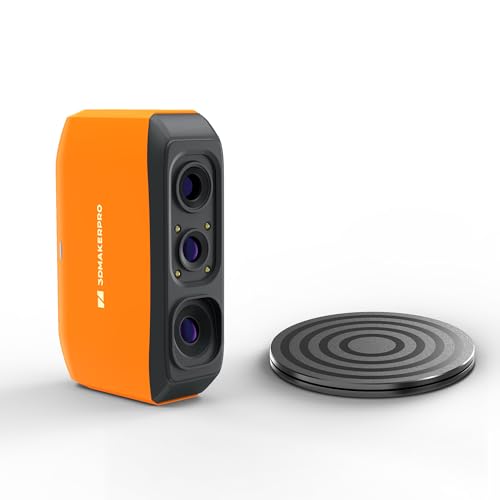
- Markerless tracking and anti-shake help simplify scanning
- 0.07mm accuracy for small to medium objects
- JMStudio adds editing, fusion, and export tools
Best For: beginners scanning small to medium objects for printing or prototypes
Best All-Round Large-Object Scanner

- Scans from 10mm up to 2000mm objects
- Dual-lens setup for small and large subjects
- Handles black/metal surfaces without spray
Best For: Mixed-size scanning, including cars and other large objects
Most Industrial-Grade Detail

- Up to 0.01 mm precision for detailed work
- Five scan modes for different parts and surfaces
- Handles dark, shiny, and metal surfaces without spray
Best For: Precision industrial scanning and reverse engineering
Best Budget-Friendly Big-Object Option

- Scans objects from 0.8" to 78"
- 30 fps handheld scanning with quad cameras
- No-spray scanning for dark or metallic surfaces
Best For: Handheld large-object scanning on a simpler budget
Precision Laser Scanner
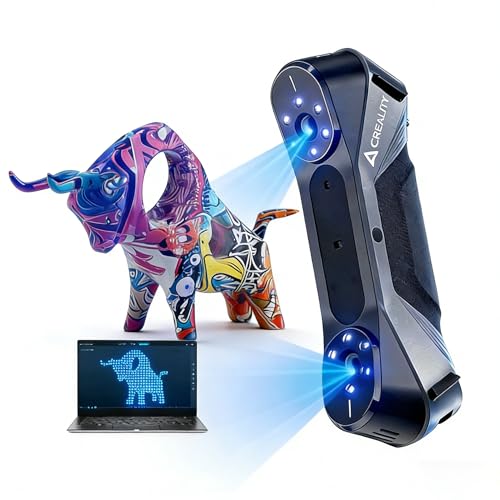
- 0.02mm accuracy for detailed results
- Scans objects from 5mm to 2000mm
- Blue laser + NIR modes with 24-bit RGB
Best For: Accuracy-focused users scanning everything from small parts to large objects
Portable Beginner Scanner

- Wireless WiFi6 scanning with easy setup
- 0.1mm accuracy and 24-bit color
- Only 105g with travel-friendly accessories
Best For: Beginners who want a portable scanner for medium to large objects
Pro Large-Format Scanner

- Up to 0.02mm accuracy and 660,000 points/sec
- Scans from 5mm to 4000mm
- Handles black, metallic, and some transparent surfaces
Best For: Professionals needing a large-format scanner for complex workflows
Photogrammetry-Ready Large-Object Capture – Revopoint MIRACO Plus 3D Scanner
If you need a 3d scanner for large objects that can also preserve fine details, the Revopoint MIRACO Plus is built for mixed-size workflows. Its Far mode is designed for quickly capturing large surfaces, while the photogrammetric metrology kit helps improve measurement accuracy on complex, oversized items.
Best For: Users who want a portable all-in-one scanner for large objects, precision measurements, and scan-to-CAD workflows.
Pros:
- Photogrammetric kit includes scale bars and coded targets for large-object measurement support
- Far mode captures large surfaces quickly, while Near mode handles small details
- 48MP RGB camera and flash LEDs help produce more lifelike color scans
- Portable design with 6-inch flip screen, Wi-Fi 6, and multiple export formats
Cons:
- Revo Design for scan-to-CAD is sold separately
- Hybrid photogrammetric workflow may be more involved than simpler entry-level scanners
Overall, the MIRACO Plus stands out for buyers who need one scanner that can move from small parts to big objects without switching tools. It is a strong pick when accuracy, portability, and workflow flexibility matter more than a bare-bones setup.
Budget-Friendly Smart Tracking – 3DMakerpro Moose Lite Premium Kit
The 3DMakerpro Moose Lite is a practical 3d scanner for large objects only within its stated size range, but it is especially appealing for medium-sized projects that still need fine detail. With AI visual tracking, 0.05mm accuracy, and a 15mm to 1500mm scan range, it offers a capable balance of precision and ease for desktop scanning.
Best For: Entry-level users who want a lightweight scanner for medium objects and detailed 3D printing projects.
Pros:
- 0.05mm accuracy and 0.10mm resolution for detailed models
- AI visual tracking and point-cloud processing simplify scanning workflow
- Supports Android, iOS, Windows, and macOS
- Lightweight, quiet design makes it easy to handle and use anywhere
Cons:
- Best suited to medium objects rather than very large items
- Entry-level users should expect a learning curve for good results
- Successful scanning benefits from basic CAD or 3D modeling knowledge
For shoppers who want a compact scanner with strong detail capture, the Moose Lite is an approachable option. It makes the most sense if your projects fall in the medium-object range and you value portability over industrial-scale coverage.
Ultra-Precision Dual-Mode Scanner – Creality CR-Scan Raptor
If your priority is a 3d scanner for large objects with serious detail capture, the Creality CR-Scan Raptor is one of the strongest options here. It combines blue laser and NIR modes, high-speed scanning, and a wide object-size range from tiny parts to very large items, making it a flexible choice for demanding projects.
Best For: Users who need high-precision scanning across a very wide size range, from small parts to large objects.
Pros:
- Up to 0.02mm accuracy with 7 parallel blue laser lines
- Blue light and NIR modes support marker-based and marker-free scanning
- Scans objects from 5 mm up to 2000 mm, covering small to large projects
- Fast scanning speeds up to 60fps in blue light mode
Cons:
- Requires a fairly powerful PC setup to run properly
- May be more scanner than casual users need for simple projects
The Raptor is a compelling pick when accuracy and speed both matter, especially if your workflow includes oversized objects. Buyers should be ready for the system requirements, but the tradeoff is a highly capable scanner with broad versatility.
Easy Markerless Scanning – 3DMakerpro Fox 3D Scanner
The 3DMakerpro Fox is an approachable 3d scanner for large objects only within its supported range, but it is mainly geared toward small to medium projects. With markerless tracking, anti-shake support, and 0.07mm accuracy, it offers a relatively easy way to digitize everyday parts, prototypes, and human forms.
Best For: Beginners and DIY users scanning small to medium objects for 3D printing or prototyping.
Pros:
- Markerless tracking reduces setup time and eliminates target dots
- NIR light supports safe face and body scanning
- 0.07mm accuracy is solid for entry-level digitization
- JMStudio includes scanning, editing, fusion, and export tools
Cons:
- Designed primarily for 40mm to 1200mm objects, not very large items
- Results may require patience and a learning curve
- Needs a capable PC, with a dedicated GPU strongly recommended
Fox makes sense if you want a simple path into 3D scanning without the hassle of marker placement. It is best viewed as a practical starter scanner for moderate-size objects, not as a heavy-duty solution for oversized assets.
Best All-Round Large-Object Scanner – Creality CR-Scan Otter
If you want a 3d scanner for large objects that can still handle small items, the Creality CR-Scan Otter stands out for its dual-lens design and broad 10mm to 2000mm scanning range. It’s built to move from coins to cars, with one-shot 3D imaging, anti-shake tracking, and support for color capture on a wide range of subjects.
Best For: Users who need one scanner that can cover both very small parts and large objects, including cars, tools, and mixed-size projects.
Pros:
- Dual long- and short-focal lenses support objects from 10 x 10 x 10mm up to 2000 x 2000 x 2000mm.
- Up to 20 fps scanning with stabilization to help reduce tracking loss.
- Can scan black and metal objects like car parts and tires without scanning spray.
- Captures full color with an RGB camera and color mapping algorithm.
Cons:
- Wireless mobile use requires accessories for iOS and Android.
- Android direct connection is not supported on Otter and Otter Lite Basic.
- Performance requirements may be demanding for older computers and phones.
For buyers who need versatility more than specialization, the Otter is a strong pick because it stretches from tiny detail work to genuinely large scans. Its main advantage is range, but you’ll want to check system compatibility before buying.
Most Industrial-Grade Detail – Revopoint MetroY Ultra
The Revopoint MetroY Ultra is a strong choice if you need a 3d scanner for large objects-adjacent industrial work where speed, accuracy, and surface handling matter. It combines blue laser scanning, multiple scan modes, and fast capture rates for tight-tolerance measurement, reverse engineering, and inspection workflows.
Best For: Industrial users who need high-precision scans, fast capture, and reliable performance on dark or shiny surfaces.
Pros:
- Up to 0.01 mm single-frame precision and 0.015 + 0.04 mm x L(m) volumetric accuracy.
- Five scan modes, including laser cross-lines, parallel lines, single-line, structured light, and turntable scanning.
- Up to 90 FPS scanning speed with NVIDIA GPU support.
- Scans black, glossy, and metallic parts without scanning spray and works outdoors up to 100,000 lux.
Cons:
- More focused on industrial parts and medium-sized objects than very large items.
- Best performance at 90 FPS depends on an NVIDIA GPU.
- Likely more scanner than casual users need for simple hobby projects.
MetroY Ultra is less about scanning huge objects and more about doing demanding scans quickly and precisely. If your buying decision comes down to accuracy, surface versatility, and workflow efficiency, this model is built for that job.
Best Budget-Friendly Big-Object Option – Creality Otter Lite Basic
The Creality Otter Lite Basic is a practical 3d scanner for large objects if you want fast handheld scanning without moving up to a more complex industrial setup. Its quad-camera design, wide object size range, and spray-free scanning for dark or metallic surfaces make it a flexible option for larger household, automotive, and display projects.
Best For: Buyers who want an affordable-feeling, easy-to-use handheld scanner for large objects, automotive parts, and full-color models.
Pros:
- Scans objects from 0.8″ to 78″ with a wide single-frame capture area at longer distances.
- 4-camera design balances fine detail and broad coverage for big projects.
- Up to 30 fps scanning for a smoother workflow.
- Can scan black and metallic surfaces without powder or spray, even outdoors in sunlight up to 30,000 lux.
Cons:
- Top size range is smaller than the Creality Otter’s 2000mm capability.
- Optional Scan Bridge handle is sold separately for added stability.
- Best for handheld scanning; not positioned as an industrial metrology tool.
Otter Lite Basic is a good middle-ground pick when you want large-object coverage, color capture, and easy handling without paying for more specialized features. It looks especially useful for users scanning cars, machinery, or other sizable objects in varied lighting.
Precision Laser Scanner – Creality CR-Scan Raptor
If you need a 3d scanner for large objects that still preserves fine detail, the Creality CR-Scan Raptor is built for that middle ground between speed and metrological accuracy. It covers objects from 5mm to 2000mm, uses a blue 7-line laser plus infrared structured light, and is designed to handle everything from industrial components to faces and full bodies.
Best For: Users who want high-precision scanning for large objects, mixed-size parts, and professional 3D workflows on Windows or macOS.
Pros:
- Up to 0.02mm accuracy for measurement-grade scanning
- Scans large objects from 5mm to 2000mm
- 60 FPS scanning with anti-shake performance
- 24-bit RGB texture capture and outdoor-capable workflow
Cons:
- Requires a fairly strong computer, including 8+ cores and 16+ threads
- Best results depend on the right mode and workflow for the object size
Overall, the Raptor is a strong choice if your priority is accuracy first and size flexibility second. It looks especially well suited to users who want one scanner that can cover both detailed objects and larger parts without sacrificing finish or texture capture.
Portable Beginner Scanner – Creality CR-Scan Ferret Pro
The Creality CR-Scan Ferret Pro is a practical 3d scanner for large objects if you want something lightweight, wireless, and easy to get started with. It scans objects from 50mm to 2000mm, supports full-color capture, and is built for flexible use across Windows, macOS, Android, and iOS.
Best For: Beginners, DIY creators, and 3D printing users who want a portable scanner for medium to large objects.
Pros:
- Wireless WiFi6 scanning with cross-platform support
- Up to 0.1mm accuracy with 24-bit full-color capture
- Very lightweight at 105g for easy portability
- Includes useful accessories like a tripod, power bank, and carrying case
Cons:
- Not suitable for very small or highly detailed items like jewelry
- Works best when reflective, transparent, and very dark surfaces are avoided
For shoppers who value simplicity and portability over top-end precision, the Ferret Pro is an approachable option. It makes the most sense when your projects are large enough to fit its scanning range and you want wireless convenience without a heavy setup.
Pro Large-Format Scanner – Creality CR-Scan Raptor Pro
If you want a 3d scanner for large objects with professional-grade capability, the Creality CR-Scan Raptor Pro is the most ambitious option here. It supports items from 5mm up to 4000mm, combines blue lasers with NIR structured light, and is designed for fast scanning of medium to massive objects with strong texture and material handling.
Best For: Professionals scanning large, complex, or difficult materials across industrial, design, or reverse-engineering workflows.
Pros:
- Up to 0.02mm accuracy with high point capture speed
- Scans objects from 5mm to 4000mm
- Handles black, metallic, and even some transparent surfaces without spray powder
- 60fps laser scanning plus wireless and outdoor-ready operation
Cons:
- Has demanding system requirements, especially on Windows
- Heavier and more specialized than entry-level handheld scanners
The Raptor Pro stands out when scanning range and workflow flexibility matter as much as detail. It is the best fit for users who need one handheld scanner to cover everything from small parts to very large objects and who want software compatibility with professional 3D tools.
How We Picked the Best 3d Scanner for Large Objects
For a 3d Scanner for Large Objects, we prioritized usable scan volume, tracking confidence, capture speed, and accuracy claims that make sense for real-world handheld scanning. We also favored models that support full-color capture, anti-shake tracking, or multi-mode scanning, since larger targets are harder to align than small parts.
We looked for products that can handle a wide object-size range, work well at practical distances, and suit both hobby and pro workflows. Ease of setup mattered too, because large-object scanning often means more walking, more passes, and more chances for drift.
Quick Comparison
If you want the fastest workflow, look at scanners with high FPS and strong tracking. If you want the best detail, prioritize lower stated accuracy and laser-based capture. If you need versatility, choose a model that can move between small, medium, and large subjects without changing your entire process.
Key Buying Factors for 3d Scanner for Large Objects
Scan Range and Working Distance
Large objects need a scanner that stays stable at a comfortable distance. A wider capture range makes it easier to scan walls, vehicle panels, furniture, and oversized parts without constantly backing up or losing tracking.
Tracking and Anti-Shake Performance
When scanning big surfaces, hand movement and feature-poor areas can cause drift. Good tracking, anti-shake tools, and multi-lens or laser-assisted systems help keep the model aligned across longer passes.
Accuracy Versus Speed
Higher speed is useful for large objects because it reduces missed areas and fatigue. But if you need dimensional fidelity for reverse engineering or fitment work, pay close attention to stated accuracy and the scanner’s ability to maintain it over larger surfaces.
Color and Surface Handling
Full-color scanning is valuable for art, props, collectibles, and documentation. For reflective, dark, or low-texture surfaces, consider whether the scanner supports laser modes, spray-free scanning, or other methods that improve surface readability.
Software and Workflow
A strong app or desktop suite can matter as much as the hardware. Look for easy mesh cleanup, alignment tools, export formats you actually use, and a workflow that matches your skill level.
Who Should Buy Which 3d Scanner for Large Objects?
Choose a budget-friendly handheld model if you are scanning occasional large items and want simple setup. Pick a higher-accuracy laser or hybrid scanner if your projects require tighter measurements, industrial parts, or cleaner geometry. If you need all-around flexibility, go with a scanner that handles both medium and large objects well, since that is often the sweet spot for most buyers.
In short, the best choice depends on whether you value speed, detail, color, or ease of use most. For many shoppers, the best 3d Scanner for Large Objects is the one that stays reliable across long scans, not the one with the most impressive spec sheet.