
Choosing the right scanner can make the difference between a frustrating capture session and a clean, usable model. The best 3D scanners in 2026 now balance speed, accuracy, and ease of use better than ever.
Whether you’re scanning parts for 3D printing, product design, or reverse engineering, this roundup focuses on practical buyer needs—not just specs on paper.
Best 10 3d Scanners Picks for 2026
Industrial Precision
Revopoint MetroX Pro Blue-Laser Scanner

- 0.01 mm single-frame precision
- Multiple laser and structured-light modes
- Scans shiny or dark surfaces without spray
Best For: Industrial measurement and reverse engineering
Portable AI Scanning
Creality Pika Wireless 3D Scanner

- Compact 260g wireless design
- Dual laser and NIR scanning modes
- AI body completion and retexturing
Best For: Portable scanning and mixed-size objects
Beginner-Friendly Medium Format
3DMakerpro Fox Entry-Level 3D Scanner

- 0.07 mm accuracy and 0.10 mm resolution
- Markerless AI tracking relocks fast
- JMStudio handles scanning and editing
Best For: Beginners and hobbyists
Wireless Dual-Light
Creality Pika 7-Line Blue Laser Scanner

- 7-line blue laser plus infrared structured light
- 0.03 mm accuracy with marker-free laser mode
- Wireless touchscreen design with Wi‑Fi 6
Best For: Wireless scanning of small parts and larger scenes
Wireless Everyday Scanner

- Up to 0.1mm accuracy and 30FPS scanning
- WiFi 6 wireless transfer for smoother workflow
- Anti-shake tracking helps beginners scan more easily
Best For: Beginners and hobbyists who want a portable 3D scanner for printing and general object capture
Industrial Detail Scanner

- Up to 0.01 mm single-frame precision
- Five scan modes for small parts and deep holes
- Handles dark, shiny, and metallic surfaces without spray
Best For: Industrial inspection, reverse engineering, and high-detail scans of small-to-medium parts
High-Precision Hybrid Scanner

- Up to 0.02mm accuracy with blue laser scanning
- Blue laser and NIR modes for different scan types
- Covers tiny parts through large objects up to 2000 mm
Best For: Mixed-use scanning where precision, versatility, and object-size range all matter
Premium AI 3D Scanner
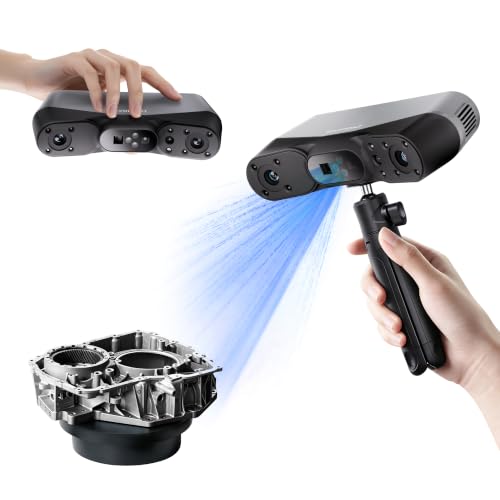
- 0.03 mm single-frame accuracy
- Five scan modes for varied objects
- WiFi 6.0 and battery grip support
Best For: high-accuracy 3D printing and reverse engineering
Wireless Starter 3D Scanner

- Up to 0.1 mm full-color scanning
- WiFi6 wireless support across platforms
- Lightweight 105g portable design
Best For: beginners scanning medium-sized objects
Standard AI 3D Scanner

- 0.03 mm single-frame accuracy
- Five modes for indoor and outdoor scanning
- WiFi 6.0 with cross-screen preview
Best For: buyers who want core POP 4 performance without bundled extras
Industrial Precision – Revopoint MetroX Pro Blue-Laser Scanner
If you need one of the more capable 3d scanners for precision modeling, inspection, or print-ready reverse engineering, the Revopoint MetroX Pro is built around accuracy and workflow speed. Its blue laser and structured-light modes give you flexibility for detailed parts, shiny surfaces, and larger objects without sacrificing measurement-focused performance.
Best For: Industrial measurement, reverse engineering, and high-detail 3D printing workflows.
Pros:
- Up to 0.01 mm single-frame precision and 0.02 mm accuracy for demanding detail work
- Multiple scan modes, including cross-line lasers, parallel lines, and 62-line structured light
- Handles shiny or dark surfaces in laser modes without scanning spray
- Auto turntable and real-time mobile streaming help streamline scanning sessions
Cons:
- Revo Design and Revo Measure are sold separately
- Those paid software tools support Windows only
- It is aimed more at precision workflows than casual plug-and-play use
Overall, the MetroX Pro is a strong fit when your scanning priorities are accuracy, surface flexibility, and professional output. It stands out for users who want a scanner that can bridge industrial measurement and creative 3D production.
Portable AI Scanning – Creality Pika Wireless 3D Scanner
The Creality Pika is one of the more travel-friendly 3d scanners, combining wireless operation, a compact body, and dual-mode capture for both small objects and full-body scans. It is designed for users who want high accuracy, fast scanning, and AI-assisted cleanup in a device that can move easily between studio, workshop, and outdoor use.
Best For: Portable scanning, mixed object sizes, and AI-assisted 3D capture.
Pros:
- Compact 260g design with Wi-Fi 6 wireless PC mode and a 3-inch touchscreen
- Dual scanning modes: 7-line blue laser for detail and NIR structured light for full-body work
- Up to 0.03 mm accuracy and 0.1 mm resolution for small parts and collectibles
- AI features include body completion, retexturing, and hole filling
Cons:
- Requires a smartphone or computer to run the scanning software
- Best portability comes with the tradeoff of a smaller on-device form factor
- Outdoor use still depends on compatible workflow and setup
For buyers who want a flexible scanner that can handle both precision objects and larger subjects, the Pika offers a well-rounded mix of mobility and capability. Its AI tools and wireless design make it especially appealing for faster, cleaner results.
Beginner-Friendly Medium Format – 3DMakerpro Fox Entry-Level 3D Scanner
If you want an approachable entry point into 3d scanners, the 3DMakerpro Fox focuses on simple operation and useful detail for hobby projects and everyday modeling. It offers a balanced medium-format scanning solution with accuracy and software support aimed at users who want dependable results without a steep learning curve.
Best For: Beginners and hobbyists who want an accessible scanner for practical 3D printing and modeling.
Pros:
- Entry-level scanner with 0.07 mm accuracy and 0.10 mm resolution
- Markerless AI visual tracking helps recover quickly if handheld movement gets messy
- JMStudio combines scanning, editing, and optimization in one workflow
- Designed for useful results in 3D printing, measurement, and inspection
Cons:
- Positioned as an entry-level model, not an industrial scanner
- Medium-format focus may not suit every tiny or extra-large capture need
- Less advanced than higher-end multi-mode systems
The Fox is a sensible choice if you want a scanner that makes the basics easier while still delivering detail you can use. It is a practical pick for first-time buyers who value workflow simplicity and reliable output.
Wireless Dual-Light – Creality Pika 7-Line Blue Laser Scanner
The Creality Pika Wireless pairs a blue laser and infrared structured light system with cordless convenience, making it a versatile option among 3d scanners. It is aimed at users who want detailed scans of small parts, full-body capture, and real-time workflow features without relying on constant cable management.
Best For: Users who want a wireless, dual-light scanner for detailed parts and larger scenes.
Pros:
- Dual light sources: 7-line blue laser and infrared structured light
- Up to 0.03 mm accuracy for fine detail and precision components
- Wireless scanning with a built-in 3-inch touchscreen and Wi-Fi 6
- AI texture enhancement, body completion, and auto hole filling improve output
Cons:
- Cannot operate as a fully standalone scanner
- Requires a smartphone or computer to run the scanning software
- Performance depends on the supported connected-device workflow
For buyers who want a more flexible scanning setup, the Pika Wireless brings together portability, detail, and AI-assisted cleanup. It is especially appealing if you want one scanner that can handle both technical parts and larger full-body projects.
Wireless Everyday Scanner – Creality CR-Scan Ferret Pro
If you want a practical entry in the world of 3d scanners, the Creality CR-Scan Ferret Pro is built around convenience as much as accuracy. It offers up to 0.1mm accuracy, 30FPS scanning, WiFi 6 wireless transfer, and anti-shake tracking, making it a strong fit for users who want smoother scans without a complicated setup.
Best For: Beginners and hobbyists who want a wireless 3d scanner for 3D printing, mobile scanning, and general-purpose object capture.
Pros:
- Up to 0.1mm accuracy with 0.16mm resolution for detailed models
- WiFi 6 support for faster, more stable wireless data transfer
- Anti-shake tracking helps improve scan success during hand movement
- Supports OBJ, STL, and PLY exports for common workflows
Cons:
- Not ideal for highly reflective, transparent, or very dark surfaces
- Wireless Android and iPhone use requires the dedicated bridge
- Requires compatible hardware and software versions for each platform
The Ferret Pro stands out if you want a flexible scanner that can move between PC and mobile use. It is a solid balance of portability, speed, and ease of use rather than a pure industrial metrology tool.
Industrial Detail Scanner – Revopoint MetroY Ultra
Among 3d scanners aimed at precision work, the Revopoint MetroY Ultra is positioned for tight-tolerance jobs, inspection, and reverse engineering. It combines up to 0.01 mm single-frame precision, blue laser scanning, five scanning modes, and support for challenging surfaces and outdoor use.
Best For: Users who need high-detail scanning for industrial inspection, reverse engineering, and small-to-medium parts.
Pros:
- Up to 0.01 mm single-frame precision for fine detail capture
- Five scanning modes handle small parts, deeper holes, and turntable work
- Scans black, glossy, and metallic surfaces without spray
- Wi-Fi 6 and battery grip add mobility for field or bench work
Cons:
- Requires a powerful PC or Mac for best performance
- More specialized than a typical beginner-friendly scanner
- Higher-end hardware needs may limit casual use
The MetroY Ultra is the strongest choice here if accuracy and versatility matter more than simplicity. Its scan modes and surface handling make it a better fit for serious technical workflows than for casual 3D printing alone.
High-Precision Hybrid Scanner – Creality CR-Scan Raptor
If you need 3d scanners that can cover both precision objects and larger subjects, the Creality CR-Scan Raptor brings together blue laser and NIR scanning in one unit. With up to 0.02mm accuracy, 60fps blue-light scanning, and anti-shake tracking, it is designed for detailed work across a wide object range.
Best For: Users who want one scanner for high-precision parts, faces, bodies, artifacts, and larger objects.
Pros:
- Up to 0.02mm accuracy for sharp, detailed scans
- Blue laser and NIR modes expand scanning options
- Scans objects from 5×5×5 mm up to 2000×2000×2000 mm
- 60fps blue-light mode and 20fps infrared mode support faster capture
Cons:
- Requires a fairly capable Windows or macOS system
- Eye safety caution applies with Class 1 blue light
- Setup may be more involved than simpler consumer scanners
The Raptor is the most versatile option in this group for mixed-use scanning. It is especially appealing if you want one tool that can handle both small precision parts and larger real-world subjects.
Premium AI 3D Scanner – Revopoint POP 4 Premium
If you want a capable 3d scanner for precision work, the Revopoint POP 4 Premium is built for users who need strong detail capture, multiple scan modes, and workflow flexibility. It targets everything from small parts to large components, while also handling reflective or dark surfaces better than many entry-level scanners.
Best For: creators and professionals who want high-accuracy scanning for 3D printing, reverse engineering, and outdoor capture
Pros:
- Up to 0.03 mm single-frame accuracy and 0.03 mm + 0.05 mm x L(m) volumetric accuracy
- Five scanning modes, including blue laser options for reflective metals and deep holes
- Fast capture performance with up to 105 fps in multi-line laser mode and 5,000,000 points/s in full-field mode
- Built-in WiFi 6.0 and a 5500mAh battery grip for untethered scanning
Cons:
- Windows-only AI segmentation may limit that feature for non-Windows users
- Outdoor filter is sold separately for the best bright-light performance
- Advanced feature set may be more than casual users need
This is one of the more versatile 3d scanners in the POP 4 line if you need high accuracy plus broader material and environment support. The Premium version makes the most sense when you want the strongest mobile and outdoor scanning setup in the family.
Wireless Starter 3D Scanner – Creality CR-Scan Ferret Pro
The Creality CR-Scan Ferret Pro is a practical 3d scanner for beginners who want an easy setup and wireless scanning without jumping straight into a more complex pro workflow. Its portable design, full-color capture, and broad device support make it a convenient choice for everyday DIY and 3D printing projects.
Best For: beginners and hobbyists who want a lightweight wireless scanner for medium-sized objects
Pros:
- Easy to start with beginner-friendly operation and simple practice-based results
- Wireless WiFi6 scanning works with Windows, macOS, Android, and iOS
- Full-color 24-bit scanning with up to 0.1 mm accuracy
- Very lightweight at 105g and includes a travel-friendly kit with accessories
Cons:
- Not suitable for very small or highly detailed items like jewelry or precision parts
- Performs best on non-reflective, non-transparent, and non-very-dark surfaces
- Outdoor use is limited to lighting under 30,000 lux
For a starter-friendly 3d scanner, the Ferret Pro focuses on convenience, portability, and cross-platform scanning rather than ultra-fine detail. That makes it a solid fit if you want to scan common household objects, props, or DIY parts with minimal setup.
Standard AI 3D Scanner – Revopoint POP 4 Standard
The Revopoint POP 4 Standard is a strong option if you want a capable 3d scanner with the same core accuracy and mode flexibility as the Premium model, but without the extra accessories bundled in. It is aimed at users who need precise scans for 3D printing, reverse engineering, and mixed indoor-outdoor workflows.
Best For: buyers who want POP 4 scanning performance and can add accessories separately
Pros:
- Up to 0.03 mm single-frame accuracy and 0.03 mm + 0.05 mm x L(m) volumetric accuracy
- Five scanning modes, including laser modes for reflective metal and dark objects
- Fast capture with up to 105 fps and 5,000,000 points/s in full-field mode
- Built-in WiFi 6.0 and phone/tablet cross-screen preview for easier monitoring
Cons:
- Outdoor filter is sold separately
- Battery grip is available separately for untethered outdoor scanning
- Windows-only AI segmentation may not help all users
If you want the POP 4 platform itself, the Standard version gives you the same scanner capabilities described in the notes while leaving add-ons optional. It is a good pick for users who already know which accessories they need and prefer to build out their setup gradually.
How We Picked These 3d Scanners
We focused on the factors that matter most in real-world use: stated accuracy, scan speed, object-size range, tracking stability, lighting or laser method, portability, and software features. We also looked for models that suit different skill levels, from first-time buyers to users who need finer detail for printing or inspection work.
Quick Comparison
In general, blue laser and structured-light systems tend to be better for detail-oriented work, while portable wireless models offer easier setup and better mobility. Higher frame rates can help reduce missed data on larger or more complex objects, while AI-assisted features and body completion tools are useful for people scanning people, cosplay parts, or uneven surfaces.
Key Buying Factors for 3d Scanners
Accuracy and Detail
If you need prints that match the original closely, prioritize lower stated accuracy values and stronger tracking. For small mechanical parts, finer detail matters more than raw scan speed.
Scan Method
Blue laser scanners often excel at capturing edges and reflective details more reliably than basic structured-light models. NIR and hybrid systems can be more flexible for larger objects or body scanning, depending on the software and workflow.
Object Size and Use Case
Check the scanner’s supported size range before buying. Some 3d Scanners are better for compact parts, while others are designed to handle medium-to-large objects, full bodies, or mixed workflows.
Portability and Connectivity
Wireless scanning and lightweight handheld designs make setup easier, especially if you move between workspaces or scan larger items. Wired models can still be a better choice when you want maximum stability.
Software and Post-Processing
Features like AI segmentation, anti-shake tracking, and automatic alignment can save time and reduce failed scans. Good software matters just as much as the hardware, especially for beginners.
Who Should Buy Which 3d Scanners?
Beginners should look for an easy-to-use, stable scanner with helpful automation. Makers and 3D printing users may want a balanced model that handles everyday parts without much setup. Advanced users and professionals should lean toward higher-accuracy options with better tracking, broader material support, and faster capture for demanding workflows.
If you’re choosing between models, start with your primary scan target—small parts, medium objects, or human-scale subjects—then match the scanner’s accuracy, speed, and software to that job. That approach will narrow the field quickly and help you avoid paying for features you won’t use.