
Choosing the right 360 degree camera for virtual tours can make the difference between a smooth, polished walkthrough and a frustrating shoot. The best options balance image quality, stitching, ease of setup, and file handling.
Below, we’ve narrowed the field to 10 standout cameras and kits for real estate, VR experiences, and other immersive content, so you can match the right gear to your workflow and budget.
Best 10 360 Degree Camera for Virtual Tours Picks for 2026
Phone-Based Tour Kit

- Turns your smartphone into a 3D virtual tour setup.
- Includes tripod, rotator, and fisheye lens gear.
- App adds dollhouse, floor plan, and touch-up tools.
Best For: Budget-conscious real estate users who want a guided phone workflow
Premium Image Quality Pick

- Dual 1-inch sensors produce 23MP spherical stills.
- RAW, JPEG, HDR, and 4K 360 video supported.
- Strong choice for low-light and indoor tour shots.
Best For: Professionals who want top-tier 360 still image quality
High-Res Dedicated Bundle

- Captures 8K and 32MP panoramic images.
- One-click shooting with remote app control.
- Includes case, tripod, USB cable, and cloth.
Best For: Creators who want a simple dedicated camera for virtual tours
Storage-Heavy Pro Option

- 51GB internal memory reduces storage management.
- Dual 1-inch sensors deliver 23MP 360 images.
- HDR and transfer features suit real estate workflows.
Best For: Frequent shooters who need premium image quality and lots of storage
Flagship 8K Travel Pick
Insta360 X5 8K 360 Action Camera

- 8K30fps 360° video with dual 1/1.28" sensors
- Triple AI chip design improves low-light results
- Replaceable lenses and waterproof build add durability
Best For: Premium virtual tours, travel, and action footage
Budget-Style Spherical Option

- 4K 360° video at 30 fps
- Built-in 4-channel spatial audio
- Compact design with wireless transfer
Best For: Simple virtual tours, travel, and VR content
Premium Low-Light Choice

- 1-inch 360° imaging for stronger low-light quality
- Native 8K video and 120MP 360° photos
- Built-in storage and invisible selfie stick kit
Best For: High-end virtual tours and travel creators
Professional 360 Tour Camera

- 11K stills and 5.7K 360 video
- Built-in GPS for location-aware tours
- OLED touchscreen and interchangeable battery
Best For: Real estate pros and tour creators who want high-resolution, GPS-tagged 360 capture
Action-Focused 360 Tour Pick
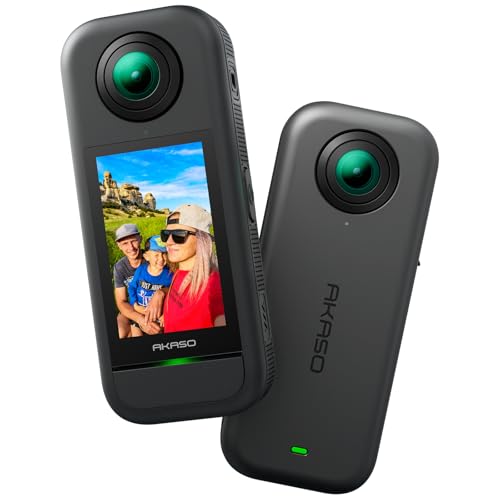
- 5.7K 360 video and 72MP photos
- 360-SuperSmooth plus Horizon Lock stabilization
- Invisible selfie stick effect and AI tracking
Best For: Budget buyers who want stabilized virtual tours and flexible reframing
Balanced 360 Tour Choice

- 5.7K 360 capture with 4K single-lens mode
- FlowState Stabilization and Horizon Lock
- AI-powered reframing with waterproof design
Best For: Creators who want a versatile 360 camera for tours and action content
Phone-Based Tour Kit – asteroom Phone-to-Tour Kit
If you want a 360 degree camera for virtual tours without buying a dedicated camera right away, this asteroom kit turns your smartphone into a 3D tour workflow. It is built for quick property capture, with the app handling tour conversion, dollhouse views, floor plans, and image touch-up after you shoot.
Best For: Real estate agents and creators who want an affordable phone-based virtual tour setup with guided app processing.
Pros:
- Lets you create 3D virtual tours from a smartphone with tripod, rotator, and fisheye lens support.
- Fast capture workflow: about 15 minutes total with no training, according to the listing.
- App processing adds dollhouse view, 2D floor plan, touch-up, and analytics features.
- No monthly subscription; listed at $59 per active tour with a free first tour promotion.
Cons:
- Asteroom phone case is sold separately.
- Tour conversion happens in the app after capture, not instantly on the device.
- Best image quality is recommended with the brand’s phone case, which adds extra cost.
This is a practical entry point if your priority is getting virtual tours produced quickly from a phone. It is less of a standalone camera and more of a complete guided system for creating polished property tours.
Premium Image Quality Pick – Ricoh Theta Z1 Pro
The Ricoh Theta Z1 is aimed at buyers who need a high-end 360 degree camera for virtual tours and want stronger still-image quality than typical consumer models. Its dual 1-inch sensors, RAW support, and 23MP spherical images make it a serious option for indoor and outdoor property work.
Best For: Creators who prioritize premium photo quality, low-noise performance, and professional editing flexibility.
Pros:
- Dual 1-inch back-illuminated sensors deliver 23MP 360 stills.
- Supports RAW and JPEG capture for more advanced editing.
- High ISO and HDR features help in darker interiors and mixed-light scenes.
- 4K 360 video includes image stabilization and 30 fps recording.
Cons:
- No water resistance, so it is not built for harsh conditions.
- Smaller body and pro features make it more specialized than entry-level options.
- Listing focuses on imaging quality, so it is less of a bundled turnkey kit.
If image quality is the main priority for virtual tour work, this model stands out with its larger sensors and editing-friendly file support. It suits users who want more control over the final look of each tour image.
High-Res Dedicated Bundle – Trisio Lite 2 VR Bundle
The Trisio Lite 2 VR is built for buyers who want a dedicated 360 degree camera for virtual tours with a simple capture process and very high-resolution output. Its nodeRotate design, 8K image support, and built-in storage make it a compact option for indoor spaces and quick remote shooting.
Best For: Virtual tour creators who want a dedicated camera with one-click shooting and high-resolution 8K stills.
Pros:
- Captures up to 8K and 32MP images with distortion-free aspherical optics.
- One-click shooting and remote app control work up to 20 meters away.
- Built-in 8GB storage means no extra memory card is needed.
- Bundle includes carrying case, tripod, USB cable, and microfiber cloth.
Cons:
- Internal storage is limited to about 300 panoramic images.
- Not water resistant, so it is mainly suited to indoor or protected use.
- Its focus is panoramic stills, so it is less video-centered than some alternatives.
This bundle is a strong fit if you want a dedicated virtual tour tool rather than a phone-based workaround. The included accessories and built-in storage make it easy to start shooting with minimal setup.
Storage-Heavy Pro Option – Ricoh Theta Z1 51GB
The Ricoh Theta Z1 51GB is a premium 360 degree camera for virtual tours built for heavy shooting and high-quality delivery. It combines the same dual 1-inch sensor design with much more internal memory, making it a practical choice when you need to capture many property scenes without stopping to manage storage.
Best For: Real estate and immersive-content creators who want premium image quality plus large internal storage.
Pros:
- 51GB internal memory supports roughly 6,350 JPEG stills or 110 minutes of 4K video.
- Dual 1-inch sensors and updated lens design help reduce ghosting, flare, and fringing.
- 23MP 360 images and HDR processing are well suited to interior/exterior real estate scenes.
- Includes high-speed wireless transfer and USB 3.0 Type-C connectivity.
Cons:
- No water resistance.
- Internal storage is a big advantage, but it is still a fixed amount rather than expandable with cards.
- Premium feature set may be more than casual users need.
For tour creators who shoot often, the larger onboard storage is a meaningful upgrade over standard models. It keeps the camera geared toward efficient, high-quality property capture rather than occasional use.
Flagship 8K Travel Pick – Insta360 X5 8K 360 Action Camera
If you want a 360 degree camera for virtual tours that can also handle action shooting, the Insta360 X5 is built around high-detail 8K capture, strong low-light performance, and easy reframing. Its dual 1/1.28" sensors, triple AI chip design, and invisible selfie stick effect make it a flexible choice for immersive walkthroughs, vlogs, and adventure footage.
Best For: Creators who want premium 8K 360 capture, better low-light performance, and rugged all-around use for virtual tours and travel.
Pros:
- 8K30fps 360° video with dual 1/1.28" sensors for sharp, detailed footage
- Triple AI chip design helps improve noise reduction and image processing in low light
- Invisible selfie stick effect and AI-assisted reframing simplify virtual tour-style shots
- Replaceable lenses, waterproof build, and 3-hour battery support demanding shoots
Cons:
- Designed as a premium action camera, so it may be more than casual users need
- Best results depend on post-capture reframing workflow
The X5 stands out if you want one camera that can cover immersive virtual tours and higher-end action content without sacrificing stabilization or audio. It is the most capable all-around option here for users who value resolution, durability, and flexibility.
Budget-Style Spherical Option – Ricoh Theta V 4K 360 Camera
The Ricoh Theta V is a straightforward 360 degree camera for virtual tours if you want a compact spherical camera focused on smooth 4K capture and simple wireless use. Its 30 fps video, 14 MP stills, and built-in 4-channel microphone make it a practical pick for travel content and virtual reality-style media.
Best For: Users who want a compact 360 camera for virtual tours, VR content, and travel with simple operation.
Pros:
- Shoots 360° video at 30 fps in 3840 x 1920 resolution
- Built-in 4-channel microphone records 360° spatial audio
- Compact form factor and wireless transfer support easy travel use
- Supports remote playback on compatible wireless display setups
Cons:
- Only 14 MP still resolution, which is lower than newer premium models
- Internal memory is non-replaceable and limited compared with card-based systems
This is a solid pick if you mainly need a simple spherical camera for virtual tours rather than the highest-end specs. It trades modern flagship features for portability and ease of use.
Premium Low-Light Choice – DJI Osmo 360 Essential Combo
The DJI Osmo 360 Essential Combo is aimed at creators who want a 360 degree camera for virtual tours with strong low-light quality, high-resolution imaging, and fast switching between shooting styles. With 1-inch 360° imaging, native 8K video, and 120MP stills, it is built for polished walkthroughs, travel scenes, and cinematic content.
Best For: Creators who want a premium 360 camera for virtual tours, high-resolution photos, and smooth travel video.
Pros:
- 1-inch 360° imaging supports better low-light performance and sharp detail
- Native 8K/30fps 360° video plus 120MP photos for high-end virtual tour work
- 1.2m invisible selfie stick helps create third-person and walkthrough-style shots
- Built-in 105GB storage and up to 190 minutes of recording reduce downtime
Cons:
- Battery life is listed at 100 minutes in the product details, so runtime may vary by setup
- Best app experience requires downloading DJI Mimo from DJI’s official website
This model is a strong fit if your virtual tours need high detail and reliable performance in mixed lighting. It also offers useful flexibility for single-lens vlogs and fast workflow changes.
Professional 360 Tour Camera – Ricoh Theta X
If you want a 360 degree camera for virtual tours with a more professional workflow, the Ricoh Theta X stands out for its 11K stills, 5.7K video, and built-in GPS for location-aware capture. The large OLED touchscreen also lets you review and adjust settings on the camera itself, which is useful when you are shooting properties or spaces without relying on a phone.
Best For: Real estate creators, tour builders, and professionals who want high-resolution 360 capture with GPS tagging and on-camera control.
Pros:
- 11K still photos and 5.7K 360 video for detailed virtual tour imagery
- Built-in GPS and A-GPS support for embedding location data in tours
- Interchangeable battery and external memory support for longer shoots
- OLED touchscreen makes field operation easier without a smartphone
Cons:
- Designed for professional use, so it may be more camera than casual users need
- External memory and extra battery are needed to fully benefit from extended shooting
Overall, the Theta X is the most polished option here for virtual tours when image detail, location data, and efficient on-device handling matter most. It is especially strong for creators who need a camera that can handle repeated indoor shoots and produce high-end results.
Action-Focused 360 Tour Pick – AKASO 360
The AKASO 360 is a practical 360 degree camera for virtual tours if you want immersive capture with an action-camera price and feature set. It records 5.7K 360 video, uses dual 1/2-inch 48MP sensors, and adds stabilization tools like 360-SuperSmooth and Horizon Lock to keep walkthrough footage steady.
Best For: Budget-conscious users who want stabilized 360 walkthroughs, reframing flexibility, and AI tracking.
Pros:
- 5.7K 360 video and 72MP 360 photos for detailed captures
- 360-SuperSmooth and Horizon Lock help keep virtual tour footage level
- Invisible selfie stick effect supports cleaner third-person-style shots
- AI subject tracking and DNG8 RAW photo mode add editing flexibility
Cons:
- Does not support HDR functionality
- Video quality may be limited in low-light conditions
For users who want a versatile 360 camera without moving into premium pricing, the AKASO 360 offers a strong mix of stabilization and creative tools. It is especially appealing if your virtual tours also need action-style footage or fast reframing in post.
Balanced 360 Tour Choice – Insta360 X3
The Insta360 X3 is a strong 360 degree camera for virtual tours because it combines 5.7K 360 capture with 4K single-lens shooting in one compact package. Its FlowState Stabilization, Horizon Lock, and AI-powered reframing make it easy to shoot a space first and fine-tune the view later in the app.
Best For: Creators who want an easy-to-use hybrid camera for virtual tours, vlogging, and general action footage.
Pros:
- 5.7K 360 capture with 4K single-lens mode for flexible shooting
- FlowState Stabilization and Horizon Lock help keep footage smooth and level
- AI-powered app reframing makes post-production easier
- Waterproof design adds versatility for travel and outdoor shoots
Cons:
- Includes a 1GB installed memory listing, so you will need a microSD card for real use
- More of a hybrid action camera than a dedicated virtual-tour tool
The X3 is a well-rounded option if you want one camera that can handle virtual tours, social content, and action footage. It is not the highest-resolution choice here, but it does bring a very usable balance of stabilization, app tools, and shooting modes.
How We Picked the Best 360 Degree Camera for Virtual Tours
For a 360 Degree Camera for Virtual Tours, the most important priorities are consistent image quality, reliable stitching, practical controls, and a workflow that fits fast-paced property shoots. We favored models that are easy to deploy on a tripod or pole, offer strong low-light performance, and produce files that are simple to edit and publish.
We also considered whether a camera is better suited to beginners, agents, content creators, or professionals who need higher-resolution capture and more advanced control.
Quick Comparison
Think of the list in three tiers. Entry-level and bundled kits are best when you need a ready-to-go setup for occasional tours. Midrange cameras like compact 5.7K models are a good match for most users who want a balance of quality and convenience. Higher-end options with larger sensors, 8K output, or interchangeable batteries are better when image quality and production flexibility matter most.
Key Buying Factors for a 360 Degree Camera for Virtual Tours
Image Quality and Resolution
Resolution matters, but sensor size and processing matter too. A higher pixel count can help with detail, yet larger sensors often perform better in dim interiors, reducing noise and preserving window views, wall texture, and fine property details.
Stitching and Workflow
Good stitching keeps seams out of doorframes, furniture edges, and ceilings. Look for cameras with simple mobile apps, quick transfer options, and predictable export tools if you need to turn tours around quickly.
Low-Light Performance
Many virtual tours are shot indoors, so low-light quality is critical. Cameras with larger sensors or strong HDR processing tend to handle mixed lighting better than smaller-sensor models.
Stabilization and Mounting
For a clean tour, the camera should mount securely on a tripod or extension pole and stay level throughout the shoot. This is especially important when moving from room to room or capturing tighter spaces.
Battery, Storage, and File Size
High-resolution 360 files can be large. If you shoot multiple properties in a day, prioritize strong battery life, removable batteries, or generous internal storage so you don’t have to stop mid-session.
Who Should Buy Which 360 Degree Camera for Virtual Tours?
Beginners and budget-minded buyers should look at simple action-style 360 cameras or bundle kits that reduce setup time. Real estate professionals who shoot often will usually be happiest with a midrange model that delivers consistent results without adding complexity. For premium listings, VR production, or clients who expect the cleanest possible output, step up to higher-end cameras with larger sensors, better low-light performance, and more control over capture.
If your main goal is dependable property tours rather than cinematic action footage, choose the camera that gives you the easiest workflow and the best indoor image quality at your price point.