
The best video switchers make it easier to combine multiple cameras, presentations, graphics, and audio sources into a polished live production. The right model can simplify streaming while giving you more control over transitions, layouts, recording, and monitoring.
This roundup compares 10 video switchers for creators, churches, classrooms, events, and professional productions. Use the buying guide below to match features such as HDMI or SDI connectivity, PTZ control, audio handling, resolution, and streaming support to your workflow.
Best 10 Video Switchers Picks for 2026
Best All-Arounder

- Four HDMI inputs with built-in multiview
- Integrated streaming, recording, and audio mixing
- Transitions and multiple keying options
Best For: Compact HDMI multicamera livestreams
Best for Integrated Production

- Six HDMI and USB video sources
- Two XLR combo inputs with Revolution Preamps
- Scenes, overlays, streaming, and ISO recording
Best For: Creators combining multicamera video and studio audio
Best for Flexible Streaming
- Four HDMI inputs with two supporting 4K input
- PTZ control for up to four VISCA cameras
- Dual streaming, PIP, keying, and portrait output
Best For: PTZ-based and landscape-orientation livestreams
Best for Large HDMI Setups

- Eight HDMI inputs for larger productions
- Built-in multiview monitor and AUX output
- 18-channel audio mixer with effects and sync delay
Best For: HDMI-heavy events, presentations, and broadcasts
Best All-in-One Video Switcher
- Built-in PTZ joystick with AI tracking
- Four 4K HDMI inputs and six-channel audio
- USB/SD recording plus three-platform streaming
Best For: Solo operators, churches, and multi-camera live events
Best Compact Streaming Video Switcher

- Four HDMI inputs plus one USB camera input
- Direct Ethernet streaming to three platforms
- Eight programmable hardware macro buttons
Best For: Compact church, education, and event setups
Best Professional Hybrid Video Switcher

- Four HDMI and four SDI inputs with NDI|HX3
- PTZ control, presets, and camera adjustments
- Dual recording and multi-protocol streaming
Best For: Professional mixed-interface live productions
Best Portable Pick
Mixer Plus Compact 4-Channel Switcher

- Built-in 4-inch Multi View screen
- Four HDMI inputs with zero-latency switching
- PTZ, keying, PIP, and AUX output tools
Best For: Portable multi-camera streams and compact live productions
Best Professional Feature Set

- 4K60 input and 4K loop-through
- Direct streaming, recording, and three-platform support
- Professional audio and PTZ control
Best For: Events, churches, studios, and advanced live production
Best for Solo Streamers
RGBlink Mini 4-Input Video Mixer

- Four HDMI inputs with 2K support
- USB 3.0 webcam output for streaming software
- 14 transitions and nine PIP layouts
Best For: Solo creators streaming through a computer
Best All-Arounder – Blackmagic ATEM Mini Pro
The Blackmagic Design ATEM Mini Pro is one of the most versatile video switchers for compact multicamera productions. It combines four HDMI inputs with built-in streaming, recording, multiview monitoring, transitions, keying, and audio mixing in a lightweight design.
Best For: Livestreaming, education, business presentations, esports, and small broadcast setups that use HDMI cameras.
Pros:
- Four HDMI inputs with 10-bit 4:2:2 video support
- Built-in multiview, streaming, recording, and six-input audio mixer
- Supports multiple transitions plus luma, linear, chroma, and pattern keys
Cons:
- Limited to four HDMI video inputs
- Does not list PTZ control or portrait-orientation support
With a strong combination of live production features and straightforward HDMI connectivity, the ATEM Mini Pro is a practical choice when you want a capable video switcher without a large studio footprint.
Best for Integrated Production – RØDECaster Video
The RØDE RØDECaster Video brings video switching and studio-grade audio into one production hub. Among video switchers, it stands out for six video sources, customizable scenes, media playback, overlays, chroma keying, direct streaming, and isolated recording.
Best For: Creators and production teams that need HDMI and USB video switching alongside XLR microphone or instrument inputs.
Pros:
- Switches up to six sources, including four HDMI and two USB inputs
- Two Neutrik combo inputs with high-gain Revolution Preamps
- Supports custom scenes, overlays, chroma keying, direct streaming, and ISO recording
Cons:
- Its broader production feature set may be more than simple switching requires
- Video inputs are split between HDMI and USB rather than eight HDMI connections
This is a particularly appealing option for productions where clean audio and video need to be managed together. Wi-Fi, Ethernet, USB streaming, and external-drive recording also provide flexible output choices.
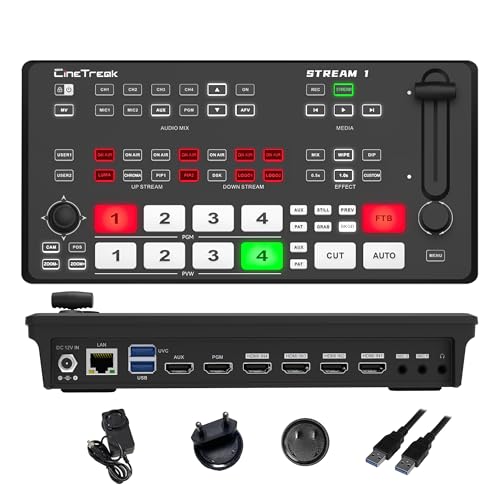
Best for Flexible Streaming – CINETREAK Stream 1
The CINETREAK Stream 1 is a feature-packed option for broadcasters who need more than basic source switching. It supports four HDMI inputs, AUX media access, PTZ control, dual RTMPS streaming, recording, playback, keying, and both landscape and portrait livestreaming.
Best For: Flexible livestreams using PTZ cameras, picture-in-picture layouts, multiple destinations, or vertical social-media formats.
Pros:
- Four HDMI inputs, with HDMI 1 and 2 supporting 4K input
- Built-in VISCA PTZ control for up to four cameras
- Supports dual RTMPS streaming, recording, PIP, chroma/luma keying, and portrait output
Cons:
- Only the first two HDMI inputs are specified for 4K input
- Its advanced controls may require more setup than a basic switcher
For productions that need orientation changes, remote camera control, or simultaneous streaming destinations, the Stream 1 offers an unusually broad toolset in a single device. Its NDI capability is listed as updatable rather than described as a current standard feature.
Best for Large HDMI Setups – Roland V-8HD
The Roland V-8HD is designed for productions that need extensive HDMI connectivity and hands-on control. It combines eight HDMI inputs with a built-in multiview monitor, AUX output, effects and keying, automated switching, still storage, and an 18-channel digital audio mixer.
Best For: Live events, presentations, and broadcasts using several HDMI sources and requiring flexible routing and audio control.
Pros:
- Eight HDMI inputs in a compact switcher
- Built-in preview monitor plus optional external display support
- Offers AUX routing, automated switching, still storage, effects, keying, and 18-channel audio mixing
Cons:
- Does not list built-in internet streaming
- Heavier and larger than the ATEM Mini Pro
The V-8HD is a strong fit when input count and routing flexibility matter more than direct streaming. Its preview monitor, programmable switching features, and broad audio controls make it well suited to repeatable event workflows.
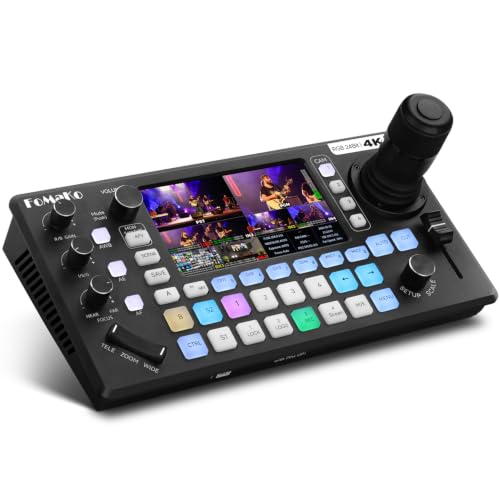
Best All-in-One Video Switcher – FoMaKo KC800
The FoMaKo KC800 is one of the more comprehensive video switchers for solo operators who need camera control, audio mixing, recording, and streaming in one unit. Its four 4K HDMI inputs, integrated PTZ joystick, LCD screen, and direct USB/SD recording make it especially practical for church services and other multi-camera productions.
Best For: Churches, weddings, corporate events, and solo operators managing PTZ cameras and live streams.
Pros:
- Controls up to four PTZ cameras with a built-in 4D joystick, presets, and AI tracking.
- Offers four 4K HDMI inputs, multiple HDMI outputs, UVC connectivity, and broad audio I/O.
- Supports six-channel audio mixing, direct USB/SD recording, and streaming to up to three platforms.
- Includes a 5.5-inch LCD screen and shortcut controls for faster operation.
Cons:
- Its extensive controls and connections may require more setup time than a basic switcher.
- The product is designed around 1080p60 output, despite supporting 4K HDMI inputs.
The KC800 is a strong choice when consolidating several production tools matters more than keeping the setup minimal. Its PTZ control and audio capabilities are particularly useful for productions operated by a small crew or a single person.
Best Compact Streaming Video Switcher – Osee GoStream Deck Pro
The Osee GoStream Deck Pro is a compact option among video switchers for creators who want tactile controls and direct streaming without relying entirely on a computer. It combines four HDMI inputs with a USB camera input, hardware encoding, macro buttons, SD recording, and Ethernet streaming.
Best For: Churches, schools, event teams, and streamers who need quick scene changes and flexible source mixing.
Pros:
- Accepts four HDMI sources plus an additional USB camera.
- Streams directly over Ethernet to up to three platforms without an external computer.
- Records high-bitrate MP4 video to an SD card while streaming through USB.
- Eight physical macro buttons provide fast access to switching, overlays, and transitions.
Cons:
- The supplied notes do not specify PTZ camera control or integrated audio mixing.
- Its four HDMI inputs may be limiting for larger multi-camera productions.
This is a sensible pick for teams that value a small footprint and hands-on operation. The macro buttons and simultaneous recording and streaming are useful for repeatable live workflows, while MultiSource layouts add flexibility for presentations and picture-in-picture scenes.
Best Professional Hybrid Video Switcher – Tenveo PC500
The Tenveo PC500 stands out among video switchers for productions that need both HDMI and SDI connectivity, network streaming, PTZ control, and recording. With four HDMI inputs, four SDI inputs, NDI|HX3 support, a 5.5-inch screen, and multiple output options, it is built for more demanding live-production environments.
Best For: Professional broadcasts, conferences, churches, studios, schools, and productions using mixed HDMI, SDI, PTZ, and network sources.
Pros:
- Combines four HDMI inputs, four SDI inputs, USB input, and NDI|HX3 support.
- Supports PTZ camera discovery and control, presets, cruise tracks, and camera adjustments.
- Offers HDMI, SDI, AUX, and USB3.0 outputs with configurable monitoring and production roles.
- Supports dual recording and streaming through UVC, SRT, RTMP, RTSP, and NDI|HX3.
Cons:
- Outputs are limited to 1080p60 even though selected inputs support 4K60.
- The professional feature set may be more than smaller or simpler productions need.
The PC500 is the strongest fit when compatibility and routing flexibility are priorities. Its combination of SDI, HDMI, network video, PTZ control, and dual recording makes it well suited to installations that may grow or use varied professional equipment.
Best Portable Pick – Mixer Plus Compact 4-Channel Switcher
If you need video switchers for mobile productions, online classes, events, or multi-camera streams, the Mixer Plus combines four HDMI inputs with a built-in 4-inch display. Its compact design and integrated monitoring make it practical for setups where space and portability matter.
Best For: Portable multi-camera streaming, online classes, events, YouTube, OBS, and Zoom productions.
Pros:
- Built-in 4-inch Multi View screen helps monitor inputs, Program, Preview, and audio levels.
- Supports four HDMI sources with zero-latency switching, 30 transition effects, and four scene presets.
- Includes PTZ control, chroma key, luma key, PIP, DSK, logo overlay, and a customizable AUX HDMI output.
Cons:
- Outputs are limited to HDMI connections, which may require additional equipment for other workflows.
- The supplied details do not specify 4K support.
The Mixer Plus is a versatile choice when portability and built-in monitoring are priorities. It offers a broad set of production tools without requiring a separate preview display, making it well suited to compact live setups.
Best Professional Feature Set – FoMaKo KC602 4K HDMI Switcher
For demanding video switchers applications, the FoMaKo KC602 pairs 4K60 input and loop-through with 1080p60 output, streaming, recording, PTZ control, and advanced audio mixing. Its extensive connectivity is suited to users building a more complete live-production system.
Best For: Churches, professional live events, studio streams, and multi-platform productions requiring 4K input and robust audio control.
Pros:
- Accepts 4K at 60 fps and provides 4K loop-through, with 1080p60 program output.
- Supports RTMP/RTMPS, USB-C UVC streaming, simultaneous streaming to up to three platforms, and 1080p60 USB recording.
- Offers PTZ control for up to four cameras, nine presets, XLR audio, 48V phantom power, EQ, AUX mixing, and monitoring controls.
- Includes a 5.5-inch display, 31 buttons, three knobs, T-bar, three-year limited warranty, and technical support.
Cons:
- Its extensive controls and interfaces may be more than casual streamers need.
- The specified program output is 1080p60 rather than 4K.
The KC602 stands out for production teams that need more than basic HDMI switching. Its combination of 4K handling, direct streaming and recording, PTZ control, and professional audio features makes it the most comprehensive option in this group.
Best for Solo Streamers – RGBlink Mini 4-Input Video Mixer
The RGBlink Mini is a straightforward option among video switchers for creators who want four HDMI inputs and computer-based streaming. Its USB 3.0 output appears as a webcam, while built-in transitions and picture-in-picture layouts help solo operators manage multi-camera content.
Best For: Solo streamers using OBS, vMix, Facebook, YouTube, Instagram, TikTok, or RTMPS.
Pros:
- Handles four HDMI inputs with 2K input and output support.
- Offers 14 transition effects, nine PIP layouts, and six-picture preview or program display options.
- USB 3.0 webcam output works with streaming software, and LAN enables remote control from a phone or computer.
Cons:
- Onboard recording is not included; the notes direct buyers to Mini-Pro or higher models for that feature.
- The supplied details do not mention PTZ control or direct hardware streaming.
With webcam-style USB connectivity and a compact, tripod-ready design, the RGBlink Mini keeps the workflow accessible for solo creators. It is a good fit when easy computer streaming matters more than built-in recording or advanced broadcast controls.
How We Picked These Video Switchers
We selected these Video Switchers by comparing the features that most directly affect real-world production: input and output formats, maximum resolution and frame rate, built-in streaming, recording, audio connections, preview monitoring, control options, and portability. We also considered whether each unit suits a specific type of buyer, from a solo streamer using a few HDMI cameras to a production team managing several sources and PTZ cameras.
Because equipment needs vary widely, this list includes compact HDMI mixers as well as more advanced systems with SDI inputs, multiview screens, keying, dual-streaming, and PTZ control. Always confirm the exact specifications and included accessories before purchase, since ports and capabilities can vary by version or retailer.
Quick Comparison
| Best For | Prioritize | Why It Matters |
|---|---|---|
| Solo creators | Simple HDMI switching and USB streaming | Reduces setup time and avoids extra capture hardware |
| Podcasts and hybrid productions | Integrated audio controls | Keeps video and microphones manageable from one workspace |
| Events and classrooms | Multiview, recording, and reliable outputs | Makes monitoring and backup recording easier |
| PTZ camera systems | Camera control and automation | Lets one operator frame and switch remote cameras |
| Professional crews | SDI, format flexibility, and scalable I/O | Better suits longer cable runs and production infrastructure |
Key Buying Factors for Video Switchers
Inputs, Outputs, and Signal Standards
Count the sources you use today, then leave room for expansion. HDMI is common for cameras, laptops, and consumer equipment, while SDI is often preferred for professional installations and longer cable runs. Check whether the switcher accepts the resolution and frame rate produced by every camera, and verify the output format required by your streaming platform, projector, or recorder.
Streaming, Recording, and Monitoring
Built-in RTMP streaming can eliminate the need for a separate computer or encoder. Recording to USB or SD media is useful for backup copies and post-production, but check the supported storage type and recording format. A built-in multiview or LCD screen can make a major difference when previewing sources, checking audio, and confirming the program feed.
Audio and Production Controls
Look for the connections you actually need, such as XLR, 3.5mm, or embedded HDMI audio. Features including picture-in-picture, chroma key, transitions, stills, playback, and macros can improve a live show, but they may add complexity. PTZ control and joystick operation are especially valuable when one person operates multiple remote cameras.
Resolution and Workflow Compatibility
A switcher that accepts 4K input may still produce a 1080p stream or program output. That is not necessarily a problem, but understand the complete signal path before buying. Match the switcher to your cameras, displays, capture devices, and streaming destination rather than choosing based on the highest number alone.
Who Should Buy Which Video Switchers?
Choose a compact HDMI model if you need a straightforward setup for gaming, online classes, presentations, or a small multi-camera stream. Buyers producing podcasts, interviews, or live talk shows should favor a unit with strong integrated audio controls. For churches, venues, and event teams, prioritize recording, multiview monitoring, dependable outputs, and enough inputs for future sources.
PTZ-focused operators should choose a model with compatible camera control and automation features. If your production uses professional cabling or needs longer runs, consider an SDI-capable switcher. Finally, creators who value portability should look for a compact chassis, built-in screen, simple control surface, and USB connectivity. The best choice is the one that fits your complete workflow without forcing unnecessary adapters or extra hardware.