
The best streaming encoders with HDMI turn a camera, switcher, or other HDMI source into a network-ready video stream for platforms such as YouTube Live, Facebook Live, and custom IPTV systems.
Our 2026 roundup covers compact 1080p units, 4K-capable encoders, NDI-compatible hardware, and advanced models with recording, loop-through, PoE, or multi-input support.
Best 10 Streaming Encoders with Hdmi Picks for 2026
Best Multi-Protocol 4K Encoder
URayCoder 4K HDMI Streaming Encoder

- 4K input and H.265/H.264 encoding
- Up to four protocol-based output streams
- Overlays, audio controls, and broad compatibility
Best For: Multi-platform 4K streaming and IPTV workflows
Best Professional Interface

- 4K streaming with H.264 and H.265/HEVC
- 12G-SDI, HDMI, USB, and Ethernet connections
- LCD and integrated technical monitoring
Best For: SDI/HDMI production and broadcast-style livestreaming
Best Compact 1080p60 Encoder
UNISHEEN HDMI Live Streaming Encoder

- Hardware 1080p60 H.265/H.264 encoding
- Browser setup without PC software
- Compact design with broad IP protocol support
Best For: Compact 1080p streaming from consoles, laptops, and cameras
Best NDI and HDMI Converter
ZowieBox 4K HDMI Encoder/Decoder

- 4K HDMI pass-through with IP conversion
- Native NDI|HX3/HX2/HX support
- SRT, RTMP(S), RTSP, PoE, and web control
Best For: NDI workflows, gaming, PTZ cameras, and HDMI/IP conversion
Professional 4K Reliability
Blackmagic Streaming Encoder 4K
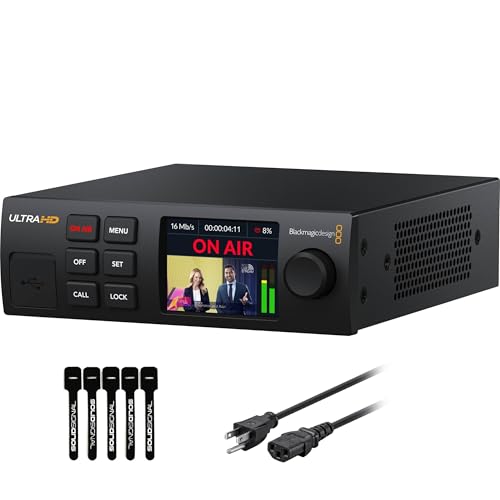
- 4K60 H.264/H.265 streaming
- 12G-SDI input with HDMI monitoring
- Ethernet and mobile auto-failover
Best For: Professional live production and remote broadcasting
Pocket HDMI Encoder
DDMALL H.265 HDMI Video Encoder

- 1080p60 HDMI input
- 2.4W, USB-powered compact design
- SRT, RTMP, HLS, RTSP, and UDP support
Best For: Portable streaming and low-power installations
Flexible Multisource Production

- HDMI and SDI inputs with source mixing
- 4K encoding and up to six destinations
- Simultaneous streaming and recording
Best For: Multicamera and hybrid live-production workflows
Best Multi-Platform Hub

- Four HDMI channels with 4Kp30 and 1080p60 support
- Up to 16 simultaneous platform feeds
- Broad protocol and OSD support
Best For: Multi-source broadcasts and IPTV distribution
Best Premium Production Pick
Magewell Ultra Encode HDMI Plus

- 4K HDMI encoding with loop-through output
- Simultaneous streaming and recording
- NDI|HX, PoE, Wi-Fi, and multi-protocol support
Best For: Professional live production and IP workflows
Best PoE Installation Choice

- 4K60 input with lossless HDMI loop-out
- 1080p60 H.264/H.265 streaming
- PoE and ONVIF support for network installs
Best For: Cleanly wired LAN, surveillance, and broadcast installations
Best Multi-Protocol 4K Encoder – URayCoder 4K HDMI Streaming Encoder
For buyers comparing streaming encoders with hdmi, the URayCoder UHE265-1L-4K stands out for its 4K input support, broad protocol compatibility, and flexible stream customization. It can encode HDMI video using H.265 or H.264 and supports up to four simultaneous outputs using different protocols.
Best For: Multi-platform 4K streaming, IPTV distribution, and users who need extensive protocol and overlay controls.
Pros:
- Supports 4K at up to 30 fps and up to 120 fps at 2K or lower resolutions.
- Works with RTMP(S), RTSP, SRT, HLS, UDP, WebRTC, and other streaming protocols.
- Supports logos, scrolling text, timestamps, cropping, rotation, and audio-input adjustments.
- Includes a claimed lifetime free warranty and technical support.
Cons:
- Its extensive settings may be more than casual streamers need.
- Only one HDMI port is listed.
This is a feature-rich choice for advanced workflows that require 4K handling, simultaneous destinations, and branding controls. Buyers seeking a simple plug-and-play encoder may prefer a more streamlined model.
Best Professional Interface – Blackmagic Web Presenter 4K
Among streaming encoders with hdmi, the Blackmagic Design Web Presenter 4K is a professional-oriented interface with 12G-SDI connectivity, HDMI monitoring, Ethernet, USB, and a front-panel LCD. Its 4K support and monitoring connections make it suitable for more structured production setups.
Best For: Professional livestreaming environments that use SDI and HDMI equipment and benefit from integrated monitoring.
Pros:
- Supports 4K streaming with H.264 and H.265/HEVC codecs.
- Offers 12G-SDI input/output alongside HDMI and USB connectivity.
- Includes an LCD display, technical monitoring, and SDI/HDMI monitor outputs.
- Supports Ethernet streaming and listed services including YouTube and Facebook.
Cons:
- Its SDI-focused feature set may be unnecessary for basic HDMI-only setups.
- The supplied notes do not specify a broad list of streaming protocols.
The Web Presenter 4K is best viewed as a production interface rather than a minimal standalone HDMI encoder. Its combination of SDI, HDMI, USB, and monitoring features can make it a stronger fit for studio or broadcast-style systems.
Best Compact 1080p60 Encoder – UNISHEEN HDMI Live Streaming Encoder
For straightforward streaming encoders with hdmi, the UNISHEEN JM1000 combines hardware H.265/H.264 encoding with 1080p60 output and browser-based setup. Its small footprint and support for common IP protocols suit live events, monitoring, and digital-signage installations.
Best For: Compact 1080p60 streaming from laptops, consoles, cameras, and other HDMI sources.
Pros:
- Provides hardware H.265/H.264 encoding at 1080p60.
- Supports SRT, RTMP(S), RTSP, UDP, HTTP, HLS, WebRTC, and additional protocols.
- Browser-based configuration requires no dedicated PC software or drivers.
- Offers HDMI embedded audio, 3.5mm audio input, and OSD overlays.
Cons:
- Maximum listed video resolution is 1080p, not 4K.
- Advanced configurations require basic networking knowledge.
- Includes a 1-year limited warranty rather than the lifetime warranty noted for some alternatives.
This encoder is a practical middle ground for users who prioritize 1080p60 performance, compact installation, and accessible browser control. It is less suitable when 4K capture or extensive production connectivity is required.
Best NDI and HDMI Converter – ZowieBox 4K HDMI Encoder/Decoder
The ZowieBox is a versatile option among streaming encoders with hdmi, combining 4K HDMI pass-through with IP encoding and decoding. It supports NDI|HX3/HX2/HX, SRT, RTMP(S), and RTSP, making it useful for gaming, PTZ camera, and professional network-video workflows.
Best For: Gamers and production teams that need HDMI pass-through, NDI conversion, and flexible IP video routing.
Pros:
- Captures up to 4K with zero-lag HDMI pass-through.
- Supports NDI|HX3/HX2/HX, SRT, RTMP(S), and RTSP workflows.
- Can operate as an encoder or decoder for HDMI-to-IP and IP-to-HDMI conversion.
- Offers web control, PoE, USB-C power, a tripod mount, and PTZ-related controls.
Cons:
- Encoder and decoder modes cannot run simultaneously.
- Full NDI signals are not supported.
- USB capture-card functionality is not currently supported.
ZowieBox is compelling when a small device must bridge HDMI and network-video systems rather than simply send one stream online. Its mode limitations and lack of USB capture functionality should be checked against the intended workflow before purchase.
Professional 4K Reliability – Blackmagic Streaming Encoder 4K
For demanding workflows, this Blackmagic Design model is one of the more capable streaming encoders with HDMI, pairing 4K H.264/H.265 encoding with a 12G-SDI input and HDMI monitoring. It can stream directly over SRT or RTMP without an encoding computer, while Ethernet and USB-C mobile connectivity add flexibility.
Best For: Broadcast, event, and remote-production users who need 4K streaming, standards conversion, and connection failover.
Pros:
- Supports H.264 and H.265 streaming up to 2160p60 through SRT or RTMP.
- 12G-SDI input, SDI loop output, and HDMI monitor output support professional video workflows.
- Gigabit Ethernet and USB-C smartphone tethering can automatically switch if the primary connection fails.
- Includes captions, timecode, REST API control, webcam output, tally, and talkback features.
Cons:
- Its SDI-focused design is more specialized than a simple HDMI-only encoder.
- Professional features may be unnecessary for basic single-camera streaming.
This is a strong choice when reliability, remote control, and production integration matter as much as image resolution. Its 4K capability and automatic failover make it especially suitable for higher-stakes live events.
Pocket HDMI Encoder – DDMALL H.265 HDMI Video Encoder
The DDMALL AVC-2K is a compact option for shoppers comparing streaming encoders with HDMI. It accepts HDMI video up to 1080p60, uses H.264 or H.265 compression, and supports protocols including RTMP, RTMPS, SRT, HLS, RTSP, and UDP in a lightweight, low-power package.
Best For: Mobile broadcasters, surveillance installations, classroom or corporate streaming, and space-constrained setups.
Pros:
- Extremely small and light at approximately 2.95 x 1.26 x 0.87 inches and 1.13 ounces.
- Supports 1080p60 HDMI input with 1080p30 encoding output.
- Uses only 2.4W and can draw power through USB or the HDMI source.
- Offers dual-stream output, web preview, OSD overlays, and optional LinkCloud management.
Cons:
- Encoding output is limited to 1080p30 rather than 4K or 1080p60.
- Its HDMI-oriented design lacks the SDI connectivity found on larger professional encoders.
- The listing specifies no included power plug.
Choose this model when portability and low power consumption are more important than maximum resolution. Its broad protocol support makes it adaptable, but the 1080p30 output is a key limitation for high-frame-rate production.
Flexible Multisource Production – Magewell Ultra Encode AIO
The Magewell Ultra Encode AIO gives streaming encoders with HDMI buyers a flexible production hub that also accepts SDI. It can mix HDMI and SDI sources in picture-in-picture or side-by-side layouts, encode up to 4K, stream to multiple destinations, and record at the same time.
Best For: Live producers who need HDMI/SDI source mixing, multistreaming, onboard recording, and network control.
Pros:
- Supports HDMI up to 4096x2160p60 and SDI up to 4096x2160p30.
- Can stream to as many as six destinations using RTMP, RTMPS, SRT, NDI|HX, HLS, and other protocols.
- Combines HDMI and SDI inputs with picture-in-picture or side-by-side layouts.
- Streams and records simultaneously to SD cards, USB storage, or network drives.
Cons:
- Its rack-mountable 3.6-pound design is less portable than compact HDMI encoders.
- SDI input support is limited to 4096x2160p30, below its HDMI 4K60 capability.
- The broad feature set may be more than a basic single-source stream requires.
This is the most versatile option of the three for mixed-source productions. It makes sense when simultaneous recording, multi-destination streaming, overlays, and flexible network connectivity justify a larger, more production-oriented device.
Best Multi-Platform Hub – 4-Channel 4K HDMI Encoder
For buyers comparing streaming encoders with hdmi, the ORIVISION ZY-EH1304 stands out when one device needs to handle several HDMI sources and destinations. It combines four-channel input and output with H.265, H.264, and MJPEG encoding, plus a built-in display for status monitoring.
Best For: Multi-source live broadcasts, IPTV systems, CATV head-ends, and setups distributing video to multiple platforms.
Pros:
- Supports up to two 4Kp30 and two 1080p60 HDMI inputs and outputs.
- Can send each channel to as many as four platforms, with up to 16 feeds overall.
- Offers RTMP, RTMPS, RTSP, SRT, RTP, UDP, HLS, FLV, and HTTP support.
- Includes LCD status monitoring, OSD overlays, mirror, and flip controls.
Cons:
- Its four-channel design may be more capability than a simple one-source stream requires.
- Some advanced configurations may require technical support or firmware updates.
This is a feature-rich choice for centralized video distribution. Its combination of channel density, protocol support, and simultaneous outputs is especially useful for professional or institutional workflows.
Best Premium Production Pick – Magewell Ultra Encode HDMI Plus
The Magewell Ultra Encode HDMI Plus is a strong premium option among streaming encoders with hdmi, particularly for production teams that want 4K encoding, local pass-through, recording, and flexible network delivery in one unit.
Best For: Live production, events, education, corporate AV, and IP video workflows requiring recording and multi-protocol streaming.
Pros:
- Encodes HDMI video up to 4096×2160p30 and provides HDMI loop-through.
- Supports RTMP, RTMPS, SRT, NDI|HX, HLS, and TS over UDP/RTP.
- Streams and records simultaneously to internal 128 GB storage, USB, or network locations.
- Includes Wi-Fi, Gigabit Ethernet with PoE, overlays, scaling, and web/API control.
Cons:
- Its advanced feature set may be unnecessary for basic single-platform streaming.
- 4G/5G modem support requires a separately supplied modem.
With recording, NDI|HX, loop-through, and multiple control methods, this model is designed for integrated production rather than casual streaming. The two-year manufacturer warranty adds useful coverage for professional deployments.
Best PoE Installation Choice – 1080p60 4K60 HDMI Encoder
For streamlined installations, this UNISHEEN model is one of the more practical streaming encoders with hdmi. It accepts a 4K60 HDMI signal, passes it through without loss, and produces a 1080p60 stream while receiving power and network connectivity over PoE.
Best For: Rack, wall, surveillance, LAN distribution, and mobile broadcast setups where a single Ethernet cable is preferred.
Pros:
- Supports 4K60 HDMI input and lossless loop-out while encoding 1080p60.
- PoE combines power and data over one Ethernet cable.
- Works with RTSP, RTMP(S), SRT, HLS, WebRTC, UDP, HTTP, and additional streaming protocols.
- ONVIF support allows integration with compatible NVR systems, with multicast and unicast LAN distribution.
Cons:
- The encoded output is limited to 1920×1080 pixels rather than 4K streaming.
- Although the product notes list a three-year warranty, the specifications also list a one-year manufacturer warranty; buyers should confirm coverage.
This encoder makes the most sense when reliable 1080p60 delivery, HDMI monitoring, and simplified cabling matter more than 4K output. Its ONVIF and LAN features also broaden its usefulness beyond conventional platform streaming.
How We Picked the Best Streaming Encoders with Hdmi
We focused on hardware encoders that accept HDMI input and provide practical options for live delivery over a wired network. The selection spans budget-friendly single-source devices, portable interfaces, and professional production tools. We considered supported resolutions and frame rates, codec efficiency, streaming protocols, setup flexibility, monitoring, recording, and connectivity.
Protocol support matters because different workflows may rely on RTMP for public platforms, SRT for more resilient contribution links, RTSP or HLS for IPTV and internal distribution, and NDI for networked production. We also separated products by their real-world strengths instead of treating every 4K encoder as interchangeable.
Quick Comparison
- Best for advanced production: Magewell Ultra Encode AIO, with broad input, recording, mixing, and protocol capabilities.
- Best for straightforward 4K streaming: Magewell Ultra Encode HDMI Plus or Blackmagic Design Web Presenter 4K.
- Best for NDI workflows: ZowieBox and Magewell models with NDI support.
- Best for multi-channel installations: The four-channel 4K encoder with multiple feed outputs.
- Best for compact or budget setups: The DDMALL 2K encoder and the 1080p60 single-input models.
- Best for flexible network deployment: Models offering PoE, loop-through, or several simultaneous output protocols.
Key Buying Factors for Streaming Encoders with Hdmi
Resolution, Frame Rate, and Input Behavior
Choose an encoder that matches the source rather than relying only on its maximum input specification. A 4K60 input may be useful for passthrough, but some devices encode at a lower resolution. Confirm whether the unit supports 1080p60, 4K30, or 4K60 output and whether HDMI loop-through preserves the original signal.
Codec and Protocol Support
H.264 remains the safest choice for broad compatibility, while H.265 can reduce bandwidth when the receiving service supports it. RTMP is common for social platforms; SRT is valuable over less reliable connections; and RTSP, HLS, WebRTC, or NDI may better suit studios, IPTV systems, and local networks.
Audio, Networking, and Control
Check embedded HDMI audio support, external audio inputs, Ethernet speed, Wi-Fi or mobile options, and whether the device supports PoE. Browser-based controls, presets, status displays, and remote management can make a major difference in unattended or multi-camera installations.
Recording and Production Features
If you need a backup copy, look for onboard recording and suitable storage support. Loop-through is helpful when monitoring on a separate display, while multiple inputs, mixing, SDI, or NDI can justify a higher price in a professional workflow.
Who Should Buy Which Streaming Encoders with Hdmi?
Choose a compact 1080p encoder for a single camera, classroom, church, webinar, or basic livestream. Move to a 4K model when you need higher-quality capture, 4K contribution, or clean passthrough to a monitor. NDI-equipped hardware is the better fit for studios that route sources through a managed production network.
For IPTV operators, venues, and organizations distributing several feeds, prioritize multi-channel capacity, simultaneous outputs, and remote administration. Professional producers should consider Magewell or Blackmagic options when recording, dependable connectivity, SDI, mobile backup, or broader workflow integration matters more than the lowest purchase price.