
When several people need to monitor the same source, a headphone distribution amplifier is often more practical than relying on a basic splitter. The right unit can provide multiple outputs, separate volume control, and enough power for a compact studio, podcast table, rehearsal space, or home audio setup.
We selected 10 compact and multi-channel models, including four- and eight-channel designs, to help you match output capacity, connector type, controls, and power requirements to your setup.
Best 10 Headphone Distribution Amplifiers for Small Setups Picks for 2026
Compact Session Hub

- Four outputs with separate volume controls
- Supports 1/4-inch and 1/8-inch source outputs
- Compact metal enclosure for desks or stands
Best For: Small tracking and rehearsal sessions
Portable Four-Way Monitor
- Shares one source across four outputs
- Separate volume knobs and metal construction
- 12V adapter included; cables sold separately
Best For: Studio, stage, computer, or TV monitoring
Tone-Controlled Monitor
LZSIG LHA2 Headphone Amplifier
- Four outputs with independent level controls
- Accepts 3.5mm and 6.35mm TS/TRS plugs
- Adds stereo/mono switching and bass boost
Best For: Flexible home-studio and stage monitoring
Simple Four-Listener Splitter

- Powers up to four headphones
- Individual volume knobs for each listener
- Compact 1/4-inch stereo monitoring design
Best For: Basic studio and on-stage monitoring
Compact Four-Listener Value
- Four independent stereo channels
- Individual volume controls
- Compact metal design with power adapter
Best For: Small recording and playback-monitoring setups
Eight-Channel Studio Splitter

- Eight independent stereo outputs
- Mono/stereo switching
- Metal body with conversion plugs
Best For: Larger rehearsal and recording groups
Five-Channel Feature Upgrade

- Five independent stereo channels
- Supports 16–300 ohm headphones and IEMs
- Master volume and one-touch mute
Best For: Podcasts, studios, teaching, and shared listening
Best for Rack-Based Monitoring
8-Channel Headphone Distribution Amplifier

- Eight independently controlled amplifier channels
- 16 front and rear 1/4-inch headphone outputs
- Mono/Stereo routing with LED level meters
Best For: Studios and live setups needing multiple monitored mixes
Best for Compact Group Listening
HP10 10-Output Headphone Amplifier
- Up to 10 outputs with separate volume controls
- Compact metal design for studio or stage use
- Supports 3.5mm headphones and 6.35mm models with an adapter
Best For: Small groups sharing one stereo monitor mix
Best for Simple Four-Person Monitoring

- Four stereo outputs from one 1/4-inch input
- Independent volume control on every channel
- Compact metal enclosure with included 12V adapter
Best For: Podcasts, rehearsals, and small recording sessions
Compact Session Hub – Mackie HM-4
The Mackie HM-4 is a straightforward choice among headphone distribution amplifiers for small setups. It sends one source to four headphones, with an independent volume control for each listener and a compact metal enclosure that fits easily on a desk, stand, or rack.
Best For: Tracking sessions, rehearsals, and small monitoring setups where four people need separate volume control.
Pros:
- Four independent headphone outputs with individual level controls
- Works with sources using 1/4-inch or 1/8-inch output connections
- Compact metal build can be mounted with Velcro
Cons:
- Uses a corded electric power source
- Provides distribution rather than mixing functionality
The HM-4 keeps the essentials simple: four outputs, per-listener volume adjustment, and a small footprint. It is a practical fit when reliable shared monitoring matters more than extra tone-shaping features.
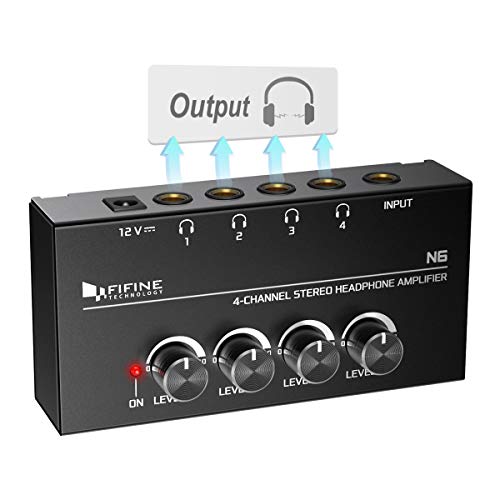
Portable Four-Way Monitor – FIFINE N6
The FIFINE N6 is a compact option for headphone distribution amplifiers for small setups, sharing one stereo source with up to four listeners. Its metal construction, separate volume knobs, and included 12V adapter suit basic studio, stage, computer, and TV monitoring applications.
Best For: Users who need four 1/4-inch headphone outputs from a single stereo or mono source.
Pros:
- Four outputs with independent volume controls
- Metal construction with low-noise stereo operation
- Includes a 12V DC power adapter and power indicator
Cons:
- All input and output connections use 6.35mm ports
- TRS/TS cables are not included
- It is a 1-input, 4-output amplifier, not a mixer
The N6 is well suited to a simple shared-monitoring chain, provided you have the appropriate 1/4-inch cables. Its clearly defined one-input/four-output layout avoids confusion for small recording or listening setups.
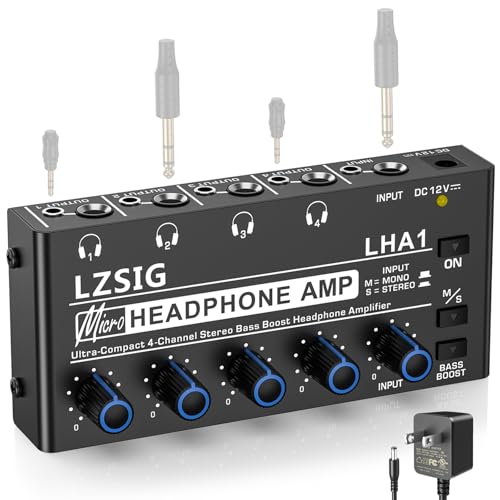
Tone-Controlled Monitor – LZSIG LHA2 Headphone Amplifier
The LZSIG LHA2 adds bass boost and flexible connection support to the headphone distribution amplifiers for small setups category. It feeds up to four headphones from one input, offers independent volume controls, and accepts both 3.5mm and 6.35mm TS/TRS connections.
Best For: Home studios and small stage setups that need flexible inputs, stereo/mono switching, and optional bass enhancement.
Pros:
- Four independently controlled headphone outputs
- Supports 3.5mm and 6.35mm TS/TRS connections
- Includes stereo/mono switching and a bass-boost function
Cons:
- Supports headphones in the specified 32–100Ω range
- Requires 12V power
- It is a headphone amplifier, not a mixer
The LHA2 stands out when connection flexibility and basic sound customization are priorities. Its metal chassis and independent controls make it a capable shared-monitoring unit for a compact studio or stage rig.
Simple Four-Listener Splitter – Pyle PHA40
The Pyle PHA40 is a compact, practical pick among headphone distribution amplifiers for small setups. It powers up to four headphones from a 1/4-inch source input, giving each listener a dedicated volume control in a small unit designed for studio or on-stage use.
Best For: Basic four-person monitoring from a mixer or other 1/4-inch stereo source.
Pros:
- Drives four headphones simultaneously
- Independent rotary volume controls for each output
- Compact design is easy to carry and use on the road
Cons:
- Uses 1/4-inch input and output connections
- Plastic enclosure may be less rugged than metal alternatives
- Designed for distribution rather than mixing
The PHA40 covers the core needs of a small monitoring system without adding unnecessary complexity. It makes the most sense when a 1/4-inch source and four separate listener levels are all you need.
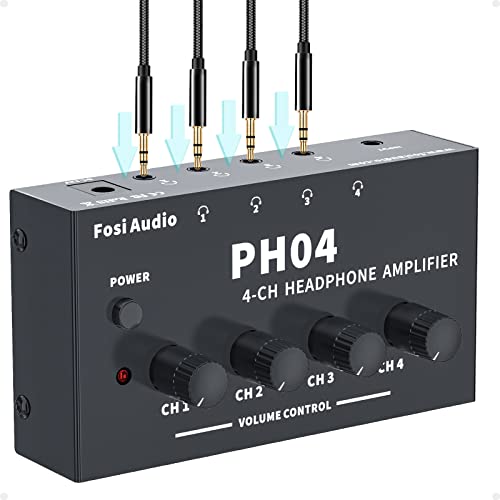
Compact Four-Listener Value – Fosi Audio PH04
The Fosi Audio PH04 is a practical choice among headphone distribution amplifiers for small setups, offering four stereo outputs with separate volume controls. Its compact metal enclosure and included 12V adapter make it well suited to recording sessions, playback monitoring, and other space-conscious applications.
Best For: Small recording setups, group playback, and monitoring up to four listeners.
Pros:
- Four independent stereo headphone amplifier channels.
- Separate output-level control for each listener.
- Supports 3.5mm outputs and 6.35mm headphones with an adapter.
- Compact design, power switch, and included 12V power adapter.
Cons:
- Only four headphone channels are available.
- A 3.5mm-to-6.35mm adapter is needed for 6.35mm headphones.
The PH04 keeps distribution simple and affordable for small groups. It is a sensible pick when four independently controlled headphone feeds are enough and portability matters.
Eight-Channel Studio Splitter – STABCL S-800 Headphone Amp
For setups that need more listening positions, this STABCL model expands headphone distribution to eight independently controlled stereo channels. It combines a metal enclosure, mono/stereo switching, and included conversion plugs for flexible studio or stage use.
Best For: Larger rehearsal, recording, and studio monitoring groups needing eight outputs.
Pros:
- Eight high-power stereo amplifier channels with independent volume controls.
- Works with 1/4-inch and 1/8-inch TS/TRS connections using the supplied conversion plugs.
- Mono/stereo switch supports different source and monitoring requirements.
- Aluminum-alloy construction and included 12V AC adapter.
Cons:
- The 1/8-inch connection requires a conversion plug.
- Its eight-channel design may be more than needed for very small groups.
The S-800 is the strongest fit here when channel count is the priority. Its independent controls and mono/stereo flexibility make it useful for multi-person monitoring, though smaller setups may prefer a four- or five-channel unit.
Five-Channel Feature Upgrade – Fosi Audio PH05
The Fosi Audio PH05 is a versatile option among headphone distribution amplifiers for small setups, adding a fifth output while supporting headphones and IEMs from 16 to 300 ohms. Independent channel controls, a master volume knob, and one-touch mute make it convenient for shared monitoring.
Best For: Studios, podcasts, teaching, and home audio sharing with up to five listeners.
Pros:
- Five independently amplified stereo headphone channels.
- Supports 16–300 ohm headphones and IEMs.
- Independent level controls plus master volume and mute.
- Solid aluminum-alloy build with anti-slip feet.
Cons:
- It provides one fewer channel than an eight-output distributor.
- A separate power adapter is required, though a 12V adapter is included.
The PH05 is a well-rounded middle ground: it adds one channel over the PH04 and offers useful master controls without becoming unwieldy. Its broad impedance support also makes it a flexible choice for mixed headphone and IEM collections.
Best for Rack-Based Monitoring – 8-Channel Headphone Distribution Amplifier
For larger small-studio or live-sound setups, this 8-channel unit is a flexible choice among headphone distribution amplifiers for small setups. It provides eight independently controlled amplifier channels, front and rear outputs, selectable input routing, and LED level monitoring.
Best For: Studios, mobile racks, and live monitoring setups that need multiple headphone feeds and flexible mix routing.
Pros:
- Eight high-power channels with independent volume controls and support for headphone loads as low as 8Ω.
- Provides 16 total 1/4-inch headphone outputs, with front and rear connections for each channel.
- Offers Mono/Stereo modes, IN1/IN2 selection, six-segment LED meters, and overload protection.
- Its standard 1U metal rack-mount design suits permanent or mobile installations.
Cons:
- Its rack-oriented design may be more equipment than a very small desktop setup requires.
- Outputs use 1/4-inch headphone jacks, so other connector types may need adapters.
This is the most capable option here for multi-channel monitoring and signal-routing flexibility. Choose it when eight discrete monitoring channels, visible metering, and rack integration matter more than minimal size.
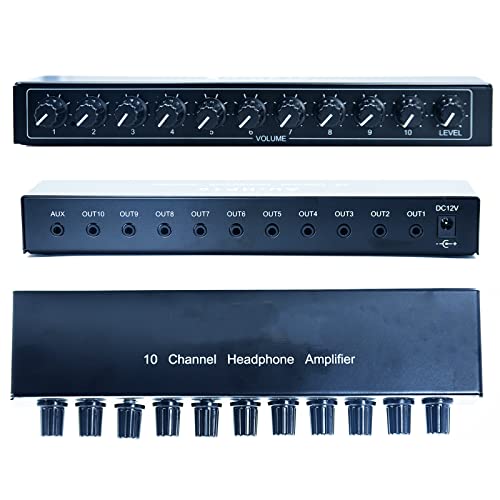
Best for Compact Group Listening – HP10 10-Output Headphone Amplifier
This compact HP10 is a practical pick among headphone distribution amplifiers for small setups when several listeners need the same stereo source. Its individual output controls support group recording, playback, and stage monitoring without taking much space.
Best For: Small recording sessions, rehearsal spaces, and portable studio or stage setups with shared stereo monitoring.
Pros:
- Provides up to 10 headphone outputs with dedicated volume control for each listener.
- Compact metal housing measures approximately 9.8 × 2 × 1.1 inches and is designed for portability.
- Includes both a power switch and a 3.5mm headphone output, with compatibility for 3.5mm and 6.35mm headphones using an adapter where needed.
- Includes a 12V DC adapter, manual, and an 18-month warranty.
Cons:
- The supplied description identifies four high-power stereo amplifiers, so it is intended for shared stereo monitoring rather than multiple discrete mixes.
- 6.35mm headphones require a 3.5mm-to-6.35mm adapter.
The HP10 emphasizes listener count and portability over advanced routing. It is a sensible choice for a small group that needs individual volume adjustments while monitoring one main mix.
Best for Simple Four-Person Monitoring – Mini 4-Channel Headphone Amp
For the simplest small setup, this four-channel model offers straightforward distribution from one stereo source. It is a compact option among headphone distribution amplifiers for small setups, with one 1/4-inch input, four outputs, and independent volume controls.
Best For: Podcasting, band practice, home recording, and small studio sessions with up to four headphone listeners.
Pros:
- Shares one stereo source with up to four pairs of headphones.
- Each channel has its own volume knob, allowing listeners to set levels independently.
- Uses a low-noise JRC4580 operational amplifier chip for stated clean stereo output.
- Small 90 × 55 × 40 mm metal housing saves desk or studio space.
Cons:
- It has only four channels and does not provide separate mix routing.
- All connections are 1/4-inch TRS, which may require adapters for other headphone plugs.
- The listed warranty is 30 days.
This is the easiest fit when four listeners are enough and the priority is a small, uncomplicated monitoring box. Its individual controls make it more useful than a passive splitter for shared recording and rehearsal sessions.
How We Picked the Best Headphone Distribution Amplifiers for Small Setups
We focused on Headphone Distribution Amplifiers for Small Setups that offer useful channel capacity without the size and complexity of larger rack systems. Our comparison considered the number of outputs, independent volume controls, input and output connector formats, power requirements, portability, construction, and suitability for common use cases such as podcast monitoring, music production, rehearsals, and shared playback.
Because specifications and included accessories can vary by seller or revision, confirm the listing details before buying—especially adapter voltage, connector size, and whether cables are included.
Quick Comparison
| Setup size | Recommended channel range | Best fit |
|---|---|---|
| Solo or two listeners | 4 channels | Home recording, practice, and compact podcast setups |
| Small group | 5–8 channels | Ensembles, classrooms, and multi-person monitoring |
| Larger monitoring needs | 8+ channels | Studios or productions requiring expansion |
Key Buying Factors for Headphone Distribution Amplifiers for Small Setups
Output Count and Control
Choose more outputs than you currently need if your group may grow. Independent volume knobs are particularly valuable because listeners often use different headphone sensitivities or preferred levels. Basic units may share one input while providing separate output-level adjustment; more advanced models may add mono/stereo switching or additional routing options.
Connectors and Compatibility
Check whether your source uses a 3.5mm auxiliary output or a 1/4-inch TRS output. Many headphone amplifiers use 1/4-inch outputs, so 3.5mm-to-1/4-inch adapters may be necessary. Stereo operation usually requires the correct TRS cable and a compatible source. Avoid assuming that “balanced” in a listing means every input or output is truly balanced.
Power, Placement, and Portability
Compact amplifiers are convenient, but they still need a suitable power supply. Verify the included adapter rating and outlet compatibility. For a desk or travel rig, prioritize a metal chassis, accessible controls, and a footprint that leaves room for headphone plugs. Mountable or higher-output models make more sense when the unit will remain in a studio or production rack.
Sound and Listening Safety
Look for clean, low-noise operation and enough output power for your headphones. High-impedance studio headphones may need more drive than efficient earbuds. Set every channel conservatively before connecting headphones, then raise levels gradually to protect hearing and reduce sudden volume spikes.
Who Should Buy Which Headphone Distribution Amplifiers for Small Setups?
Choose a four-channel model for most home studios, small rehearsals, and podcast sessions. These units balance cost, size, and capacity.
Choose a five- or eight-channel model when several people need simultaneous monitoring or you want spare outputs for future use. Confirm that your desk has enough space and that the power adapter suits your setup.
Choose a unit with extra routing or mounting features for semi-permanent studio, classroom, or production use. For simple audio sharing, a compact model with straightforward volume controls is usually the better value.