
Focal headphones are known for detailed sound, but the right amplifier can improve drive, volume headroom, and listening flexibility—especially with a desktop or portable source.
This roundup compares 10 options across desktop, rechargeable, bass-boosted, and multi-channel designs so you can match the amplifier to your headphones, source, and listening setup.
Best 10 Headphone Amplifier for Focal Headphones Picks for 2026
High-Power Desktop Pick

- 1500mW output for 18Ω–600Ω headphones
- RCA, 3.5mm, and 6.35mm connections
- Replaceable op-amp design
Best For: Desktop listeners seeking power and customization
Shared Listening Choice

- Four independent headphone outputs
- Individual volume for every listener
- Compact metal enclosure
Best For: Tracking and rehearsal sessions
Warm-Sounding Value Pick

- 1300mW maximum output
- Class A design with warm sound
- Replaceable op-amp socket
Best For: Compact desktop listening and DIY tuning
Portable High-Impedance Option

- 16Ω–600Ω stated compatibility
- Low/high gain switch
- 12-plus-hour rechargeable operation
Best For: Portable listening with varied headphones
Portable Bass-Boost Pick
Neoteck 3.5mm HiFi Headphone Amp

- 16–600Ω headphone support
- Selectable bass boost
- 8+ hours of battery life
Best For: Portable listening with adjustable bass
Multi-Listener Choice
HA400 4-Channel Headphone Amplifier

- Four independent headphone channels
- Separate volume controls
- Compact metal enclosure
Best For: Studio monitoring and shared listening
Long-Battery Portable Pick
- 16–300Ω compatibility
- Two-stage gain switch
- 12+ hours of battery life
Best For: Extended mobile listening with gain control
Best for Shared Monitoring
4-Channel Studio Headphone Amp
- Four independently controlled outputs
- 3.5mm and 6.35mm compatibility
- Metal build with bass boost
Best For: Home studios and multi-listener monitoring
Best Budget Portable Pick
Rechargeable Two-Stage Gain Amp
- Handles 16–300Ω headphones
- Two-stage gain adjustment
- Compact 3.5mm rechargeable design
Best For: Portable listening from phones and music players
Best for Extended Battery Life
- Supports 16–300Ω headphones
- Up to 10 hours of playback
- Aluminum body with gain control
Best For: Longer mobile listening across varied devices
High-Power Desktop Pick – Douk Audio U3 PRO
If you need a headphone amplifier for Focal headphones and want plenty of desktop headroom, the Douk Audio U3 PRO is a versatile option. Its 1500mW output is designed for headphones from 18Ω to 600Ω, while the RCA and 3.5mm inputs make it easy to add to a desktop setup.
Best For: Desktop listeners who want high output, multiple connections, and replaceable op-amp options.
Pros:
- High-power output supports a broad 18Ω–600Ω headphone range.
- Offers 3.5mm and 6.35mm headphone outputs plus RCA and 3.5mm inputs.
- Pluggable op-amp socket allows future customization.
- Compact design suits home or office desks.
Cons:
- Requires a DC 5V power connection.
- Its feature set is more desktop-focused than portable.
The U3 PRO is a strong fit when your priority is driving flexibility and connection options. It is especially appealing for Focal owners who want a compact desktop amplifier with room for experimentation.
Shared Listening Choice – Mackie HM-4
The Mackie HM-4 is a practical headphone amplifier for Focal headphones when several people need to monitor the same source. It provides four independent outputs, with a separate volume control for each listener, in a small metal enclosure.
Best For: Tracking sessions, rehearsals, and shared listening setups with up to four headphones.
Pros:
- Four independent headphone outputs support multiple listeners.
- Each output has its own level control.
- Compact metal housing can be placed on a desk, rack, or stand.
- Accepts a 1/4-inch or 1/8-inch source output.
Cons:
- It is intended for distribution rather than detailed sound customization.
- Only 6.35mm connectors are listed in the supplied specifications.
- Best suited to group monitoring, not a portable setup.
Choose the HM-4 when flexibility means sharing one audio source rather than tailoring amplification for one listener. Its independent controls make it convenient for sessions where each person prefers a different volume.
Warm-Sounding Value Pick – Douk Audio U3
For listeners looking for a headphone amplifier for Focal headphones at a compact desktop price point, the Douk Audio U3 emphasizes a warm, smooth presentation and strong drive capability. Its Class A design and 1300mW maximum output are intended to handle many headphones, including higher-impedance models.
Best For: Home or office listeners who want a small amplifier with a warm character and op-amp upgrade potential.
Pros:
- 1300mW maximum output provides substantial drive power.
- Supports 5–20V input and uses a high-voltage amplifier circuit.
- Pluggable op-amp socket adds DIY flexibility.
- Includes 3.5mm and 6.35mm headphone connections with RCA input.
Cons:
- The supplied notes do not specify a headphone impedance range for this model.
- Its Class A design is primarily suited to stationary use.
- Only one RCA input is listed.
The U3 is a sensible choice if you prefer a mellow, full presentation and want to explore op-amp changes later. Its mini form factor keeps it easy to place beside a computer or other desktop source.
Portable High-Impedance Option – eSynic Rechargeable Amplifier
The eSynic is a portable headphone amplifier for Focal headphones when you want rechargeable operation and support for a wide range of loads. Its two-stage gain switch is designed for 16Ω–32Ω earphones on low gain and 50Ω–600Ω headphones on high gain, with a claimed 12-plus-hour play time.
Best For: Mobile listeners who need a compact, rechargeable amplifier for both low- and high-impedance headphones.
Pros:
- Supports stated impedance ranges from 16Ω to 600Ω.
- Two-stage gain switch helps match different headphone loads.
- Rechargeable battery provides 12-plus hours of continuous playback under the stated conditions.
- Aluminum enclosure and included 3.5mm cables support portable use.
Cons:
- 80mW maximum output is lower than the two Douk desktop amplifiers.
- Uses a 3.5mm analog connection rather than digital inputs.
- Playback time depends on the stated 80mW/600Ω test condition.
The eSynic is the most travel-friendly option in this group. It makes the most sense when battery operation, gain flexibility, and compatibility with both efficient and higher-impedance headphones matter more than maximum desktop output.
Portable Bass-Boost Pick – Neoteck 3.5mm HiFi Headphone Amp
If you need a compact headphone amplifier for Focal headphones, the Neoteck 3.5mm model offers broad 16–600Ω compatibility, a rechargeable design, and a selectable bass boost. Its 3.5mm input and output make it a practical match for phones, laptops, MP3 players, and other portable sources.
Best For: Portable listening when you want adjustable bass and support for a wide range of headphone impedances.
Pros:
- Supports headphones rated from 16–600Ω.
- Offers a bass-boost switch for a fuller low end.
- Compact aluminum body weighs 6.7 ounces.
- Provides more than 8 hours of battery life.
Cons:
- Uses 3.5mm connections rather than a full-size headphone jack.
- The manufacturer advises against using it while charging.
For Focal owners who want a simple, travel-friendly amp with extra bass control, this Neoteck model is a flexible option. Its long impedance range is useful, though battery operation and 3.5mm connectivity may not suit every setup.
Multi-Listener Choice – HA400 4-Channel Headphone Amplifier
For a shared listening or recording setup, the HA400 is a practical headphone amplifier for Focal headphones when several people need to monitor the same source. It provides four independently controlled channels and a compact metal enclosure for studio, stage, gaming, and karaoke use.
Best For: Home studios, rehearsals, and group listening where up to four people need separate volume control.
Pros:
- Drives up to four pairs of headphones simultaneously.
- Each channel has independent volume control.
- Compact 90 × 55 × 40 mm metal design.
- Includes a 12V DC power adapter.
Cons:
- Uses a 6.35mm input and may require adapters for other headphone connections.
- Its stated suitability is for 32–100Ω headphones, narrower than some Focal models may require.
- Requires external power rather than operating as a portable battery amp.
The HA400 makes the most sense when multiple listeners or performers need independent control. Check your Focal headphones’ impedance and connection requirements before choosing it, especially if you need a personal, battery-powered setup.
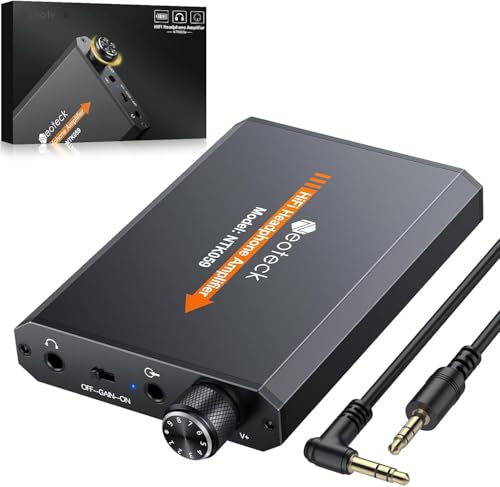
Long-Battery Portable Pick – Neoteck 16–300Ω Headphone Amp
The Neoteck 16–300Ω model is a portable headphone amplifier for Focal headphones that combines two-stage gain control, 3.5mm connectivity, and a rechargeable battery. Its aluminum body and smartphone-sized design make it suited to mobile listening with compatible phones, tablets, laptops, and media players.
Best For: Mobile users who want gain adjustment, extended battery life, and support for low- to high-impedance headphones.
Pros:
- Supports headphones rated from 16–300Ω.
- Two-stage gain switch helps tailor output to different headphones.
- Offers more than 12 hours of continuous use.
- Lightweight aluminum design weighs about 160 g.
Cons:
- 3.5mm connectivity may require an adapter for other plug sizes.
- Its 300Ω maximum support is lower than the first Neoteck model’s range.
- Battery charging adds another device to manage.
With its gain switch and 12-plus-hour battery, this Neoteck amp is a strong everyday travel candidate for compatible Focal headphones. Confirm your headphones’ impedance and source connection before buying.
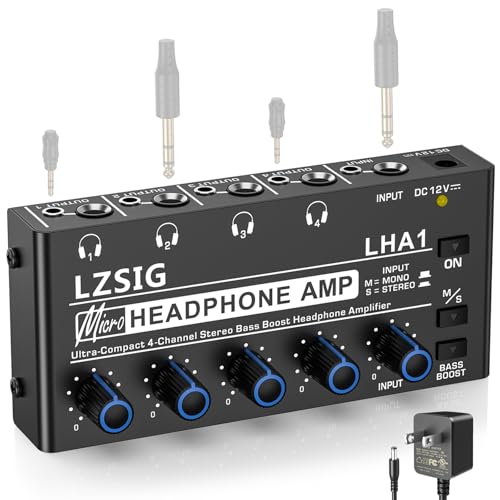
Best for Shared Monitoring – 4-Channel Studio Headphone Amp
If you need a headphone amplifier for Focal headphones in a home studio or shared listening setup, the LZSIG LHA2 is built for distributing one source to up to four listeners. It offers independent volume controls, 3.5mm and 6.35mm connectivity, and a bass-boost switch for flexible monitoring.
Best For: Home studios, DJ setups, and shared monitoring with multiple headphones.
Pros:
- Four independently controlled headphone outputs.
- Supports 32–100Ω headphones and both 3.5mm and 6.35mm plugs.
- Metal chassis, low-noise circuitry, and stereo/mono switching.
- Bass boost can enhance vocals and bass frequencies.
Cons:
- Designed for distribution rather than mixing.
- Specified headphone support tops out at 100Ω.
- Requires a 12V power source.
Choose this model when multiple people need controlled access to the same audio source. Its four-channel layout is more useful for group monitoring than for a portable Focal headphone setup.
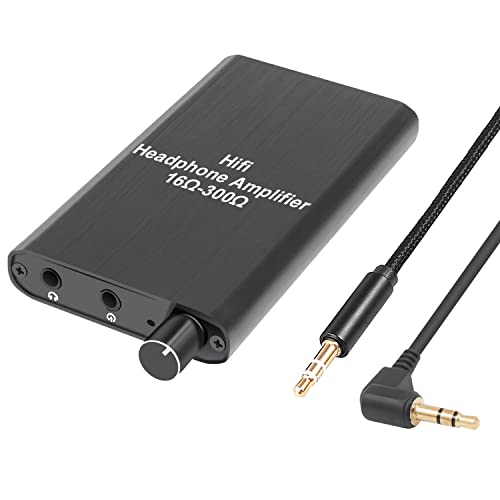
Best Budget Portable Pick – Rechargeable Two-Stage Gain Amp
For a compact headphone amplifier for Focal headphones, the LVY A010 adds portable amplification through a 3.5mm connection. Its two-stage gain switch helps match the amp to headphones from 16–300Ω, while the rechargeable design suits phones, computers, and portable music players.
Best For: Portable listening with 3.5mm-equipped phones, computers, MP3 players, and similar devices.
Pros:
- Supports a broad 16–300Ω load range.
- Two-stage gain switch helps optimize headphone output.
- Compact rechargeable design with more than five hours of use.
- Claims an SNR above 120dB and distortion of 0.004%.
Cons:
- Uses 3.5mm input and output only.
- Battery life is specified as more than five hours, which is limited for extended trips.
- Not intended for multi-headphone distribution.
The LVY is a straightforward choice when portability and gain adjustment matter more than extra connections. It is especially practical for Focal headphones used with older or standard 3.5mm audio devices.
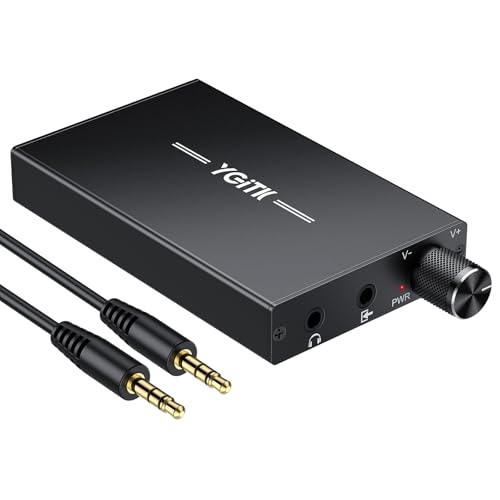
Best for Extended Battery Life – 16–300Ω HiFi Portable Amp
This portable headphone amplifier for Focal headphones combines a 16–300Ω operating range with two-stage gain and a physical volume knob. Its aluminum housing, 1500mAh battery, and 3.5mm input/output make it a strong option for listeners who want portable amplification with longer playback time.
Best For: Mobile listening with low- or high-impedance headphones and devices such as phones, iPads, PCs, and game consoles.
Pros:
- Supports headphones from 16–300Ω.
- Two-stage gain switch and dedicated volume knob.
- 1500mAh battery provides up to 10 hours of playback.
- Aluminum alloy body provides durability and RF/EMI shielding.
Cons:
- Uses wired 3.5mm connectivity rather than wireless connections.
- Not recommended for use while charging because interference may cause noise.
- Only one 3.5mm output is provided.
Among these portable options, this model is the better fit for longer sessions and a wider range of headphone impedances. The gain switch and volume knob also make it easier to tailor output for different Focal headphones.
How We Picked the Best Headphone Amplifier for Focal Headphones
We focused on practical compatibility rather than assuming every Focal model needs a powerful amplifier. The selected products cover common use cases: desktop listening, portable playback, multiple headphones, and systems that need extra gain or bass adjustment.
Our comparison emphasizes published impedance ranges, connection types, output layout, power requirements, portability, and useful controls. Since amplifier performance depends on the specific Focal headphone and source, treat output claims as a starting point and prioritize clean, controllable volume over maximum wattage.
Quick Comparison
| Best for | Look for | Most suitable design |
|---|---|---|
| Desktop Focal listening | RCA or line input, stable power, 6.35mm output | Compact Class A or desktop amplifier |
| Travel and commuting | Rechargeable battery, 3.5mm connections, gain switch | Portable headphone amplifier |
| Two to four listeners | Multiple independently usable outputs | Multi-channel distribution amplifier |
| Low-volume recordings | Higher gain and adequate output headroom | High-power desktop or gain-switch model |
| More bass control | Dedicated bass-boost switch or control | Tone-enhanced portable or desktop amp |
Key Buying Factors for a Headphone Amplifier for Focal Headphones
Impedance and Output Power
Check your Focal model’s impedance before buying. Many Focal headphones are relatively easy to drive, so an amplifier does not need extreme power to reach useful volume. Extra headroom can still help with dynamic recordings, quieter sources, or future headphones rated up to 300 or 600 ohms. Avoid judging quality from wattage alone; noise, distortion, and volume control matter just as much.
Inputs and Connector Compatibility
Portable models typically use 3.5mm connections, while desktop units may add RCA input and a 6.35mm headphone jack. If your source has only USB-C, Lightning, or optical output, you may need a separate DAC or adapter. A distribution amplifier with one input is better suited to sharing than to switching between several sources.
Gain, Bass Boost, and Volume Control
A two-stage gain switch is useful when one amplifier serves both sensitive and less-efficient headphones. Bass boost can be helpful for personal preference, but it should be optional so the Focal headphone’s original tuning remains available. A physical volume knob is generally convenient for desktop use.
Power, Noise, and Portability
Rechargeable amplifiers are convenient with phones and music players, but battery life and charging needs add another maintenance point. Desktop models are better for continuous use and usually offer more consistent power. Keep sensitive headphones at low gain and listen for hiss before committing to a permanent setup.
Who Should Buy Which Headphone Amplifier for Focal Headphones?
Choose a desktop amplifier if you mainly listen at a desk and want easy access to a volume knob, RCA input, or a full-size 6.35mm connection. A compact high-power model is the most flexible choice for mixed headphone collections.
Choose a portable rechargeable amplifier if your Focal headphones are used with a phone, laptop, or music player and you want more volume control or gain flexibility without a permanent setup.
Choose a four-channel amplifier for group listening, studio monitoring, or connecting several headphones at once. These units are convenient splitters, but they are not the best choice when you need multiple source inputs or advanced digital features.
Choose a bass-boost model only if adjustable low-end emphasis is important to you. For the most neutral result, leave the boost disabled and use the amplifier primarily for connection convenience, gain, and volume headroom.