
Finding reliable lighting control on a limited budget is easier when you focus on channel count, programming workflow, and compatibility rather than flashy specifications. These DMX controllers under $100 cover compact party consoles, 192-channel boards, and wireless transmitter-receiver kits.
Whether you run a mobile DJ setup, small venue, home studio, or occasional event, the right controller should match your fixtures and your preferred way of working. Use the guide below to compare the most important features before buying.
Best 10 Dmx Controllers Under 100 Picks for 2026
Best Programmable Console
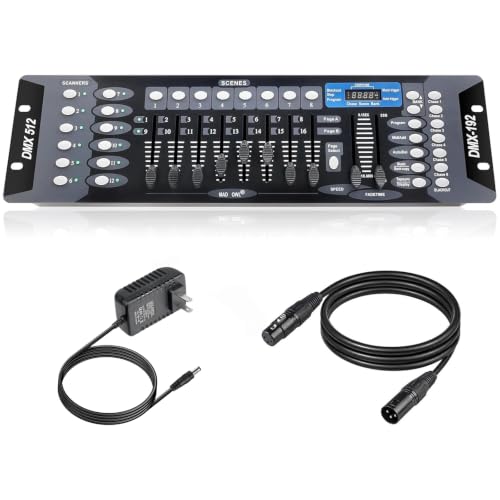
- Controls up to 12 fixtures
- Stores scenes and six chases
- Includes 6.6-foot DMX cable
Best For: Programmed stage and DJ lighting setups
Best Wireless DMX Kit
2.4G Transmitter and Receivers

- Includes one transmitter and two receivers
- Supports seven group IDs
- Uses frequency hopping transmission
Best For: Fast mobile and event lighting setups
Best Compact Wireless Option

- Compact 13.7-ounce design
- Supports 126-channel frequency hopping
- Offers 16 group IDs and adjustable output
Best For: Portable wireless DJ and party lighting
Best Overall
DMX512 192-Channel Stage Lighting Console

- Controls up to 12 fixtures and up to 240 scenes
- Supports detailed scene timing and fade adjustments
- Includes voice control and 3-pin DMX output
Best For: Complex small-stage shows and versatile event lighting
Best for Beginners
Portable 14-Channel DMX512 Controller

- Simple layout with LCD status display
- Grand Master and instant Blackout controls
- Compact 1.83-pound design for mobile use
Best For: Small parties, bars, KTV venues, and first-time users
Best Classic Console
CO-Z 192 DMX512 Lighting Mixer

- 192 channels support up to 12 intelligent lights
- Stores up to 240 programmable scenes
- Adds voice control and three-pin fixture compatibility
Best For: DJs and small venues needing expandable manual control
Compact 12-Channel Pick

- Controls up to 12 DMX512 channels
- Portable aluminum design
- Simple manual fader layout
Best For: Small stages and basic dimming systems
Programmable Scene Pick
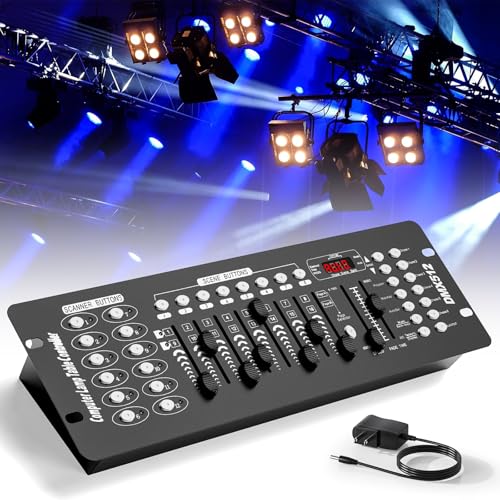
- Supports 12 devices with 16 channels each
- Stores scenes and programmable chases
- Includes eight manual control sliders
Best For: Small shows, parties, and beginner programming
Best Programmable Console – 192-Channel DMX Board
For shoppers comparing DMX controllers under 100, this 192-channel wired console offers substantial programming capacity for stage and DJ lighting. It controls up to 12 fixtures with 16 channels or fewer and includes a 6.6-foot DMX cable.
Best For: DJs, small stages, clubs, and users who need programmable scenes and chases.
Pros:
- Controls up to 12 lighting fixtures.
- Stores 23 banks of 8 programmable scenes.
- Supports 240-step scenes across 6 programmable chases.
- Includes a 6.6-foot DMX cable.
Cons:
- Uses a wired DMX connection rather than wireless control.
- Its 22.44-inch width may require dedicated rack or table space.
This is a practical choice when hands-on fader control and extensive scene programming matter more than portability or wireless setup.
Best Wireless DMX Kit – 2.4G Transmitter and Receivers
Among DMX controllers under 100, this wireless set is designed to simplify lighting setups by replacing long XLR runs. It includes one transmitter, two receivers, power adapters, and 2.4G transmission with automatic frequency hopping.
Best For: Mobile DJs, weddings, parties, and venues where quick wireless installation is useful.
Pros:
- Includes one transmitter and two receivers.
- Offers a stated range of up to 1,000 feet.
- Uses 126-channel frequency hopping for interference resistance.
- Supports seven independent group IDs.
Cons:
- Each unit requires a power adapter; it is not battery-powered.
- This is a wireless DMX link set rather than a full scene-programming console.
Choose this kit when your existing DMX console and lights work properly but cable placement is slowing down event setup.
Best All-Around Console – MINGJIE 192-Channel Controller
This MINGJIE model is a strong option among DMX controllers under 100 for users who want both automatic and programmable operation. Its 192 channels support up to 12 intelligent fixtures, with sound activation, 240 scenes, and six chases.
Best For: Beginners and mobile DJs who want a console that can grow into more structured lighting programming.
Pros:
- Controls up to 12 intelligent fixtures through 192 channels.
- Stores 240 scenes in 30 banks.
- Provides sound-activated operation and six programmable chases.
- Includes a 4-foot, 3-pin DMX cable and supports 100–240V input.
Cons:
- Requires wired DMX connections to the lighting system.
- Its feature-rich layout may take time for first-time users to learn.
With automatic, sound-activated, and manual programming modes, this console offers useful flexibility for parties, events, clubs, and small performance setups.
Best Compact Wireless Option – Lixada 2.4G DMX Controller
For buyers seeking compact DMX controllers under 100, the Lixada 2.4G unit focuses on wireless DMX512 transmission rather than large-console programming. It supports frequency hopping, group coding, adjustable power output, and real-time signal transmission.
Best For: DJs and party-light users who need a small wireless transmitter or receiver solution.
Pros:
- Compact design weighs 13.7 ounces.
- Supports 126-channel frequency hopping.
- Offers 16 group IDs for separate wireless networks.
- Provides four selectable power-output levels.
Cons:
- Supplied notes do not specify the exact transmitter/receiver quantity.
- It does not provide the scene-bank and chase programming features of a full console.
This is best viewed as a space-saving wireless DMX transmission tool for disco, DJ, party, and stage-light applications.
Best Overall – DMX512 192-Channel Stage Lighting Console
For shoppers comparing dmx controllers under 100, this 192-channel console offers substantial programming capacity for DJs, event hosts, and small stage setups. It can control up to 12 intelligent lights with up to 16 channels each, as well as up to 240 scenes.
Best For: Users who need extensive scene programming, voice control, and compatibility with multiple 3-pin DMX fixtures.
Pros:
- Controls up to 12 fixtures and supports up to 240 scenes.
- Allows up to 40 steps per scene with adjustable pause and fade times.
- Includes voice control and a 3-pin DMX512 output for compatible equipment.
- Organized controls and upgraded buttons support easier operation.
Cons:
- The large number of controls may take time for beginners to learn.
- It uses corded power rather than a battery.
This is a feature-rich choice when programming flexibility matters more than portability. Its scene capacity and timing controls make it suitable for more involved lighting shows.
Best for Beginners – Portable 14-Channel DMX512 Controller
This compact 14-channel console is a practical entry point for shoppers seeking dmx controllers under 100. Its straightforward layout, LCD display, channel faders, and low-power design suit parties, bars, KTV venues, and small performances.
Best For: Beginners and mobile users who want simple manual control without complicated programming.
Pros:
- Supports standard DMX512 and works with many common stage and DJ lights.
- Provides seven faders per page with quick switching between channels 1–7 and 8–14.
- Grand Master and one-touch Blackout controls simplify live operation.
- Compact, lightweight body weighs 1.83 pounds and uses only 0.7W.
Cons:
- Its 14-channel capacity is much smaller than 192-channel consoles.
- The supplied notes do not indicate advanced scene-programming features.
Choose this model for accessible, hands-on control in smaller setups. The portable size and Blackout button are especially useful when quick adjustments matter.
Best Classic Console – CO-Z 192 DMX512 Lighting Mixer
The CO-Z 192 DMX512 console is a strong option among dmx controllers under 100 for users who want broad fixture control in a traditional mixer-board format. It supports up to 12 intelligent lights, 240 scenes, and compatible three-pin equipment such as fog machines and strobes.
Best For: DJs, event operators, and small venues wanting high channel capacity with physical faders and scene controls.
Pros:
- Offers 192 channels and control for up to 12 intelligent lights.
- Stores up to 240 scenes for creating more involved lighting shows.
- Includes voice control and a three-pin connection for compatible fixtures.
- Upgraded buttons and precision control sticks are designed for smooth operation.
Cons:
- At 19.1 inches long and 3.9 pounds, it is less portable than mini consoles.
- The extensive controls may be more than casual users need.
This console balances substantial programming capacity with an organized physical interface. It makes sense for operators who prefer dedicated controls and need room to expand a lighting setup.
Compact 12-Channel Pick – MAD OWL Mini DMX Dimmer
For shoppers comparing DMX controllers under 100, the MAD OWL 12-channel dimming controller is a compact option for basic DMX512 setups. Its six sub-control faders and one master fader provide straightforward manual control, while the standard 3-pin XLR output supports compatible fixtures.
Best For: Small stages, simple dimming systems, and users who prioritize portability.
Pros:
- Controls up to 12 DMX512 channels.
- Compact, lightweight aluminum design for travel and quick installation.
- Simple layout with six sub-control faders, a master fader, and blackout function.
- Uses a standard 3-pin DMX output.
Cons:
- Not suitable for lighting equipment requiring more than 12 channels.
- Designed for manual dimming rather than complex programmed shows.
This is a practical entry-level choice when your fixtures have modest channel requirements. Confirm your equipment’s DMX channel count before buying, especially if you plan to expand the setup.
Programmable Scene Pick – 192-Channel DMX Controller
Among DMX controllers under 100, this 192-channel console offers considerably more programming capacity than a basic dimmer. It supports up to 12 devices with 16 channels each, plus programmable scenes and chases for parties, small shows, and seasonal displays.
Best For: Beginners who need programmable scenes and control for multiple DMX fixtures.
Pros:
- Supports up to 192 channels across 12 devices.
- Offers 23 banks of programmable scenes and six programmable chases.
- Includes eight sliders for manual channel control.
- Works with compatible 3-pin DMX equipment and includes a 3-pin cable.
Cons:
- Each supported device is limited to 16 channels.
- The control layout may take time for first-time users to learn.
- Manufacturer warranty details in the listing are inconsistent, so verify coverage before purchase.
With scene storage, chase programming, and manual sliders, this controller is a flexible step up from a simple fader board. It is best suited to users who want repeatable lighting sequences without moving to a larger professional console.
Compact Console Pick – DMX-M192 192-Channel Controller
This compact 192-channel console is a strong candidate among DMX controllers under 100 for users who want programming features in a smaller format. It controls up to 12 fixtures with up to 16 channels each and includes scene banks, chases, and real-time sliders.
Best For: Mobile lighting technicians and small productions needing programmable fixture control.
Pros:
- Controls up to 192 individual fixture or dimmer channels.
- Supports 23 banks of eight scenes and six programmable chases.
- Provides eight sliders for real-time adjustments.
- Compact aluminum body measures 10 by 5 by 1.5 inches.
Cons:
- Fixture control is limited to 12 units with up to 16 channels each.
- The supplied notes do not specify included accessories or warranty coverage.
- Its programming-focused interface may be more than needed for basic dimming.
The DMX-M192 balances a broad channel count with a compact footprint, making it useful when portability matters. Check fixture addressing and channel requirements carefully to ensure your equipment fits its 12-fixture, 16-channel-per-fixture configuration.
How We Picked the Best Dmx Controllers Under 100
We focused on controllers that support the DMX512 standard and serve common budget lighting applications, including DJ fixtures, PAR lights, moving heads, dimmers, and small stage systems. The selection represents several practical formats: traditional 192-channel consoles, compact 12- or 14-channel boards, and wireless DMX kits.
We also considered programming access, portability, control layout, included accessories, and the likely learning curve. At this price, build quality and software features can vary, so compatibility and ease of use are just as important as the channel count.
Quick Comparison
| Controller Type | Best For | Main Advantage | Potential Limitation |
|---|---|---|---|
| 192-channel console | Multiple conventional fixtures | More scenes and fixture control | Larger learning curve |
| 12- or 14-channel mini console | Small parties and simple rigs | Compact, straightforward operation | Limited fixture flexibility |
| Wireless DMX kit | Clean installations and mobile setups | Less cabling between fixtures | Requires compatible wireless connections |
| Console with LCD display | Users who want clearer navigation | Easier status and menu visibility | May require more setup time |
Key Buying Factors for Dmx Controllers Under 100
Channel Count and Fixture Compatibility
Channel count determines how many DMX addresses you can manage, not necessarily how many lights you can connect. A 192-channel board can control several simple fixtures, while advanced moving heads may consume many channels each. Check your lights’ DMX modes and address requirements before choosing.
Programming and Live Control
Look for features such as programmable scenes, chases, faders, blackout, grand master, and adjustable speed. Faders are useful for manual adjustments, while scenes and chases make repeatable shows easier. A compact controller may be preferable if you mainly need basic color, dimmer, and strobe changes.
Wired Versus Wireless Operation
Wireless DMX can reduce cable runs and make temporary setups cleaner, but transmitter and receiver compatibility matters. For permanent or demanding installations, a wired DMX connection is often simpler to troubleshoot. Confirm whether wireless components are included and whether each fixture needs a receiver.
Portability and Connectivity
Check the controller’s size, power requirements, DMX input or output arrangement, and included cables. A lightweight board suits mobile DJs, while a larger console may offer more comfortable access to faders. Do not assume that included cables or adapters fit every fixture.
Who Should Buy Which Dmx Controllers Under 100?
Choose a 192-channel console if you need to manage several lights, build scenes, or leave room for a growing rig. A 12- or 14-channel mini controller is better for beginners and simple party setups where portability matters more than deep programming. Wireless kits make sense when cable routing is inconvenient or you frequently assemble temporary lighting systems.
Before ordering, verify the DMX mode, connector type, fixture addressing, and power setup for every light. If your system may expand, prioritize programmable scenes and a higher channel capacity; if it is mainly for occasional events, a simple layout and fast blackout control may provide the best value.